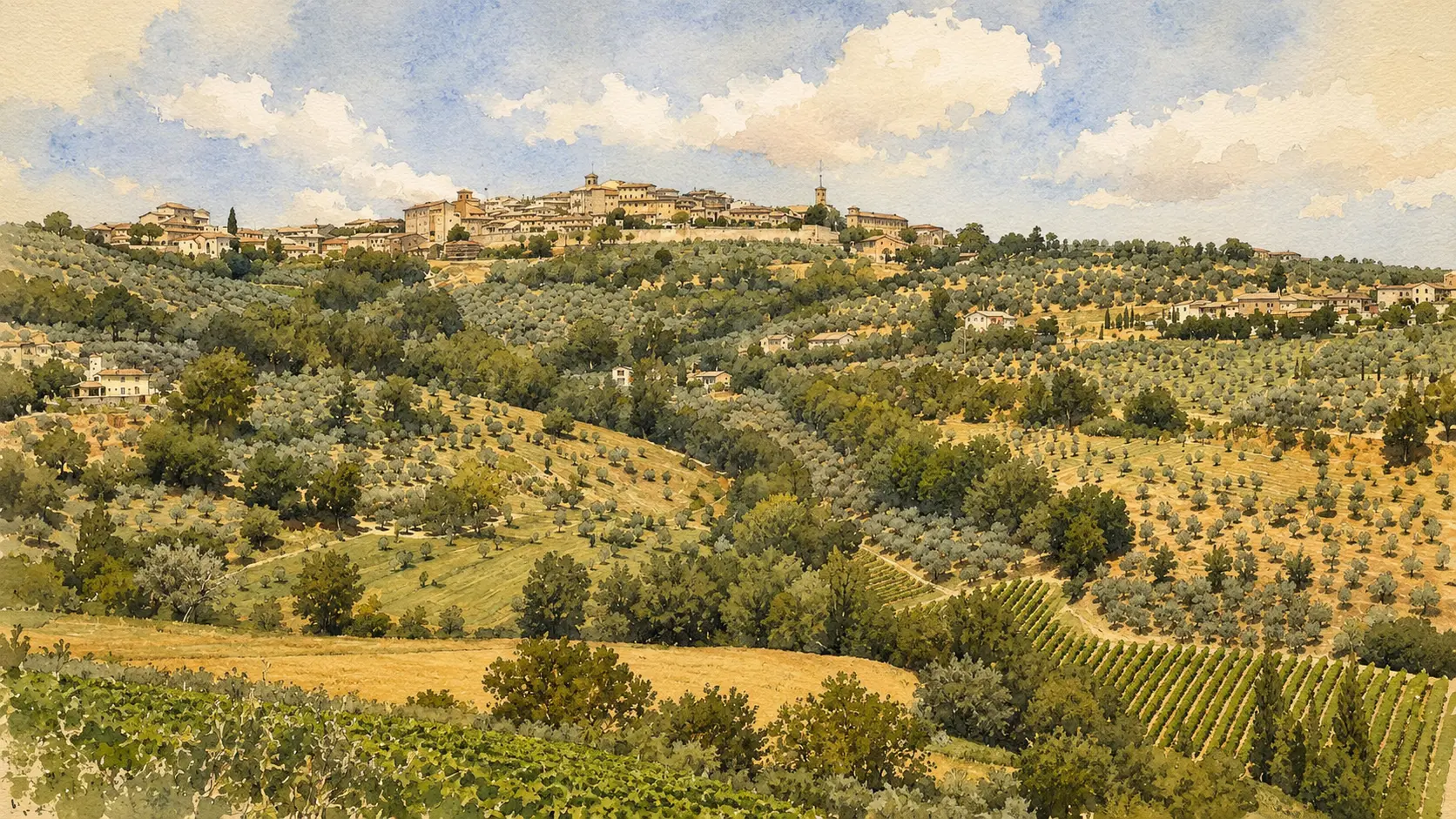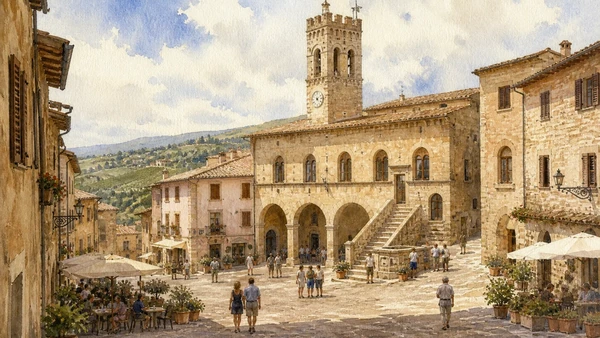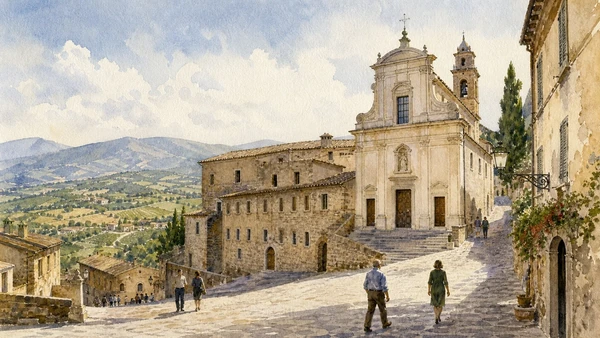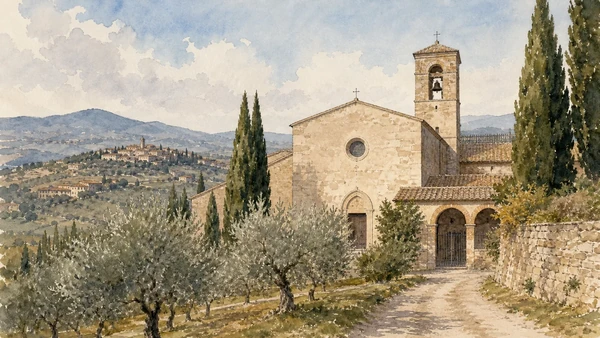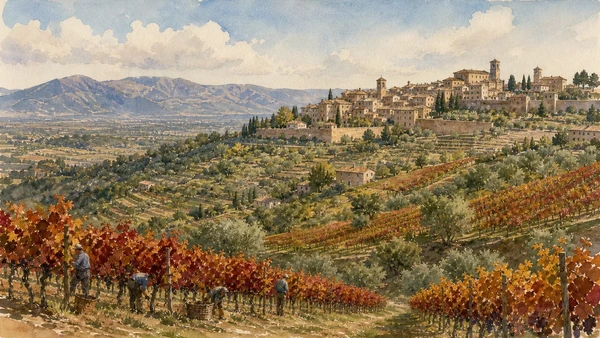
Documentary watercolour panorama of Montefalco among vineyards with the Umbrian valley beyond

Illustrated guide · Montefalco

Painting, vines
and the wide horizon

Ten places through which to read a fortified hill town, Renaissance Franciscan art and the agricultural landscape that made Montefalco the Balcony of Umbria.

Explore the places
Balcony of Umbria · Sagrantino country

Preface

Montefalco is understood by looking both inward and outward.

Inside the walls, a former Franciscan church preserves one of the clearest painted narratives of the life of Saint Francis. Outside them, vineyards and olive groves stretch towards Assisi, Spello, Trevi and the Apennines.

After forty-two years in Umbria, the panorama is familiar to me, but never generic. Montefalco's identity comes from the exact relationship between its ring of stone, its devotional art and a working agricultural landscape celebrated through Sagrantino.

This guide begins with the museum complex, moves through the civic and sacred centre, and ends beyond the walls where the town's famous view becomes an economic and cultural history.

Montefalco looks across Umbria without losing sight of its own soil.

One destination

Montefalco,
inside and beyond.

The selection gives equal weight to the museum of San Francesco, the compact medieval town and the vineyard landscape. Wine is treated as culture and land use, not as a decorative addition to the monuments.

The selection

Ten places,
one story

A circuit from the museum church to the communal square and gates, followed by the Franciscan sites and vineyard viewpoints around the town.

  1. 01Museum Complex of San Francesco
  2. 02Benozzo Gozzoli's Franciscan cycle
  3. 03Sagrantino Museum and historic cellars
  4. 04Piazza del Comune
  5. 05Town Hall and civic tower
  6. 06Walls and Porta Federico II
  7. 07Church of Sant'Agostino
  8. 08Sanctuary of Santa Chiara della Croce
  9. 09Church of San Fortunato
  10. 10Sagrantino vineyards and panoramic landscape
01

The painted heart of Montefalco

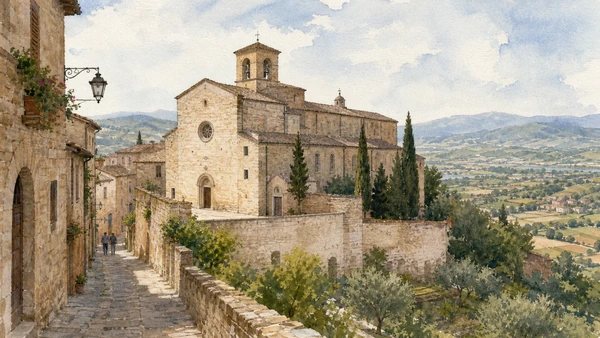
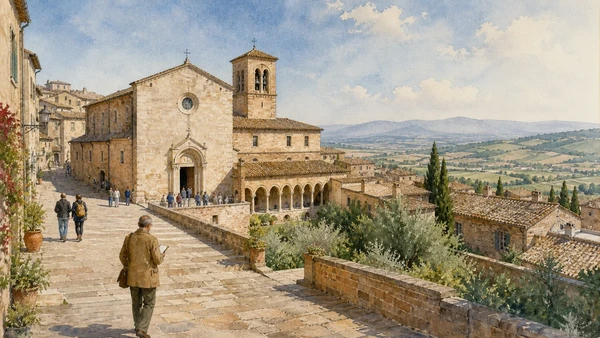
Museum Complex of San Francesco

A former Franciscan church unites architecture, fresco, civic collections and the agricultural history of Sagrantino.

Original documentary watercolour showing Museum Complex of San Francesco in its Montefalco urban or landscape context
Museum Complex of San FrancescoMuseum Complex of San Francesco · original Merlintravel watercolour

The place today

The museum occupies the church, former convent rooms, archaeological section, picture gallery, crypt and historic cellars. The route is unusually coherent: art remains close to the architecture and territory that produced it. Benozzo Gozzoli's apse and Perugino's Annunciation are the major works, but the cellars and material culture complete the story.

The historical chapter

The Franciscans built the church between 1335 and 1338. Local patrons commissioned major decorations in the fifteenth and early sixteenth centuries, when Montefalco's civic and religious institutions sought artists of regional and national importance. After suppression, the complex gradually became the town's principal museum.

What to notice

  • The church preserved as the main museum room
  • Connections between frescoed chapels and donor families
  • Historic wine-making spaces below the sacred architecture
Museum of Montefalco · official website
02

A city inside a saint's life

Benozzo Gozzoli's Franciscan cycle

The apse turns episodes from the life of Francis into a richly observed world of Umbrian cities, patrons and landscapes.

Original documentary watercolour showing Benozzo Gozzoli's Franciscan cycle in its Montefalco urban or landscape context
Benozzo Gozzoli’s Franciscan cycleBenozzo Gozzoli’s Franciscan cycle · original Merlintravel watercolour

The place today

The scenes wrap around the apse in three registers beneath the vault. Clear viewing rewards attention to far more than the principal narratives: town walls, processions, clothing, donor portraits and distant hills construct a vivid fifteenth-century environment. An inscription dates and signs the work.

The historical chapter

Benozzo painted the cycle between 1450 and 1452 for the Franciscan church. He drew on established biographies of the saint while making the settings contemporary to his own audience. The result documents both devotion to Francis and the visual self-confidence of central Italian patrons in the early Renaissance.

What to notice

  • The meeting of Francis and the wolf staged as an urban narrative
  • Portraits and inscriptions identifying the artist and patrons
  • Architectural settings that echo real Umbrian towns
Museum of Montefalco · Benozzo Gozzoli
03

The history beneath the art

Sagrantino Museum and historic cellars

Presses, tools and underground rooms explain wine as work, technology and collective memory.

Original documentary watercolour showing Sagrantino Museum and historic cellars in its Montefalco urban or landscape context
Sagrantino Museum and historic cellarsSagrantino Museum and historic cellars · original Merlintravel watercolour

The place today

The cellars beneath San Francesco preserve presses, vats, tools and documentary material related to grape growing and wine production. The museum interprets the distinctive Sagrantino grape and the long relationship between convent, town and surrounding farms.

The historical chapter

Grapes and wine have been part of Montefalco's economy for centuries, while the modern protected designation and international reputation are recent developments. The museum avoids collapsing that long history into a marketing label by showing the labour, containers, spaces and seasonal practices behind production.

What to notice

  • Large beam presses and their mechanical logic
  • Cool underground rooms adapted for storage
  • Documents distinguishing historical practice from modern appellation
Museum of Montefalco · Sagrantino section
04

The circular civic centre

Piazza del Comune

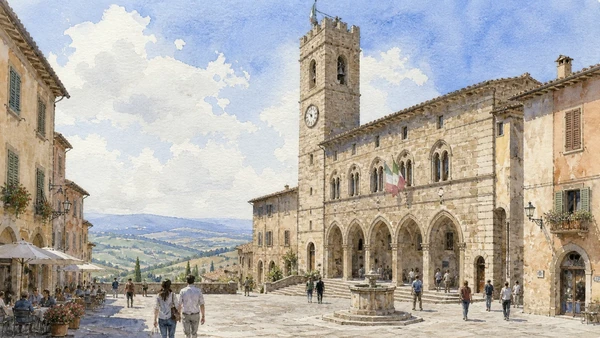
A compact, gently curved square where civic palaces and former churches record Montefalco's communal life.

Original documentary watercolour showing Piazza del Comune in its Montefalco urban or landscape context
Piazza del ComunePiazza del Comune · original Merlintravel watercolour

The place today

The piazza gathers the Town Hall, former Santa Maria de Platea and a sequence of historic houses and arcades. Streets enter at different angles, making the space feel enclosed without being geometrically regular. Cafés and public events keep it part of ordinary town life.

The historical chapter

The square developed as the political and commercial centre of the medieval commune. Buildings were repeatedly enlarged or given new façades, so the present appearance combines thirteenth-century foundations with Renaissance and later work. Its scale reflects a prosperous small town rather than a regional capital.

What to notice

  • The curved rather than rectangular enclosure
  • Different building heights recording gradual growth
  • Routes radiating towards the gates and religious houses
Umbria Tourism · Montefalco city guide
05

The commune's long memory

Town Hall and civic tower

A thirteenth-century communal palace enlarged over time and crowned by a tower visible above the ring of roofs.

Original documentary watercolour showing Town Hall and civic tower in its Montefalco urban or landscape context
Town Hall and civic towerTown Hall and civic tower · original Merlintravel watercolour

The place today

The Town Hall occupies the highest side of the square with an arcade, broad façade and tower. Different window types and masonry phases reveal successive alterations. Interior civic rooms are not always open as a continuous museum, so the exterior remains the principal public reading.

The historical chapter

The original palace dates to around 1270 and expanded as Montefalco's institutions developed. Renaissance and later interventions regularised parts of the façade and tower. The building continued to serve local government, preserving function even as its architectural language changed.

What to notice

  • The ground-floor arcade opening to the square
  • Changes in window form across building phases
  • The tower as the central marker of Montefalco's skyline
Umbria Tourism · Montefalco city guide
06

The ring of stone

Walls and Porta Federico II

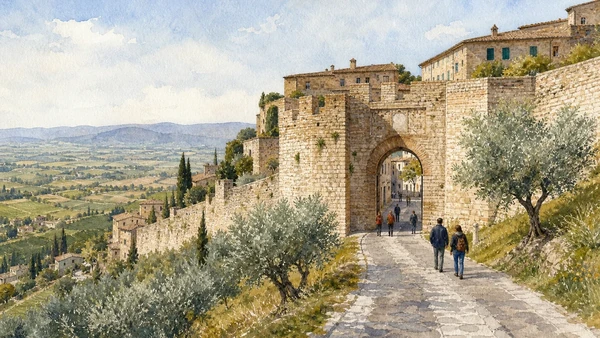
The fortified perimeter still shapes approaches, views and the compact form of the historic centre.

Original documentary watercolour showing Walls and Porta Federico II in its Montefalco urban or landscape context
Walls and Porta Federico IIWalls and Porta Federico II · original Merlintravel watercolour

The place today

Roads and walking routes follow sections of the wall circuit, with gates opening to different sides of the hill. Porta Federico II preserves an inscription dated 1244 and forms one of the clearest medieval entrances. Restored masonry shows that the walls are a structure maintained over centuries rather than untouched fabric.

The historical chapter

Montefalco's defences developed in the communal period and were repaired or strengthened during fourteenth-century conflict. Lorenzo Maitani is traditionally linked to works on the circuit. The gates controlled roads to Foligno, Spoleto and the surrounding agricultural territory.

What to notice

  • The 1244 inscription at Porta Federico II
  • Wall segments adapted as retaining structures
  • Views from the gates across vineyards and valley routes
Umbria Tourism · Montefalco city guide
07

A Gothic church inside the walls

Church of Sant'Agostino

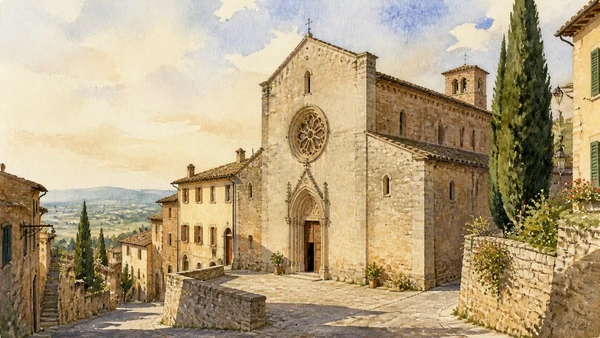
A mendicant interior preserves frescoes, chapels and the devotional life of Montefalco beyond its best-known museum.

Original documentary watercolour showing Church of Sant'Agostino in its Montefalco urban or landscape context
Church of Sant’AgostinoChurch of Sant’Agostino · original Merlintravel watercolour

The place today

The church stands near one of the main approaches to the centre. Its stone exterior is restrained, while the interior contains wall paintings, altars and funerary monuments from different periods. The tall single nave reflects the preaching needs of a mendicant order.

The historical chapter

The Augustinians built the church in the late thirteenth century and expanded its decoration as local families established chapels. Surviving frescoes range across the fourteenth and fifteenth centuries, showing that Montefalco supported a broader artistic culture than the commissions now concentrated in San Francesco.

What to notice

  • The high single-nave spatial form
  • Fresco fragments associated with local workshops
  • Family chapels inserted along the perimeter
Umbria Tourism · Montefalco city guide
08

The enclosed Franciscan tradition

Sanctuary of Santa Chiara della Croce

A later church and monastery preserve the memory of a medieval Augustinian mystic deeply connected to Montefalco.

Original documentary watercolour showing Sanctuary of Santa Chiara della Croce in its Montefalco urban or landscape context
Sanctuary of Santa Chiara della CroceSanctuary of Santa Chiara della Croce · original Merlintravel watercolour

The place today

The sanctuary includes the church, chapel and monastic spaces associated with Clare of Montefalco. The present architecture is largely later than her lifetime, but relics, artworks and the continuing enclosed community preserve the devotional centre created around her memory.

The historical chapter

Clare lived from 1268 to 1308 and led the community of Santa Croce under the Rule of Saint Augustine. After her death, her cult grew locally and beyond. The current sanctuary was substantially rebuilt in the seventeenth and eighteenth centuries, enclosing older spaces and traditions within a new architectural setting.

What to notice

  • The distinction between medieval memory and later church fabric
  • Spaces linked to the earlier community
  • The continuing presence of an enclosed religious house
Umbria Tourism · Montefalco city guide
09

Franciscan memory outside the town

Church of San Fortunato

A quiet complex among trees preserves frescoes and traditions linked to Francis and to Benozzo Gozzoli's work in Montefalco.

Original documentary watercolour showing Church of San Fortunato in its Montefalco urban or landscape context
Church of San FortunatoChurch of San Fortunato · original Merlintravel watercolour

The place today

The church and former convent stand outside the walls in a wooded setting. The portico, simple nave and chapels retain a rural Franciscan scale. Frescoes include work by Benozzo Gozzoli, providing a valuable counterpart to his monumental cycle in San Francesco.

The historical chapter

A religious site existed here before the Franciscan settlement. The complex developed in the fifteenth century, when patronage supported new decoration. Tradition connects Francis with the place, while the surviving architecture and paintings securely document later Franciscan use.

What to notice

  • The portico opening to the surrounding landscape
  • Benozzo's frescoes at a smaller devotional scale
  • The difference between an extra-urban friary and the civic museum church
Umbria Tourism · Montefalco city guide
10

The balcony and its soil

Sagrantino vineyards and panoramic landscape

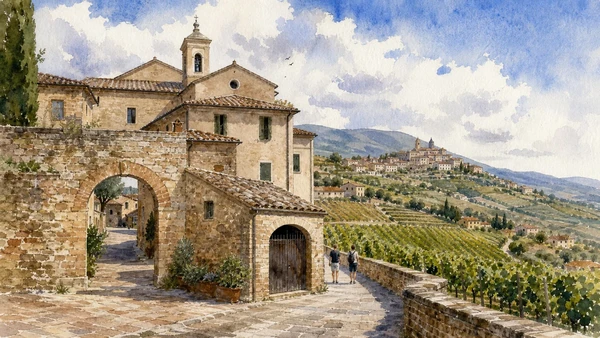
The celebrated view is also a working territory of vines, olive groves, farms and routes between Umbrian towns.

Original documentary watercolour showing Sagrantino vineyards and panoramic landscape in its Montefalco urban or landscape context
Sagrantino vineyards and panoramic landscapeSagrantino vineyards and panoramic landscape · original Merlintravel watercolour

The place today

Viewpoints around the walls open towards the Umbrian Valley, Martani Mountains, Subasio and Apennines. Vineyard roads and estates extend beyond the centre, offering different forms of visit. The landscape changes sharply with season: pruning, new growth, harvest and winter reveal the agricultural structure.

The historical chapter

Viticulture around Montefalco is documented over centuries, though methods, ownership and markets have changed. Sagrantino di Montefalco achieved DOCG status in the modern period, consolidating recognition of a grape historically tied to the area. The protected wine landscape remains productive rather than frozen for tourism.

What to notice

  • Vine rows following slope and exposure
  • Olive groves and field boundaries mixed with vineyards
  • Distant identification of Assisi, Spello, Trevi and the Apennine edge
Consorzio Tutela Vini Montefalco · official website

The city through time

Eight dates for orientation

An essential chronology showing how ancient foundations, medieval institutions and later transformations overlap.

  1. The fortified settlement develops around the hill later known as Montefalco.

  2. The inscription at Porta Federico II records the communal-period gate.

  3. The core of the Town Hall is established.

  4. Clare of Montefalco lives and leads the community of Santa Croce.

  5. The Franciscans build the church now housing the museum.

  6. Montefalco is freed from the rule of the Trinci of Foligno.

  7. Benozzo Gozzoli paints the apse cycle of San Francesco.

  8. Museum, protected wine and landscape interpretation are brought into one destination narrative.

Before your visit

Practical information,
without turning it into promises

01

Museum first

San Francesco provides the historical framework for the town and deserves more than a quick look. Check ticket and guided-visit options.

02

Compact but sloping

The centre is small, with stone paving and short climbs. Parking is outside or near the wall circuit.

03

Religious houses

Santa Chiara and other churches remain active places of worship. Respect enclosure, services and access instructions.

04

Wine visits

Cellar tastings require responsible transport and often reservation. Verify producers directly and treat agricultural property as working land.

Sources

The guide was checked against the Museum of Montefalco, the official regional portal and the wine protection consortium. It distinguishes the long history of local viticulture from the more recent legal and commercial framework of the DOCG.

The hero image is an illustration, not a photograph. Opening hours, tickets, worship schedules, restoration works and path access can change; always consult the linked official pages shortly before visiting.