Italy · Regional journey 04

Lombardy

Cities of power and invention, Alpine valleys, lake worlds and the long agricultural plain.

6historic layers
4editorial journeys
8territorial gateways
Lombardy is not only Milan; it is a network of radically different territories.
The regional idea

The region joins a European metropolis to Roman and Lombard cities, Renaissance courts, industrial districts, great lakes, Valtellina terraces and the Po plain. Its modern dynamism rests on historical routes, water systems and productive landscapes.

Time made visible

History in layers.

Celts, Rome, the Lombard kingdom, communes, Visconti and Sforza, Habsburg rule and industrial modernity all left durable institutions and urban forms.

01

Celts and Roman cities

Mediolanum, Brixia, Cremona and other centres tied the region to imperial roads and river commerce.

02

The Lombard kingdom

Pavia became a royal capital while religious and civic sites preserved an early medieval political landscape.

03

Communes and signorie

Milan, Bergamo, Brescia, Como, Cremona and Mantua developed powerful but distinct urban cultures.

04

Visconti, Sforza and Gonzaga

Courts transformed castles, cathedrals, irrigation systems and the visual arts between Milan and Mantua.

05

Habsburg administration

Spanish and Austrian rule changed institutions, fortifications, roads and the culture of reform.

06

Industry and the contemporary metropolis

Textiles, steel, design, finance and migration reshaped Milan and a wider network of productive towns.

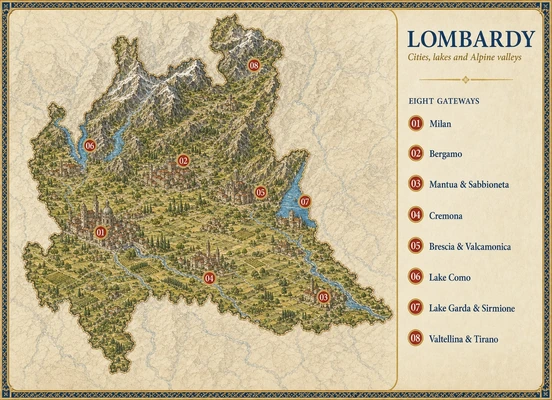
Illustrated map of Lombardy with eight numbered Merlintravel gateways
Merlintravel illustrated atlas · official ISTAT profile archived separately
The complete circuit

Cities, lakes and Alpine valleys form a polycentric region.

The atlas moves from Milan across a polycentric region: art cities on the plain, lakes at the Alpine edge, valleys to the north and Mantua’s river landscape to the south-east.

Map markers identify editorial gateways, not a ranking.

Four ways through

Journeys, not checklists.

The four circuits deliberately distribute attention between metropolitan culture, historic cities, water landscapes and mountain communities.

01

Milan beyond the centre

Roman and early Christian foundations, ducal power, modern design and industrial districts form successive cities.

02

The art-city constellation

Bergamo, Brescia, Cremona, Pavia and Mantua offer different civic, religious and court histories.

03

The great lakes

Como, Maggiore, Iseo and Garda unite villas, gardens, fishing towns, industrial memory and Alpine horizons.

04

Valleys and the Po plain

Valcamonica, Valtellina, Franciacorta and the lower river country connect rock art, terraces and water management.

Eight territorial doors

Places that open the story.

Each gateway is a future chapter: a city, landscape or cultural system large enough to deserve its own documented guide.

01

Milan

From Roman Mediolanum to ducal capital, industrial city and international centre of design and culture.

02

Bergamo

Venetian walls, the upper city and a lower modern centre joined by a long civic history.

03

Mantua and Sabbioneta

Gonzaga court culture, planned urbanism and water landscapes recognised together by UNESCO.

04

Cremona

Roman foundations, a monumental communal square and a living tradition of violin making.

05

Brescia and Valcamonica

Roman Brixia, Lombard heritage and one of Europe’s great concentrations of prehistoric rock art.

06

Lake Como

Historic towns, villas, gardens, silk culture and mountain settlements around a branching lake.

07

Lake Garda and Sirmione

Roman remains, thermal waters, medieval fortification and a shared lake landscape.

08

Valtellina and Tirano

Terraced viticulture, Alpine passes, sanctuaries and cross-border routes towards the Bernina.

Living and monumental heritage

What the region keeps.

Monuments matter, but so do languages, crafts, routes, rituals and working landscapes.

01

Lombard and Roman sites

Brescia, Castelseprio and other monuments make early medieval and classical layers visible.

02

Water engineering

Canals, irrigation and rivers supported agriculture, transport, power and urban growth.

03

Craft and design

Violin making, silk, furniture and industrial design connect workshops to global cultural networks.

04

Court landscapes

Milan and Mantua show how dynasties used castles, churches, gardens and art to shape territory.

Land and water

Nature is part of the archive.

Land, water and ecological systems are read together with the communities that have learned to inhabit them.

01

Alpine valleys

Valtellina and Valcamonica combine high ecosystems with settlement, terraces and long-distance routes.

02

The lake district

Glacial lakes generate microclimates, wetlands, gardens and dense shore communities.

03

Po and Ticino

Great rivers and protected corridors structure the agricultural plain and its biodiversity.

04

Stelvio landscapes

High passes, glaciers and wildlife connect Lombardy to one of the Alps’ largest protected systems.

A documented journey, still open.

The Hub separates the Lombards as an early medieval people from modern regional identity and distinguishes UNESCO serial sites such as the Longobards in Italy from individual city centres.

The journey continues.

Return to the Italy regional atlas