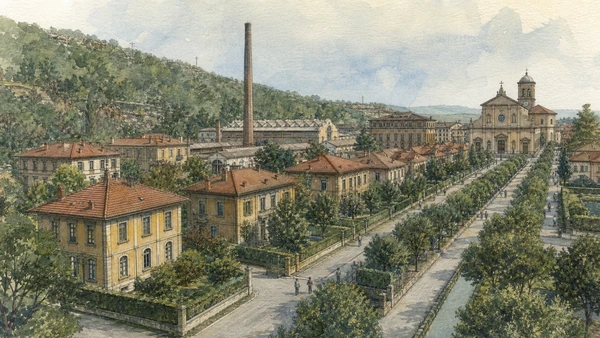
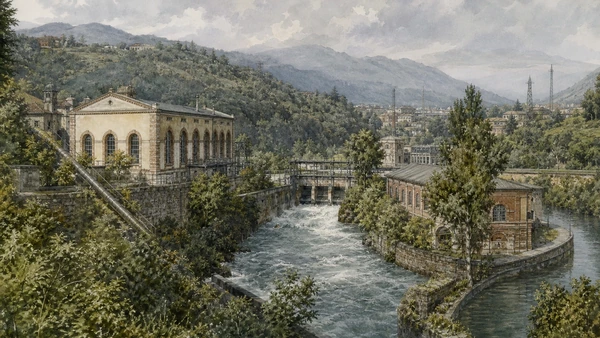
Original documentary watercolour panorama for Bergamo and Crespi d'Adda: Complete Guide, with accurate Lombardy architecture, landscape and lived context

Lombardy Guide 02 · Upper city, Venetian walls, civic collections, lower city, industrial village and Adda landscape

Bergamo
& Crespi d’Adda

A two-day guide joining Bergamo’s elevated Roman, medieval and Venetian city to the modern lower town, then following industrial settlement and river infrastructure at Crespi d’Adda.

Plan the route
Bergamo and the Adda · Lombardy10 chapters · one complete route

Why this route must be read in layers

Bergamo is a vertical city whose fortifications, religious institutions and modern expansion require movement between levels; Crespi adds a deliberately planned industrial settlement whose heritage still borders homes and workplaces.

Città Alta preserves street alignments, civic buildings and churches inside a defensive perimeter greatly expanded under Venetian rule. The walls are both engineered military landscape and today’s public edge.

Piazza Vecchia, Santa Maria Maggiore and the Colleoni Chapel bring communal government, church power and elite commemoration into one small area, while Accademia Carrara shifts attention toward collection and public education.

Crespi d’Adda must be read through factory, housing, services, cemetery and river power as one paternalist company system. UNESCO status does not turn the village into an empty museum.

Give Bergamo a full day and Crespi a separate half or full day; the funicular and river approaches are useful transport, not substitutes for reading terrain.

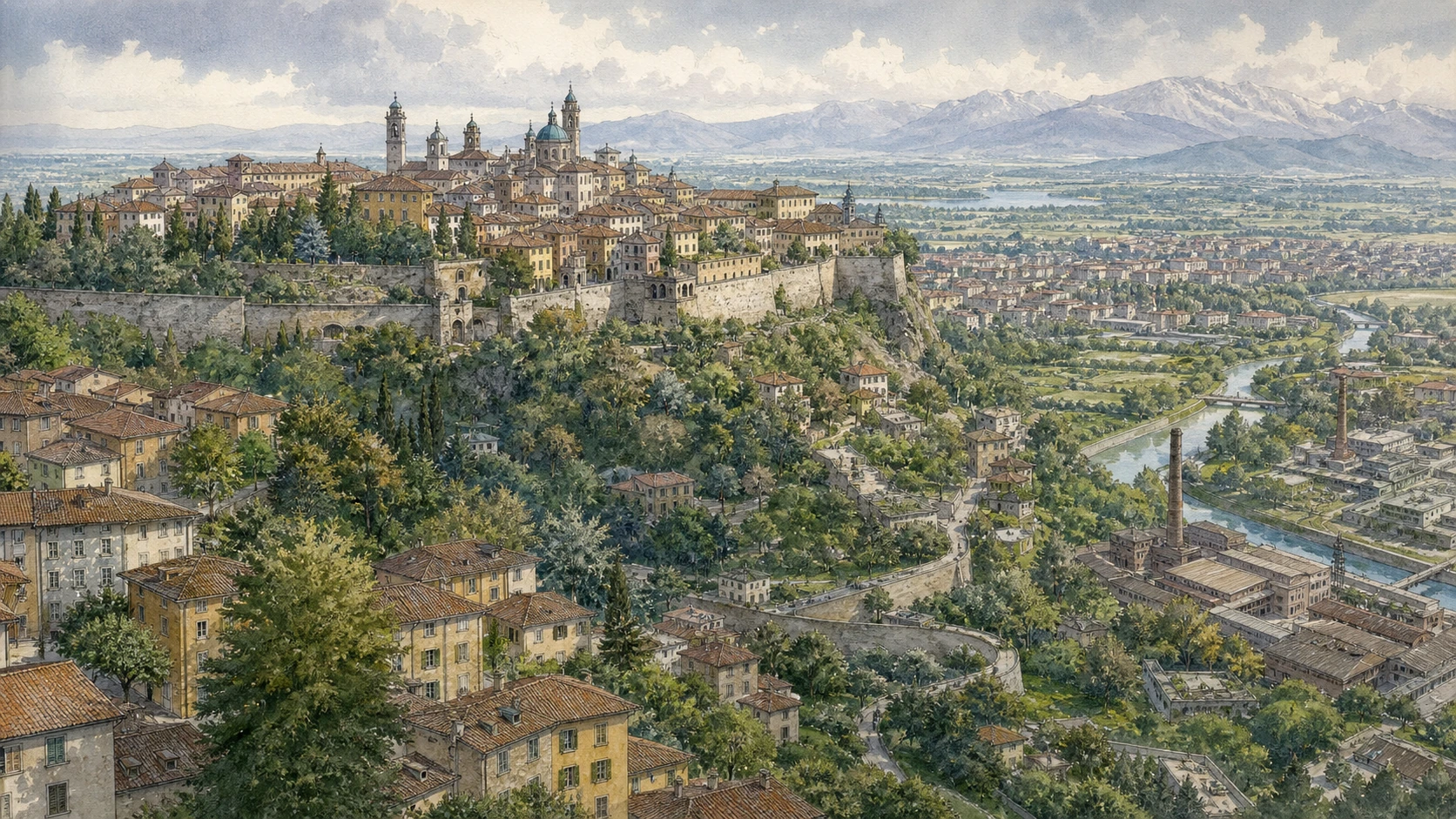
The route

Plan your visit

Begin at the gates and civic centre of Città Alta, descend through the collections and modern lower city, then visit Crespi through its official access and resident-sensitive route.

Early morning

Venetian Walls · Piazza Vecchia · Santa Maria Maggiore

Move in the documented order: Venetian Walls: defence around the upper city; then Piazza Vecchia: communal government in a civic room; then Santa Maria Maggiore: civic basilica and changing interior. Recheck live access and transport before entering a controlled site.

Late morning

Colleoni Chapel · Rocca and Campanone views · Accademia Carrara

Move in the documented order: Colleoni Chapel: mercenary power beside the basilica; then Rocca and Campanone views: terrain as historical evidence; then Accademia Carrara: collection, school and civic museum. Recheck live access and transport before entering a controlled site.

Afternoon

Bergamo Bassa · The funiculars · Crespi d’Adda

Move in the documented order: Bergamo Bassa: the modern city below the walls; then The funiculars: infrastructure across a vertical city; then Crespi d’Adda: company village as a complete system. Recheck live access and transport before entering a controlled site.

Late afternoon

Adda landscape

Move in the documented order: Adda landscape: water, power and industrial territory. Recheck live access and transport before entering a controlled site.

Ten chapters

Explore the places

The order follows terrain, institutions and present-day movement. Use the index to return to a chapter without reducing the route to isolated monuments.

  1. 01Venetian Walls: defence around the upper city
  2. 02Piazza Vecchia: communal government in a civic room
  3. 03Santa Maria Maggiore: civic basilica and changing interior
  4. 04Colleoni Chapel: mercenary power beside the basilica
  5. 05Rocca and Campanone views: terrain as historical evidence
  6. 06Accademia Carrara: collection, school and civic museum
  7. 07Bergamo Bassa: the modern city below the walls
  8. 08The funiculars: infrastructure across a vertical city
  9. 09Crespi d’Adda: company village as a complete system
  10. 10Adda landscape: water, power and industrial territory
01

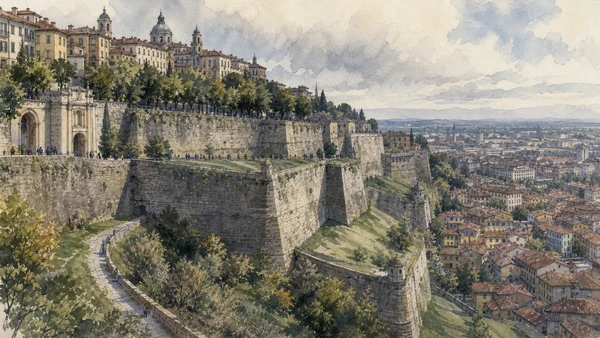
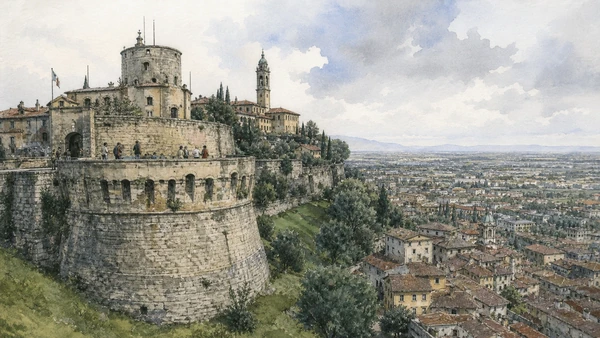
Bastions, gates and long viewpoints define the sixteenth-century military perimeter now included in a transnational UNESCO property.

Venetian Walls: defence around the upper city

Bastions, gates and long viewpoints define the sixteenth-century military perimeter now included in a transnational UNESCO property. The site becomes clearer when its surviving fabric, later alterations and present use are read together.

Today

The exterior can usually be read from public space, but events, works and crowd management may change circulation. Keep access routes open and verify any interior visit with the responsible institution.

History

Venice rebuilt Bergamo’s fortifications in the sixteenth century to secure its western frontier, displacing buildings and reshaping approaches around the hill.

How to read this place

Begin with bastion geometry and firing lines. Then compare monumental gates with the relationship between walls and terrain; the differences are evidence, not visual noise.

What to notice

  • bastion geometry and firing lines
  • monumental gates
  • the relationship between walls and terrain
UNESCO · Venetian Works of Defence
Original documentary watercolour of Venetian Walls: defence around the upper city in Bergamo and the Adda · Lombardy, showing accurate architecture, landscape, people and present-day use
Venetian Walls: defence around the upper cityOriginal Merlintravel documentary watercolour · 2026
02

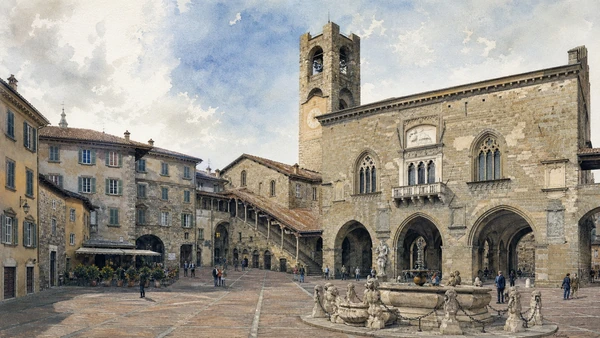
Palazzo della Ragione, civic tower, library and fountain compress several political phases into an unusually coherent square.

Piazza Vecchia: communal government in a civic room

Palazzo della Ragione, civic tower, library and fountain compress several political phases into an unusually coherent square. The site becomes clearer when its surviving fabric, later alterations and present use are read together.

Today

The exterior can usually be read from public space, but events, works and crowd management may change circulation. Keep access routes open and verify any interior visit with the responsible institution.

History

Medieval communal buildings developed before Venetian rule altered façades, functions and the relationship to adjacent Piazza Duomo.

How to read this place

Begin with the palazzo della ragione arcades. Then compare the civic tower as timekeeper with the opening toward religious buildings behind; the differences are evidence, not visual noise.

What to notice

  • the Palazzo della Ragione arcades
  • the civic tower as timekeeper
  • the opening toward religious buildings behind
Visit Bergamo · Official destination site
Original documentary watercolour of Piazza Vecchia: communal government in a civic room in Bergamo and the Adda · Lombardy, showing accurate architecture, landscape, people and present-day use
Piazza Vecchia: communal government in a civic roomOriginal Merlintravel documentary watercolour · 2026
03

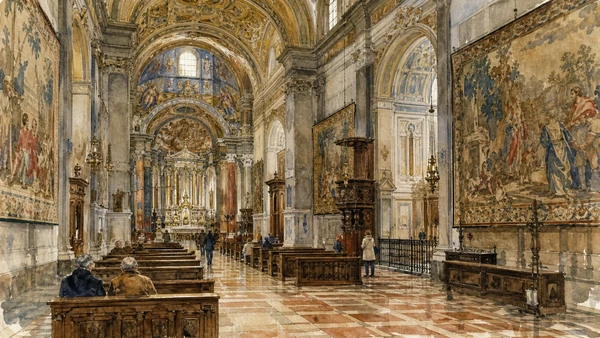
Romanesque exterior portals lead into a richly transformed church tied to communal devotion, music and burial.

Santa Maria Maggiore: civic basilica and changing interior

Romanesque exterior portals lead into a richly transformed church tied to communal devotion, music and burial. The site becomes clearer when its surviving fabric, later alterations and present use are read together.

Today

This is an active religious place as well as a historic building. Services, ceremonies and conservation can interrupt tourist access; dress appropriately, remain quiet and never treat a booked visit as priority over worship.

History

Work began in the twelfth century; medieval structure received major later decoration, tapestries, choir furnishings and the tomb of composer Gaetano Donizetti.

How to read this place

Begin with the absence of a conventional west façade. Then compare sculpted side portals with later interior layers within romanesque mass; the differences are evidence, not visual noise.

What to notice

  • the absence of a conventional west façade
  • sculpted side portals
  • later interior layers within Romanesque mass
Fondazione MIA · Basilica Santa Maria Maggiore
Original documentary watercolour of Santa Maria Maggiore: civic basilica and changing interior in Bergamo and the Adda · Lombardy, showing accurate architecture, landscape, people and present-day use
Santa Maria Maggiore: civic basilica and changing interiorOriginal Merlintravel documentary watercolour · 2026
04

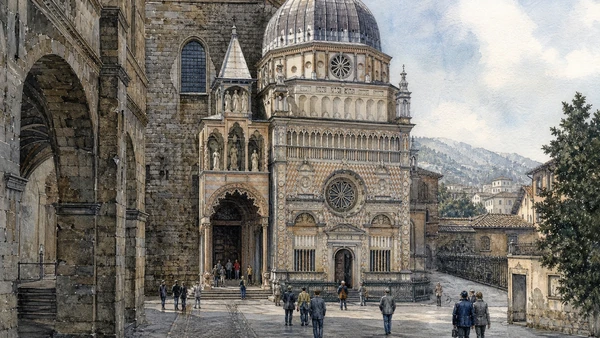
A polychrome Renaissance mausoleum asserts Bartolomeo Colleoni’s status within Bergamo’s sacred civic centre.

Colleoni Chapel: mercenary power beside the basilica

A polychrome Renaissance mausoleum asserts Bartolomeo Colleoni’s status within Bergamo’s sacred civic centre. The site becomes clearer when its surviving fabric, later alterations and present use are read together.

Today

This is an active religious place as well as a historic building. Services, ceremonies and conservation can interrupt tourist access; dress appropriately, remain quiet and never treat a booked visit as priority over worship.

History

Giovanni Antonio Amadeo designed the chapel in the fifteenth century, inserting a private commemorative project against the basilica and earlier urban fabric.

How to read this place

Begin with polychrome marble geometry. Then compare the tomb and equestrian imagery with the chapel’s tight relationship to the basilica; the differences are evidence, not visual noise.

What to notice

  • polychrome marble geometry
  • the tomb and equestrian imagery
  • the chapel’s tight relationship to the basilica
Visit Bergamo · Official destination site
Original documentary watercolour of Colleoni Chapel: mercenary power beside the basilica in Bergamo and the Adda · Lombardy, showing accurate architecture, landscape, people and present-day use
Colleoni Chapel: mercenary power beside the basilicaOriginal Merlintravel documentary watercolour · 2026
05

Fortified high points reveal the relation among upper city, plains, valleys and successive defensive rings.

Rocca and Campanone views: terrain as historical evidence

Fortified high points reveal the relation among upper city, plains, valleys and successive defensive rings. The site becomes clearer when its surviving fabric, later alterations and present use are read together.

Today

Opening, ticketing, room access and temporary displays can change. Check the institution’s official notice shortly before visiting, use the designated entrance and allow for security or conservation controls.

History

Medieval and later military works occupied strategic ground, while modern museum and public access reframed the fortifications as sites of civic memory.

How to read this place

Begin with ridge control and sightlines. Then compare wall phases and reused masonry with the lower city expanding across the plain; the differences are evidence, not visual noise.

What to notice

  • ridge control and sightlines
  • wall phases and reused masonry
  • the lower city expanding across the plain
Visit Bergamo · Official destination site
Original documentary watercolour of Rocca and Campanone views: terrain as historical evidence in Bergamo and the Adda · Lombardy, showing accurate architecture, landscape, people and present-day use
Rocca and Campanone views: terrain as historical evidenceOriginal Merlintravel documentary watercolour · 2026
06

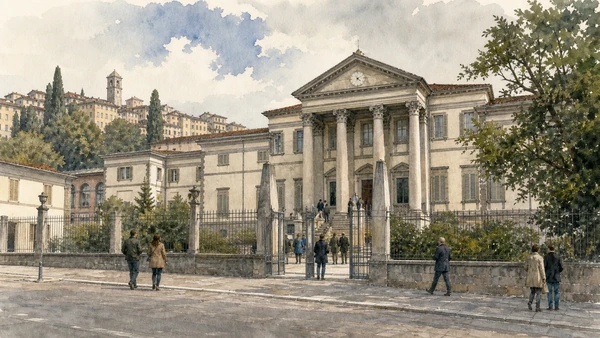
Paintings assembled through local collecting connect Renaissance masters to education and Bergamo’s public cultural identity.

Accademia Carrara: collection, school and civic museum

Paintings assembled through local collecting connect Renaissance masters to education and Bergamo’s public cultural identity. The site becomes clearer when its surviving fabric, later alterations and present use are read together.

Today

Opening, ticketing, room access and temporary displays can change. Check the institution’s official notice shortly before visiting, use the designated entrance and allow for security or conservation controls.

History

Giacomo Carrara founded a gallery and school at the end of the eighteenth century; later donors expanded a collection reorganised through successive museum campaigns.

How to read this place

Begin with donor histories in the labels. Then compare works tied to bergamo and wider italy with the purpose-built gallery sequence; the differences are evidence, not visual noise.

What to notice

  • donor histories in the labels
  • works tied to Bergamo and wider Italy
  • the purpose-built gallery sequence
Accademia Carrara · Official museum
Original documentary watercolour of Accademia Carrara: collection, school and civic museum in Bergamo and the Adda · Lombardy, showing accurate architecture, landscape, people and present-day use
Accademia Carrara: collection, school and civic museumOriginal Merlintravel documentary watercolour · 2026
07

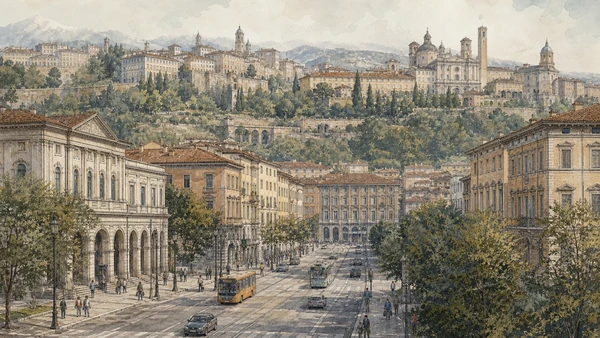
Boulevards, civic buildings, theatre and rail approaches show expansion beyond the fortified hill.

Bergamo Bassa: the modern city below the walls

Boulevards, civic buildings, theatre and rail approaches show expansion beyond the fortified hill. The site becomes clearer when its surviving fabric, later alterations and present use are read together.

Today

The area is inhabited and worked, not staged for visitors. Keep doorways, pavements, cycle lanes and deliveries clear, ask before photographing people and use current municipal mobility information.

History

Nineteenth- and twentieth-century planning consolidated a new commercial and administrative centre between the station and the funicular approach.

How to read this place

Begin with the axis from station toward porta nuova. Then compare civic and theatrical façades with views back to the upper city; the differences are evidence, not visual noise.

What to notice

  • the axis from station toward Porta Nuova
  • civic and theatrical façades
  • views back to the upper city
Visit Bergamo · Official destination site
Original documentary watercolour of Bergamo Bassa: the modern city below the walls in Bergamo and the Adda · Lombardy, showing accurate architecture, landscape, people and present-day use
Bergamo Bassa: the modern city below the wallsOriginal Merlintravel documentary watercolour · 2026
08

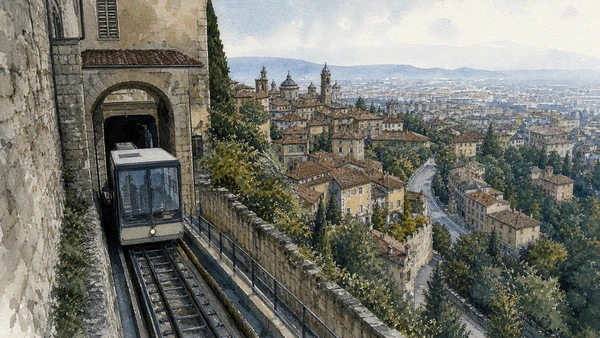
Rail systems connect the lower town, Città Alta and San Vigilio while making slope and historic access legible.

The funiculars: infrastructure across a vertical city

Rail systems connect the lower town, Città Alta and San Vigilio while making slope and historic access legible. The site becomes clearer when its surviving fabric, later alterations and present use are read together.

Today

Timetables, engineering works, capacity and accessibility arrangements can change. Check the operator on the day, leave a realistic connection margin and never enter tracks, depots or restricted infrastructure.

History

Funicular service developed from the late nineteenth century as Bergamo expanded and visitors and residents required reliable links across steep gradients.

How to read this place

Begin with track alignment on the slope. Then compare station thresholds within historic fabric with the changing panorama during ascent; the differences are evidence, not visual noise.

What to notice

  • track alignment on the slope
  • station thresholds within historic fabric
  • the changing panorama during ascent
ATB Bergamo · Tourist services
Original documentary watercolour of The funiculars: infrastructure across a vertical city in Bergamo and the Adda · Lombardy, showing accurate architecture, landscape, people and present-day use
The funiculars: infrastructure across a vertical cityOriginal Merlintravel documentary watercolour · 2026
09

Factory, ordered housing and services express industrial paternalism at settlement scale.

Crespi d’Adda: company village as a complete system

Factory, ordered housing and services express industrial paternalism at settlement scale. The site becomes clearer when its surviving fabric, later alterations and present use are read together.

Today

The area is inhabited and worked, not staged for visitors. Keep doorways, pavements, cycle lanes and deliveries clear, ask before photographing people and use current municipal mobility information.

History

The Crespi family developed the cotton factory and village from the late nineteenth century, organising residence, education, worship and welfare around production.

How to read this place

Begin with the hierarchy of house types. Then compare factory frontage and central axis with services positioned within the planned settlement; the differences are evidence, not visual noise.

What to notice

  • the hierarchy of house types
  • factory frontage and central axis
  • services positioned within the planned settlement
UNESCO · Crespi d’Adda
Original documentary watercolour of Crespi d'Adda: company village as a complete system in Bergamo and the Adda · Lombardy, showing accurate architecture, landscape, people and present-day use
Crespi d’Adda: company village as a complete systemOriginal Merlintravel documentary watercolour · 2026
10

River topography and hydraulic works explain why production settled here and how the village related to a wider industrial corridor.

Adda landscape: water, power and industrial territory

River topography and hydraulic works explain why production settled here and how the village related to a wider industrial corridor. The site becomes clearer when its surviving fabric, later alterations and present use are read together.

Today

Weather, water levels, trail conditions and seasonal services can alter the route. Use official transport and park information, remain on authorised paths and do not enter farms, vineyards or private gardens without permission.

History

Canals and hydroelectric infrastructure along the Adda supplied energy to factories and helped make the river a laboratory of Lombard industrial modernisation.

How to read this place

Begin with the height difference between village and river. Then compare canal and power infrastructure with wooded banks surrounding industrial buildings; the differences are evidence, not visual noise.

What to notice

  • the height difference between village and river
  • canal and power infrastructure
  • wooded banks surrounding industrial buildings
UNESCO · Crespi d’Adda
Original documentary watercolour of Adda landscape: water, power and industrial territory in Bergamo and the Adda · Lombardy, showing accurate architecture, landscape, people and present-day use
Adda landscape: water, power and industrial territoryOriginal Merlintravel documentary watercolour · 2026

Lombardy through time

A short chronology

From prehistoric settlement and Roman routes to communes, regional states, industrial transformation, heritage protection and climate-sensitive mobility.

  1. Settlements, ritual places and rock imagery document long human occupation from Alpine valleys to the Po plain.

  2. Camuni, Celts, Etruscan networks and other communities develop distinct territories before Roman expansion.

  3. Roman roads, colonies and municipia integrate the region while retaining different local settlement patterns.

  4. Cities, villas, farms, sanctuaries and Alpine routes connect the Po basin to transalpine and imperial systems.

  5. Christian institutions, new burial landscapes and political change reshape Roman urban centres.

  6. Lombard rule establishes courts, duchies and monasteries whose material traces survive unevenly across the region.

  7. Castles, monasteries, parishes and landed powers organise countryside, lakes and mountain routes.

  8. Communal cities expand public buildings, cathedrals, walls, trade and conflict across the Lombard plain.

  9. Visconti and then Sforza power links Milan to fortified towns, courts, canals and agricultural territories.

  10. Venetian expansion incorporates much of eastern Lombardy, creating a durable political and architectural frontier.

  11. The Peace of Lodi stabilises a territorial balance whose borders continue to shape cities and landscapes.

  12. Spanish and Austrian governments reorganise defence, taxation, institutions and infrastructure in different parts of Lombardy.

  13. Napoleonic and Austrian administrations alter civic institutions, roads, collections and territorial government before unification.

  14. Railways, factories, hydropower, migration, tourism, war and resistance transform urban and Alpine societies.

  15. Reconstruction, industrial growth, deindustrialisation, heritage protection, mass mobility and climate pressure repeatedly reshape the region.

Before your visit

Practical information

01

Check the live page

Opening hours, reservation systems, restoration, exhibitions and transport can change. Recheck the linked official institution shortly before departure.

02

Separate worship and tourism

Churches and sanctuaries remain religious spaces. Services, funerals and community use take priority over visitor itineraries.

03

Plan real distances

Bergamo and the Adda · Lombardy combines dense urban routes with lakes, valleys and dispersed towns. Do not compress distant chapters into an unsafe or superficial day.

04

Keep thresholds open

Arcades, station halls, markets, courtyards, workshops and residential streets must continue to function while you observe or photograph them.

05

Use current mobility data

Check the responsible rail, navigation, bus, road or park operator on the day; replacement services and weather can change an otherwise sound route.

06

Read change honestly

Restoration, reconstruction, adaptive reuse and new development have all shaped the landscape visible today.

Method and sources

Sources and image credits

This guide uses official museum, ministry, municipal, transport, park and UNESCO documentation checked on 29 August 2026. It separates durable historical interpretation from access details that can change, distinguishes surviving fabric from restoration or reconstruction, and treats worship, work, residence and public movement as part of the evidence. Every chapter links its principal institutional source; tickets, closures, weather and transport must always be verified again on the day of the visit.

All ten images are original Merlintravel editorial watercolours based on documented present-day conditions. They are illustrations, not substitutes for archaeological plans. Opening hours, tickets, accessible routes, temporary exhibitions and conservation work can change; consult the linked official pages shortly before visiting.