Italy · Regional journey 14

Campania

Greek and Roman cities, volcanic landscapes, Naples, Bourbon ambition, inland Sannio and island seas.

6historic layers
4editorial journeys
8territorial gateways
Campania’s beauty is inseparable from danger, density and cultural invention.
The regional idea

The region contains ancient Greek foundations, Pompeii and Herculaneum, cosmopolitan Naples, Longobard Benevento, the Royal Palace of Caserta, Amalfi’s maritime history, Paestum, Vesuvius, the Phlegraean Fields, Cilento, Irpinia and the islands of the Bay.

Time made visible

History in layers.

Campania was repeatedly central to Mediterranean exchange. Greek, Samnite, Roman, Lombard, Norman, Angevin, Aragonese, Spanish and Bourbon layers survive in cities and landscapes that remain intensely inhabited.

01

Indigenous peoples and Greek foundations

Oscans, Samnites, Etruscans and Greek colonies created a plural pre-Roman Campania.

02

Roman Campania

Ports, villas, roads, farms and cities made the Bay and northern plain central to imperial life.

03

Late antiquity and Lombard Benevento

Christian centres, duchies and shifting coastal powers reshaped the region after Rome.

04

Norman, Angevin and Aragonese kingdoms

Naples and Salerno grew within dynastic networks connecting southern Italy and the Mediterranean.

05

Spanish and Bourbon capital

Naples became one of Europe’s largest cities while Caserta, San Leucio and infrastructure expressed royal power.

06

Modern metropolis and resilient territories

Unification, migration, industry, war, earthquakes and volcanic crises transformed modern Campania.

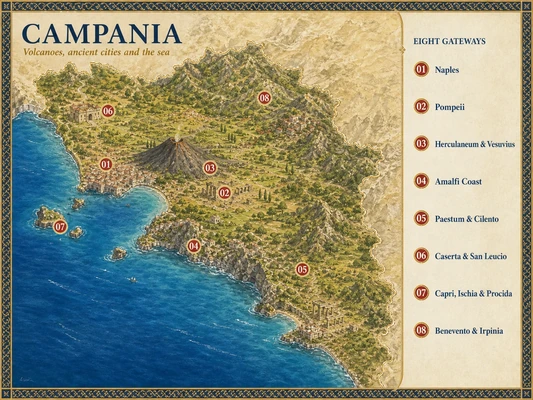
Illustrated map of Campania with eight numbered Merlintravel gateways
Merlintravel illustrated atlas · official ISTAT profile archived separately
The complete circuit

Bays, islands, royal plains and southern mountains.

The atlas moves from the Bay of Naples to Caserta, Sannio and Irpinia, then south through Salerno, Paestum and Cilento, with islands treated as distinct worlds.

Map markers identify editorial gateways, not a ranking.

Four ways through

Journeys, not checklists.

Four circuits prevent the Amalfi Coast and Pompeii from eclipsing inland histories, living Naples and the Cilento south.

01

Naples and the volcanic bay

The historic centre, waterfront, Vesuvius, Phlegraean Fields and buried Roman cities form one dense system.

02

Caserta, Capua and the northern plain

Roman roads, Bourbon landscapes and planned industry reveal power beyond the capital.

03

Sannio and Irpinia

Benevento, Avellino, abbeys, castles, vineyards and earthquake memory open the mountain interior.

04

Salerno, Amalfi and Cilento

Lombard and Norman history, maritime towns, Greek temples and national-park landscapes lead south.

Eight territorial doors

Places that open the story.

Each gateway is a future chapter: a city, landscape or cultural system large enough to deserve its own documented guide.

01

Naples

A continuously layered Mediterranean metropolis of Greek streets, churches, palaces, theatre, music and daily life.

02

Pompeii

An excavated Roman city whose houses, streets and objects document social life before the 79 CE eruption.

03

Herculaneum and Vesuvius

Extraordinary preservation, volcanic science and densely inhabited slopes around an active volcano.

04

Amalfi Coast

Maritime history, terraced agriculture, monasteries and towns built within steep coastal valleys.

05

Paestum and Cilento

Greek temples, Lucanian and Roman layers, coastal plains and a vast protected mountain hinterland.

06

Caserta and San Leucio

Royal palace, waterworks, gardens and an Enlightenment-era silk community within a designed landscape.

07

Capri, Ischia and Procida

Three islands with different geology, settlement, thermal, agricultural and cultural histories.

08

Benevento and Irpinia

Roman arches, Lombard heritage, inland sanctuaries, villages and wine landscapes.

Living and monumental heritage

What the region keeps.

Monuments matter, but so do languages, crafts, routes, rituals and working landscapes.

01

Ancient cities

Pompeii, Herculaneum, Paestum and other sites preserve ordinary spaces as well as monumental history.

02

Naples as living heritage

Language, music, theatre, craft, devotion and food traditions continue within a changing metropolis.

03

Royal and industrial experiment

Caserta and San Leucio join palace culture to water engineering and planned silk production.

04

Art of the Neapolitan pizzaiuolo

UNESCO recognition concerns knowledge, gestures and social transmission, not simply a dish.

Land and water

Nature is part of the archive.

Land, water and ecological systems are read together with the communities that have learned to inhabit them.

01

Vesuvius

An active volcano, national park and densely settled cultural landscape requiring risk-aware interpretation.

02

Phlegraean Fields

Calderas, lakes, thermal activity, archaeology and modern towns occupy a dynamic volcanic system.

03

Cilento

Mountains, karst, coast and biodiversity surround ancient sites and long-lived communities.

04

Bay islands

Volcanic Ischia, limestone Capri and tuff-built Procida support distinct marine and terrestrial environments.

A documented journey, still open.

Archaeological sites are described as ancient cities and research landscapes, not ruins frozen by catastrophe. Volcanic risk and access rules will be checked through current official sources in each guide.

The journey continues.

Return to the Italy regional atlas