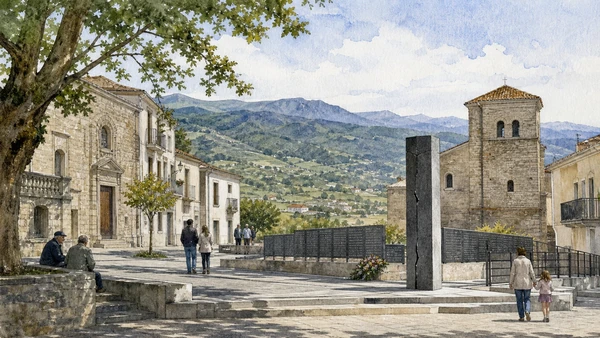
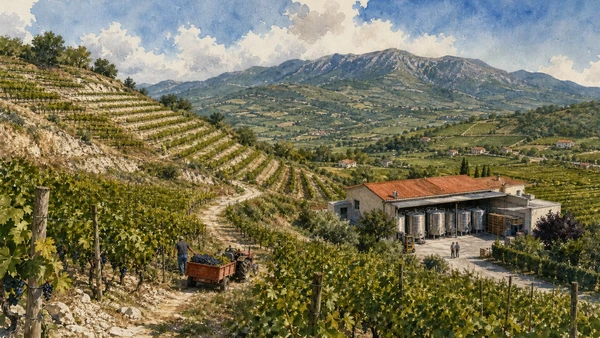
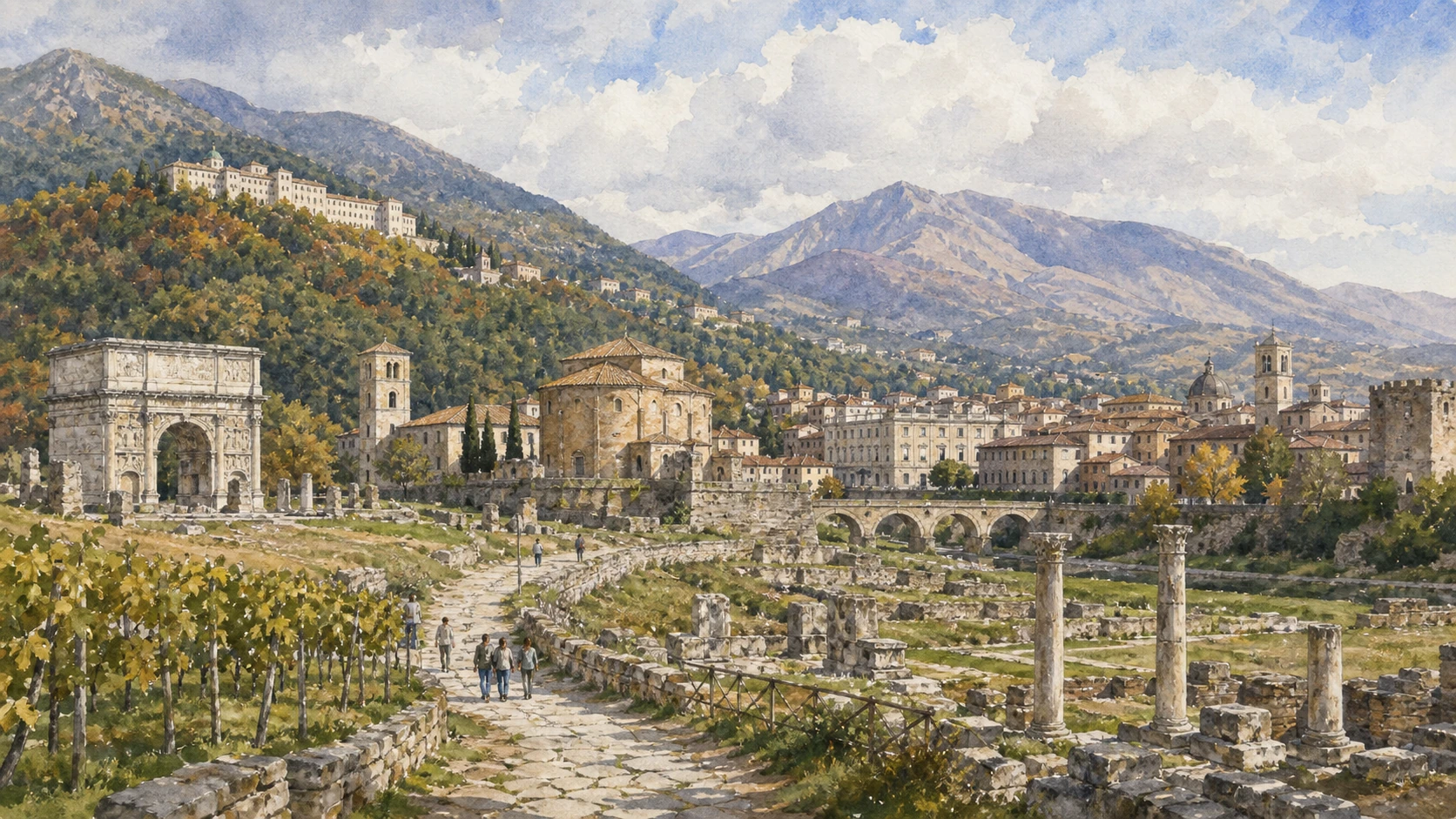
Original documentary watercolour panorama for Benevento and Irpinia: Roman City, Lombard Heritage and Apennine Landscape — Complete Guide, showing landscape, heritage and present-day use

Campania Guide 08 · Roman gateway, Lombard duchy, monasteries, earthquake memory, archaeology and wine landscape

Benevento, Irpinia
& the Apennine Interior

A multi-day inland guide joining Benevento’s Roman and Lombard monuments to Avellino, Montevergine, Abellinum, Aeclanum, earthquake memory and the agricultural landscapes of Taurasi, Fiano and Greco di Tufo.

Plan the route
Campania · Italy10 chapters · one to three days

Why this Campania landscape must be read in layers

Campania’s interior is not an empty alternative to the coast: routes through the Apennines supported Roman roads, Lombard power, monasteries, towns, farming and modern migration while earthquakes repeatedly reshaped settlement.

Benevento’s Arch of Trajan, Roman theatre and long road history reveal an imperial node, while Santa Sofia and its cloister preserve the capital of a major Lombard duchy within the serial UNESCO property Longobards in Italy.

Irpinia is distributed rather than centred on one monument. Avellino, Montevergine, ancient Abellinum and Aeclanum, hill towns and wine districts require road or carefully planned bus travel and should be grouped by valley.

The 1980 earthquake is essential contemporary history. Reconstruction, relocation, depopulation and memorial practices differ by town; disaster sites should be approached through institutions and resident memory, never as ruin tourism.

Use Benevento as one full urban day, then choose one Irpinia corridor for a second or third day; verify museum hours, mountain weather, transport and winery appointments directly.

The route

Plan your visit

Begin with Benevento’s Roman and Lombard layers, then move west and south through archaeology, pilgrimage, earthquake memory and agricultural landscapes without forcing distant sites into one day.

Early morning

Arch of Trajan · Roman Theatre of Benevento · Santa Sofia

Follow the documented sequence: Arch of Trajan: imperial gateway and carved programme; then Roman Theatre of Benevento: performance within the modern city; then Santa Sofia: Lombard church and UNESCO complex. Recheck current access, transport and weather before departure.

Late morning

Museo del Sannio · Rocca dei Rettori · Benevento and Isis

Follow the documented sequence: Museo del Sannio: archaeology, Lombard art and civic collections; then Rocca dei Rettori: fortress, government and reused masonry; then Benevento and Isis: Egyptian cult within a Roman crossroads. Recheck current access, transport and weather before departure.

Afternoon

Montevergine · Abellinum and Aeclanum · The 1980 earthquake

Follow the documented sequence: Montevergine: pilgrimage monastery above Irpinia; then Abellinum and Aeclanum: two ancient cities in modern Irpinia; then The 1980 earthquake: towns, reconstruction and memory. Recheck current access, transport and weather before departure.

Late afternoon

Irpinia wine landscape

Follow the documented sequence: Irpinia wine landscape: altitude, soils and working agriculture. Recheck current access, transport and weather before departure.

Ten chapters

Explore the places

The order follows terrain, chronology and current movement. Use the index without detaching monuments from the living landscape and infrastructure that sustain them.

  1. 01Arch of Trajan: imperial gateway and carved programme
  2. 02Roman Theatre of Benevento: performance within the modern city
  3. 03Santa Sofia: Lombard church and UNESCO complex
  4. 04Museo del Sannio: archaeology, Lombard art and civic collections
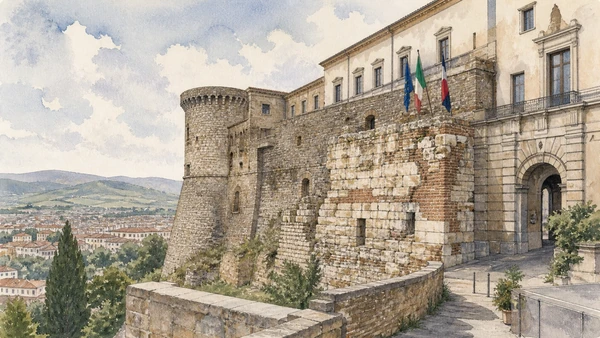
  5. 05Rocca dei Rettori: fortress, government and reused masonry
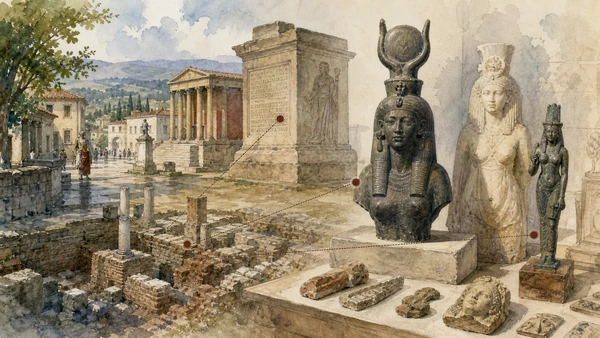
  6. 06Benevento and Isis: Egyptian cult within a Roman crossroads
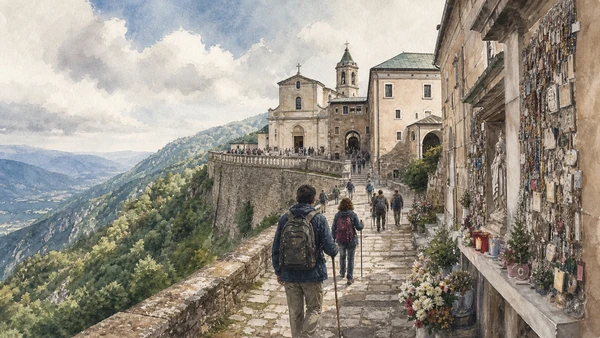
  7. 07Montevergine: pilgrimage monastery above Irpinia
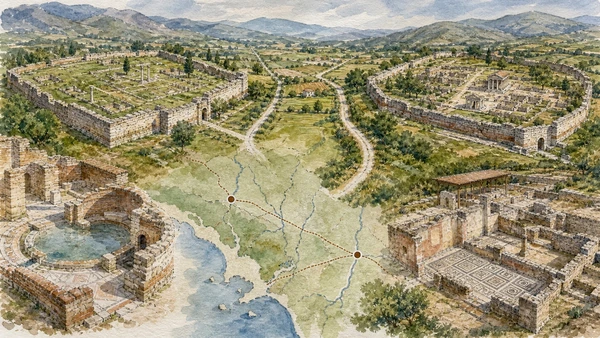
  8. 08Abellinum and Aeclanum: two ancient cities in modern Irpinia
  9. 09The 1980 earthquake: towns, reconstruction and memory
  10. 10Irpinia wine landscape: altitude, soils and working agriculture
01

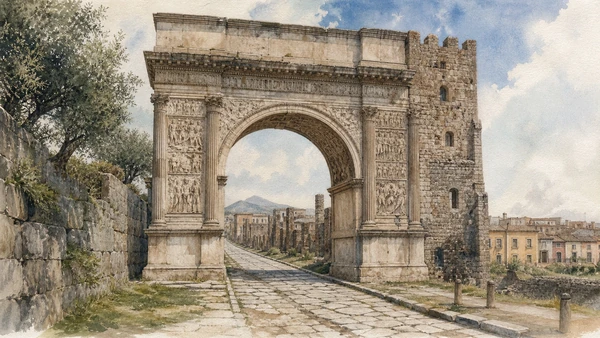
A richly sculpted arch marked the Via Traiana and the emperor’s relationship with Italy and the provinces

Arch of Trajan: imperial gateway and carved programme

It belongs to a road system, not an isolated trophy.

Today

The monument stands in public urban space. Use pedestrian areas and avoid touching the reliefs or blocking local movement.

History

Dedicated in 114 CE, the arch celebrated Trajan and the new route toward Brindisi. Medieval city use helped preserve it while changing its setting.

How to read this place

Circle both faces and compare relief themes. Reconstruct the Roman road and lost urban approach before photographing details.

What to notice

  • Single arch framing the Via Traiana
  • Reliefs addressing city and provinces
  • Medieval reuse preserving an imperial monument
Comune di Benevento · Official city
Original documentary watercolour of Arch of Trajan: imperial gateway and carved programme in Campania, showing accurate heritage, terrain and present-day use
Arch of Trajan: imperial gateway and carved programmeOriginal Merlintravel documentary watercolour · 2026
02

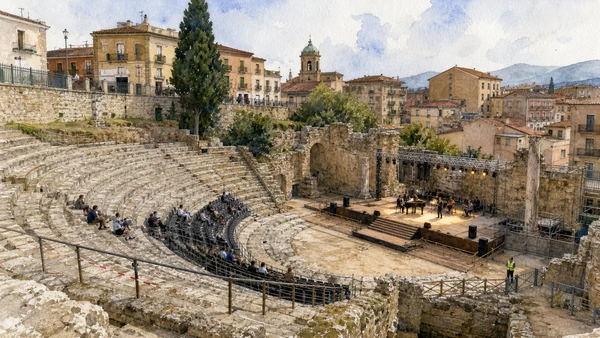
A large imperial theatre preserves cavea, stage remains and a strong relation to the Triggio district

Roman Theatre of Benevento: performance within the modern city

Its current events continue rather than simply imitate ancient performance.

Today

The MiC site follows live opening and event schedules. Stone seating, sun and restricted stage areas require care.

History

The theatre developed in the second century CE and was altered under later emperors. Building reuse and excavation changed its relation to surrounding streets.

How to read this place

Follow entrances and seating sectors before the stage. Compare surviving masonry with reconstructed or event infrastructure.

What to notice

  • Cavea embedded among later neighbourhood streets
  • Stage remains preserving performance scale
  • Modern events governed by heritage controls
Direzione regionale Musei nazionali Campania · Teatro Romano
Original documentary watercolour of Roman Theatre of Benevento: performance within the modern city in Campania, showing accurate heritage, terrain and present-day use
Roman Theatre of Benevento: performance within the modern cityOriginal Merlintravel documentary watercolour · 2026
03

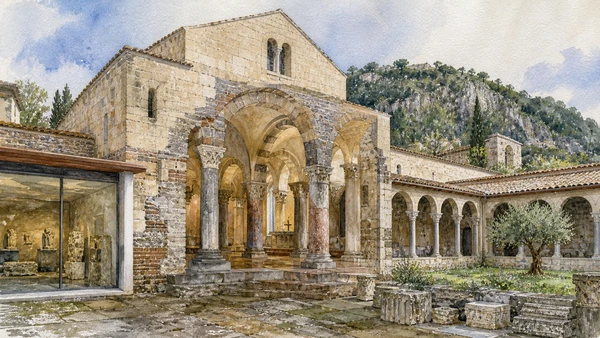
A compact, unusual plan concentrates columns, vaults and sacred authority at the heart of the Lombard duchy

Santa Sofia: Lombard church and UNESCO complex

Church, cloister and museum must be read as one institutional precinct.

Today

The church remains active and museum access follows separate rules. Services and conservation can limit interior viewing.

History

Duke Arechis II founded Santa Sofia in the eighth century. Earthquakes and Baroque alteration changed it before twentieth-century restoration sought to recover aspects of the Lombard structure.

How to read this place

Walk around the central supports and identify irregular geometry. Distinguish Lombard fabric, later repair and restoration decisions.

What to notice

  • Centralised plan using varied columns
  • Vaults creating a complex sacred interior
  • Cloister extending worship into learned institution
UNESCO · Longobards in Italy
Original documentary watercolour of Santa Sofia: Lombard church and UNESCO complex in Campania, showing accurate heritage, terrain and present-day use
Santa Sofia: Lombard church and UNESCO complexOriginal Merlintravel documentary watercolour · 2026
04

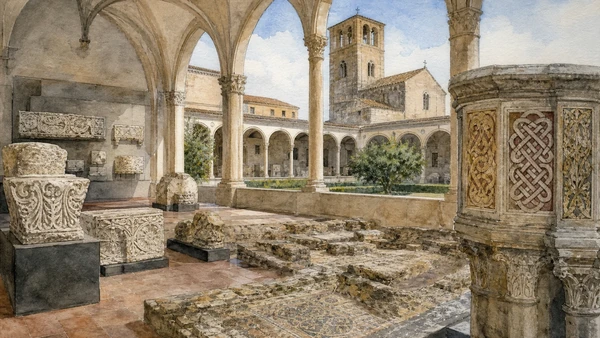
Collections distributed around Santa Sofia restore regional depth to Benevento’s monuments

Museo del Sannio: archaeology, Lombard art and civic collections

Objects connect the city to Sannite, Roman, medieval and later histories.

Today

Museum hours can change and some departments may rotate. Check the official institution and allow time for the cloister.

History

Founded by the provincial administration in the nineteenth century, the museum grew through archaeological, historical and artistic collections and expanded into the former abbey complex.

How to read this place

Group works by findspot and institution. Compare fragments from monuments with the buildings still visible outside.

What to notice

  • Archaeological collections grounding the Roman city
  • Lombard fragments connected to Santa Sofia
  • Cloister serving as museum architecture
Ministero della Cultura · Museo del Sannio
Original documentary watercolour of Museo del Sannio: archaeology, Lombard art and civic collections in Campania, showing accurate heritage, terrain and present-day use
Museo del Sannio: archaeology, Lombard art and civic collectionsOriginal Merlintravel documentary watercolour · 2026
05

A fortified high point combines Roman material, medieval power and present provincial administration

Rocca dei Rettori: fortress, government and reused masonry

Its name records papal government after Lombard Benevento.

Today

Interior access can depend on exhibitions and offices. Respect controlled administrative zones and read the public exterior.

History

Defensive and governmental use accumulated on the site through Roman, Lombard and papal phases. Later restoration shaped the castle-like appearance.

How to read this place

Compare towers, curtain walls and visible reused stone. Current flags and offices continue the history of government.

What to notice

  • Fortified mass occupying a strategic city edge
  • Reused ancient material in later walls
  • Modern administration preserving political function
Provincia di Benevento · Official institution
Original documentary watercolour of Rocca dei Rettori: fortress, government and reused masonry in Campania, showing accurate heritage, terrain and present-day use
Rocca dei Rettori: fortress, government and reused masonryOriginal Merlintravel documentary watercolour · 2026
06

Sculptures and inscriptions document an important sanctuary and imperial religious network

Benevento and Isis: Egyptian cult within a Roman crossroads

They should not be turned into a generic mystery narrative.

Today

Objects are held in museum collections and displays can rotate. Use current labels and provenance.

History

Domitianic-period patronage supported an Iseum at Benevento, producing Egyptian and Egyptianising works linked to Roman cult and imperial power.

How to read this place

Separate imported stone, Roman manufacture and ancient Egyptian models. Map findspots cautiously because the sanctuary is not fully preserved in one open site.

What to notice

  • Egyptian and Egyptianising sculpture in a Roman city
  • Inscriptions linking cult to imperial patronage
  • Dispersed finds requiring museum reconstruction
Museo del Sannio · Official museum
Original documentary watercolour of Benevento and Isis: Egyptian cult within a Roman crossroads in Campania, showing accurate heritage, terrain and present-day use
Benevento and Isis: Egyptian cult within a Roman crossroadsOriginal Merlintravel documentary watercolour · 2026
07

A major Marian sanctuary occupies a high mountain setting reached through road and funicular systems

Montevergine: pilgrimage monastery above Irpinia

Landscape, Benedictine institution and living pilgrimage are inseparable.

Today

Mountain weather and funicular or road service change. Check the sanctuary and transport operator, dress for worship and avoid blocking pilgrims.

History

The sanctuary traces its foundation to William of Vercelli in the twelfth century and developed through monastic patronage, pilgrimage and repeated rebuilding.

How to read this place

Read approach, church, monastic spaces and votive practice in order. The mountain view is part of pilgrimage geography, not only leisure.

What to notice

  • Sanctuary terrace above forested slopes
  • Pilgrim routes converging at the monastery
  • Votive practice preserving living devotion
Abbazia Territoriale di Montevergine · Official sanctuary
Original documentary watercolour of Montevergine: pilgrimage monastery above Irpinia in Campania, showing accurate heritage, terrain and present-day use
Montevergine: pilgrimage monastery above IrpiniaOriginal Merlintravel documentary watercolour · 2026
08

Walls, houses, baths and roads preserve different nodes of Roman settlement

Abellinum and Aeclanum: two ancient cities in modern Irpinia

Their dispersed locations require current opening checks and should not be conflated.

Today

State archaeological areas may use reduced or event-based hours. Verify with the regional museum directorate and do not enter fenced remains.

History

Abellinum developed near present Atripalda, while Aeclanum occupied a strategic route near Mirabella Eclano. Both grew through Roman colonisation and regional movement.

How to read this place

Compare city wall, road relation and public buildings at each. A regional map is more useful than a monument checklist.

What to notice

  • Urban walls preserving Roman construction
  • Bath and house remains showing civic investment
  • Road corridors explaining inland settlement
Direzione regionale Musei nazionali Campania · Archaeological parks
Original documentary watercolour of Abellinum and Aeclanum: two ancient cities in modern Irpinia in Campania, showing accurate heritage, terrain and present-day use
Abellinum and Aeclanum: two ancient cities in modern IrpiniaOriginal Merlintravel documentary watercolour · 2026
09

Destruction across Irpinia and Basilicata produced loss, displacement and decades of rebuilding

The 1980 earthquake: towns, reconstruction and memory

It was both a seismic disaster and a test of institutions, construction and territorial inequality.

Today

Visit memorials and rebuilt towns respectfully, preferably through local museums or guides. Never enter unstable ruins or photograph residents as disaster subjects.

History

On 23 November 1980 a major earthquake devastated many communities and killed thousands. Emergency response, reconstruction policy, migration and corruption debates shaped modern southern Italian history.

How to read this place

Compare relocated centres, repaired buildings and retained ruins with precise dates and local testimony. Avoid reducing every changed town to one event.

What to notice

  • Memorials restoring names and local experience
  • New settlements revealing reconstruction policy
  • Retained ruins requiring safety and consent
INGV · Italian earthquakes and seismic research
Original documentary watercolour of The 1980 earthquake: towns, reconstruction and memory in Campania, showing accurate heritage, terrain and present-day use
The 1980 earthquake: towns, reconstruction and memoryOriginal Merlintravel documentary watercolour · 2026
10

Taurasi, Fiano di Avellino and Greco di Tufo emerge from distinct grapes, zones and production rules

Irpinia wine landscape: altitude, soils and working agriculture

Wine identity depends on growers, cellars and regulated origin, not one scenic vineyard.

Today

Winery visits require appointments and responsible transport. Vineyards are private workplaces; do not enter rows without permission.

History

Long local cultivation was reorganised by modern appellations, cooperatives and estate investment. Earthquake recovery, migration and changing markets affected producers unevenly.

How to read this place

Compare elevation, exposure, soil and settlement between zones. Use consortium and producer documentation for rules and vintages.

What to notice

  • High inland vineyards shaped by varied exposure
  • Cellars connecting agriculture to skilled production
  • Appellation boundaries preserving distinct local systems
Consorzio Tutela Vini d’Irpinia · Official consortium
Original documentary watercolour of Irpinia wine landscape: altitude, soils and working agriculture in Campania, showing accurate heritage, terrain and present-day use
Irpinia wine landscape: altitude, soils and working agricultureOriginal Merlintravel documentary watercolour · 2026

The landscape through time

A short chronology

A documented sequence from ancient settlement and environmental formation to modern conservation, mobility and resident life.

  1. Roman expansion incorporates Sannite territory and develops major inland routes.

  2. The Via Traiana and Benevento’s monumental arch reinforce the city as a route junction.

  3. Benevento’s theatre and other public buildings express imperial investment.

  4. A Lombard duchy is established at Benevento.

  5. Arechis II rules and promotes Santa Sofia as a central ducal institution.

  6. Benevento becomes a principality after the fall of the Lombard kingdom in northern Italy.

  7. Papal and Norman power reshape the political region.

  8. The monastic tradition of Montevergine begins under William of Vercelli.

  9. Castles, monasteries, towns and agricultural estates develop across Sannio and Irpinia.

  10. French-period reform ends older feudal structures and changes administration.

  11. Benevento and Irpinia enter unified Italy amid deep territorial change.

  12. A major earthquake devastates Irpinia and neighbouring regions.

  13. Santa Sofia enters the UNESCO serial property Longobards in Italy.

  14. Archaeological parks, wineries and community institutions expand inland cultural routes.

  15. Seismic safety, transport, depopulation, agriculture and heritage access remain linked challenges.

Before your visit

Practical information

01

Use only official tickets

Avoid resellers and verify timed-entry, named-ticket or same-day rules on the managing institution’s current site.

02

Keep a weather alternative

Heat, wind, sea state, volcanic conditions and heavy rain can change exposed archaeological, coastal and mountain routes.

03

Respect protected land

Stay on open paths, do not remove stone, plants or archaeological material and follow marine or park zoning.

04

Plan realistic transport

Rail, bus, ferry and road congestion vary sharply by season; do not combine distant chapters without a live connection check.

05

Protect resident access

Homes, farms, markets and working harbours are not sets; keep gates, lanes and deliveries clear and photograph people only with consent.

06

Separate fact from tradition

Legends and local narratives are identified as cultural evidence and are not substituted for archaeological, geological or archival proof.

Method and sources

Sources and image credits

This guide uses current documentation from the managing archaeological park, museum, ministry, UNESCO property, civil-protection authority, protected-area body or transport institution, checked on 29 August 2026. Claims are cross-checked against at least one second primary or institutional source where available. The guide separates current access from durable history and distinguishes surviving fabric from reconstruction, restoration, legend and promotional simplification.

All ten images are original Merlintravel editorial watercolours based on documented present-day conditions. They are illustrations, not substitutes for archaeological plans. Opening hours, tickets, accessible routes, temporary exhibitions and conservation work can change; consult the linked official pages shortly before visiting.