Trentino-Alto Adige
Two autonomous provinces, many languages and a shared Alpine geography of valleys and Dolomites.
One region contains two autonomous histories and more than two cultural worlds.
The Hub treats Trentino and Alto Adige/Südtirol distinctly while showing their connections. Prince-bishoprics, Habsburg rule, Ladin valleys, German- and Italian-speaking communities, border changes and modern autonomy are read within a mountain environment shaped by passes, agriculture and tourism.
History in layers.
The historical narrative does not flatten Trento and Bolzano into one identity. It follows Roman roads, ecclesiastical territories, Tyrolean connections, the First World War and the post-war autonomy framework.
Rhaetian worlds and Rome
Pre-Roman Alpine communities and Roman roads connected the Adige valley to northern and southern Europe.
Prince-bishoprics
Trento and Brixen/Bressanone developed ecclesiastical territories with different institutions and cultural connections.
County of Tyrol and Habsburg rule
Dynastic integration tied valleys, passes and towns to a broad Central European political space.
The Council of Trent
The sixteenth-century council made Trento a central place in the Catholic response to the Reformation.
War and border change
The First World War scarred mountain fronts; the post-war frontier incorporated the territory into Italy.
Autonomy and plural society
The autonomy settlement developed through conflict, negotiation and protections for German, Italian and Ladin communities.

Two provinces, many valleys and more than one language.
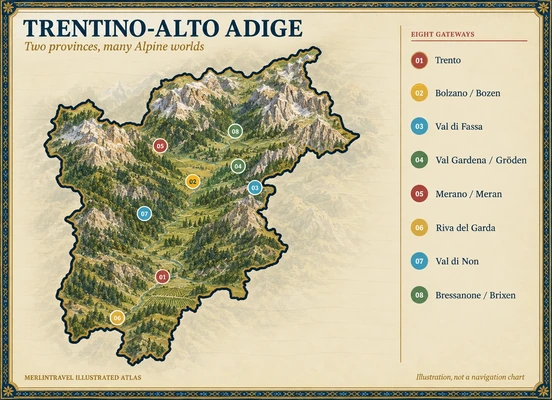
The atlas uses valleys as the organising structure: Adige, Isarco, Pusteria, Non, Sole and the Dolomite systems that cross provincial and linguistic boundaries.
Map markers identify editorial gateways, not a ranking.
Journeys, not checklists.
Separate circuits for Trentino and South Tyrol are joined by shared routes through passes, Dolomite communities and the Adige corridor.
Trento, Garda and the western valleys
Castles, council history, lake climates and mountain communities structure the Trentino circuit.
Bolzano, Merano and the Adige
Trading towns, vineyards, spa culture and bilingual public life mark the South Tyrolean valley route.
Dolomite cultures
Fassa, Gardena, Badia and surrounding valleys connect Ladin language, geological drama and changing tourism.
Passes, fortifications and memory
Brenner, Stelvio and wartime landscapes reveal the Alps as political borders and lived crossings.
Places that open the story.
Each gateway is a future chapter: a city, landscape or cultural system large enough to deserve its own documented guide.
Trento
Roman Tridentum, the prince-bishops’ castle and the council that transformed European religious history.
Bolzano / Bozen
A multilingual trading city between Mediterranean vineyards and Central European routes.
Fassa and the Dolomites
Ladin culture, pale rock towers and valley settlements centred on Canazei and surrounding communities.
Val Gardena / Gröden
Ladin language, woodcarving, village culture and high landscapes around Ortisei / St. Ulrich.
Merano / Meran
A spa town of gardens, water channels, medieval streets and mountain approaches.
Riva del Garda
The northern lake shore where Mediterranean vegetation meets Trentino fortifications and mountain routes.
Val di Non
Castle landscapes, apple cultivation, canyons and sanctuaries around a broad high valley.
Bressanone / Brixen
An episcopal city on the Isarco route, with cathedral culture and access to eastern Alpine valleys.
What the region keeps.
Monuments matter, but so do languages, crafts, routes, rituals and working landscapes.
Languages in place
German, Italian, Ladin, Mòcheno and Cimbrian traditions require precise local context.
Castle and farm landscapes
Fortified residences, masi and vineyards show different systems of land, inheritance and authority.
War in the mountains
Fortifications, tunnels, cemeteries and museums preserve a difficult transnational memory.
Wood, music and craft
Carving, sacred art, instruments and domestic architecture translate Alpine materials into local forms.
Nature is part of the archive.
Land, water and ecological systems are read together with the communities that have learned to inhabit them.
The Dolomites
A UNESCO serial property crosses regional and provincial borders; geology and living valleys must be read together.
Stelvio and high passes
Glacial environments, wildlife and historic routes meet at one of Europe’s major Alpine systems.
Adige river corridor
The river organises settlement, orchards, vineyards, transport and flood landscapes from north to south.
Lake and valley climates
Garda’s northern shore, dry basins and high valleys create unusual ecological contrasts over short distances.
A documented journey, still open.
Place names and languages are handled contextually. Individual guides will use official bilingual or multilingual forms where appropriate and explain rather than erase linguistic differences.
The journey continues.
Return to the Italy regional atlas