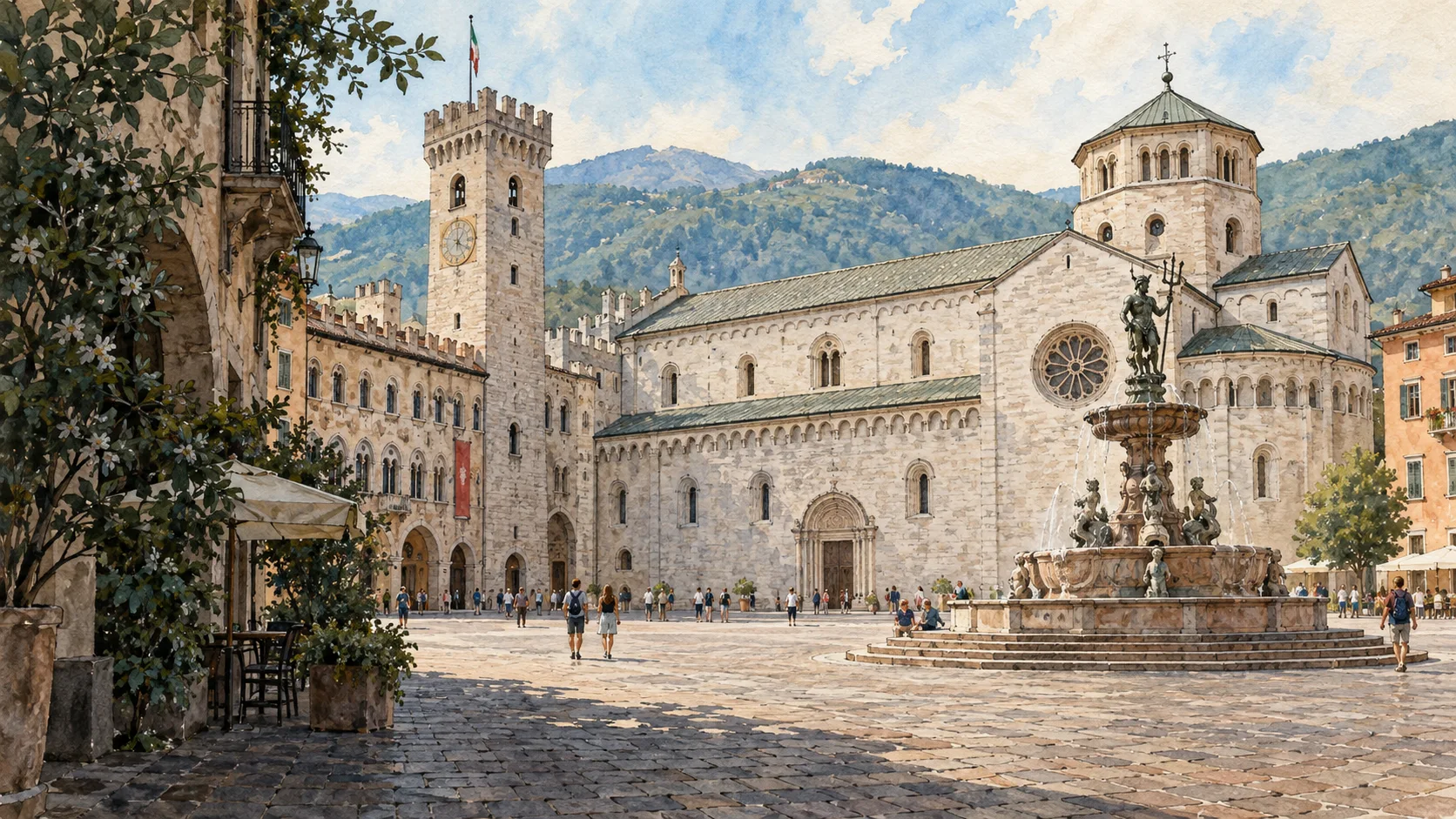
Editorial watercolour establishing view for Trento

Trentino-Alto Adige · Guide 01

Trento

Roman streets beneath the pavement, the city of the Council above it, and a river that connects an Alpine capital to a wider world.

Plan the route
Trento10 chapters · history, culture and landscape

Why this place matters

A city shaped by institutions and crossings.

Trento becomes easier to read when the square, castle and river are treated as different centres of power. The cathedral is not the castle chapel, and the prince-bishops’ residence is not a single medieval building. Archaeology adds an older street system beneath this later city.

The guide separates documented history from suggestions for reading the site. Named buildings and landscape relationships follow institutional sources; the illustrations are editorial interpretations, not measured surveys or records of current access.

Roman streets beneath the pavement, the city of the Council above it, and a river that connects an Alpine capital to a wider world.

The route

Plan your visit

Keep the compact centre together on the first day. Reserve the castle and Torre Aquila as a second substantial visit, then cross the Adige for Piedicastello and Doss Trento. MUSE is a separate museum stop, not a quick detour between booked entries.

Day 1 · morning

Piazza Duomo, cathedral and diocesan collections

Keep the compact centre together on the first day.

Day 1 · afternoon

SASS and Santa Maria Maggiore

Day 2 · morning

Buonconsiglio and Torre Aquila

Day 2 · choose an extension

MUSE or Piedicastello and Doss Trento

Ten chapters

Explore the places

The chapters connect history and terrain. Mountain areas and outlying towns are separate options, not a single continuous walking route.

  1. 01Piazza Duomo
  2. 02Cathedral of San Vigilio
  3. 03Palazzo Pretorio and the Diocesan Museum
  4. 04SASS: the city beneath the city
  5. 05Santa Maria Maggiore
  6. 06Buonconsiglio Castle
  7. 07Torre Aquila and the Cycle of the Months
  8. 08MUSE and the contemporary city
  9. 09Piedicastello and Le Gallerie
  10. 10Doss Trento and the river crossing
01

The inhabited landscape

Piazza Duomo

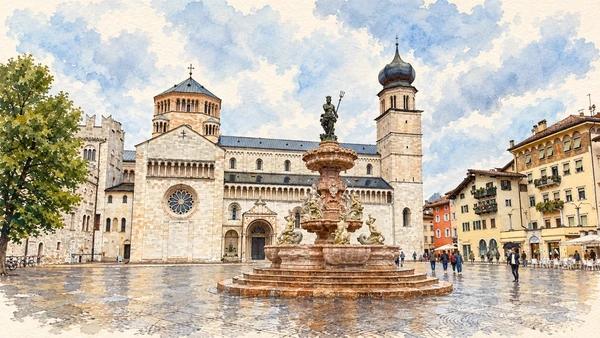
The square gathers the cathedral, Palazzo Pretorio and decorated urban façades around the Neptune fountain. Start here to understand the city’s scale before entering any collection.

Today

This remains an inhabited place. Use pedestrian routes, keep entrances clear and check municipal mobility notices for any restricted area.

History

Civic space accumulated around episcopal institutions; the appearance of the square also records Renaissance and later interventions.

How to read this place

Compare the open square with the narrower streets leading away from it. Read the fountain as one historical layer, rather than assuming everything belongs to the Council.

What to notice

  • Compare the open square with the narrower streets leading away from it.
  • The relationship between the site and its surrounding route.
  • The distinction between surviving evidence and modern interpretation.
Visit Trentino · Trento
Watercolour: Neptune fountain before the north side of Trento Cathedral.
Piazza DuomoOriginal Merlintravel documentary watercolour · 2026
02

Worship and memory

Cathedral of San Vigilio

The cathedral remains an active church beside the city’s principal public square. Its stone exterior and interior should be read slowly, independently of museum opening hours.

Today

Worship and local religious life continue here. Visitor access may pause for services; consult the church or managing institution before planning an interior visit.

History

The church hosted the promulgation of the Council of Trent’s decrees in 1563. The surviving building also belongs to a longer history of Christian worship.

How to read this place

Distinguish the cathedral itself from the archaeological and museum visits associated with the complex. Worship takes precedence over sightseeing.

What to notice

  • Distinguish the cathedral itself from the archaeological and museum visits associated with the complex.
  • The relationship between the site and its surrounding route.
  • The distinction between surviving evidence and modern interpretation.
Visit Trentino · Trento
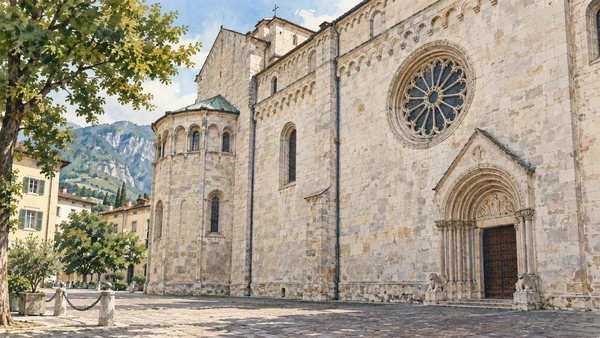
Watercolour: The cathedral’s pale stone north wall, rose window and side entrance.
Cathedral of San VigilioOriginal Merlintravel documentary watercolour · 2026
03

Evidence and interpretation

Palazzo Pretorio and the Diocesan Museum

The museum beside the cathedral connects sacred objects with the institutions that used and preserved them. It gives the Council a material context beyond the famous name.

Today

Check the institution’s current opening, booking arrangements and accessible route. Individual rooms, exhibitions and approaches may have separate conditions.

History

Palazzo Pretorio’s reuse as a museum allows episcopal history and religious art to be interpreted together.

How to read this place

Ask where objects originally belonged. A painting in a display room and a furnishing still used in worship have different present-day contexts.

What to notice

  • Ask where objects originally belonged.
  • The relationship between the site and its surrounding route.
  • The distinction between surviving evidence and modern interpretation.
Visit Trentino · Trento
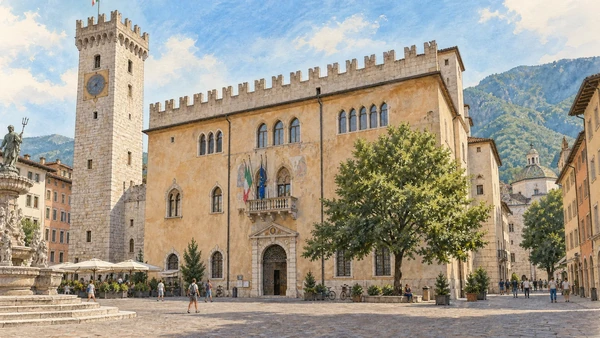
Watercolour: Palazzo Pretorio and Torre Civica beside Piazza Duomo.
Palazzo Pretorio and the Diocesan MuseumOriginal Merlintravel documentary watercolour · 2026
04

Evidence and interpretation

SASS: the city beneath the city

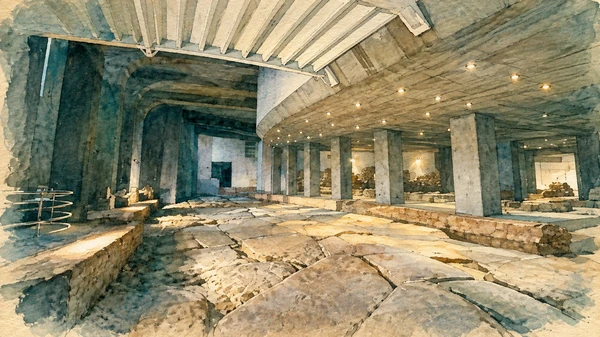
The underground archaeological area exposes parts of Roman Tridentum beneath the modern centre. Excavated street and building fragments explain a city that cannot be recovered from the surface alone.

Today

Check the institution’s current opening, booking arrangements and accessible route. Individual rooms, exhibitions and approaches may have separate conditions.

History

Roman urban remains survive here within a much later built environment. Modern interpretation includes digital reconstructions, which must be distinguished from excavated fabric.

How to read this place

Follow the actual exposed masonry and street surfaces first; treat reconstructed views as explanatory hypotheses.

What to notice

  • Follow the actual exposed masonry and street surfaces first; treat reconstructed views as explanatory hypotheses.
  • The relationship between the site and its surrounding route.
  • The distinction between surviving evidence and modern interpretation.
Trentino Cultura · underground Tridentum
Watercolour: Roman paving below the supporting ceiling of the SASS archaeological site.
SASS: the city beneath the cityOriginal Merlintravel documentary watercolour · 2026
05

Worship and memory

Santa Maria Maggiore

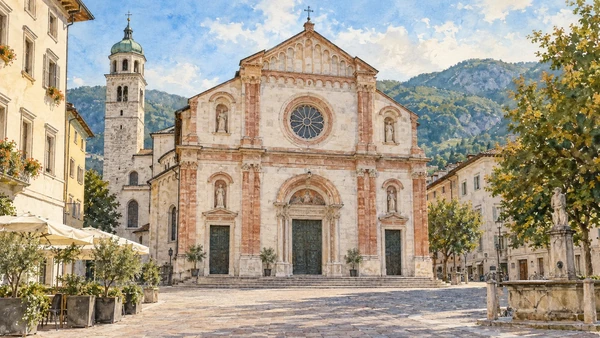
This church introduces another religious centre within the walkable historic city. Its urban position matters as much as its decorative façade.

Today

Worship and local religious life continue here. Visitor access may pause for services; consult the church or managing institution before planning an interior visit.

History

Archaeological work associates this area with Roman baths, probably built in the first century CE, beneath the later sixteenth-century church.

How to read this place

Separate the visible church from subsurface archaeology. An archaeological finding does not imply that an underground visitor route is always available.

What to notice

  • Separate the visible church from subsurface archaeology.
  • The relationship between the site and its surrounding route.
  • The distinction between surviving evidence and modern interpretation.
Trentino Cultura · Roman baths beneath Santa Maria Maggiore
Watercolour: The red-and-white stone facade of Santa Maria Maggiore.
Santa Maria MaggioreOriginal Merlintravel documentary watercolour · 2026
06

Evidence and interpretation

Buonconsiglio Castle

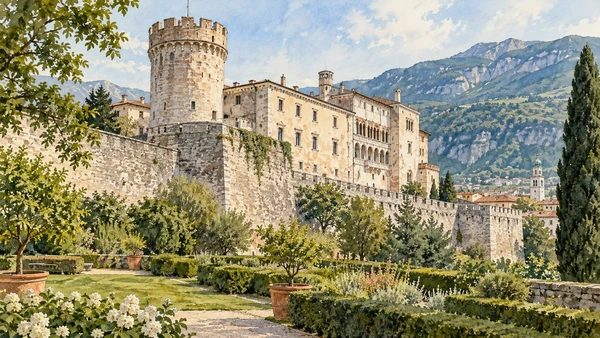
The castle is a substantial museum complex rather than a short scenic stop. Allow time to move between courtyards, rooms and the separately managed Torre Aquila visit.

Today

Check the institution’s current opening, booking arrangements and accessible route. Individual rooms, exhibitions and approaches may have separate conditions.

History

Successive episcopal building campaigns produced a layered residence. Its present museum route brings together spaces whose purposes and decoration changed over time.

How to read this place

Notice where architectural phases meet. Check the museum’s access information before assuming every room or tower is included in one route.

What to notice

  • Notice where architectural phases meet.
  • The relationship between the site and its surrounding route.
  • The distinction between surviving evidence and modern interpretation.
Buonconsiglio Museum · visiting the castle
Watercolour: Buonconsiglio Castle above its gardens and enclosing walls.
Buonconsiglio CastleOriginal Merlintravel documentary watercolour · 2026
07

Evidence and interpretation

Torre Aquila and the Cycle of the Months

A controlled visit brings viewers close to an unusually detailed late-medieval painted world. Space and timed admission limit how it is experienced.

Today

Check the institution’s current opening, booking arrangements and accessible route. Individual rooms, exhibitions and approaches may have separate conditions.

History

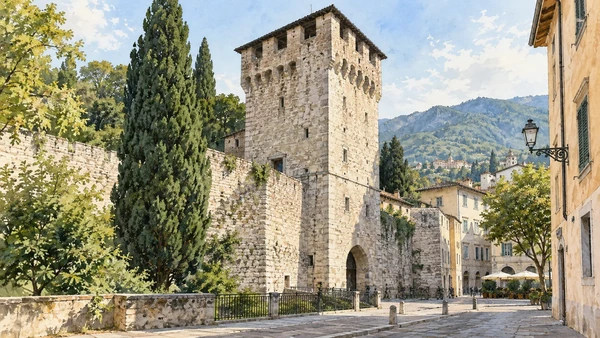
Commissioned by Prince-Bishop Georg von Liechtenstein around 1400, the cycle presents seasonal labour and aristocratic recreation. Eleven painted months survive; March is lost.

How to read this place

Compare labour, dress and seasonal activity across the panels. The scenes are a courtly representation of society, not a neutral record of every inhabitant.

What to notice

  • Compare labour, dress and seasonal activity across the panels.
  • The relationship between the site and its surrounding route.
  • The distinction between surviving evidence and modern interpretation.
Buonconsiglio Museum · Torre Aquila
Watercolour: The square Torre Aquila beside the city wall.
Torre Aquila and the Cycle of the MonthsOriginal Merlintravel documentary watercolour · 2026
08

Evidence and interpretation

MUSE and the contemporary city

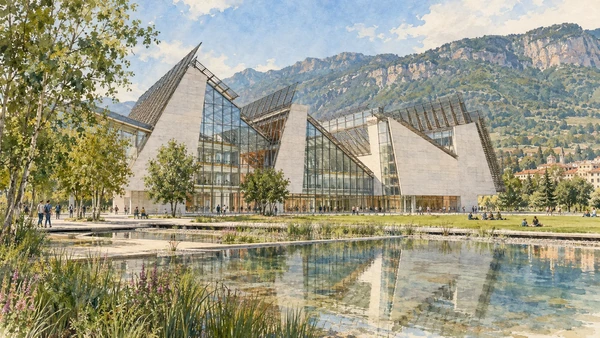
Renzo Piano’s science museum makes modern architecture and environmental interpretation part of Trento’s cultural itinerary. It deserves its own visiting time.

Today

Check the institution’s current opening, booking arrangements and accessible route. Individual rooms, exhibitions and approaches may have separate conditions.

History

The building belongs to the contemporary city, adding a scientific institution to a place better known for ecclesiastical history.

How to read this place

Read the angular roofline and relationship with outdoor space before entering. Exhibition interpretation is distinct from an unmediated view of Alpine nature.

What to notice

  • Read the angular roofline and relationship with outdoor space before entering.
  • The relationship between the site and its surrounding route.
  • The distinction between surviving evidence and modern interpretation.
MUSE · science museum
Watercolour: The sloping glass roof volumes and pools of MUSE.
MUSE and the contemporary cityOriginal Merlintravel documentary watercolour · 2026
09

Evidence and interpretation

Piedicastello and Le Gallerie

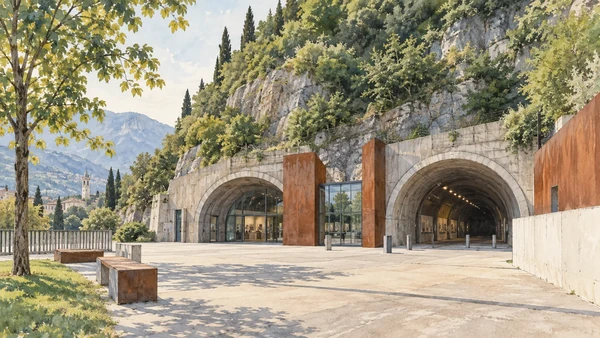
Across the Adige, former road tunnels now contain exhibition spaces. The approach gives a different view of the city’s relationship with the river.

Today

Check the institution’s current opening, booking arrangements and accessible route. Individual rooms, exhibitions and approaches may have separate conditions.

History

The conversion preserves a piece of transport infrastructure while giving it a new cultural use.

How to read this place

Keep the scale of the tunnel visible in your reading of the exhibition. The building itself is evidence of movement through the city.

What to notice

  • Keep the scale of the tunnel visible in your reading of the exhibition.
  • The relationship between the site and its surrounding route.
  • The distinction between surviving evidence and modern interpretation.
Visit Trentino · Trento
Watercolour: The paired former road-tunnel entrances at Piedicastello.
Piedicastello and Le GallerieOriginal Merlintravel documentary watercolour · 2026
10

Terrain and access

Doss Trento and the river crossing

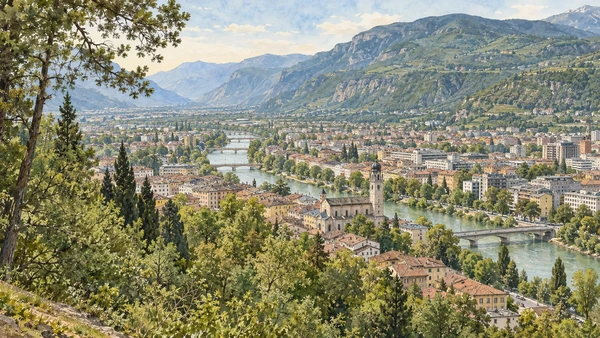
The wooded rise above Piedicastello changes the perspective from streets to valley. Reach it as a separate uphill walk rather than an extension inside a museum ticket.

Today

Conditions depend on the exact route and the day. Check the responsible operator, weather and local access notices; a viewpoint is not the same undertaking as a mountain traverse.

History

The route from Buonconsiglio through the centre and over the Adige connects the monumental city with a long-used natural landmark.

How to read this place

Look back at the river corridor and the density of settlement below. Terrain, shade and the return descent matter more than a straight-line distance on a map.

What to notice

  • Look back at the river corridor and the density of settlement below.
  • The relationship between the site and its surrounding route.
  • The distinction between surviving evidence and modern interpretation.
Visit Trentino · Buonconsiglio to Doss Trento
Watercolour: Trento and the Adige valley seen from the wooded Doss Trento.
Doss Trento and the river crossingOriginal Merlintravel documentary watercolour · 2026

The territory through time

A short chronology

A concise chronology linking the documented sites to the wider story.

  1. Tridentum’s streets and buildings survive in archaeological fragments below the modern centre.

  2. Episcopal institutions and an inhabited urban centre develop around several distinct sites.

  3. The Cycle of the Months is painted at Torre Aquila for Georg von Liechtenstein.

  4. Renaissance building changes the appearance of the episcopal city.

  5. The Council’s decrees are promulgated in the cathedral.

  6. Buildings continue to be altered, restored and reused.

  7. Former road tunnels become exhibition spaces at Piedicastello.

  8. MUSE and the older museums offer different ways of interpreting the city and its environment.

Before your visit

Practical information

01

Plan separate days

Choose a manageable set of visits and allow for transport, booked entries and the return journey.

02

Use the exact place name

Italian, German and Ladin names may differ. Match the actual destination and province when reading signs, booking a visit or checking transport.

03

Check the institution

Opening hours, tickets, exhibitions and religious access change. Use the linked managing institution shortly before visiting.

04

Check the actual terrain

A town walk, gorge walkway, lift arrival and mountain path have different demands. Use current route information, weather and closures for the option you choose.

05

Arrange accessible visits

Historic interiors and mountain approaches can include steps, gradients or uneven surfaces. Ask about the specific route instead of assuming an entire destination is step-free.

06

Respect work and residence

Farms, workshops, churches and historic streets remain in use. Follow signs, keep entrances clear and ask permission before entering private spaces.

Method and sources

Sources and image credits

Prepared on 8 September 2026 from the institutional sources linked below. Historical claims are separated from editorial observations and itinerary suggestions. Older institutional brochures are used for stable cultural context, never as current timetables. Prices, lift schedules, trail status and admission are deliberately left to the responsible operators. Illustrations are not photographs, measured reconstructions or evidence of current conditions.

The eleven images are original Merlintravel editorial watercolours. They interpret named places and are not photographs or substitutes for measured plans. Opening hours, tickets, accessible routes, temporary exhibitions and conservation work can change; consult the linked official pages shortly before visiting.