Basilicata
Rock-cut Matera, Greek shores, Norman castles, inland mountains and two very different seas.
Basilicata’s apparent silence contains very long human histories.
Ancient Lucania, Basilicata today spans the ravines of Matera, Greek Metapontum, Vulture’s volcanic landscape, Norman-Swabian towns, the Lucanian Dolomites, Pollino communities and the short Tyrrhenian coast of Maratea.
History in layers.
Prehistoric settlement, Oenotrian and Lucanian cultures, Greek colonies, Rome, Byzantine and Lombard frontiers, Norman power and modern land struggles give the region unusual depth.
Prehistory and rock settlement
Caves, villages and plateau sites document very long occupation around Matera and other valleys.
Oenotrians, Lucanians and Greeks
Indigenous communities and colonies such as Metapontum created interacting Ionian cultural worlds.
Rome and late antiquity
Roads, farms, towns and changing rural systems tied Lucania to imperial and post-imperial networks.
Byzantines, Lombards and monasteries
Frontier conflict and eastern monastic traditions marked caves, valleys and fortified settlements.
Normans, Swabians and southern kingdoms
Melfi, castles and church networks reveal Basilicata’s role in medieval monarchy.
Peasant society and modern transformation
Landholding, brigandage, emigration, reform and the recovery of Matera shaped modern identity.

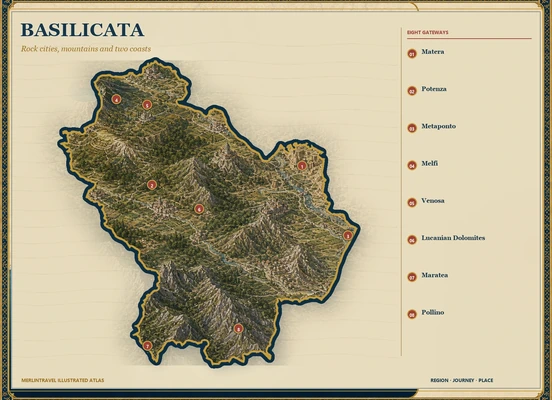
From Matera to Maratea across an inland mountain world.
The atlas links Matera and Metaponto to Potenza, Vulture, the Basento valley, Pollino and Maratea, showing the distance between Ionian and Tyrrhenian worlds.
Map markers identify editorial gateways, not a ranking.
Journeys, not checklists.
The routes pair internationally known Matera with archaeological coasts, castle landscapes and mountain interiors.
Matera and the Murgia
Rock-cut neighbourhoods, plateau churches, water systems and deep ravines form one cultural landscape.
Metaponto and the Ionian
Greek temples, archaeology, wetlands and an agricultural coastal plain open the ancient east.
Vulture and Norman-Swabian Basilicata
Melfi, Venosa, volcanic lakes, abbeys and wine country shape the north.
Dolomiti Lucane, Pollino and Maratea
Mountain villages and a short dramatic Tyrrhenian shore reveal contrasting southern landscapes.
Places that open the story.
Each gateway is a future chapter: a city, landscape or cultural system large enough to deserve its own documented guide.
Matera
The Sassi, rupestrian churches, water collection and plateau archaeology form a complex inhabited landscape.
Potenza
A high regional capital rebuilt through earthquakes, with Roman routes and mountain valleys around it.
Metaponto
A Greek colonial city and museum landscape within the fertile Ionian plain.
Melfi
A Norman and Swabian castle city central to medieval law, monarchy and routes across the Vulture.
Venosa
Roman Venusia, Jewish catacombs, an unfinished medieval abbey and the cultural landscape of Vulture.
Lucanian Dolomites
Castelmezzano and Pietrapertosa occupy dramatic peaks above paths, forests and valley settlements.
Maratea
A Tyrrhenian coast of cliffs, villages, churches and marine landscapes separated from the Ionian plain.
Pollino
Arbëreshë communities, high plateaux, ancient pines and villages within Italy’s largest national park.
What the region keeps.
Monuments matter, but so do languages, crafts, routes, rituals and working landscapes.
Sassi and rupestrian churches
Matera’s heritage joins architecture to water, agriculture, social policy and human adaptation.
Greek and Lucanian archaeology
Metaponto, Policoro and inland museums reveal interaction rather than isolated colonial monuments.
Arbëreshë culture
Albanian-language communities preserve religious, linguistic and ritual traditions in the Pollino area.
Peasant and craft memory
Museums, festivals, bread, ceramics and weaving document lives often excluded from monumental histories.
Nature is part of the archive.
Land, water and ecological systems are read together with the communities that have learned to inhabit them.
Pollino
Bosnian pines, high grasslands and river valleys cross the boundary with Calabria.
Vulture
An extinct volcano, crater lakes, forests and cultivated slopes distinguish northern Basilicata.
Murgia Materana
Limestone ravines, caves and plateau habitats are inseparable from human settlement.
Ionian and Tyrrhenian shores
A broad sandy east and a short rocky west create two very different maritime landscapes.
A documented journey, still open.
The Sassi are described as a long-lived urban and rural system marked by displacement, policy and restoration, not as caves discovered for tourism.
The journey continues.
Return to the Italy regional atlas