Lazio
Rome within a wider territory of Etruscan cities, volcanic lakes, abbeys, gardens and Tyrrhenian shores.
Rome is a world, but Lazio begins where the capital’s horizon widens.
The Hub gives Rome its necessary scale while restoring the region around it: Etruscan southern cities, Roman roads and ports, papal towns, Benedictine landscapes, Renaissance villas, volcanic lakes, reclaimed plains and island coasts.
History in layers.
Lazio includes many ancient peoples and territories before Roman dominance. Later imperial, papal and modern capital layers never fully erased those local geographies.
Etruscans, Latins and other peoples
Necropoleis, sanctuaries and hill settlements record a complex pre-Roman central Italy.
Rome and its territory
Roads, aqueducts, ports, villas and colonies tied the metropolis to a vast regional infrastructure.
Early Christianity and monasteries
Catacombs, basilicas, abbeys and pilgrimage routes transformed sacred and settlement patterns.
Papal territories and baronial power
Castles, hill towns and estates reveal competing authorities around medieval and early modern Rome.
Renaissance and Baroque landscapes
Villas, gardens, fountains and urban projects extended artistic ambition beyond the city walls.
Capital, reclamation and modernity
After 1870, metropolitan growth, Fascist planning, land reclamation and migration remade the region.

Rome is the centre, but not the whole region.
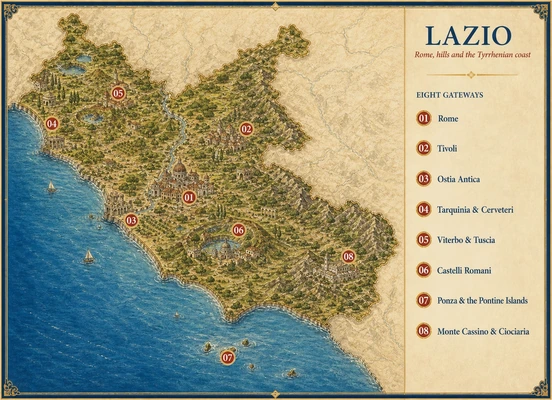
The atlas radiates from Rome along ancient roads towards Tuscia, Sabina, Tivoli, the Castelli Romani, Ciociaria, the Pontine plain and islands.
Map markers identify editorial gateways, not a ranking.
Journeys, not checklists.
The circuits place the capital inside systems of water, roads, ports, villas, pilgrimage and rural production.
Rome in layers
Ancient city, Christian capital, papal court, national capital and contemporary metropolis must be read together.
Tuscia and Etruscan Lazio
Tarquinia, Cerveteri, Viterbo and volcanic lakes connect archaeology to medieval and agricultural landscapes.
Villas, abbeys and eastern valleys
Tivoli, Subiaco and hill routes follow water, retreat, pilgrimage and elite residence.
South Lazio and the Tyrrhenian
Castelli Romani, Anzio, Circeo, Monte Cassino and the Pontine Islands widen the regional journey.
Places that open the story.
Each gateway is a future chapter: a city, landscape or cultural system large enough to deserve its own documented guide.
Rome
A city of unmatched historical density, approached through districts, roads, water systems and changing centres.
Tivoli
Hadrian’s Villa, Renaissance Villa d’Este and the Aniene landscape connect empire, retreat and water design.
Ostia Antica
Rome’s port city preserves streets, warehouses, houses and cults shaped by Mediterranean trade.
Tarquinia and Cerveteri
Painted tombs and necropoleis reveal Etruscan urban societies beyond later Roman narratives.
Viterbo and Tuscia
Papal history, medieval quarters, volcanic lakes and tufa landscapes north of Rome.
Castelli Romani
Volcanic lakes, villas, wine towns and papal residences along the Alban Hills.
Ponza and the Pontine Islands
Volcanic geology, Roman remains, fishing settlements and marine environments offshore.
Monte Cassino and Ciociaria
Benedictine history, wartime destruction and inland towns across southern Lazio.
What the region keeps.
Monuments matter, but so do languages, crafts, routes, rituals and working landscapes.
Rome’s world heritage
The historic centre includes ancient, Christian, Renaissance and Baroque layers across a living capital.
Etruscan necropoleis
Tarquinia and Cerveteri preserve architecture and images fundamental to understanding Etruscan society.
Villas and water
Tivoli’s imperial and Renaissance estates turn landscape, hydraulics and architecture into distinct cultural systems.
Monastic routes
Subiaco, Farfa and Monte Cassino link learning, pilgrimage, agriculture and repeated reconstruction.
Nature is part of the archive.
Land, water and ecological systems are read together with the communities that have learned to inhabit them.
Volcanic lakes
Bolsena, Bracciano, Vico and Albano occupy calderas surrounded by towns, forests and cultivation.
Circeo and coastal wetlands
Dunes, forests and lakes preserve part of a coast profoundly transformed by reclamation.
Apennine and pre-Apennine ranges
Simbruini, Ernici and Reatini mountains create a high inland Lazio of forests and villages.
Tiber system
The river and its tributaries connect the capital to floodplains, ports and regional settlement history.
A documented journey, still open.
The page distinguishes ancient Latium from the present administrative region and avoids treating every site as an excursion subordinate to Rome.
The journey continues.
Return to the Italy regional atlas