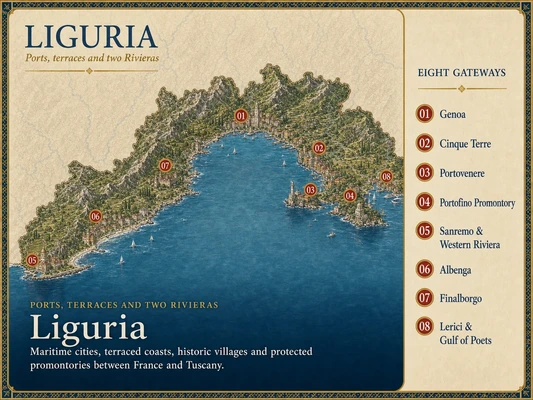
Liguria
A narrow maritime arc of ports, terraces, painted towns and mountains descending into the sea.
In Liguria, the coast is a vertical landscape.
Liguria’s identity grows from the difficult meeting of mountains and sea. Genoa’s maritime networks, Riviera towns, terraced agriculture, fortified headlands and inland Apennine communities form one connected but sharply varied region.
History in layers.
From ancient Ligurian peoples to Rome, medieval communes, the Genoese Republic and modern port industry, the region’s history repeatedly turns towards movement across water.
Ancient Ligurians and Rome
Hill communities, coastal harbours and Roman routes linked the western Mediterranean to the Po basin.
Communes and maritime power
Genoa developed institutions, fleets and colonies that projected influence far beyond the region.
The Republic of Genoa
Banking, trade and aristocratic government produced palaces, churches and a dense port city.
Riviera settlements
Fishing, shipbuilding, olive culture and coastal defence shaped towns on constrained terrain.
Railway and resort culture
Nineteenth-century mobility transformed parts of the Riviera into international winter and seaside destinations.
Port, industry and renewal
Modern Genoa combines industrial infrastructure, migration, working-class districts and recovered waterfront spaces.

A crescent of coast held together by inland valleys.
The atlas follows the crescent from the French border to the Gulf of La Spezia, then climbs into valleys that explain how coastal towns were supplied, defended and connected.
Map markers identify editorial gateways, not a ranking.
Journeys, not checklists.
The routes balance famous shores with port history, agricultural terraces and quieter inland systems.
Genoa and its sea
The old port, Rolli palaces, caruggi and hillside districts reveal a republic built through maritime networks.
Western Riviera
Sanremo, Albenga, Finalborgo and border valleys connect gardens, medieval centres and an older agricultural coast.
Eastern Riviera
Portofino, Camogli, the Tigullio and the abbey of San Fruttuoso mix seafaring history with protected landscapes.
Cinque Terre and the Gulf
Terraces, villages, Portovenere, Lerici and La Spezia form a coast of labour, defence and naval history.
Places that open the story.
Each gateway is a future chapter: a city, landscape or cultural system large enough to deserve its own documented guide.
Genoa
A vertical port city of medieval lanes, mercantile palaces, industrial waterfronts and global connections.
Cinque Terre
Five distinct villages within a terraced cultural landscape maintained between steep slopes and sea.
Portovenere
A fortified harbour, island landscape and Romanesque-Gothic architecture at the edge of the Gulf.
Portofino and the promontory
A historic harbour framed by Mediterranean woodland, paths, abbeys and marine protection.
Sanremo and the western Riviera
Garden culture, Belle Époque travel, music, markets and the older hill towns behind the coast.
Albenga
Roman Albingaunum, medieval towers and an agricultural plain facing Gallinara island.
Finalborgo
A walled inland centre that opens onto climbing landscapes, caves and the Finale coast.
Lerici and the Gulf of Poets
Castles, maritime villages and literary travel histories on the eastern Gulf of La Spezia.
What the region keeps.
Monuments matter, but so do languages, crafts, routes, rituals and working landscapes.
The Rolli system
Genoa’s aristocratic residences made private palaces part of a public diplomatic system.
Terraced agriculture
Dry-stone walls, vineyards and olive groves convert steep slopes into cultivated cultural landscapes.
Maritime crafts
Boatbuilding, navigation, fishing and port labour connect material knowledge to the sea.
Painted façades and stone lanes
Colour, slate, plaster and constrained urban space give Ligurian settlements their distinctive texture.
Nature is part of the archive.
Land, water and ecological systems are read together with the communities that have learned to inhabit them.
Ligurian Sea
Marine protected areas, cetacean routes and small harbours make the coast an ecological as well as cultural system.
Coastal mountains
The Alps and Apennines rise close to the shore, creating short valleys and dramatic climate shifts.
Portofino and Cinque Terre parks
Protected promontories preserve woodland, paths, terraces and marine habitats.
Inland valleys
Beech woods, chestnut culture and historic routes reveal a Liguria beyond the immediate coast.
A documented journey, still open.
Cinque Terre is treated as a cultural landscape created by labour, not as five interchangeable viewpoints; Genoa is read as a city of global exchange and social complexity.
The journey continues.
Return to the Italy regional atlas