Italy · Regional journey 08

Emilia-Romagna

Roman road, communal cities, mosaics, courts, food landscapes and an Adriatic horizon.

6historic layers
4editorial journeys
8territorial gateways
The Via Emilia is a line; the region it organises is a web.
The regional idea

Emilia-Romagna joins two historical-cultural areas and a chain of distinct cities. Roman infrastructure, Byzantine Ravenna, medieval communes, Este and Farnese courts, university Bologna, Po wetlands, Apennine routes and food production form a region of exceptional civic density.

Time made visible

History in layers.

The narrative follows the Roman road but avoids turning it into a single story: Ravenna’s Adriatic world and Romagna’s towns complicate the western sequence of Emilian cities.

01

Etruscans, Celts and Rome

Earlier settlements and the Via Aemilia created a durable urban axis across the plain.

02

Ravenna and late antiquity

Imperial, Ostrogothic and Byzantine capitals left mosaics and churches of global importance.

03

Communes and universities

Bologna, Parma, Modena and other cities developed civic institutions, markets and scholarly cultures.

04

Courts and duchies

Este, Farnese and other dynasties reshaped Ferrara, Modena, Parma and surrounding territories.

05

Agriculture and industry

Reclamation, cooperatives, mechanisation and food production transformed the plain.

06

War, resistance and reconstruction

The Gothic Line, partisan memory and post-war social change remain visible across towns and mountains.

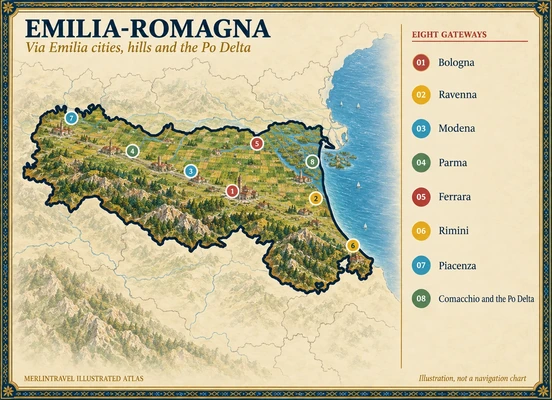
Illustrated map of Emilia-Romagna with eight numbered Merlintravel gateways
Merlintravel illustrated atlas · official ISTAT profile archived separately
The complete circuit

The Via Emilia binds cities, plains and Apennine valleys.

The atlas tracks the Via Emilia from Piacenza to Rimini, then opens north to the Po and Delta and south to Apennine valleys.

Map markers identify editorial gateways, not a ranking.

Four ways through

Journeys, not checklists.

Cities, courts, mosaics and food are tied to rivers, roads, agricultural labour and independent civic traditions.

01

The Via Emilia cities

Piacenza, Parma, Reggio, Modena, Bologna, Imola, Forlì, Cesena and Rimini form a chain, not repetitions.

02

Ravenna and the Adriatic

Mosaics, pinewoods, canals and coastal settlements link imperial heritage to a changing shore.

03

Courts and music

Ferrara, Modena, Parma and smaller centres connect dynastic culture, theatre and collections.

04

Po, Apennines and food landscapes

Wetlands, farms, dairies, vineyards and mountain routes show how regional cuisines are made.

Eight territorial doors

Places that open the story.

Each gateway is a future chapter: a city, landscape or cultural system large enough to deserve its own documented guide.

01

Bologna

Etruscan roots, Europe’s historic university, medieval towers, porticoes and a strong civic culture.

02

Ravenna

A late-antique capital where mosaics connect Roman, Ostrogothic and Byzantine worlds.

03

Modena

Romanesque cathedral culture, Este collections, music, engineering and an agricultural hinterland.

04

Parma

Cathedral art, Farnese theatre, opera, printing and a food landscape extending into the hills.

05

Ferrara

A Renaissance court city whose planned additions, walls and Po Delta connections remain legible.

06

Rimini

Roman Ariminum, Malatesta patronage, seaside modernity and the Adriatic cultures of Romagna.

07

Piacenza

The western gateway on the Po, with Roman origins, Farnese architecture and Apennine valleys.

08

Comacchio and the Po Delta

Canals, eel fishing, wetlands and reclamation within a vast river-sea landscape.

Living and monumental heritage

What the region keeps.

Monuments matter, but so do languages, crafts, routes, rituals and working landscapes.

01

Ravenna mosaics

Eight UNESCO monuments preserve changing political and religious worlds of late antiquity.

02

Bologna’s porticoes

A serial urban system records centuries of housing, movement, devotion and public life.

03

Romanesque civic art

Modena, Parma and smaller centres connect cathedral workshops to communal identity.

04

Food knowledge

Cheese, cured meats, pasta, vinegar and wine depend on regulated craft and productive landscapes.

Land and water

Nature is part of the archive.

Land, water and ecological systems are read together with the communities that have learned to inhabit them.

01

Po Delta

Lagoons, dunes, fishing valleys and reclaimed land form a complex human and ecological mosaic.

02

Northern Apennines

Forests, passes and historic roads link the plain with Tuscany and Liguria.

03

Romagna coast

Beaches, pinewoods and wetlands require a history extending beyond modern resort culture.

04

Rivers of the plain

The Trebbia, Taro, Secchia, Reno and others organise agriculture, settlement and flood risk.

A documented journey, still open.

Food heritage is presented through landscapes and production knowledge, not brand lists. Bologna’s porticoes and Ravenna’s monuments are contextualised as serial urban systems.

The journey continues.

Return to the Italy regional atlas