Tuscany
Etruscan cities, communes and Renaissance centres within cultivated hills, marble mountains and island seas.
The Tuscan landscape is historical work, not timeless scenery.
Tuscany’s familiar beauty was created by Etruscan and Roman routes, medieval communes, banking, Renaissance patronage, farming systems, quarrying, ports and modern conservation. Florence is central, but Siena, Pisa, Lucca, Arezzo, Maremma and the archipelago tell different stories.
History in layers.
The Hub moves from Etruscan territories to maritime Pisa, communal rivalries, Medici statecraft, Enlightenment reform and modern cultural tourism.
Etruscan territories
Cities, necropoleis, roads and metal resources created a powerful pre-Roman network.
Rome and early Christianity
Colonies, roads, villas and episcopal centres transformed but did not erase earlier urban worlds.
Communes and maritime republics
Florence, Siena, Pisa, Lucca and Arezzo developed rival institutions, economies and artistic languages.
Renaissance systems
Patronage, workshops, humanism, engineering and political conflict reshaped cities and European culture.
Medici grand duchy and reform
Territorial government, ports, villas, science and agricultural projects linked centre and countryside.
Modern Tuscany
Unification, industry, war, reconstruction and heritage tourism added new layers to the celebrated landscape.

Art cities share the stage with valleys, coasts and islands.
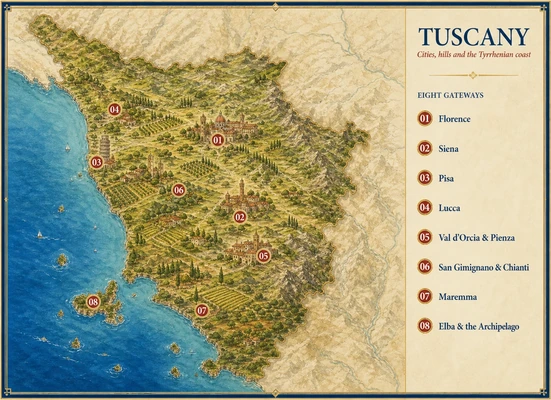
The atlas balances art cities with Val d’Orcia, Chianti, the Apuan Alps, Maremma, Etruscan tufa towns and the Tuscan Archipelago.
Map markers identify editorial gateways, not a ranking.
Journeys, not checklists.
Four journeys connect cities to the materials, roads, ports and countryside that sustained their cultural power.
Florence and the Arno
The city is read through Roman foundations, republican institutions, Medici power, craft and river connections.
Siena and Val d’Orcia
Medieval civic culture leads into a Renaissance ideal landscape that remains actively farmed.
Pisa, Lucca and the northern coast
Maritime history, intact walls, marble quarries and Lunigiana routes open a different Tuscany.
Maremma and the archipelago
Etruscan towns, wetlands, pastoral culture, mines and islands reveal the southern and maritime region.
Places that open the story.
Each gateway is a future chapter: a city, landscape or cultural system large enough to deserve its own documented guide.
Florence
A global art city whose workshops, republic, Medici court and river economy demand layered reading.
Siena
A preserved communal city organised around neighbourhoods, civic ritual, painting and the Campo.
Pisa
A maritime republic, monumental cathedral complex, river port and historic university city.
Lucca
Roman grid, medieval churches, silk wealth, Renaissance walls and a strong tradition of civic independence.
Val d’Orcia and Pienza
A Renaissance-planned town within a cultivated landscape of farms, roads, thermal waters and hill centres.
San Gimignano and Chianti
Communal towers and vineyard hills connect urban competition to a long agricultural culture.
Maremma
Etruscan tufa towns, wetlands, pastoral traditions, coastal parks and transformed agricultural land.
Elba and the archipelago
Mining, ports, Napoleonic memory, island settlements and protected Mediterranean environments.
What the region keeps.
Monuments matter, but so do languages, crafts, routes, rituals and working landscapes.
Etruscan landscapes
Necropoleis, museums and hill towns reconnect celebrated Renaissance territory to deeper histories.
Communal cities
Palaces, towers, cathedrals and squares express different experiments in medieval civic government.
Workshop Renaissance
Painting, sculpture, architecture, textiles and books emerged from collaborative systems of skill and patronage.
Working countryside
Vines, olives, wheat, sheep and forestry continue to shape the visual identity visitors often call natural.
Nature is part of the archive.
Land, water and ecological systems are read together with the communities that have learned to inhabit them.
Apuan Alps
Marble geology, quarry labour and high biodiversity create a landscape of beauty and environmental tension.
Maremma wetlands
Coastal marshes, dunes, pasture and protected habitats preserve a less domesticated Tuscany.
Tuscan Archipelago
Seven major islands combine endemic life, marine protection and distinct settlement histories.
Arno and river valleys
Waterways link cities, industry, agriculture and recurring flood histories.
A documented journey, still open.
The Renaissance is not treated as an isolated miracle. It is tied to workshops, patronage, finance, republican conflict and knowledge inherited from earlier periods.
The journey continues.
Return to the Italy regional atlas