Tuscany · Independent city chapter

FlorenceRiver, republic, workshop and court

Ten illustrated gateways through the city that made art, finance, government, devotion and skilled labour parts of the same inhabited landscape.

10complete guides
100illustrated chapters
110guide images
Florence is not one Renaissance image. It is a river city where republic, court, devotion, commerce, making and residence continuously altered the same compact ground.
A city chapter within Tuscany

The ten guides divide Florence by connected territories rather than isolated masterpieces. Cathedral workshops explain the marble monuments; civic institutions connect Signoria to the Bargello; Medici passages cross the river; convents, markets and workshops keep neighbourhood history inside ordinary streets.

Fiesole and San Miniato complete the basin. Their heights reveal that the celebrated centre depends on river risk, roads, gardens, stone, worship and metropolitan movement beyond the medieval core.

Four systems to follow

Explore the city

Each guide can stand alone, but Florence becomes clearer when movement, institutions, materials and inhabitation are traced across their borders.

01

River and terrain

The Arno, bridges, floodplain and surrounding hills organise access, risk, production and views.

02

Republic and court

Civic palaces, Medici residences and ceremonial passages record changing forms of power.

03

Worship and knowledge

Cathedral, convents, basilicas, libraries and care institutions remain distinct living systems.

04

Making and residence

Workshops, markets, housing and visitor pressure keep heritage tied to contemporary labour.

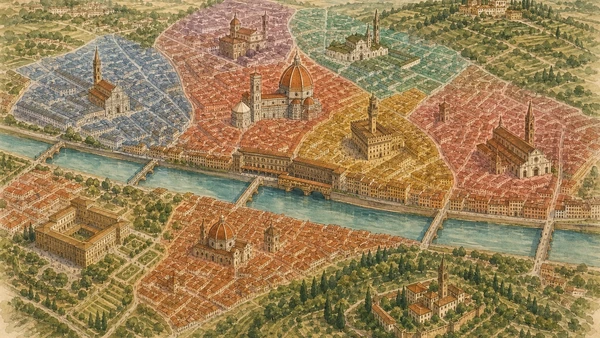
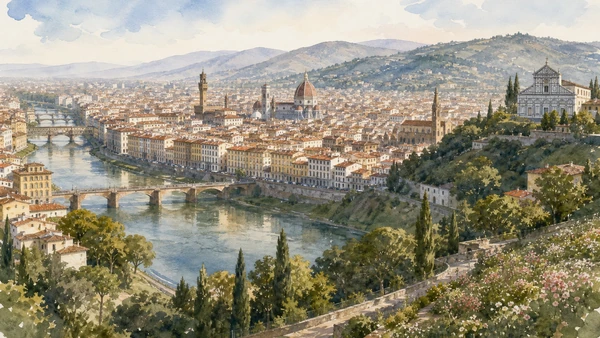
Original illustrated atlas of Florence showing the Arno, historic centre, Oltrarno, San Miniato and Fiesole
The city as a basin

Ten gateways across one walkable fabric.

The Arno divides and connects. The cathedral and civic centre anchor the north bank; Pitti, Santo Spirito and the Carmine structure the Oltrarno; San Miniato and Fiesole place the dense centre between inhabited hills.

The Florence atlas

Ten complete guides, all open.

Every card leads to a published guide with ten chapters, current official references and eleven distinct documentary watercolours.

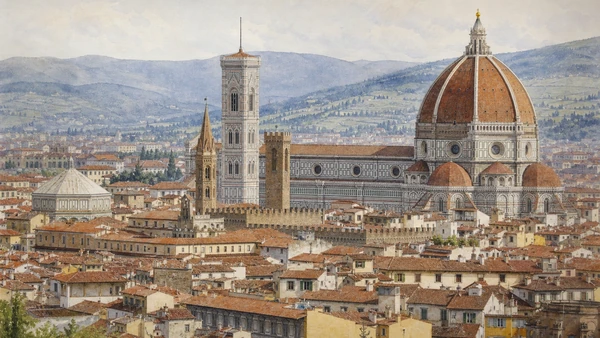
Documentary watercolour for Duomo, Baptistery and Cathedral Workshops
01Cathedral city

Duomo, Baptistery and Cathedral Workshops

Roman ground, medieval worship, Brunelleschi’s dome, Ghiberti’s doors and the labour that maintains the marble complex.

Open guide ↗
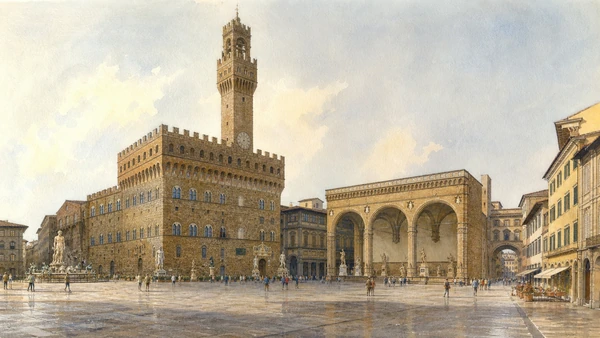
Documentary watercolour for Signoria and Palazzo Vecchio
02Civic power

Signoria and Palazzo Vecchio

Republican government, Medici court, Roman archaeology, public sculpture and the institutions surrounding the civic square.

Open guide ↗
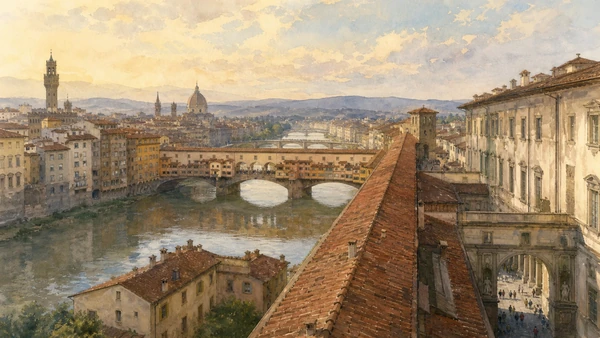
Documentary watercolour for Uffizi, Vasari Corridor and Ponte Vecchio
03Collection and crossing

Uffizi, Vasari Corridor and Ponte Vecchio

Administrative palace, chronological galleries, dynastic passage and the commercial bridge across the Arno.

Open guide ↗
Documentary watercolour for Santa Croce and the Bargello
04Eastern centre

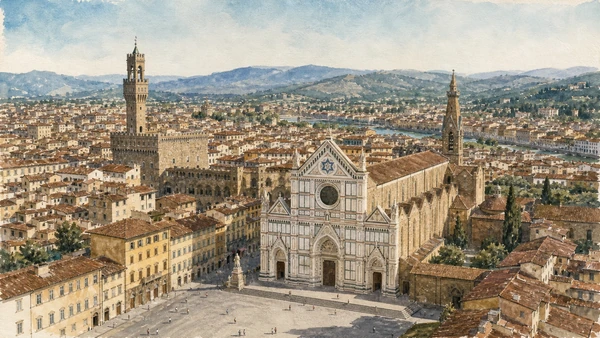
Santa Croce and the Bargello

Franciscan space, fresco, burial, flood memory, civic justice, sculpture and the neighbourhoods east of Signoria.

Open guide ↗
Documentary watercolour for Santa Maria Novella and Ognissanti
05Western centre

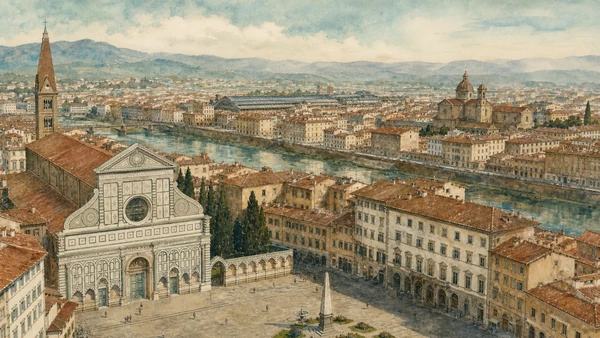
Santa Maria Novella and Ognissanti

Dominican learning, perspective, pharmacy, river trades, changing access and the palace city west of the cathedral.

Open guide ↗
Documentary watercolour for San Lorenzo and Via Larga
06Medici district

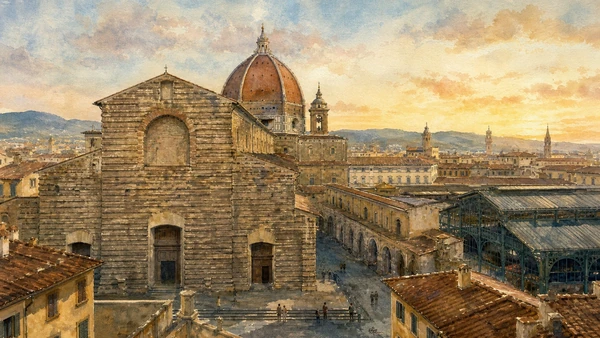
San Lorenzo and Via Larga

Brunelleschi, Michelangelo, family burial, library, palace and market within the quarter shaped by Medici patronage.

Open guide ↗
Documentary watercolour for Accademia, San Marco and Annunziata
07Northern centre

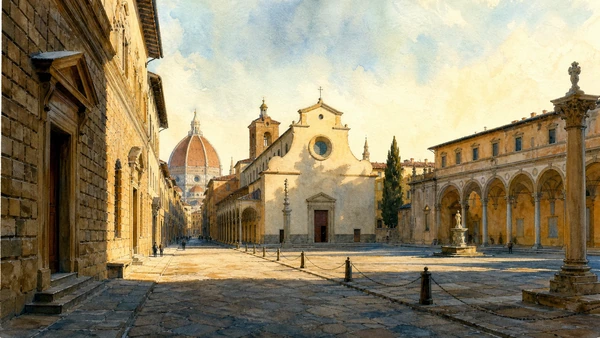
Accademia, San Marco and Annunziata

Sculpture display, Dominican cells, humanist library, Renaissance square, living sanctuary and care institution.

Open guide ↗
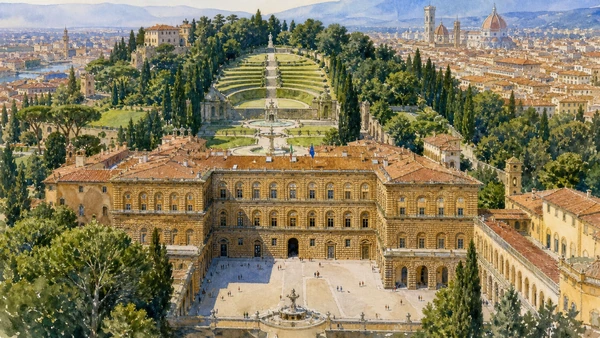
Documentary watercolour for Pitti Palace and Boboli
08Court and garden

Pitti Palace and Boboli

Dynastic residence, layered collections, royal apartments and the experimental landscape above the Oltrarno.

Open guide ↗
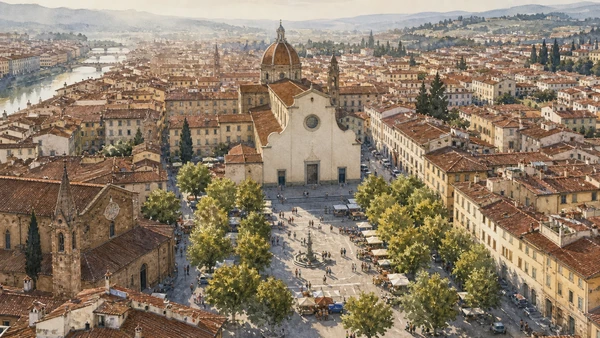
Documentary watercolour for Santo Spirito, Carmine and Artisan Streets
09Inhabited Oltrarno

Santo Spirito, Carmine and Artisan Streets

Churches, frescoes, workshops, markets, housing and visitor pressure in the living quarter west of Pitti.

Open guide ↗
Documentary watercolour for Arno, San Miniato and Fiesole
10River and heights

Arno, San Miniato and Fiesole

Flood infrastructure, capital-era landscapes, monastic worship, civic memory and archaeology above the basin.

Open guide ↗
How to use the atlas

Build a route that can breathe.

Choose one territory

A complete guide is designed for one full day or two linked half-days, not a race across the city.

Check live access

Church, museum, garden and transport systems publish different rules; verify official notices before travel.

Look beyond the icon

Approaches, thresholds, workshops, conservation and neighbourhood use explain why monuments matter.

Leave room for residence

Entrances, worship, markets, mobility and night-time quiet belong to people who live and work here.

Official starting points

Institutions before shortcuts.

Opening hours and access conditions change. The current institution remains the final reference for tickets, closures and visitor rules.

Florence begins between places.

Ten gateways through the river city, its institutions, its workshops and the hills that hold the whole landscape together.