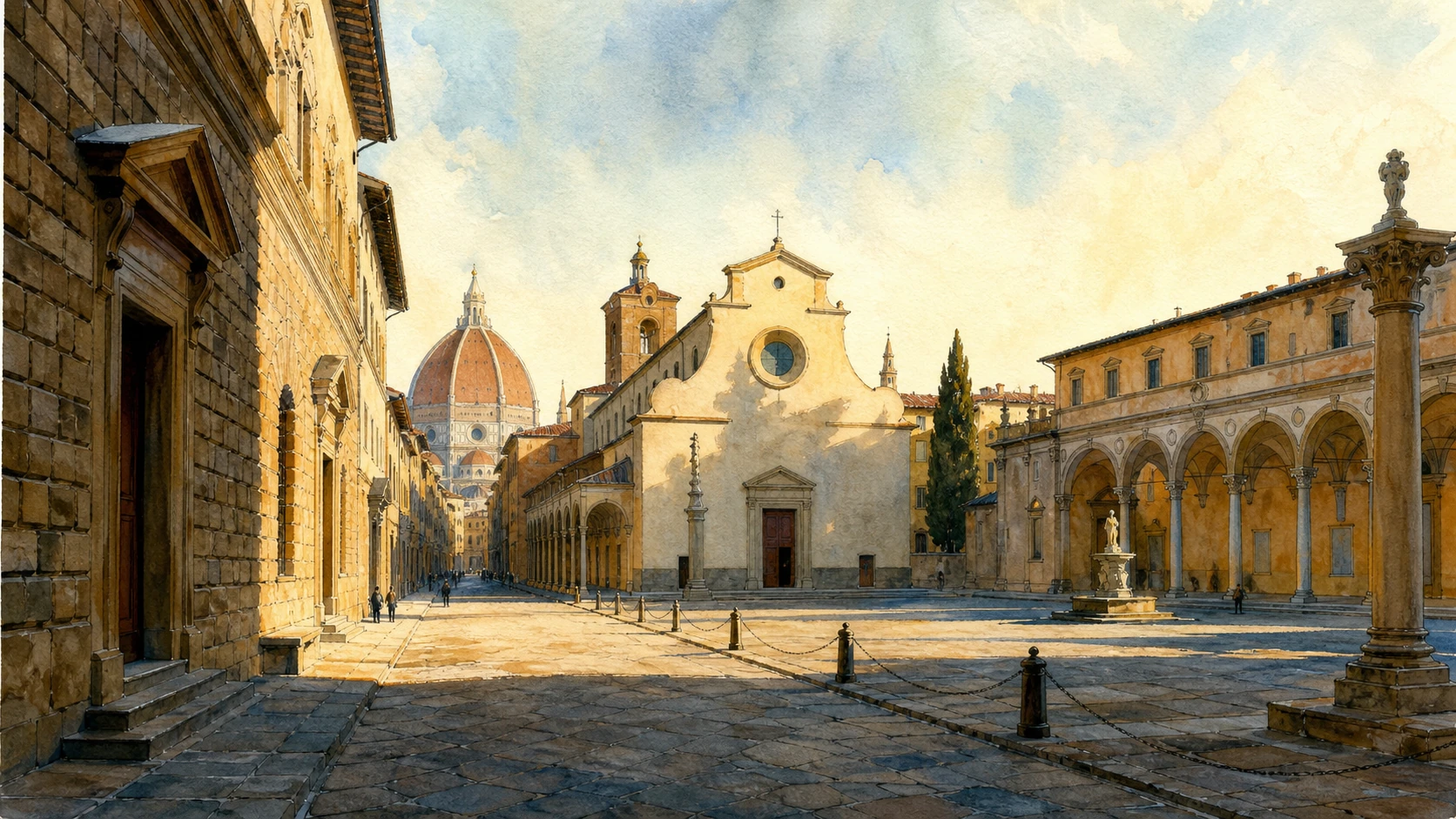
Original documentary watercolour panorama linking Via Ricasoli, San Marco and Santissima Annunziata

Florence Guide 07 · Art school, convent, sanctuary and civic care

Accademia, San Marco
& Santissima Annunziata

A documented northern-centre route from the Accademia’s purpose-built sculpture display to Dominican cells and humanist library, then through Florence’s most coherent Renaissance square to a living sanctuary and an institution still devoted to children.

Plan the route
Via Ricasoli to the Annunziata · Florence10 chapters · one full day

Why this northern centre matters

The northern centre is not a queue for one statue: academy, state gallery, Dominican convent, humanist library, Marian sanctuary, foundling hospital and archaeological museum form a district where art was taught, prayed before, collected, restored and used for care.

The Galleria dell’Accademia began within an educational system founded by Grand Duke Pietro Leopoldo in 1784. Its collections served artistic training before Michelangelo’s David was moved from Piazza della Signoria in 1873 and the Tribuna transformed one work into a museum destination. The corridor of Prisoners, early Italian paintings and musical instruments reveals a broader institution whose rooms have different closing procedures.

At San Marco, Michelozzo’s convent architecture joined Cosimo de’ Medici’s patronage to Dominican observance. Fra Angelico’s images were made for corridors, cells and shared rooms, not for a modern picture gallery. Savonarola’s later presence and the library assembled from Niccolò Niccoli’s books add political preaching and humanist study without erasing the continuing religious community beside the state museum.

Piazza Santissima Annunziata connects Brunelleschi’s Ospedale degli Innocenti to the Servite basilica through repeated loggias. The hospital’s beauty supported a hard social history of abandoned children, wet nurses, records and identity tokens. Its successor still works for children and families. The archaeological museum and restoration institutions nearby extend the route from Renaissance Florence into the material afterlives of much older cultures.

Reserve the Accademia, reach San Marco before its early last entry, cross the Annunziata square by reading its loggias as civic architecture, then choose the sanctuary, Innocenti museum and archaeology according to their separate hours.

The route

Plan your visit

Begin at the Accademia’s timed entrance, move to San Marco before midday, follow Via Cesare Battisti into Piazza Santissima Annunziata, then divide the afternoon between the sanctuary, Museo degli Innocenti and the archaeological collections.

Opening hour

Accademia beyond the headline

Use the timed entry for the Tribuna, Prisoners, early painting and musical-instrument rooms before crowd pressure builds.

Late morning

San Marco before last entry

Enter the cloister, communal rooms, dormitory cells and Michelozzo library while the state museum’s short day remains open.

Early afternoon

Santissima Annunziata square and sanctuary

Read the repeated porticoes outside, then enter the living Servite church respectfully around its liturgical timetable.

Afternoon

Innocenti and archaeology

Use the museum’s history, art and architecture routes before crossing toward the national archaeological collections if their current calendar allows.

Ten chapters

Explore the places

The route crosses four institutions with different purposes: an art museum, a former Dominican convent, a living Marian sanctuary and a museum inside an active child-welfare institute. Use the index without merging their tickets or histories.

  1. 01Via Ricasoli and the Accademia threshold
  2. 02The Tribuna: how a museum reframed David
  3. 03The Prisoners and the problem of non finito
  4. 04Painting galleries and the musical-instrument rooms
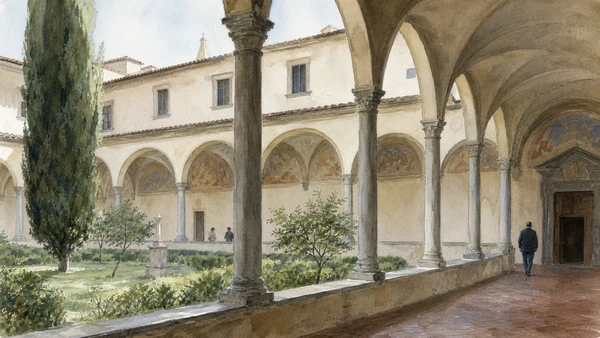
  5. 05San Marco: cloister, community and museum boundary
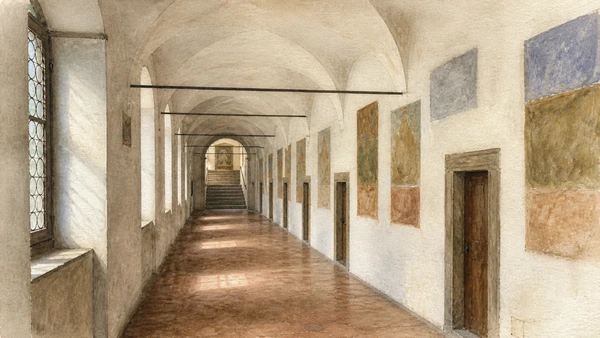
  6. 06Fra Angelico’s corridor and cells
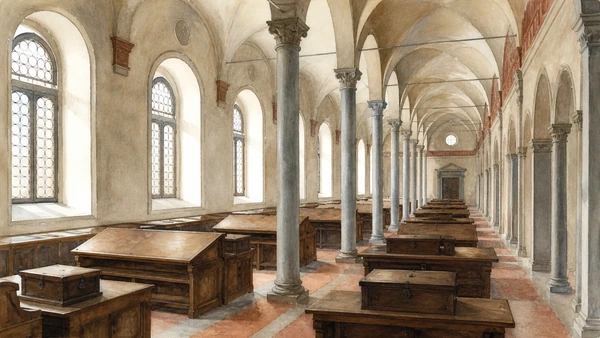
  7. 07Michelozzo’s library and the Savonarola layer
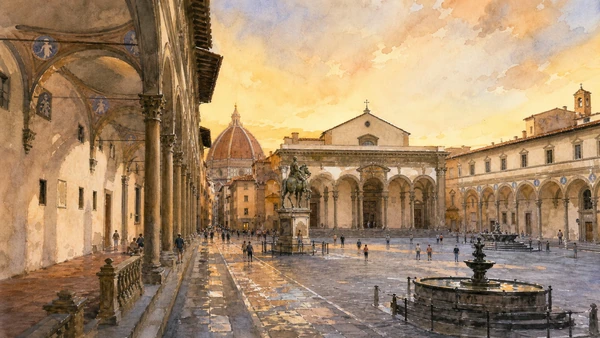
  8. 08Piazza and Basilica Santissima Annunziata
  9. 09Ospedale and Museo degli Innocenti: beauty, care and records
  10. 10The archaeological museum and the district of conservation
01

A modest street entrance controls access to an institution created for artistic education and later transformed by mass attention

Via Ricasoli and the Accademia threshold

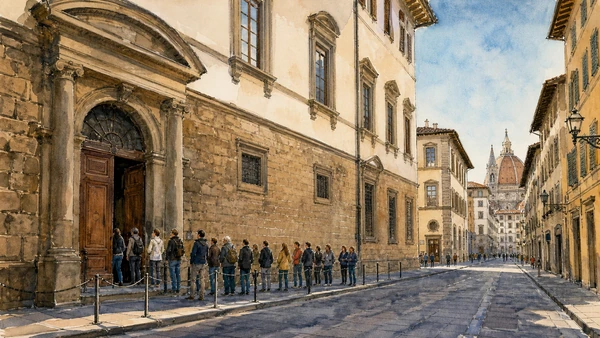
The museum’s plain exterior and carefully timed door contrast with the global image of the work inside, making queue management part of its present architecture.

Today

The Galleria dell’Accademia entrance occupies Via Ricasoli 58/60. Reserved and non-reserved lines, security screening and group rules compress visitors along a relatively narrow street. The ticket office and accessible entrance use number 60. The institution recommends reservations because waits without them can be long, and only the official B-Ticket channel is authorised for online sales.

History

Pietro Leopoldo founded the Academy of Fine Arts in 1784 and organised a gallery of works for student study. Suppressed religious institutions supplied many early paintings, so teaching and state redistribution shaped the collection before tourism. The gallery later became administratively distinct from the still-active academy next door, although their names and buildings remain linked.

How to read this place

Look past the queue and identify the former institutional block rather than expecting a monumental museum façade. The controlled doorway explains why a timed ticket does not eliminate every delay. Inside, begin with the museum’s educational origin before treating the route as a race toward a single image.

What to notice

  • Unassuming street entrance serving a high-volume state museum
  • Separate reserved, unreserved and accessible arrival procedures
  • Adjacent art academy surviving beside the museum that inherited its name
Galleria dell’Accademia · Visit
Original documentary watercolour of the Accademia entrance and controlled queue on Via Ricasoli
Via Ricasoli and the Accademia thresholdOriginal Merlintravel documentary watercolour · 2026
02

A nineteenth-century skylit apse turned a civic outdoor monument into the axial centre of a national museum

The Tribuna: how a museum reframed David

Michelangelo’s statue matters here together with Emilio De Fabris’s display architecture, the 1873 relocation and the later replica that changed Piazza della Signoria.

Today

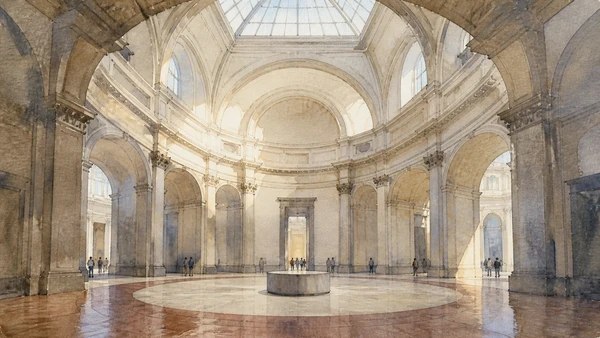
The long Prisoners corridor culminates in the domed and skylit Tribuna, where David stands on a raised base surrounded by circulating visitors. Daylight and the radial room separate the sculpture from a wall while barriers preserve distance. Crowd flow can make the central axis difficult to hold, yet side views clarify that the figure was designed for another location and scale.

History

Michelangelo carved David between 1501 and 1504 for the cathedral works but the finished sculpture was installed outside Palazzo Vecchio. Concern for weathering led to its transfer to the Accademia in 1873. Emilio De Fabris designed the Tribuna; the statue remained boxed while the room was completed and opened to the public. A marble replica replaced it in the piazza in 1910.

How to read this place

Begin with the roof, apse and sightline before approaching the sculpture. Compare the museum’s even circulation with the work’s earlier outdoor political address. The move created a new national-museum setting and left Florence with an original, a replica and different visual contexts.

What to notice

  • Skylight producing controlled overhead illumination
  • Axial corridor ending in an apsidal display room
  • Museum relocation separating original sculpture from its civic site
Galleria dell’Accademia · Collections
Original documentary watercolour of the Accademia Tribuna as skylit museum architecture
The Tribuna: how a museum reframed DavidOriginal Merlintravel documentary watercolour · 2026
03

Blocked marble, visible tool marks and an abandoned papal tomb project expose making and incompletion inside a corridor built for finished display

The Prisoners and the problem of non finito

The four figures belong to repeated revisions of Julius II’s tomb, so their unfinished surfaces should not be reduced to a universal theory of forms escaping stone.

Today

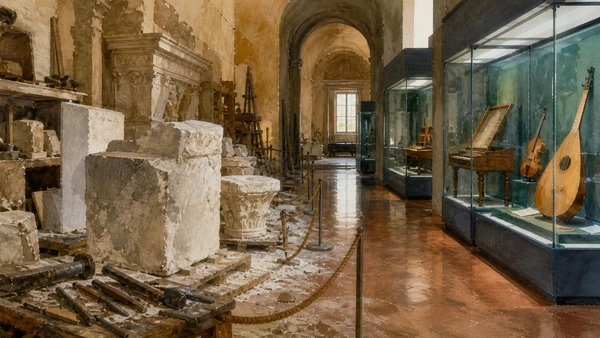
Four large Prisoners line the approach to the Tribuna together with the unfinished Saint Matthew and other sculptures. Changing viewpoints reveal drill holes, chisel transitions and areas left close to the quarried block. Museum arrangement encourages a narrative of emergence toward David, but that sequence is curatorial rather than the order or destination of the original commissions.

History

Michelangelo conceived figures for the repeatedly reduced tomb of Pope Julius II. The Florence Prisoners did not enter the final monument at San Pietro in Vincoli and remained in the artist’s workshop before passing into Medici possession. They reached the Accademia in 1909. Names such as Atlas or Awakening describe modern visual impressions, not necessarily Michelangelo’s fixed titles.

How to read this place

Walk around each available side and separate rough quarry surface from deliberate cutting and later damage. Resist the romantic certainty that Michelangelo intentionally completed every figure at precisely this stage. Contract change, workshop sequence and abandonment offer material explanations alongside aesthetic ones.

What to notice

  • Tool marks moving from rough block toward modelled surface
  • Different degrees of completion within one displaced tomb project
  • Modern corridor arrangement creating a story of progress toward David
Galleria dell’Accademia · Prisoners and Julius II project
Original documentary watercolour combining rough marble workshop evidence and historic instrument displays
The Prisoners and the problem of non finitoOriginal Merlintravel documentary watercolour · 2026
04

Gold-ground paintings and Medici court instruments recover the collection’s teaching history beyond Michelangelo

Painting galleries and the musical-instrument rooms

The museum contains major early Italian painting and a specialised music collection whose rooms may close to new entry before the building itself.

Today

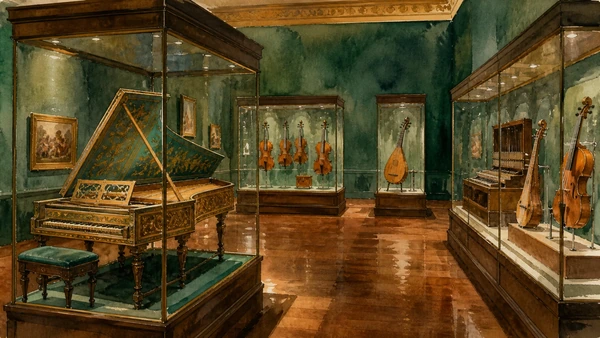
Ground- and first-floor rooms present Florentine panels, altarpieces and changing displays, while a separate section holds instruments from Medici and Lorraine collections. Harpsichords, strings and experimental instruments are read alongside paintings of court music. Closing procedures currently bar entry to the musical-instrument and upper rooms ten minutes before the general museum closing sequence begins.

History

Many paintings entered the gallery after late-eighteenth- and early-nineteenth-century suppressions, supporting training in styles and techniques. The instrument collection developed from the grand-ducal court and later museum transfers. Antonio Stradivari and Bartolomeo Cristofori are among the names connected to objects, but court performers, makers, custodians and changing restorations shaped their histories too.

How to read this place

Use frames, reconstructed altarpiece groupings and display labels to distinguish an original church ensemble from a later teaching collection. In the music rooms, study construction and acoustic purpose before prestige attribution. Check the time before reaching these sections; a late arrival can leave them inaccessible even when the exit has not closed.

What to notice

  • Early paintings organised through later educational and museum systems
  • Instrument cases linking objects to Medici court performance
  • Room-specific closing procedure affecting a complete visit
Galleria dell’Accademia · Official visit kit
Original documentary watercolour of the Accademia's historic musical-instrument gallery
Painting galleries and the musical-instrument roomsOriginal Merlintravel documentary watercolour · 2026
05

Michelozzo’s quiet arcades organise a Dominican institution in which museum rooms still border areas of religious life

San Marco: cloister, community and museum boundary

The former convent is neither an empty shell nor entirely secular: state museum, church and Dominican community occupy adjoining but distinct spaces.

Today

The state museum entrance on Piazza San Marco leads into the Cloister of Sant’Antonino and communal rooms including hospice, chapter house and refectories. Arcades connect movement, burial memory and garden. The adjacent church and parts of the complex remain outside the museum route and continue religious functions. Temporary conservation can alter the order of rooms.

History

Cosimo de’ Medici supported the Observant Dominican rebuilding undertaken by Michelozzo between 1437 and 1443. Architecture provided cells, library, refectory and shared devotional spaces. The convent became a national monument in 1869 and parts opened as a museum, bringing panel paintings from other contexts into the complex while preserving wall paintings in situ.

How to read this place

Begin with the cloister’s circulation rather than searching immediately for Fra Angelico. Identify doors into communal rooms and the way lunette paintings address repeated passage. Museum conversion makes some boundaries visible and others easy to miss; do not assume every courtyard or doorway is open to visitors.

What to notice

  • Rounded arcade organising movement around a planted court
  • Museum rooms and living religious areas sharing one historic fabric
  • Wall paintings designed for repeated convent use rather than isolated display
Musei nazionali Toscana · Museo di San Marco
Original documentary watercolour of the Sant'Antonino cloister at San Marco
San Marco: cloister, community and museum boundaryOriginal Merlintravel documentary watercolour · 2026
06

Small images placed at thresholds and in cells use repetition, restraint and monastic routine rather than gallery spectacle

Fra Angelico’s corridor and cells

The upper dormitory should be read as an inhabited devotional sequence, with differences of authorship and condition across a workshop programme.

Today

A stair leads to the famous Annunciation at the corridor turn and to rows of small cells carrying painted scenes. Light, doorways and close viewing create an unusually intimate museum experience. Some rooms relate to Cosimo de’ Medici and Savonarola, while access can change during exhibitions and conservation. The paintings remain attached to architectural settings even though the convent no longer functions here as it once did.

History

Fra Angelico and assistants painted the convent in the late 1430s and 1440s. Images supported contemplation by friars rather than public tourism. Workshop participation and varying levels of finish complicate the habit of calling every cell an individual autograph. Later use, suppression, museum opening and restoration changed surfaces and routes.

How to read this place

Approach the corridor Annunciation from the stair and notice how architecture in the painting answers the real passage. In cells, allow scale and sparsity to matter. Do not use flash or crowd doorways. Compare repeated Dominican figures and landscape fragments without turning the sequence into a checklist of masterpieces.

What to notice

  • Painted and real architecture meeting at the corridor turn
  • Small cell scale controlling distance and attention
  • Workshop programme distributed across a communal dormitory
Musei nazionali Toscana · San Marco current route
Original documentary watercolour of the San Marco dormitory corridor and abstract wall-painting fields
Fra Angelico’s corridor and cellsOriginal Merlintravel documentary watercolour · 2026
07

A three-aisled reading hall and a preacher’s contested memory reveal different uses of Dominican knowledge and Medici patronage

Michelozzo’s library and the Savonarola layer

Manuscript study, humanist exchange and religious reform shaped San Marco in different periods.

Today

The long library uses slender columns and repeated windows to create three parallel aisles of light. Displays and temporary dossier exhibitions may occupy the room. Elsewhere, objects and cells associated with Girolamo Savonarola interpret his years at San Marco. The museum presents those materials critically within a larger Dominican and Florentine history.

History

Cosimo de’ Medici financed the library to house books including the collection of the humanist Niccolò Niccoli. It became one of the earliest Renaissance libraries accessible beyond a private household and hosted scholars connected to Medici Florence. Savonarola lived at San Marco from 1489, became prior and preached reform before his execution in 1498. Later memory made his rooms into political relics.

How to read this place

Read the library’s column grid together with windows and former book desks; openness still depended on controlled scholarly community. In the Savonarola rooms, distinguish objects with documented provenance from later commemoration. Patronage by Cosimo and later conflict with Medici power belong to different moments of the same institution.

What to notice

  • Three-aisled hall translating church-like rhythm into study space
  • Book collection joining Dominican learning and civic humanism
  • Savonarola memory layered through later display and political interpretation
Musei nazionali Toscana · Library and Savonarola
Original documentary watercolour of Michelozzo's three-aisled library at San Marco
Michelozzo’s library and the Savonarola layerOriginal Merlintravel documentary watercolour · 2026
08

Repeated porticoes transform separate church, hospital and residence fronts into one of Florence’s clearest designed urban rooms

Piazza and Basilica Santissima Annunziata

Brunelleschi’s hospital loggia set a proportional language repeated around the square, while the Servite sanctuary behind its portico preserves a much denser history of Marian devotion.

Today

The square opens at the end of Via dei Servi with a view back toward the cathedral dome. The Ospedale degli Innocenti arcade faces the Loggiato dei Serviti, while the basilica portico closes the north side. Inside, the Chiostrino dei Voti leads to the revered Annunciation chapel and a richly layered living church. Masses, prayer, markets, processions and the September Rificolona all change the district’s rhythm.

History

Brunelleschi began the hospital loggia in 1419, and later architects extended its language across the square rather than executing one simultaneous master plan. The Servants of Mary had established the sanctuary in the thirteenth century; a tradition of miraculous completion attached to its Annunciation image made it a pilgrimage focus. Until 1750 Florence’s civil year began on 25 March. Later monuments and church additions brought Medici and Baroque layers.

How to read this place

Stand on the Via dei Servi axis and compare arch width, column height and upper-storey treatment on all three sides. Similarity does not mean shared author or function. Under the basilica portico, shift from urban analysis to devotional space: enter quietly, do not block worshippers and distinguish the early sanctuary tradition from later architectural enrichment.

What to notice

  • Brunelleschian module repeated by later surrounding loggias
  • Cathedral dome framed on the southern approach
  • Votive cloister and revered chapel carrying Marian devotion behind the public square
FeelFlorence · Piazza Santissima Annunziata
Original documentary watercolour of Piazza Santissima Annunziata and its corresponding loggias
Piazza and Basilica Santissima AnnunziataOriginal Merlintravel documentary watercolour · 2026
09

Renaissance proportion served an institution for abandoned children whose archives preserve lives that architectural celebration can otherwise hide

Ospedale and Museo degli Innocenti: beauty, care and records

The loggia is an architectural landmark, but the museum’s history, art and architecture routes keep the children, wet nurses, identity signs and continuing mission at the centre.

Today

The museum enters from Piazza Santissima Annunziata 13 and moves through history displays, art collection, monumental courtyards, architectural route and an overlook into the protected archive. Bags and backpacks must be deposited in lockers. The institute still provides child and family services, research and training, so museum visitation occupies only part of a working social organisation.

History

The Silk Guild founded the hospital in 1419 with support including Francesco Datini’s bequest and commissioned Brunelleschi. The first recorded child, Agata e Smeralda, arrived on 5 February 1445. The iron window received abandoned infants until anonymous abandonment ended in 1875. Art commissions, records and tens of thousands of identification signs built an archive of institutional life. The reorganised museum opened in 2016.

How to read this place

Measure one loggia bay outside, then connect repeated arches to dormitory, church and courtyards inside. Do not sentimentalise the blue medallions while ignoring the social system they came to symbolise. In the history route, small tokens and records can carry more individual evidence than celebrated paintings.

What to notice

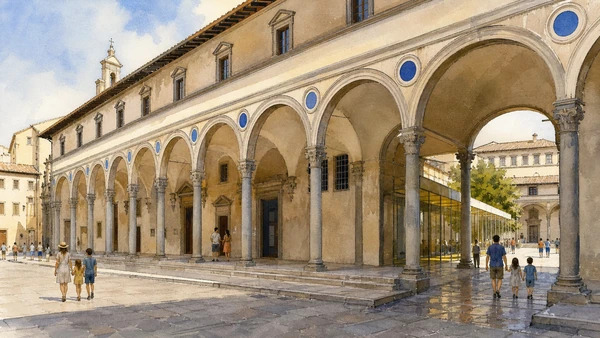
  • Pietra-serena arcade establishing a public architectural module
  • History route centring children, wet nurses and identity records
  • Active institute continuing beyond the museum boundary
Museo degli Innocenti · History
Original documentary watercolour of the Innocenti loggia, courtyard and museum passage
Ospedale and Museo degli Innocenti: beauty, care and recordsOriginal Merlintravel documentary watercolour · 2026
10

Collections from Egypt, Etruria, Greece and Rome reveal Florence as a later collector and conservator of cultures beyond the Renaissance

The archaeological museum and the district of conservation

The final stop shifts chronology and geography, asking how grand-ducal collecting, national archaeology and modern restoration shaped the objects now shown near the Annunziata.

Today

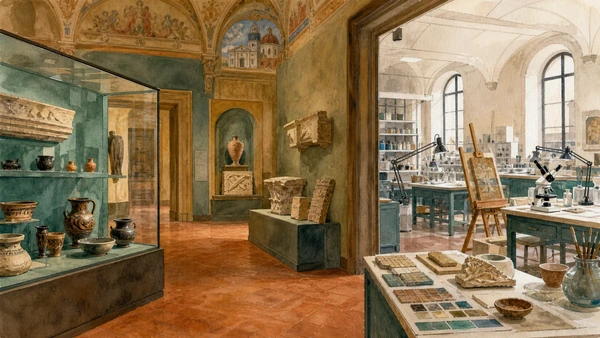
The Museo Archeologico Nazionale occupies the Palazzo della Crocetta at the corner of the square, with access from Piazza Santissima Annunziata. Egyptian, Etruscan, Greek and Roman collections fill rooms created from a Medici residence. Nearby conservation institutions, including the Opificio delle Pietre Dure, remind visitors that display depends on laboratories, documentation and material care not normally visible in galleries.

History

Grand-ducal collections supplied important antiquities before the national museum formed in the nineteenth century and moved to the palace in 1880. Excavation, purchase, exchange and colonial-era collecting histories differ across the collections and require object-level evidence. Florence’s restoration traditions later became formal institutions, especially after the 1966 flood accelerated technical cooperation and public awareness.

How to read this place

Choose one material group rather than treating every civilisation as a rapid survey. Read acquisition and excavation information as carefully as date and style. The Renaissance palace is part of the display history, not the ancient object’s original context. End by noticing mounts, repaired fragments, climate cases and other signs of conservation labour.

What to notice

  • Ancient objects displayed inside a later Medici residence
  • Collection histories extending beyond formal style and dynasty
  • Mounts, repairs and environmental cases making preservation visible
FeelFlorence · National Archaeological Museum
Original documentary watercolour of archaeological displays and a Florence conservation laboratory
The archaeological museum and the district of conservationOriginal Merlintravel documentary watercolour · 2026

Accademia, San Marco and the Annunziata through time

A short chronology

From the Servite sanctuary and Renaissance hospital to the art academy, state museums and present-day conservation.

  1. The Servants of Mary establish the sanctuary that becomes Santissima Annunziata.

  2. The Silk Guild commissions Brunelleschi to begin the Ospedale degli Innocenti.

  3. Michelozzo rebuilds San Marco under Medici patronage for the Observant Dominicans.

  4. Fra Angelico and assistants paint corridors, cells and communal spaces at San Marco.

  5. Agata e Smeralda becomes the first recorded infant received by the Innocenti.

  6. Michelozzo and Alberti contribute to the developing Santissima Annunziata complex.

  7. Glazed terracotta medallions complete the public identity of the Innocenti loggia.

  8. Savonarola’s San Marco years culminate in reform preaching, political conflict and execution.

  9. Florence finally abandons 25 March, feast of the Annunciation, as the start of its civil year.

  10. Pietro Leopoldo founds the Academy of Fine Arts and its teaching gallery.

  11. San Marco is declared a national monument and develops as a state museum.

  12. Michelangelo’s David is transferred from Piazza della Signoria to the Accademia.

  13. The National Archaeological Museum settles in the Palazzo della Crocetta.

  14. The Prisoners reach the Accademia and a replica takes David’s former civic site.

  15. The redesigned Museo degli Innocenti opens history, art and architecture routes.

Before your visit

Practical information

01

Reserve only through the official channel

The Accademia identifies B-Ticket as its authorised online seller; third-party appearance does not prove official status.

02

Reach San Marco before 12:45

Its current last admission is much earlier than the Accademia and Innocenti closing times.

03

Protect side rooms at the Accademia

Musical instruments and upper-floor galleries can stop admitting visitors during closing procedures.

04

Treat the basilica as a sanctuary

Prayer, Mass and feast preparations take priority over photography and sightseeing.

05

Use the Innocenti lockers

Bags, backpacks, luggage, helmets and umbrellas must be deposited before the museum route.

06

Read provenance in archaeology

Ancient date, excavation location, acquisition history and modern repair are separate pieces of evidence.

Method and sources

Sources and image credits

This guide uses current official material from the Galleria dell’Accademia, Musei nazionali Toscana, Comune di Firenze and Museo degli Innocenti, checked on 28 August 2026. It distinguishes Academy from Gallery; original civic site from museum Tribuna; unfinished project from romantic non finito; wall painting in a convent from detached panel display; state museum from living Dominican spaces; humanist library from Savonarola memory; urban unity from institutional difference; Marian devotion from tourist access; architectural beauty from the difficult history of abandonment; and ancient object from Florentine collection and conservation history.

All ten images are original Merlintravel editorial watercolours based on documented present-day conditions. They are illustrations, not substitutes for archaeological plans. Opening hours, tickets, accessible routes, temporary exhibitions and conservation work can change; consult the linked official pages shortly before visiting.