Molise
Samnite archaeology, grassy transhumance roads, mountain communities and a short Adriatic coast.
Molise becomes visible when the journey slows down.
One of Italy’s smallest regions holds Palaeolithic evidence, Samnite sanctuaries, Roman towns, Lombard and Norman layers, abbeys, castle villages, bell-making and knife crafts, high plateaux, tratturi and a compact coast centred on Termoli.
History in layers.
Molise’s history is not an appendix to Abruzzo or Campania. Samnium, Romanisation, the Duchy of Benevento, the Kingdom of Naples and long patterns of pastoral movement created a distinct regional archive.
Deep prehistory
The Isernia area preserves major Palaeolithic evidence that expands the time scale of human presence.
Samnite territories
Sanctuaries, hill forts and communities of ancient Samnium structured the inland Apennines before Rome.
Roman towns and roads
Saepinum and other sites show urban life tied to routes, markets and pastoral movement.
Lombards, monasteries and castles
The Duchy of Benevento, San Vincenzo al Volturno and fortified towns shaped the medieval region.
Kingdom of Naples and tratturi
Feudal jurisdictions and sheep customs connected Molise to wider southern pastoral economies.
Separation, migration and modern identity
Administrative autonomy, emigration and changing rural life formed the contemporary region.

Mountains, valleys and the Adriatic connect two provinces.
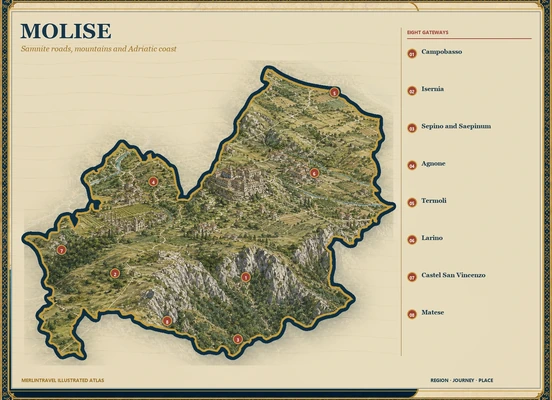
The atlas links Campobasso and Isernia to Sepino, Agnone, Matese, the upper Volturno and the Biferno route towards Termoli.
Map markers identify editorial gateways, not a ranking.
Journeys, not checklists.
The circuits privilege archaeology, pastoral roads, craft towns and the movement from Apennine forests to the Adriatic.
Campobasso and the Biferno
The hill city, Samnite collections, villages and river landscapes lead from interior to coast.
Isernia and the upper Volturno
Prehistory, Roman remains, monasteries and mountain water systems structure the west.
Samnite and transhumance routes
Sepino, Pietrabbondante and the tratturi reveal ancient and continuing movement through uplands.
Agnone to Termoli
Bell foundries, castle towns, Larino and the Adriatic harbour connect craft, agriculture and sea.
Places that open the story.
Each gateway is a future chapter: a city, landscape or cultural system large enough to deserve its own documented guide.
Campobasso
A double city of medieval slopes and the planned Murattian quarter, anchored by Samnite collections.
Isernia
Palaeolithic archaeology, Roman memory, lace craft and access to the Mainarde and upper Volturno.
Sepino and Saepinum
A remarkably legible Roman town on a pastoral route, with earlier Samnite landscapes nearby.
Agnone
A high craft town known for a centuries-old bell-founding tradition and a layered historic centre.
Termoli
A fortified old town on a headland, fishing culture, trabucchi and the region’s Adriatic gateway.
Larino
Roman Larinum, medieval cathedral art, agricultural plains and ritual traditions in eastern Molise.
Castel San Vincenzo
A lake and mountain landscape opening onto one of medieval Europe’s important monastic centres.
Matese
Karst plateaux, forests, villages and pastoral routes across a massif shared with Campania.
What the region keeps.
Monuments matter, but so do languages, crafts, routes, rituals and working landscapes.
Samnite archaeology
Pietrabbondante, Sepino and museums return voice to a culture too often described only through Roman conquest.
Tratturi
Broad grassy roads preserve the spatial memory of seasonal migration between Abruzzo and Apulia.
Bell and blade crafts
Agnone’s foundries and Frosolone’s metalworking link specialised knowledge to small-town economies.
Ritual communities
Processions, wheat festivals and seasonal practices connect towns to agriculture and collective memory.
Nature is part of the archive.
Land, water and ecological systems are read together with the communities that have learned to inhabit them.
Mainarde
Forests and mountain habitats form the Molise sector of a major transregional national park.
Matese
Limestone peaks, caves, lakes and high pasture define the southern border landscape.
Biferno and Volturno
River systems carry water, settlement and cultivation in different directions across the region.
Adriatic coast
A short shore of dunes, river mouths, fishing structures and the fortified headland of Termoli.
A documented journey, still open.
The region is not presented through the cliché that it does not exist. Small scale and low visitor density are treated as conditions for careful historical and environmental attention.
The journey continues.
Return to the Italy regional atlas