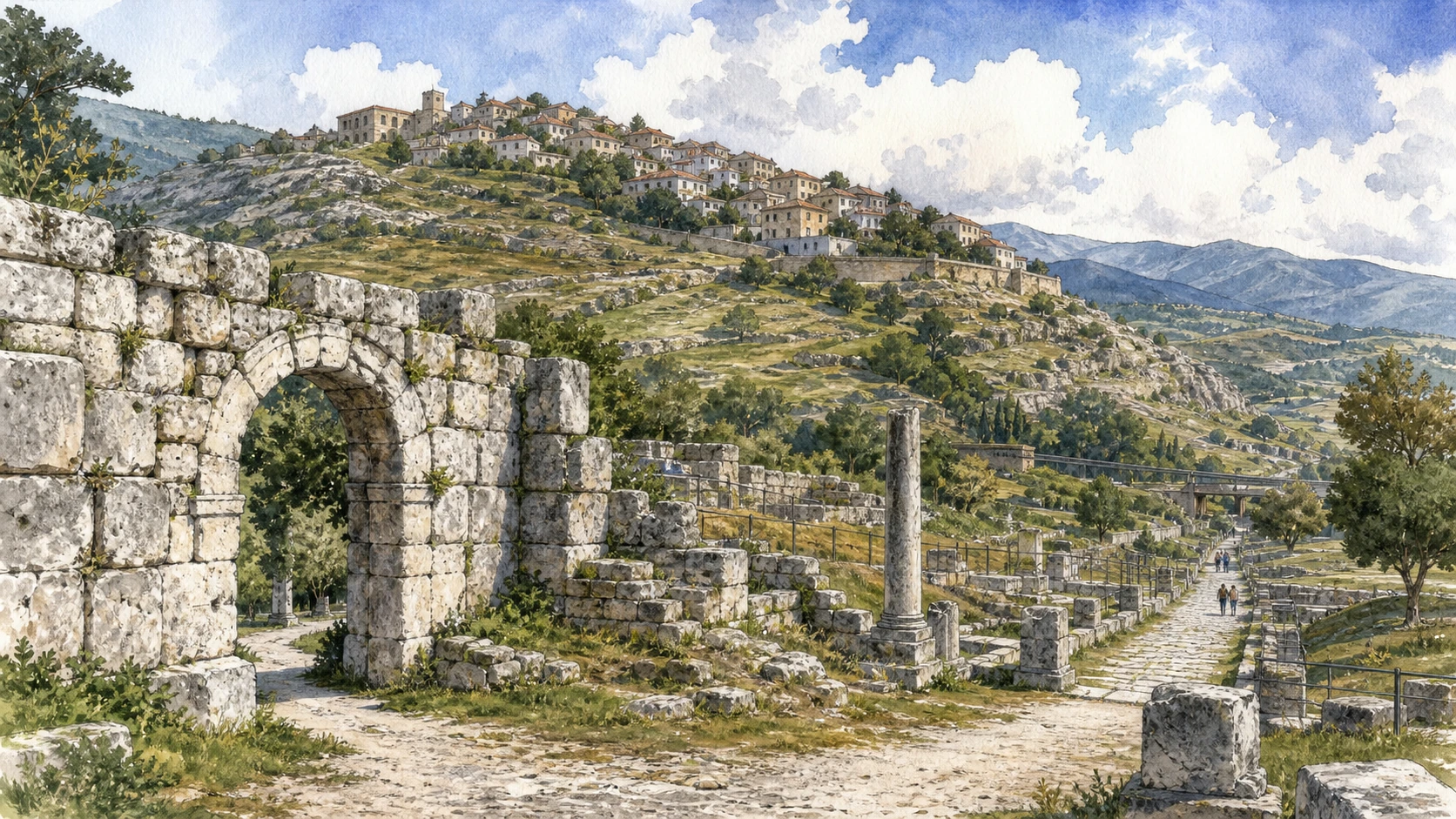
Original documentary watercolour panorama for Sepino and Saepinum: Complete Guide, with accurate Molisian architecture, landscape and lived context

Molise Guide 03 · Archaeology, architecture, working landscapes and contemporary access

Saepinum
keeps the road visible

A two-day archaeological route linking a Samnite hill enclosure, the Roman town below, the transhumance road crossing its gates and the later village that inherited the name.

Plan the route
Sepino, Saepinum and the Tammaro · Molise10 chapters · one complete route

Why this route must be read in layers

Saepinum is best understood as a sequence of movement rather than an isolated ruin: upland defence, Roman urbanism, market traffic, pastoral migration, rural reuse and modern conservation occupy the same corridor.

The route begins with documented fabric and institutional collections rather than a list of photogenic surfaces. Each chapter separates what survives, what was rebuilt and what remains in use.

Molise’s archaeological parks, forests, villages, religious sites, mountain roads and short coast operate under different access conditions. Current notices therefore belong to the route rather than an appendix.

Each chapter includes an illustration of the place described. The images are watercolours rather than photographs.

A two-day archaeological route linking a Samnite hill enclosure, the Roman town below, the transhumance road crossing its gates and the later village that inherited the name.

The route

Plan your visit

A two-day archaeological route linking a Samnite hill enclosure, the Roman town below, the transhumance road crossing its gates and the later village that inherited the name.

Early morning

Terravecchia · Porta Bojano · The forum

Move in the documented order: Terravecchia: the Samnite enclosure above Sepino; then Porta Bojano: road, inscription and pastoral traffic; then The forum: civic space without an imagined crowd. Recheck live access, weather and transport before entering a controlled place.

Late morning

The basilica and macellum · The theatre · Baths and water

Move in the documented order: The basilica and macellum: law beside exchange; then The theatre: Roman seating inside a later farm court; then Baths and water: infrastructure behind urban comfort. Recheck live access, weather and transport before entering a controlled place.

Afternoon

Porta Benevento · The Saepinum museum · The Pescasseroli–Candela tratturo

Move in the documented order: Porta Benevento: the town opens southeast; then The Saepinum museum: objects returned to their contexts; then The Pescasseroli–Candela tratturo: a road through the town. Recheck live access, weather and transport before entering a controlled place.

Late afternoon

Sepino

Move in the documented order: Sepino: the later town above the archaeological plain. Recheck live access, weather and transport before entering a controlled place.

Ten chapters

Explore the places

The order follows terrain, institutions and present-day movement. Use the index to return to a chapter without reducing the route to isolated monuments.

  1. 01Terravecchia: the Samnite enclosure above Sepino
  2. 02Porta Bojano: road, inscription and pastoral traffic
  3. 03The forum: civic space without an imagined crowd
  4. 04The basilica and macellum: law beside exchange
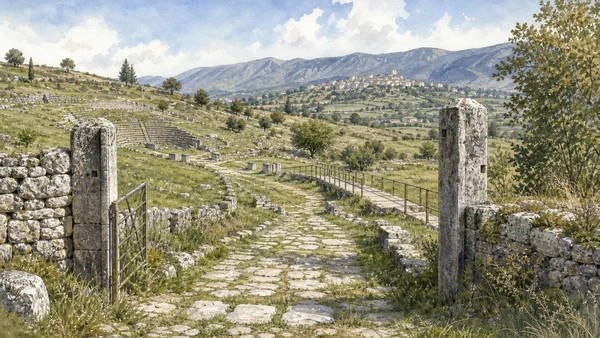
  5. 05The theatre: Roman seating inside a later farm court
  6. 06Baths and water: infrastructure behind urban comfort
  7. 07Porta Benevento: the town opens southeast
  8. 08The Saepinum museum: objects returned to their contexts
  9. 09The Pescasseroli–Candela tratturo: a road through the town
  10. 10Sepino: the later town above the archaeological plain
01

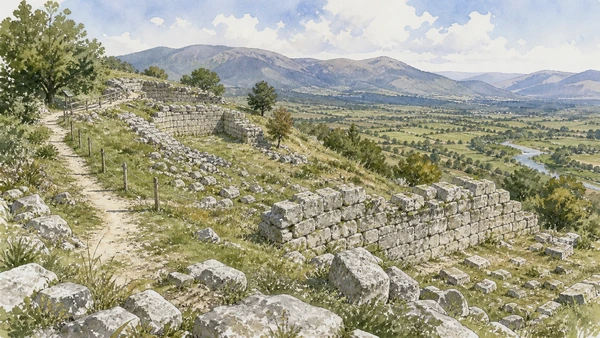
Polygonal walls and mountain terrain preserve a fortified position overlooking the later Roman plain.

Terravecchia: the Samnite enclosure above Sepino

Polygonal walls and mountain terrain preserve a fortified position overlooking the later Roman plain. The place becomes clearer when surviving fabric, later change and present use are read together.

Today

Archaeological access can change because of conservation, excavation, weather or staffing. Stay outside barriers and verify the official opening notice.

History

The enclosure belongs to the Samnite landscape that preceded Roman Saepinum and controlled routes through the Tammaro valley.

How to read this place

Use authorised paths. Surviving wall courses and fallen stone preserve fragments of the former hill town.

What to notice

  • original masonry and later support work
  • the relation between excavation and modern surroundings
  • areas intentionally left unexcavated
Parco archeologico di Sepino
Original documentary watercolour of Terravecchia: the Samnite enclosure above Sepino in Sepino, Saepinum and the Tammaro · Molise, showing accurate architecture, landscape and present-day use
Terravecchia: the Samnite enclosure above SepinoOriginal Merlintravel documentary watercolour · 2026
02

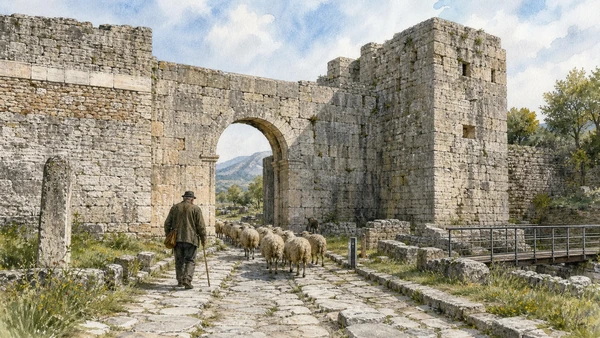
The western gate frames the route toward Bojano and preserves a monumental threshold crossed by the tratturo.

Porta Bojano: road, inscription and pastoral traffic

The western gate frames the route toward Bojano and preserves a monumental threshold crossed by the tratturo. The place becomes clearer when surviving fabric, later change and present use are read together.

Today

Archaeological access can change because of conservation, excavation, weather or staffing. Stay outside barriers and verify the official opening notice.

History

The Augustan town wall and gates formalised an older line of movement that continued to serve livestock and travellers.

How to read this place

Read wheel routes, inscriptions, towers and later repairs together; the gate did not function as a decorative arch.

What to notice

  • original masonry and later support work
  • the relation between excavation and modern surroundings
  • areas intentionally left unexcavated
Parco archeologico di Sepino
Original documentary watercolour of Porta Bojano: road, inscription and pastoral traffic in Sepino, Saepinum and the Tammaro · Molise, showing accurate architecture, landscape and present-day use
Porta Bojano: road, inscription and pastoral trafficOriginal Merlintravel documentary watercolour · 2026
03

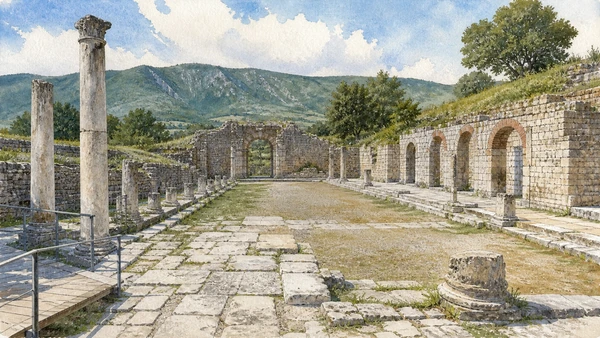
Paving, public buildings and inscriptions organise the centre of Roman Saepinum with unusual clarity.

The forum: civic space without an imagined crowd

Paving, public buildings and inscriptions organise the centre of Roman Saepinum with unusual clarity. The place becomes clearer when surviving fabric, later change and present use are read together.

Today

Archaeological access can change because of conservation, excavation, weather or staffing. Stay outside barriers and verify the official opening notice.

History

Administrative, commercial and religious buildings developed across the early imperial town and changed as civic life contracted.

How to read this place

Follow the ground plan and surviving thresholds, distinguishing secure functions from conjectural reconstruction.

What to notice

  • original masonry and later support work
  • the relation between excavation and modern surroundings
  • areas intentionally left unexcavated
Parco archeologico di Sepino
Original documentary watercolour of The forum: civic space without an imagined crowd in Sepino, Saepinum and the Tammaro · Molise, showing accurate architecture, landscape and present-day use
The forum: civic space without an imagined crowdOriginal Merlintravel documentary watercolour · 2026
04

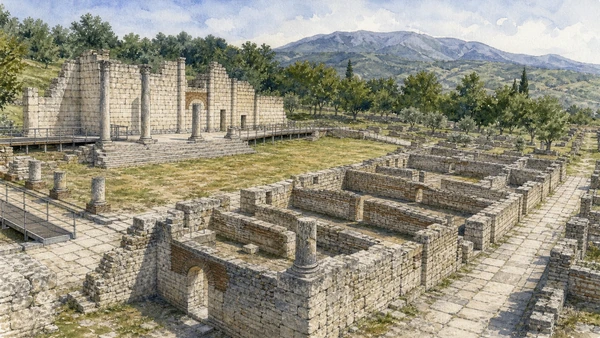
Public architecture around the forum reveals how administration and market activity were spatially connected.

The basilica and macellum: law beside exchange

Public architecture around the forum reveals how administration and market activity were spatially connected. The place becomes clearer when surviving fabric, later change and present use are read together.

Today

Archaeological access can change because of conservation, excavation, weather or staffing. Stay outside barriers and verify the official opening notice.

History

The basilica served civic proceedings while the market complex structured regulated exchange within the Roman town.

How to read this place

Use columns, wall lines and access points to understand circulation; fragmentary elevations should not be completed imaginatively.

What to notice

  • original masonry and later support work
  • the relation between excavation and modern surroundings
  • areas intentionally left unexcavated
Parco archeologico di Sepino
Original documentary watercolour of The basilica and macellum: law beside exchange in Sepino, Saepinum and the Tammaro · Molise, showing accurate architecture, landscape and present-day use
The basilica and macellum: law beside exchangeOriginal Merlintravel documentary watercolour · 2026
05

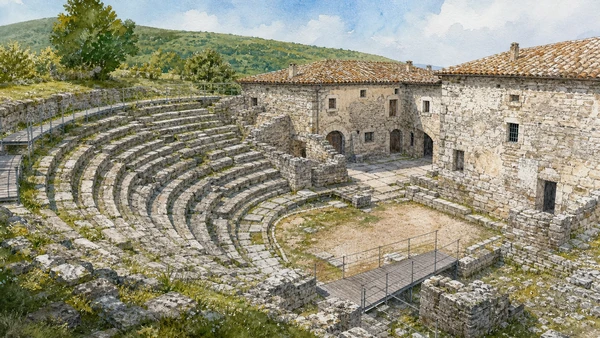
Ancient performance space survives together with rural buildings constructed when the site was reused.

The theatre: Roman seating inside a later farm court

Ancient performance space survives together with rural buildings constructed when the site was reused. The place becomes clearer when surviving fabric, later change and present use are read together.

Today

Archaeological access can change because of conservation, excavation, weather or staffing. Stay outside barriers and verify the official opening notice.

History

The theatre changed after antiquity and later houses occupied parts of its curved structure, producing a layered ensemble.

How to read this place

Keep the Roman cavea, later masonry and modern visitor route distinct; rural reuse is evidence, not an intrusion to erase.

What to notice

  • original masonry and later support work
  • the relation between excavation and modern surroundings
  • areas intentionally left unexcavated
Parco archeologico di Sepino
Original documentary watercolour of The theatre: Roman seating inside a later farm court in Sepino, Saepinum and the Tammaro · Molise, showing accurate architecture, landscape and present-day use
The theatre: Roman seating inside a later farm courtOriginal Merlintravel documentary watercolour · 2026
06

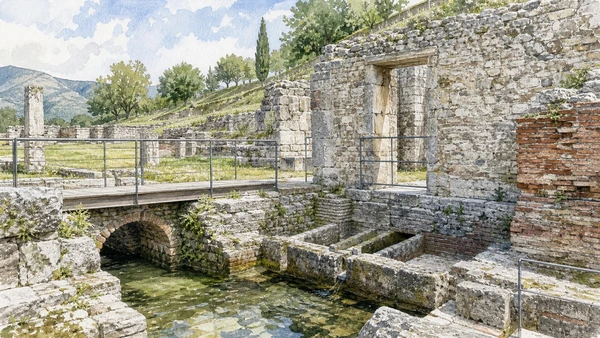
Masonry, heated rooms and water management document the technical systems required by the Roman settlement.

Baths and water: infrastructure behind urban comfort

Masonry, heated rooms and water management document the technical systems required by the Roman settlement. The place becomes clearer when surviving fabric, later change and present use are read together.

Today

Archaeological access can change because of conservation, excavation, weather or staffing. Stay outside barriers and verify the official opening notice.

History

Public bathing depended on supply, drainage and maintenance that changed with the fortunes of the town.

How to read this place

Read room sequence and construction rather than imagining intact decoration; remain behind conservation barriers.

What to notice

  • original masonry and later support work
  • the relation between excavation and modern surroundings
  • areas intentionally left unexcavated
Parco archeologico di Sepino
Original documentary watercolour of Baths and water: infrastructure behind urban comfort in Sepino, Saepinum and the Tammaro · Molise, showing accurate architecture, landscape and present-day use
Baths and water: infrastructure behind urban comfortOriginal Merlintravel documentary watercolour · 2026
07

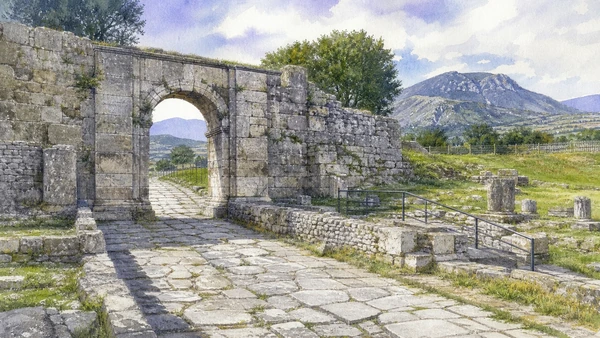
The gate maintains the axis of the decumanus toward the Tammaro and routes into Campania.

Porta Benevento: the town opens southeast

The gate maintains the axis of the decumanus toward the Tammaro and routes into Campania. The place becomes clearer when surviving fabric, later change and present use are read together.

Today

Archaeological access can change because of conservation, excavation, weather or staffing. Stay outside barriers and verify the official opening notice.

History

Fortifications and road planning expressed Roman control while retaining the practical movement of people, goods and animals.

How to read this place

Compare it with Porta Bojano and observe orientation, inscriptions and the landscape beyond rather than treating both gates as interchangeable.

What to notice

  • original masonry and later support work
  • the relation between excavation and modern surroundings
  • areas intentionally left unexcavated
Parco archeologico di Sepino
Original documentary watercolour of Porta Benevento: the town opens southeast in Sepino, Saepinum and the Tammaro · Molise, showing accurate architecture, landscape and present-day use
Porta Benevento: the town opens southeastOriginal Merlintravel documentary watercolour · 2026
08

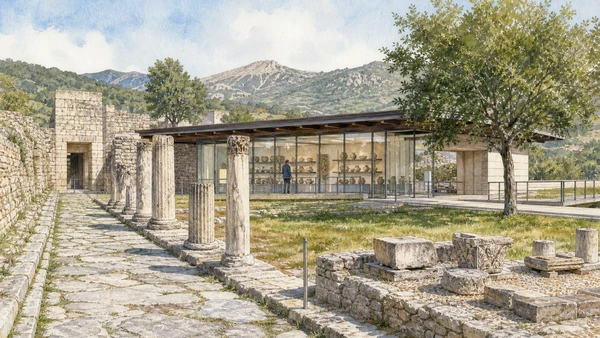
A small site museum supports the reading of streets, buildings and the surrounding territory.

The Saepinum museum: objects returned to their contexts

A small site museum supports the reading of streets, buildings and the surrounding territory. The place becomes clearer when surviving fabric, later change and present use are read together.

Today

Opening, ticketing, room access and temporary displays can change. Check the museum’s official notice shortly before visiting and allow for security or conservation controls.

History

Finds from excavation and local research were assembled to explain phases that cannot be understood from exposed masonry alone.

How to read this place

Match labels and provenance to the outdoor route; opening and display arrangements can change.

What to notice

  • the chronological order of the displays
  • finds tied to documented excavation contexts
  • modern conservation and interpretation
Direzione regionale Musei nazionali Molise
Original documentary watercolour of The Saepinum museum: objects returned to their contexts in Sepino, Saepinum and the Tammaro · Molise, showing accurate architecture, landscape and present-day use
The Saepinum museum: objects returned to their contextsOriginal Merlintravel documentary watercolour · 2026
09

The broad pastoral route passes through Saepinum and makes seasonal movement visible within Roman urban planning.

The Pescasseroli–Candela tratturo: a road through the town

The broad pastoral route passes through Saepinum and makes seasonal movement visible within Roman urban planning. The place becomes clearer when surviving fabric, later change and present use are read together.

Today

Weather, heat, fire risk, snow, sea state and seasonal restrictions can alter access. Use official park or reserve information and remain on authorised routes.

History

Transhumance long predated and outlasted the Roman town, later becoming regulated by southern Italian institutions.

How to read this place

Read width, gates and surrounding pasture without reducing the tratturo to a hiking path; it remains a cultural landscape crossing working land.

What to notice

  • geology and native vegetation
  • authorised paths and protected habitats
  • working land or water beside conservation zones
Italia.it · landscapes of Molise
Original documentary watercolour of The Pescasseroli–Candela tratturo: a road through the town in Sepino, Saepinum and the Tammaro · Molise, showing accurate architecture, landscape and present-day use
The Pescasseroli–Candela tratturo: a road through the townOriginal Merlintravel documentary watercolour · 2026
10

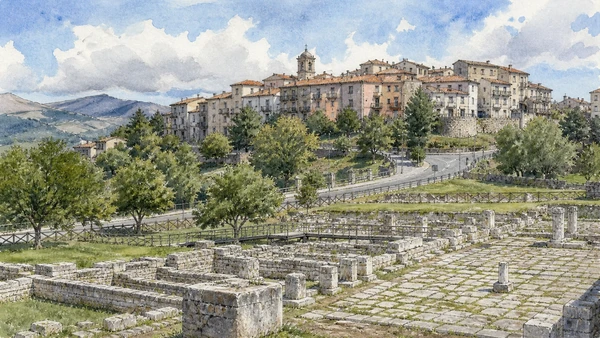
The inhabited centre gathers churches, lanes and civic life uphill from Altilia.

Sepino: the later town above the archaeological plain

The inhabited centre gathers churches, lanes and civic life uphill from Altilia. The place becomes clearer when surviving fabric, later change and present use are read together.

Today

This is an inhabited place, not a visitor set. Keep doorways, pavements and deliveries clear, and use current municipal mobility information.

History

Population and institutions reorganised after antiquity, while the ancient name and territory continued in new settlement forms.

How to read this place

Visit the modern town as its own historical layer and avoid treating it merely as a service stop for the Roman site.

What to notice

  • street width and building materials
  • residential use behind historic facades
  • later infrastructure and adaptation
Italia.it · Sepino
Original documentary watercolour of Sepino: the later town above the archaeological plain in Sepino, Saepinum and the Tammaro · Molise, showing accurate architecture, landscape and present-day use
Sepino: the later town above the archaeological plainOriginal Merlintravel documentary watercolour · 2026

Molise through time

A short chronology

From Palaeolithic evidence and Samnite sanctuaries to Roman towns, monastic power, pastoral routes, emigration, modern infrastructure and cultural renewal.

  1. Isernia La Pineta preserves evidence of very early human activity and environment in the central Mediterranean.

  2. Bronze and Iron Age communities organise upland settlement, exchange and burial across the Apennine interior.

  3. Samnite and Frentan communities establish sanctuaries, fortified ridges and routes linking mountains, plains and Adriatic approaches.

  4. Wars with Rome transform political control without immediately erasing local institutions and material culture.

  5. Romanisation reshapes Aesernia, Bovianum, Larinum and the pastoral corridor later formalised at Saepinum.

  6. Urban building, roads, amphitheatres, baths, estates and markets connect Molise to wider imperial systems.

  7. Population, worship and authority reorganise after Roman government, with Lombard Benevento becoming a decisive political framework.

  8. San Vincenzo al Volturno grows into a major Benedictine monastery before attack, destruction and later rebuilding.

  9. Monasteries, dioceses, castles and new settlements organise routes between the upper Volturno, Matese, Trigno and Biferno.

  10. Fortresses become noble residences while Albanian-speaking communities settle parts of lower Molise.

  11. Pastoral regulation, churches, craft towns and feudal estates connect the region to Naples, Abruzzo, Campania and Apulia.

  12. A destructive earthquake accelerates rebuilding and the reorganisation of Campobasso and many inland settlements.

  13. Unification, emigration, war damage and rural change precede the creation of the autonomous Molise region in 1963.

  14. Roads, reservoirs, coastal tourism and mountain facilities change access while depopulation reshapes inland communities.

  15. Museum renewal, park management, craft continuity and cultural-route projects expand interpretation under continuing demographic and climate pressure.

Before your visit

Practical information

01

Check the institution again

Opening hours, guided routes, restoration, worship and staffing change. Recheck the linked official notice shortly before departure.

02

Respect mountain time

Short distances can involve slow roads, snow, fog, heat or livestock. Do not compress distant valleys and coasts into one superficial day.

03

Keep inhabited places liveable

Historic centres, Arbëreshë communities, farms, ports and craft towns remain places of work and residence. Keep doors, quays and deliveries clear.

04

Treat archaeology as evidence

Stay behind barriers. Excavated remains and later reconstructions represent different stages of the site’s history.

05

Use current nature notices

Snow, fire risk, storms, caves, forest work, wildlife and sea conditions can alter access. Follow the responsible reserve, park or municipality.

06

Read modern change honestly

Reservoirs, roads, ski lifts, migration, rebuilding and museum reuse are documented parts of Molise rather than visual intrusions to hide.

Method and sources

Sources and image credits

This guide uses official ministry, museum, municipal, diocesan, reserve and national-tourism documentation checked on 1 September 2026. It distinguishes Palaeolithic, Samnite, Frentan, Roman, Lombard, monastic, Norman, early modern and contemporary phases rather than treating Molise as a timeless rural landscape. Every chapter links its principal institutional source; tickets, worship, closures, snow, fire risk, sea conditions and transport must always be verified again on the day of the visit.

All ten images are original Merlintravel editorial watercolours based on documented present-day conditions. They are illustrations, not substitutes for archaeological plans. Opening hours, tickets, accessible routes, temporary exhibitions and conservation work can change; consult the linked official pages shortly before visiting.