Italy · Regional journey 17

Calabria

Magna Graecia, Byzantine valleys, mountain plateaux and coasts between the Tyrrhenian and Ionian seas.

6historic layers
4editorial journeys
8territorial gateways
Calabria is a mountain peninsula whose histories repeatedly face the sea.
The regional idea

From Greek colonies and the Riace Bronzes to Byzantine churches, Norman centres, Arbëreshë and Grecanic communities, Sila forests, Aspromonte, Pollino and two contrasting coastlines, Calabria demands an itinerary larger than its beaches.

Time made visible

History in layers.

Bruttians and Greek cities, Rome, Byzantine continuity, Norman reorganisation, southern kingdoms, seismic disasters and migration all shaped a long, rugged peninsula.

01

Indigenous cultures and Greek cities

Oenotrian and Bruttian territories interacted with coastal poleis such as Sybaris, Kroton and Locri.

02

Roman Calabria

Roads, estates and towns transformed ancient systems while maintaining important Mediterranean connections.

03

Byzantine themes and monasticism

Eastern Christian institutions, cave settlements and Greek language endured especially in southern areas.

04

Normans and medieval kingdoms

Cathedrals, castles and Latin monasteries reorganised power while preserving varied local traditions.

05

Aragonese, Spanish and Bourbon south

Coastal defence, feudal estates and repeated earthquakes shaped settlement and authority.

06

Migration and contemporary Calabria

Emigration, land reform, infrastructure, archaeology and cultural recovery changed the modern region.

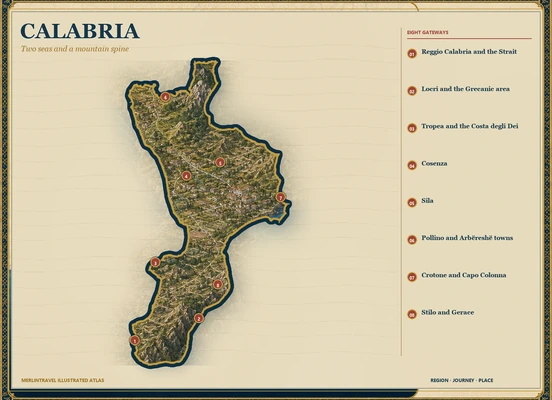
Illustrated map of Calabria with eight numbered Merlintravel gateways
Merlintravel illustrated atlas · official ISTAT profile archived separately
The complete circuit

A mountain spine between the Ionian and Tyrrhenian seas.

The atlas follows both seas while repeatedly crossing the mountain spine through Pollino, Sila, Serre and Aspromonte.

Map markers identify editorial gateways, not a ranking.

Four ways through

Journeys, not checklists.

Four circuits connect archaeology, language, sacred landscapes, towns rebuilt after earthquakes and protected mountain environments.

01

Reggio and the Strait

The museum, waterfront, Aspromonte and Grecanic area form a southern gateway facing Sicily.

02

Locride and the Ionian Greeks

Locri, Gerace, Stilo and coastal valleys connect Greek archaeology to Byzantine and medieval heritage.

03

Crotone, Sila and the north-east

Magna Graecia, forest plateaux, Arbëreshë towns and Ionian landscapes define a broad circuit.

04

Cosenza, Pollino and the Tyrrhenian

Historic centres, mountain parks, Riviera towns and the Costa degli Dei lead down the western shore.

Eight territorial doors

Places that open the story.

Each gateway is a future chapter: a city, landscape or cultural system large enough to deserve its own documented guide.

01

Reggio Calabria and the Strait

The Riace Bronzes, rebuilt city, seafront and a cultural horizon facing Sicily.

02

Locri and the Grecanic area

Greek archaeology, Byzantine memory and living language traditions along the southern Ionian coast.

03

Tropea and the Costa degli Dei

A historic cliff town above Tyrrhenian beaches, farming landscapes and views towards the Aeolian Islands.

04

Cosenza

An old city on two rivers, a modern cultural centre and gateway to Sila and Pollino.

05

Sila

Forests, lakes, plateau villages, pastoral history and a national park in the peninsula’s high interior.

06

Pollino and Arbëreshë towns

Ancient pines, canyons and Albanian-language communities across a shared mountain massif.

07

Crotone and Capo Colonna

Greek Kroton, Hera’s sanctuary, Pythagorean memory and a protected Ionian marine landscape.

08

Stilo and Gerace

Byzantine churches, Norman cathedrals and hill towns above the Ionian valleys.

Living and monumental heritage

What the region keeps.

Monuments matter, but so do languages, crafts, routes, rituals and working landscapes.

01

Magna Graecia collections

Museums and archaeological parks reconnect celebrated bronzes to cities, sanctuaries and Indigenous neighbours.

02

Byzantine south

Churches, monasteries, icons and Greek-derived traditions preserve eastern Mediterranean continuities.

03

Arbëreshë and Grecanic languages

Minority communities maintain distinct languages, rites, music and social memory.

04

Rebuilt cities

Earthquakes repeatedly altered urban form; reconstruction belongs to the region’s architectural history.

Land and water

Nature is part of the archive.

Land, water and ecological systems are read together with the communities that have learned to inhabit them.

01

Pollino

High limestone, old Bosnian pines and deep gorges create a vast transregional protected area.

02

Sila

Forests, plateaux and lakes form an unexpected highland environment close to both seas.

03

Aspromonte

Steep valleys descend from forests to the Strait and the southern Ionian, sustaining rare habitats.

04

Two coastlines

Tyrrhenian cliffs and bays contrast with longer Ionian shores, river mouths and ancient coastal plains.

A documented journey, still open.

Magna Graecia is not used as a generic label for every ancient site; Greek, Indigenous and Roman phases are distinguished. Minority languages are located in real communities.

The journey continues.

Return to the Italy regional atlas