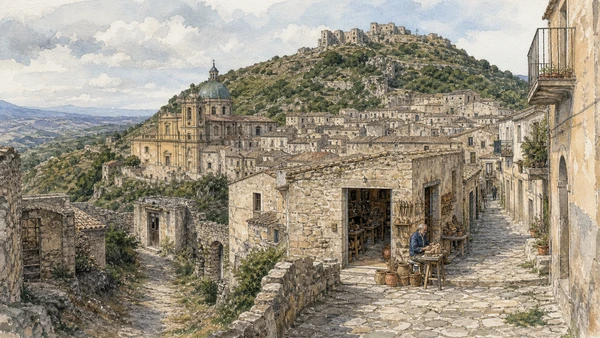
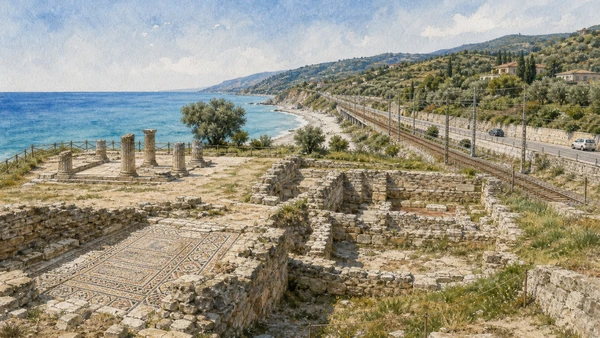
Original documentary watercolour panorama for Stilo and Gerace: Complete Guide, with accurate Calabrian architecture, landscape and lived context

Calabria Guide 08 · Byzantine church, monastic valleys, ironworks, charterhouse, Norman cathedral, hill towns and Ionian archaeology

Stilo and Gerace
above the Ionian

A four-day route through the Stilaro and Locride interiors, connecting Byzantine and Latin institutions, industry, forests, hill towns and the ancient coast.

Plan the route
Stilo and Gerace · Calabria10 chapters · one complete route

Why this route must be read in layers

Stilo and Gerace reveal a long Ionian interior in which Byzantine, Norman, monastic, industrial and modern layers remain adjacent but distinct.

The Cattolica is a compact middle-Byzantine church whose plan, reused columns and frescoes require close reading. Its fame should not reduce Stilo to one isolated monument or confuse every later church with Byzantine survival.

Bivongi, Mongiana and Serra San Bruno extend the route through Orthodox revival, waterfalls, state ironworks, forests and a continuing Carthusian institution. These are different chronologies joined by mountain roads.

Gerace preserves one of Calabria’s major cathedral landscapes, but earthquakes, liturgical change and restoration affected every phase. Kaulon on the coast closes the circuit by returning to Greek and Roman archaeology without turning medieval towns into direct continuations of a polis.

Allow four days: Stilo, the Stilaro valley, Serra San Bruno, and Gerace-Kaulon each require their own route and current access checks.

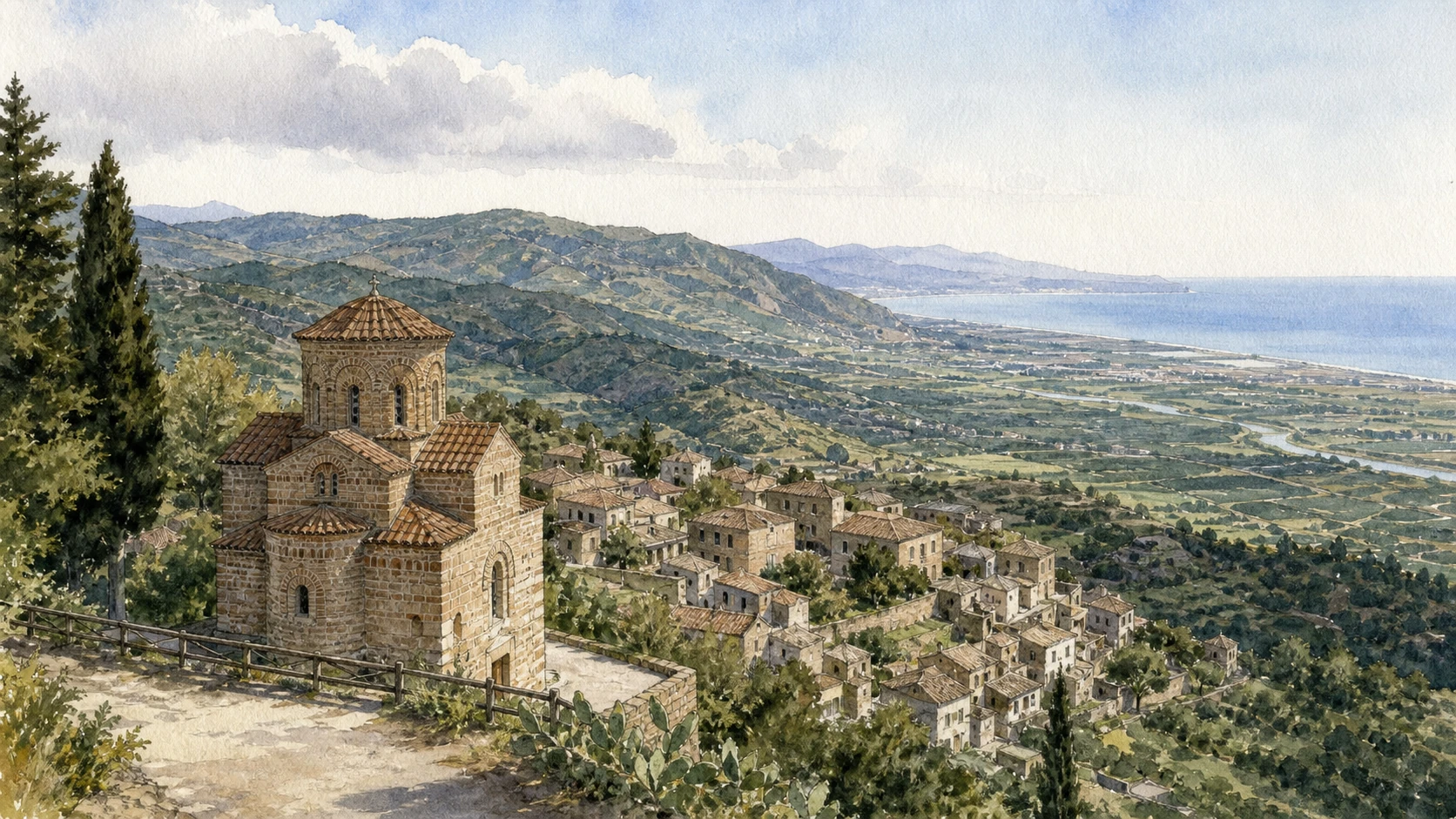
The route

Plan your visit

Climb Stilo first, follow the valley through monastic and industrial sites, cross the Serre separately, then devote a final day to Gerace and Kaulon’s archaeological coast.

Early morning

Cattolica di Stilo · Stilo historic centre · Mount Consolino and Stilo Castle

Move in the documented order: Cattolica di Stilo: middle-Byzantine architecture in miniature; then Stilo historic centre: Campanella’s town beyond the monument; then Mount Consolino and Stilo Castle. Recheck live access and transport before entering a controlled site.

Late morning

San Giovanni Theristis · Mongiana ironworks · Serra San Bruno

Move in the documented order: San Giovanni Theristis: monastic revival and historic fabric; then Mongiana ironworks: state industry in the Serre; then Serra San Bruno: charterhouse, forest and living enclosure. Recheck live access and transport before entering a controlled site.

Afternoon

Gerace Cathedral · San Francesco d’Assisi in Gerace · Gerace

Move in the documented order: Gerace Cathedral: Greek and Latin worlds in one long building history; then San Francesco d’Assisi in Gerace: mendicant church and later reuse; then Gerace: castle ridge, workshops and inhabited stone streets. Recheck live access and transport before entering a controlled site.

Late afternoon

Kaulon at Monasterace

Move in the documented order: Kaulon at Monasterace: Greek city and Roman maritime house. Recheck live access and transport before entering a controlled site.

Ten chapters

Explore the places

The order follows terrain, institutions and present-day movement. Use the index to return to a chapter without reducing the route to isolated monuments.

  1. 01Cattolica di Stilo: middle-Byzantine architecture in miniature
  2. 02Stilo historic centre: Campanella’s town beyond the monument
  3. 03Mount Consolino and Stilo Castle
  4. 04San Giovanni Theristis: monastic revival and historic fabric
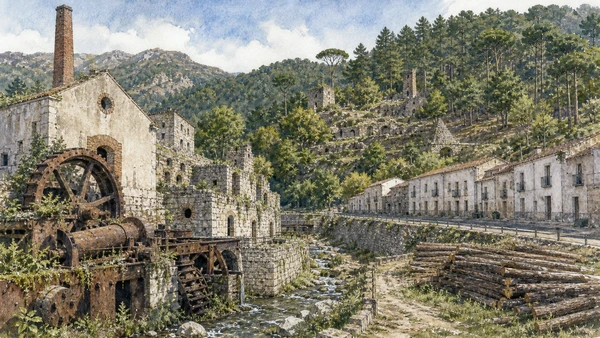
  5. 05Mongiana ironworks: state industry in the Serre
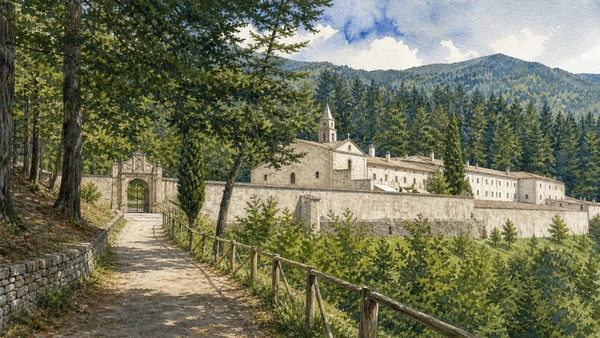
  6. 06Serra San Bruno: charterhouse, forest and living enclosure
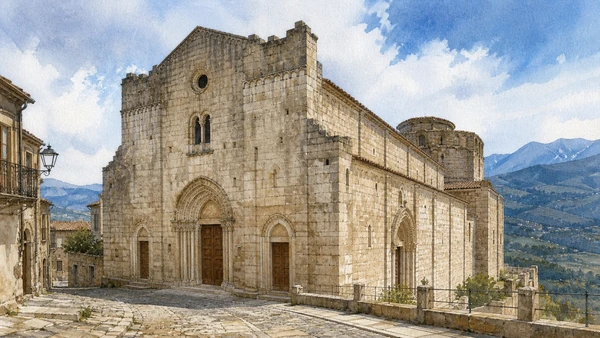
  7. 07Gerace Cathedral: Greek and Latin worlds in one long building history
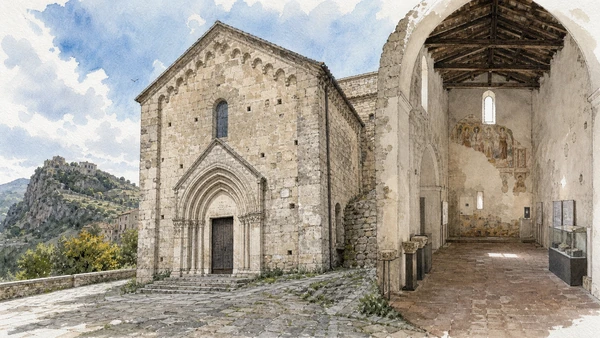
  8. 08San Francesco d’Assisi in Gerace: mendicant church and later reuse
  9. 09Gerace: castle ridge, workshops and inhabited stone streets
  10. 10Kaulon at Monasterace: Greek city and Roman maritime house
01

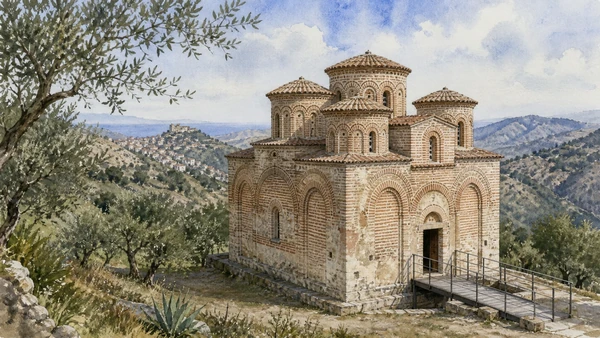
Greek-cross plan, five domes, reused columns and fragmentary frescoes concentrate a complex liturgical and material history.

Cattolica di Stilo: middle-Byzantine architecture in miniature

Greek-cross plan, five domes, reused columns and fragmentary frescoes concentrate a complex liturgical and material history. The site becomes clearer when its surviving fabric, later alterations and present use are read together.

Today

This is an active religious place as well as a historic building. Services, ceremonies and conservation can interrupt tourist access; dress appropriately, remain quiet and never treat a booked visit as priority over worship.

History

The church belongs to the middle-Byzantine cultural environment of southern Calabria; later use, repair and conservation affected its surviving surfaces.

How to read this place

Begin with cross-in-square spatial organisation. Then compare reused columns and inscriptions with fresco layers under controlled interior light; the differences are evidence, not visual noise.

What to notice

  • cross-in-square spatial organisation
  • reused columns and inscriptions
  • fresco layers under controlled interior light
Ministero della Cultura · La Cattolica di Stilo
Original documentary watercolour of Cattolica di Stilo: middle-Byzantine architecture in miniature in Stilo and Gerace · Calabria, showing accurate architecture, landscape, people and present-day use
Cattolica di Stilo: middle-Byzantine architecture in miniatureOriginal Merlintravel documentary watercolour · 2026
02

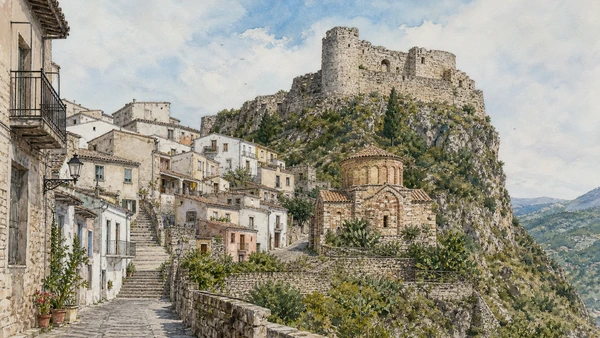
Lanes, churches, palaces and civic memory occupy the slopes below Mount Consolino.

Stilo historic centre: Campanella’s town beyond the monument

Lanes, churches, palaces and civic memory occupy the slopes below Mount Consolino. The site becomes clearer when its surviving fabric, later alterations and present use are read together.

Today

The area is inhabited and worked, not staged for visitors. Keep doorways, pavements, cycle lanes and deliveries clear, ask before photographing people and use current municipal mobility information.

History

The town developed through Byzantine, Norman and later southern-kingdom phases; Tommaso Campanella’s birthplace adds an intellectual history distinct from the Cattolica.

How to read this place

Begin with street levels climbing the slope. Then compare churches from different periods with inhabited houses and civic spaces; the differences are evidence, not visual noise.

What to notice

  • street levels climbing the slope
  • churches from different periods
  • inhabited houses and civic spaces
Regione Calabria · Cattolica of Stilo
Original documentary watercolour of Stilo historic centre: Campanella's town beyond the monument in Stilo and Gerace · Calabria, showing accurate architecture, landscape, people and present-day use
Stilo historic centre: Campanella’s town beyond the monumentOriginal Merlintravel documentary watercolour · 2026
03

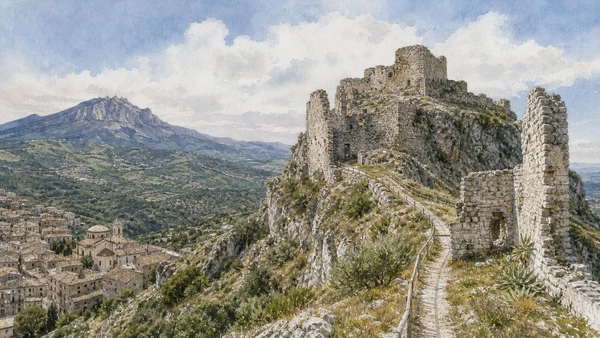
Ruined fortification and mountain paths reveal the strategic terrain above the Stilaro valley.

Mount Consolino and Stilo Castle

Ruined fortification and mountain paths reveal the strategic terrain above the Stilaro valley. The site becomes clearer when its surviving fabric, later alterations and present use are read together.

Today

Weather, water levels, trail conditions and seasonal services can alter the route. Use official transport and park information, remain on authorised paths and do not enter farms, vineyards or private gardens without permission.

History

Medieval defensive works occupied the summit and were changed by conflict, abandonment and natural decay; access depends on path and weather conditions.

How to read this place

Begin with castle position above town and valley. Then compare surviving walls without imagined reconstruction with exposed authorised paths on the mountain; the differences are evidence, not visual noise.

What to notice

  • castle position above town and valley
  • surviving walls without imagined reconstruction
  • exposed authorised paths on the mountain
Regione Calabria · Cattolica of Stilo
Original documentary watercolour of Mount Consolino and Stilo Castle in Stilo and Gerace · Calabria, showing accurate architecture, landscape, people and present-day use
Mount Consolino and Stilo CastleOriginal Merlintravel documentary watercolour · 2026
04

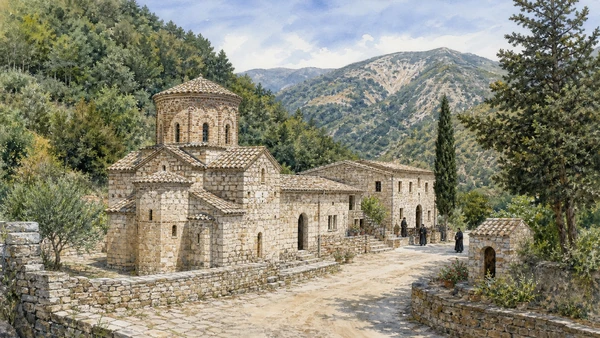
The church and present Orthodox community occupy a rural valley shaped by Byzantine monastic memory and modern restoration.

San Giovanni Theristis: monastic revival and historic fabric

The church and present Orthodox community occupy a rural valley shaped by Byzantine monastic memory and modern restoration. The site becomes clearer when its surviving fabric, later alterations and present use are read together.

Today

This is an active religious place as well as a historic building. Services, ceremonies and conservation can interrupt tourist access; dress appropriately, remain quiet and never treat a booked visit as priority over worship.

History

The medieval monastic site underwent decline and later recovery; contemporary worship is a living revival, not an unchanged continuation of every earlier practice.

How to read this place

Begin with church masonry and plan. Then compare restored monastic spaces with current religious use within the valley; the differences are evidence, not visual noise.

What to notice

  • church masonry and plan
  • restored monastic spaces
  • current religious use within the valley
Regione Calabria · Official tourism
Original documentary watercolour of San Giovanni Theristis: monastic revival and historic fabric in Stilo and Gerace · Calabria, showing accurate architecture, landscape, people and present-day use
San Giovanni Theristis: monastic revival and historic fabricOriginal Merlintravel documentary watercolour · 2026
05

Foundry remains, museum collections and planned worker settlement challenge the idea of a purely rural interior.

Mongiana ironworks: state industry in the Serre

Foundry remains, museum collections and planned worker settlement challenge the idea of a purely rural interior. The site becomes clearer when its surviving fabric, later alterations and present use are read together.

Today

Opening, ticketing, room access and temporary displays can change. Check the institution’s official notice shortly before visiting, use the designated entrance and allow for security or conservation controls.

History

Bourbon state industry expanded iron production and forestry management in the eighteenth and nineteenth centuries before decline after unification.

How to read this place

Begin with industrial machinery and buildings. Then compare worker housing and planned streets with forest resources tied to production; the differences are evidence, not visual noise.

What to notice

  • industrial machinery and buildings
  • worker housing and planned streets
  • forest resources tied to production
Ministero della Cultura · National museums in Calabria
Original documentary watercolour of Mongiana ironworks: state industry in the Serre in Stilo and Gerace · Calabria, showing accurate architecture, landscape, people and present-day use
Mongiana ironworks: state industry in the SerreOriginal Merlintravel documentary watercolour · 2026
06

The Carthusian complex and surrounding woods represent continuing religious life with strict limits on visitor access.

Serra San Bruno: charterhouse, forest and living enclosure

The Carthusian complex and surrounding woods represent continuing religious life with strict limits on visitor access. The site becomes clearer when its surviving fabric, later alterations and present use are read together.

Today

This is an active religious place as well as a historic building. Services, ceremonies and conservation can interrupt tourist access; dress appropriately, remain quiet and never treat a booked visit as priority over worship.

History

Bruno of Cologne founded the monastery around the turn of the twelfth century; earthquakes and rebuilding produced the present complex while enclosure remained central.

How to read this place

Begin with publicly accessible church and museum areas. Then compare forest approaches and pilgrimage spaces with clear boundaries around the monastic enclosure; the differences are evidence, not visual noise.

What to notice

  • publicly accessible church and museum areas
  • forest approaches and pilgrimage spaces
  • clear boundaries around the monastic enclosure
Regione Calabria · Official tourism
Original documentary watercolour of Serra San Bruno: charterhouse, forest and living enclosure in Stilo and Gerace · Calabria, showing accurate architecture, landscape, people and present-day use
Serra San Bruno: charterhouse, forest and living enclosureOriginal Merlintravel documentary watercolour · 2026
07

Large basilican spaces, crypt, reused elements and later furnishings anchor the hill town’s ecclesiastical power.

Gerace Cathedral: Greek and Latin worlds in one long building history

Large basilican spaces, crypt, reused elements and later furnishings anchor the hill town’s ecclesiastical power. The site becomes clearer when its surviving fabric, later alterations and present use are read together.

Today

This is an active religious place as well as a historic building. Services, ceremonies and conservation can interrupt tourist access; dress appropriately, remain quiet and never treat a booked visit as priority over worship.

History

The cathedral developed under Norman rule within a region of Greek Christian traditions; earthquakes, rebuilding and liturgical change altered its fabric.

How to read this place

Begin with nave columns and reused material. Then compare crypt and later chapels with cathedral precinct within the living town; the differences are evidence, not visual noise.

What to notice

  • nave columns and reused material
  • crypt and later chapels
  • cathedral precinct within the living town
Ministero della Cultura · Museo diocesano di Gerace
Original documentary watercolour of Gerace Cathedral: Greek and Latin worlds in one long building history in Stilo and Gerace · Calabria, showing accurate architecture, landscape, people and present-day use
Gerace Cathedral: Greek and Latin worlds in one long building historyOriginal Merlintravel documentary watercolour · 2026
08

Gothic portal, austere interior and surviving decoration record a medieval institution adapted after religious suppression.

San Francesco d’Assisi in Gerace: mendicant church and later reuse

Gothic portal, austere interior and surviving decoration record a medieval institution adapted after religious suppression. The site becomes clearer when its surviving fabric, later alterations and present use are read together.

Today

This is an active religious place as well as a historic building. Services, ceremonies and conservation can interrupt tourist access; dress appropriately, remain quiet and never treat a booked visit as priority over worship.

History

The church belonged to a Franciscan complex and experienced changing functions after the suppression of religious houses.

How to read this place

Begin with pointed portal and façade masonry. Then compare interior spatial simplicity with conservation and present cultural use; the differences are evidence, not visual noise.

What to notice

  • pointed portal and façade masonry
  • interior spatial simplicity
  • conservation and present cultural use
Ministero della Cultura · National museums in Calabria
Original documentary watercolour of San Francesco d'Assisi in Gerace: mendicant church and later reuse in Stilo and Gerace · Calabria, showing accurate architecture, landscape, people and present-day use
San Francesco d’Assisi in Gerace: mendicant church and later reuseOriginal Merlintravel documentary watercolour · 2026
09

Churches, palaces, rock-cut spaces and craft activity form a town whose value lies in the whole urban organism.

Gerace: castle ridge, workshops and inhabited stone streets

Churches, palaces, rock-cut spaces and craft activity form a town whose value lies in the whole urban organism. The site becomes clearer when its surviving fabric, later alterations and present use are read together.

Today

The area is inhabited and worked, not staged for visitors. Keep doorways, pavements, cycle lanes and deliveries clear, ask before photographing people and use current municipal mobility information.

History

A strategic hill settlement grew through Byzantine and Norman periods and later southern kingdoms; earthquakes and migration changed occupancy and building condition.

How to read this place

Begin with relationship between upper castle and cathedral. Then compare stone lanes and active workshops with restored, inhabited and vacant fabric side by side; the differences are evidence, not visual noise.

What to notice

  • relationship between upper castle and cathedral
  • stone lanes and active workshops
  • restored, inhabited and vacant fabric side by side
Regione Calabria · Official tourism
Original documentary watercolour of Gerace: castle ridge, workshops and inhabited stone streets in Stilo and Gerace · Calabria, showing accurate architecture, landscape, people and present-day use
Gerace: castle ridge, workshops and inhabited stone streetsOriginal Merlintravel documentary watercolour · 2026
10

Temple remains, mosaics, museum objects and shoreline change return the route to the ancient Ionian coast.

Kaulon at Monasterace: Greek city and Roman maritime house

Temple remains, mosaics, museum objects and shoreline change return the route to the ancient Ionian coast. The site becomes clearer when its surviving fabric, later alterations and present use are read together.

Today

Archaeological access may be limited to protected viewpoints, scheduled openings or guided routes. Stay outside barriers, distinguish original material from supports and reconstruction, and verify the official opening notice.

History

The Greek city developed from the archaic period and later passed through Roman occupation; erosion and modern infrastructure complicate the archaeological landscape.

How to read this place

Begin with temple area against the coast. Then compare mosaic and building remains with rail, road and shoreline beside the protected site; the differences are evidence, not visual noise.

What to notice

  • temple area against the coast
  • mosaic and building remains
  • rail, road and shoreline beside the protected site
Ministero della Cultura · Museum and Archaeological Park of ancient Kaulon
Original documentary watercolour of Kaulon at Monasterace: Greek city and Roman maritime house in Stilo and Gerace · Calabria, showing accurate architecture, landscape, people and present-day use
Kaulon at Monasterace: Greek city and Roman maritime houseOriginal Merlintravel documentary watercolour · 2026

Calabria through time

A short chronology

From Indigenous and Greek landscapes to Byzantine continuity, Norman institutions, earthquakes, migration, protected parks and contemporary cultural recovery.

  1. Caves, shelters and river valleys preserve evidence of long human occupation before permanent coastal cities.

  2. Indigenous Oenotrian landscapes encounter Greek settlement; Rhegion, Sybaris, Kroton and Locri develop as distinct poleis.

  3. Coastal cities establish sanctuaries, workshops, farms and exchange systems while maintaining different relations with inland communities.

  4. Bruttian power expands across the interior and contests Greek territories before Roman intervention.

  5. Roman roads, colonies, estates and ports reorganise older urban and rural systems across the peninsula.

  6. Byzantine administration, monastic networks and Greek liturgy remain especially influential in southern and Ionian Calabria.

  7. Norman conquest reshapes bishoprics, castles and monasteries while incorporating Greek and Latin institutions.

  8. Swabian, Angevin and Aragonese rule modifies fortifications, towns and routes; Albanian-speaking communities settle in several northern districts.

  9. Coastal towers and inland refuges respond to maritime raids while feudal estates and religious houses organise land and labour.

  10. A devastating earthquake sequence transforms settlements throughout central and southern Calabria and prompts new planning and reconstruction.

  11. French rule suppresses feudal institutions and many religious houses before Bourbon restoration.

  12. Italian unification is followed by administrative change, conflict over land and accelerating migration.

  13. The Messina Strait earthquake and tsunami destroy much of Reggio Calabria and neighbouring communities, shaping modern reconstruction.

  14. Land reform, roads, dams, tourism, internal migration and emigration transform cities, plateaux and both coastlines.

  15. National parks, archaeological networks, minority-language initiatives and cultural recovery operate alongside fire, erosion, depopulation and climate risk.

Before your visit

Practical information

01

Check the live page

Opening hours, reservation systems, restoration, exhibitions and transport can change. Recheck the linked official institution shortly before departure.

02

Separate worship and tourism

Churches and sanctuaries remain religious spaces. Services, funerals and community use take priority over visitor itineraries.

03

Plan real distances

Stilo and Gerace · Calabria combines dense urban routes with lakes, valleys and dispersed towns. Do not compress distant chapters into an unsafe or superficial day.

04

Keep thresholds open

Arcades, station halls, markets, courtyards, workshops and residential streets must continue to function while you observe or photograph them.

05

Use current mobility data

Check the responsible rail, navigation, bus, road or park operator on the day; replacement services and weather can change an otherwise sound route.

06

Read change honestly

Restoration, reconstruction, adaptive reuse and new development have all shaped the landscape visible today.

Method and sources

Sources and image credits

This guide uses official museum, ministry, regional-tourism, park and UNESCO documentation checked on 1 September 2026. It separates Greek, Indigenous, Roman, Byzantine and later phases instead of using Magna Graecia as a generic label, distinguishes surviving fabric from post-earthquake reconstruction, and treats worship, minority languages, farming, fishing, residence and public movement as part of the evidence. Every chapter links its principal institutional source; tickets, closures, weather, fire risk, sea conditions, trails and transport must always be verified again on the day of the visit.

All ten images are original Merlintravel editorial watercolours based on documented present-day conditions. They are illustrations, not substitutes for archaeological plans. Opening hours, tickets, accessible routes, temporary exhibitions and conservation work can change; consult the linked official pages shortly before visiting.