Friuli Venezia Giulia
Adriatic ports, Roman and Lombard cities, border cultures, vineyards and eastern Alpine valleys.
A frontier is not an edge; it is a place where histories accumulate.
Friuli Venezia Giulia brings together Friulian plains and hills, Trieste’s Adriatic and Central European worlds, Slovenian and German-speaking communities, Roman Aquileia, Lombard Cividale, Karst landscapes and mountains crossed by long routes.
History in layers.
The region’s past moves between Aquileia, the Patriarchate, Venetian Friuli, Habsburg Trieste, world wars, border violence and the difficult construction of a plural autonomous region.
Aquileia and the Roman Adriatic
A major Roman city and early Christian centre connected northern Europe to Mediterranean trade.
Patriarchate and Lombard Cividale
Ecclesiastical and ducal powers created durable institutions across Friuli’s medieval landscape.
Venice and Habsburg frontiers
Western Friuli and the eastern Adriatic followed different political paths while remaining commercially connected.
Trieste, port of empire
Free-port status, shipping, insurance, railways and migration made Trieste a cosmopolitan Habsburg city.
World wars and shifting borders
Fronts, occupations, fascist violence, the Foibe and the post-war exodus scarred communities across the region.
Autonomy and European crossings
The contemporary region protects linguistic diversity and now sits within renewed cross-border networks.

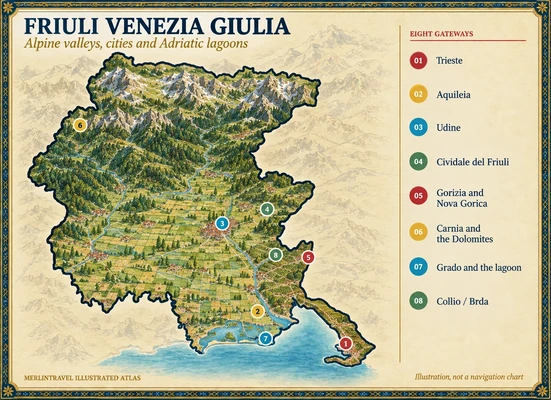
An Adriatic frontier shaped by mountains, rivers and borders.
The atlas follows the Adriatic from Grado to Trieste, then turns inland through the Karst, Collio, Udine, Cividale and the valleys of Carnia and the Julian Alps.
Map markers identify editorial gateways, not a ranking.
Journeys, not checklists.
Four circuits show how sea, plain, hills and mountains produced different but connected cultural worlds.
Trieste and the Karst
Port architecture, literary cafés, Slovenian villages, caves and border memorials form a complex eastern circuit.
Aquileia, Grado and the lagoon
Roman archaeology, early Christian mosaics, island settlement and wetland ecology meet on the coast.
Udine, Cividale and Collio
Friulian civic culture, Lombard heritage and vineyard hills lead towards the Slovenian border.
Carnia and the Julian Alps
Mountain villages, timber, pastoral routes, war landscapes and protected valleys reveal the northern region.
Places that open the story.
Each gateway is a future chapter: a city, landscape or cultural system large enough to deserve its own documented guide.
Trieste
A Habsburg-Adriatic port of neoclassical streets, literary cultures, multiple languages and difficult border memory.
Aquileia
Roman streets, museum collections and vast early Christian mosaics in a once-great Adriatic city.
Udine
A Friulian capital of Venetian art, civic squares, castles and routes towards hills and mountains.
Cividale del Friuli
Roman Forum Iulii, Lombard art, the Natisone gorge and a multilingual border hinterland.
Gorizia and Nova Gorica
A once-divided urban landscape now central to cross-border European cultural exchange.
Carnia and the Dolomites
Stone and timber villages, mountain craft, valleys and high protected landscapes around Forni di Sopra.
Grado and the lagoon
Early Christian heritage, fishing culture, islands and shallow-water ecosystems facing the Adriatic.
Collio / Brda
Vineyard hills, villages and food cultures continuing across the Italian-Slovenian border.
What the region keeps.
Monuments matter, but so do languages, crafts, routes, rituals and working landscapes.
Languages of the border
Friulian, Slovenian, German and Italian belong to specific communities, schools, signs and landscapes.
Aquileian mosaics
Archaeology and early Christianity document the scale and reach of the ancient city.
Lombard Cividale
Architecture and metalwork reveal an early medieval duchy connected to a wider European network.
Memory landscapes
Military cemeteries, trenches, monuments and museums require contextual, non-triumphal interpretation.
Nature is part of the archive.
Land, water and ecological systems are read together with the communities that have learned to inhabit them.
Julian Alps
Limestone peaks, forests and valleys form a transboundary ecological system.
Karst
Caves, sinkholes, dry stone and underground water shape both settlement and science.
Marano and Grado lagoons
Wetlands sustain fishing traditions, birdlife and fragile island environments.
Tagliamento
One of the Alps’ great braided rivers remains a key corridor of sediment, habitat and cultural geography.
A documented journey, still open.
Border history is written with care: Italian, Friulian, Slovenian and German-language communities are presented as living presences, while war and displacement are not reduced to picturesque multiculturalism.
The journey continues.
Return to the Italy regional atlas