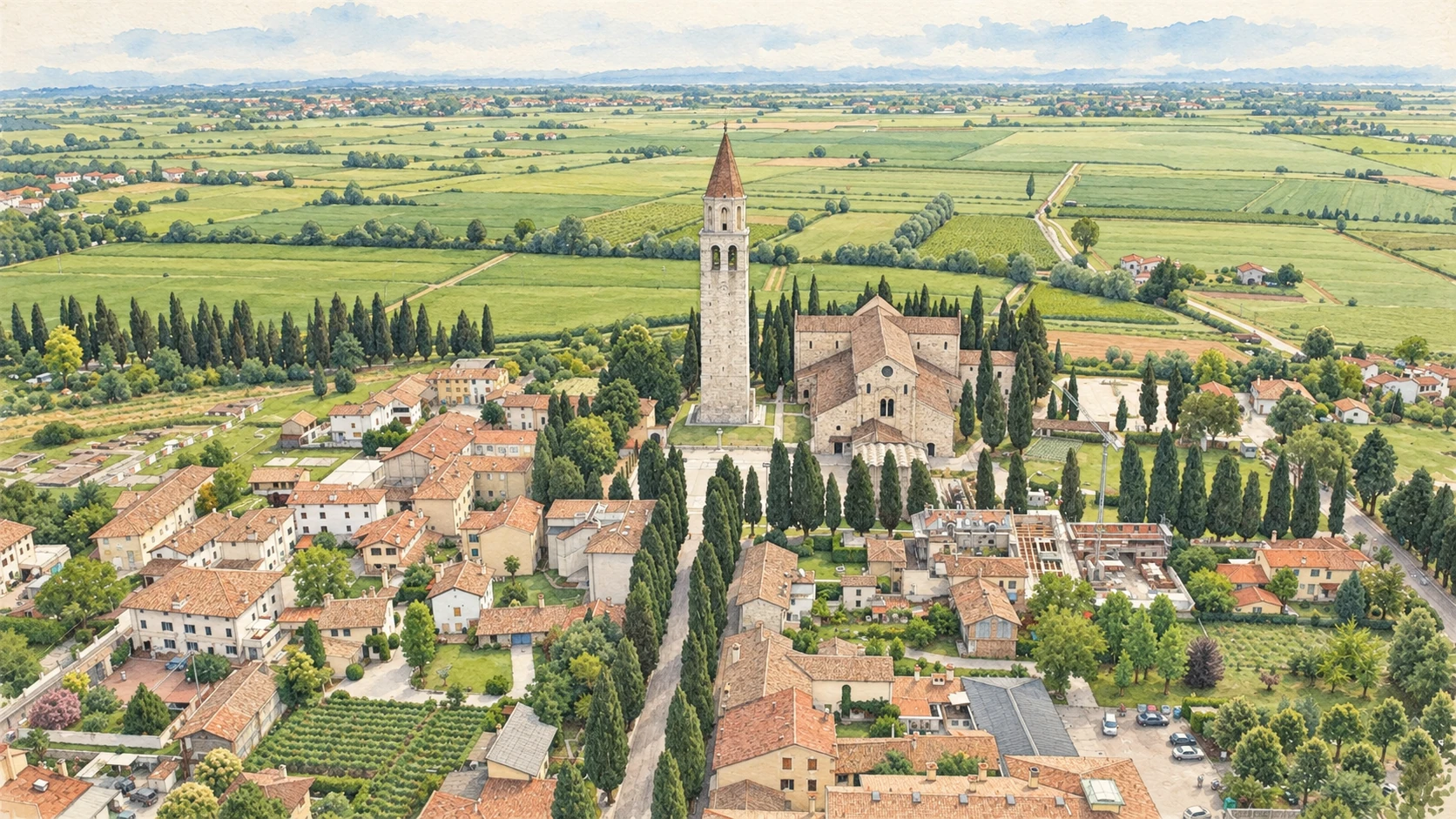
Watercolour: Aquileia establishing view

Friuli Venezia Giulia · Guide 02

Aquileia

A Roman port survives beneath a small modern town, while mosaics and successive sacred buildings reveal the changing life of an Adriatic crossroads.

Plan the route
Aquileia10 chapters · history, culture and landscape

Why this place matters

Look for the city beneath the open spaces.

Aquileia asks the visitor to change scale. A row of columns, a stretch of quay or a mosaic floor is a fragment of a much larger city. The basilica and museums give these fragments a setting, but they do not belong to one moment in time. Begin with a plan of the ancient settlement and return to it between visits. The present town remains inhabited; archaeological ground, museum collections and places of worship have distinct entrances and conditions.

The guide separates documented history from suggestions for reading the site. Named buildings and landscape relationships follow institutional sources; the illustrations are editorial interpretations, not measured surveys or records of current access.

A Roman port survives beneath a small modern town, while mosaics and successive sacred buildings reveal the changing life of an Adriatic crossroads.
The route

Plan your visit

Combine a manageable outdoor circuit with time inside the basilica and one museum. The Paleochristian Museum is a separate northern extension. Check the operator for conservation works and which archaeological areas are accessible; visible remains do not always mean an open visitor route.

Orientation

The forum and ancient city plan

Combine a manageable outdoor circuit with time inside the basilica and one museum.

Water and movement

The river port

Sacred complex

Basilica, baptistery and archaeological levels

Separate collections

National Archaeological and Paleochristian Museums

Ten chapters

Explore the places

The chapters connect history and terrain. Use the route notes to choose visits and plan transfers between separate sites.

  1. 01The Roman forum
  2. 02The river port
  3. 03The patriarchal basilica
  4. 04The basilica’s early Christian floor
  5. 05The crypt of the frescoes
  6. 06Baptistery and Südhalle
  7. 07Domus di Tito Macro
  8. 08Domus and episcopal palace
  9. 09Museo Archeologico Nazionale
  10. 10Museo Nazionale Paleocristiano
01

Evidence and interpretation

The Roman forum

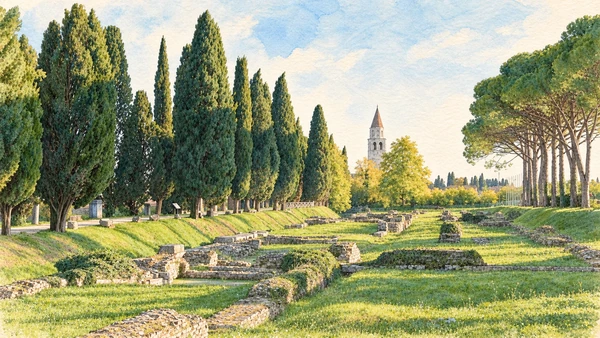
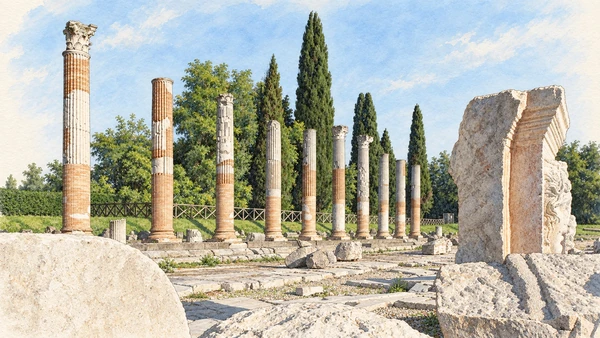
The surviving columns and paving mark a civic centre whose scale must be reconstructed intellectually rather than by filling every gap with an imagined building. The modern road and open ground are part of the encounter with its remains.

Today

Check the institution’s current opening, booking arrangements and accessible route. Individual rooms, exhibitions and approaches may have separate conditions.

History

Aquileia was founded as a Roman colony in 181 BCE. The forum belonged to the city’s civic and commercial organisation. Conservation of its surviving structures continues; restoration campaigns should not be confused with the uninterrupted survival of a complete ancient square.

How to read this place

Read the spacing of the columns, the paved surface and the boundary of excavated ground. Use interpretation to distinguish ancient stone, re-erected elements and modern protection. Follow any diversion associated with conservation work.

What to notice

  • Read the spacing of the columns, the paved surface and the boundary of excavated ground.
  • Use interpretation to distinguish ancient stone, re-erected elements and modern protection.
  • Follow any diversion associated with conservation work.
Fondazione Aquileia · Forum conservation
Watercolour: Aquileia actual Roman forum fragmentary standing columns and low remains beside modern town
The Roman forumEditorial watercolour · AI-generated · 2026
02

Evidence and interpretation

The river port

The quay makes the trading city tangible, even though the waterscape no longer resembles the ancient river. Long stone edges and loading levels tell a history of movement that differs from the formal spaces of the forum.

Today

Check the institution’s current opening, booking arrangements and accessible route. Individual rooms, exhibitions and approaches may have separate conditions.

History

The port stood on the ancient course of the Natisone and Torre. It was extensively reorganised in the early first century CE with quays and buildings behind them. The interpretation of those structures connects storage, loading and navigation.

How to read this place

Compare the different levels and the surviving mooring features. Do not use the present width or course of a water channel as a literal measure of the ancient river. Authorised paths protect both the visitor and fragile archaeological surfaces.

What to notice

  • Compare the different levels and the surviving mooring features.
  • Do not use the present width or course of a water channel as a literal measure of the ancient river.
  • Authorised paths protect both the visitor and fragile archaeological surfaces.
Fondazione Aquileia · Porto fluviale
Watercolour: Aquileia river-port archaeological remains and excavated masonry amid green grounds
The river portEditorial watercolour · AI-generated · 2026
03

Worship and memory

The patriarchal basilica

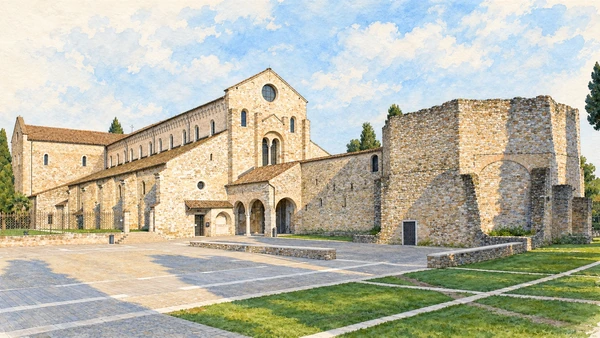
The basilica is the most conspicuous standing monument in a town where much of the Roman city survives below ground. Its exterior offers a first orientation; the interior then requires a slower reading of floors, columns and later interventions.

Today

Worship and local religious life continue here. Visitor access may pause for services; consult the church or managing institution before planning an interior visit.

History

The archaeological area and patriarchal basilica were inscribed on the World Heritage List in 1998. Their importance lies in the relationship between the Roman city and the early Christian centre, as well as the quality and extent of surviving evidence.

How to read this place

Distinguish the standing church from the earlier structures preserved beneath and within it. A medieval architectural volume can contain a much older floor. Consult the basilica’s current arrangements for worship and the different components of the visit.

What to notice

  • Distinguish the standing church from the earlier structures preserved beneath and within it.
  • A medieval architectural volume can contain a much older floor.
  • Consult the basilica’s current arrangements for worship and the different components of the visit.
UNESCO · Archaeological Area and Patriarchal Basilica of Aquileia
Watercolour: Aquileia basilica facade and baptistery on Piazza Capitolo
The patriarchal basilicaEditorial watercolour · AI-generated · 2026
04

Worship and memory

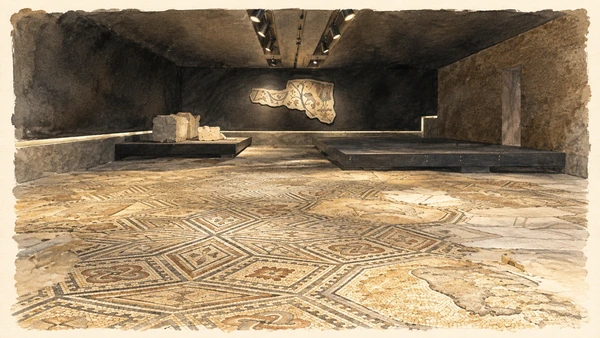
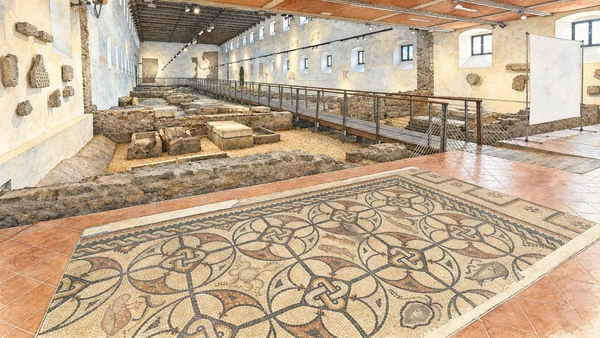
The basilica’s early Christian floor

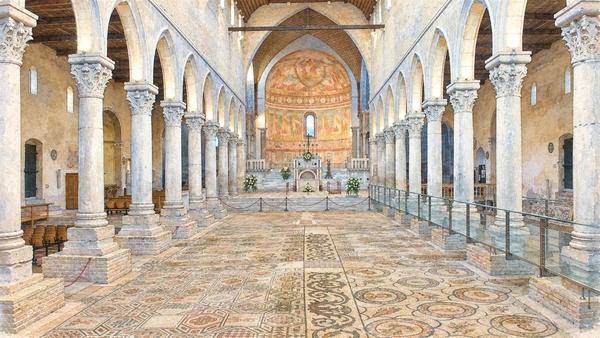
The mosaic is a surface to be read across the room rather than a single framed artwork. Figures, animals and marine scenes belong to a programme whose details become clearer when the overall arrangement is understood first.

Today

Worship and local religious life continue here. Visitor access may pause for services; consult the church or managing institution before planning an interior visit.

History

The floor preserves evidence of the early fourth-century halls of worship. The southern hall corresponds to the present basilica, while remains of the northern hall survive in the excavations area around the later bell tower’s foundations.

How to read this place

Observe from the designated walkway. Identify the Jonah sequence using the basilica’s interpretation, and distinguish a symbolic reading from a claim about a depicted real landscape. The illustration is a view of the floor, not an exact archaeological tracing.

What to notice

  • Observe from the designated walkway.
  • Identify the Jonah sequence using the basilica’s interpretation, and distinguish a symbolic reading from a claim about a depicted real landscape.
  • The illustration is a view of the floor, not an exact archaeological tracing.
Basilica di Aquileia · PromoTurismoFVG
Watercolour: Aquileia basilica authentic extensive early Christian mosaic floor seen from visitor walkway
The basilica’s early Christian floorEditorial watercolour · AI-generated · 2026
05

Worship and memory

The crypt of the frescoes

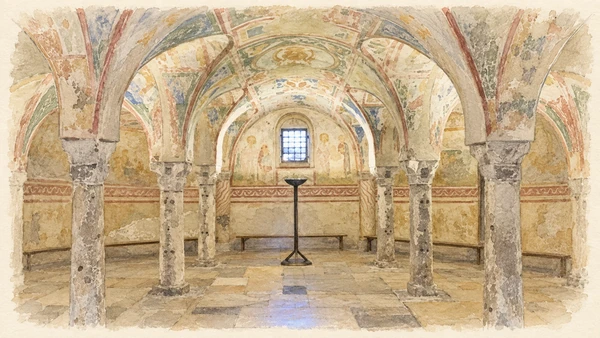
Below the raised sacred area, painted walls and vaults produce a different scale of experience from the broad mosaic floor. This is a distinct part of the basilica complex, not another name for the archaeological excavation crypt.

Today

Worship and local religious life continue here. Visitor access may pause for services; consult the church or managing institution before planning an interior visit.

History

The crypt was established in the ninth century and decorated with frescoes in the twelfth. Its imagery belongs to a medieval religious setting, several centuries later than the early Christian mosaics.

How to read this place

Compare the confined architecture with the painted narratives. Keep the two crypts distinct in planning and description: one is associated with medieval frescoes, the other with excavated earlier remains. Consult the current route for access to each.

What to notice

  • Compare the confined architecture with the painted narratives.
  • Keep the two crypts distinct in planning and description: one is associated with medieval frescoes, the other with excavated earlier remains.
  • Consult the current route for access to each.
Basilica di Aquileia · PromoTurismoFVG
Watercolour: Aquileia actual fresco crypt low vaulted interior with medieval wall painting
The crypt of the frescoesEditorial watercolour · AI-generated · 2026
06

Evidence and interpretation

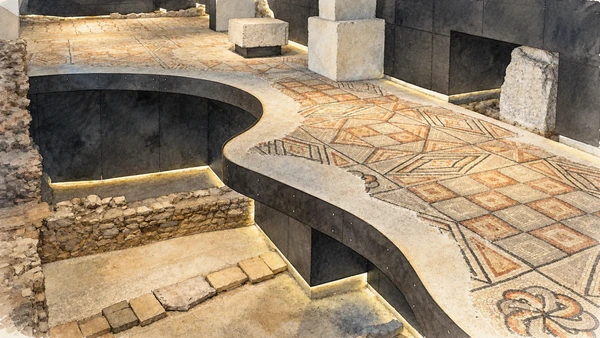
Baptistery and Südhalle

The baptistery and its southern hall extend the story beyond the basilica nave. The protected mosaic area makes it possible to read surviving floor material without mistaking the shelter for ancient architecture.

Today

Check the institution’s current opening, booking arrangements and accessible route. Individual rooms, exhibitions and approaches may have separate conditions.

History

The baptistery probably originated in the late fourth or early fifth century and was substantially changed later. Its font relates to baptism by immersion. The southern hall’s modern presentation also includes the peacock mosaic from the former connecting passage.

How to read this place

Separate the surviving structure, the excavated floor and the museum’s protective enclosure. The suggested function of the adjacent halls is an interpretation rather than a certainty. Use the official visitor route to understand their spatial relationship.

What to notice

  • Separate the surviving structure, the excavated floor and the museum’s protective enclosure.
  • The suggested function of the adjacent halls is an interpretation rather than a certainty.
  • Use the official visitor route to understand their spatial relationship.
Battistero di Aquileia e Südhalle · PromoTurismoFVG
Watercolour: Aquileia Südhalle actual protected mosaic floor and modern archaeological shelter
Baptistery and SüdhalleEditorial watercolour · AI-generated · 2026
07

Evidence and interpretation

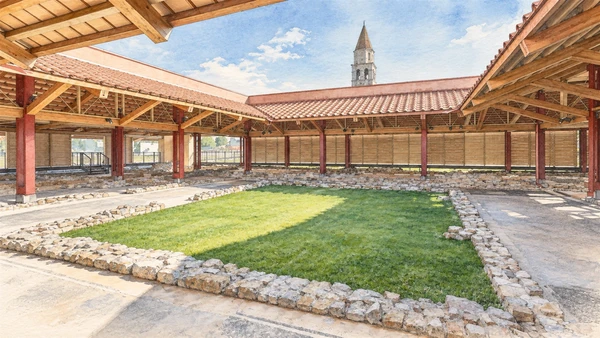
Domus di Tito Macro

The house provides a domestic counterpart to the civic square and harbour. Its plan gives the visitor a way to think about rooms, circulation and the organisation of a substantial Roman residence.

Today

Check the institution’s current opening, booking arrangements and accessible route. Individual rooms, exhibitions and approaches may have separate conditions.

History

The house developed from the first century BCE and remained in use into late antiquity. Its conventional attribution to Titus Macer derives from an inscribed stone weight found during excavation; the identification remains a proposal.

How to read this place

Distinguish ancient floors and walls from the modern architectural system that makes the plan legible. Avoid imagining every room as occupied at the same date. A useful question is how the residence changed over its long history.

What to notice

  • Distinguish ancient floors and walls from the modern architectural system that makes the plan legible.
  • Avoid imagining every room as occupied at the same date.
  • A useful question is how the residence changed over its long history.
Domus di Tito Macro · PromoTurismoFVG
Watercolour: Aquileia Domus di Tito Macro actual modern red roof shelter over low Roman house foundations
Domus di Tito MacroEditorial watercolour · AI-generated · 2026
08

Evidence and interpretation

Domus and episcopal palace

Here, depth is a way of reading time. The protected area presents floors and walls at different levels, allowing successive uses of one urban plot to be compared.

Today

Check the institution’s current opening, booking arrangements and accessible route. Individual rooms, exhibitions and approaches may have separate conditions.

History

The sequence includes a Roman house, a fourth-century apsidal hall and fifth-century structures associated with the episcopal palace. The remains belong to overlapping phases rather than to one building excavated all at once.

How to read this place

Begin with the section or phase diagram. Compare two levels before studying a decorative detail: a beautifully preserved mosaic is historically more useful when its relationship to surrounding walls and later construction is clear.

What to notice

  • Begin with the section or phase diagram.
  • Compare two levels before studying a decorative detail: a beautifully preserved mosaic is historically more useful when its relationship to surrounding walls and later construction is clear.
Domus e Palazzo Episcopale · PromoTurismoFVG
Watercolour: Aquileia Domus and episcopal palace real layered mosaic floors beneath modern protective building
Domus and episcopal palaceEditorial watercolour · AI-generated · 2026
09

Evidence and interpretation

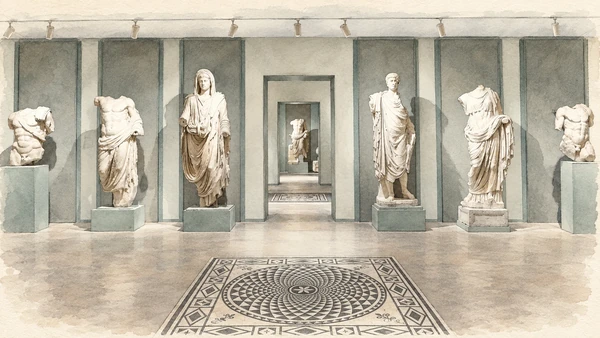
Museo Archeologico Nazionale

The museum turns isolated remains into evidence of people, exchange and everyday work. Objects from different materials and contexts help explain why Aquileia mattered beyond the limits of the excavated streets.

Today

Check the institution’s current opening, booking arrangements and accessible route. Individual rooms, exhibitions and approaches may have separate conditions.

History

The collection was formed through a long history of discoveries and excavation. Its displays address the Roman city’s production, trade, religious variety and population through inscriptions, portraits, sculpture and objects of daily use.

How to read this place

Select a small group of related finds and read the provenance information. Objects now placed side by side may have come from different settings and dates. The main galleries and visitable stores have their own arrangements; check the museum before planning a specialist visit.

What to notice

  • Select a small group of related finds and read the provenance information.
  • Objects now placed side by side may have come from different settings and dates.
  • The main galleries and visitable stores have their own arrangements; check the museum before planning a specialist visit.
Museo Archeologico Nazionale di Aquileia · PromoTurismoFVG
Watercolour: Aquileia National Archaeological Museum actual galleries or lapidary collection in museum setting
Museo Archeologico NazionaleEditorial watercolour · AI-generated · 2026
10

Evidence and interpretation

Museo Nazionale Paleocristiano

This northern extension is both a museum and an archaeological site. Its different viewing levels help the visitor compare individual details with the overall floor plan of an earlier sacred building.

Today

Check the institution’s current opening, booking arrangements and accessible route. Individual rooms, exhibitions and approaches may have separate conditions.

History

The museum preserves the mosaic floor of a paleochristian basilica in place, as well as material from other contexts. The building subsequently served religious, residential and agricultural purposes before becoming a museum.

How to read this place

Identify which mosaics remain in their original position and which have been transferred. Inscriptions and funerary evidence add people to the history of architectural change. Treat this as a separate stop, allowing for its location and current opening arrangements.

What to notice

  • Identify which mosaics remain in their original position and which have been transferred.
  • Inscriptions and funerary evidence add people to the history of architectural change.
  • Treat this as a separate stop, allowing for its location and current opening arrangements.
Museo Nazionale Paleocristiano di Aquileia · PromoTurismoFVG
Watercolour: Aquileia Paleochristian Museum actual large mosaic floor preserved inside former church with viewing gallery
Museo Nazionale PaleocristianoEditorial watercolour · AI-generated · 2026

The territory through time

A short chronology

A concise chronology linking the documented sites to the wider story.

  1. A Roman colony is founded at Aquileia.

  2. Urban commerce and the river port develop on a large scale.

  3. Christian halls receive the mosaic floors preserved in the basilica complex.

  4. Domestic and episcopal structures occupy successive levels near the sacred complex.

  5. The later fresco crypt is established.

  6. The bell tower and medieval painting add new layers to the sacred ensemble.

  7. Excavation and museum collecting make the buried city increasingly legible.

  8. The archaeological area and patriarchal basilica enter the World Heritage List.

Before your visit

Practical information

01

Plan separate days

Choose a manageable set of visits and allow for transport, booked entries and the return journey.

02

Use the exact place name

Friuli Venezia Giulia contains separate valleys, towns and coastal approaches; some guides also include nearby places in Slovenia. Confirm the precise locality and route rather than treating nearby names as one destination.

03

Check the institution

Opening hours, tickets, exhibitions and religious access change. Use the linked managing institution shortly before visiting.

04

Check the actual terrain

Steps, gradients and uneven ground vary between the individual sites. Use current route information, weather and closures for the option you choose.

05

Arrange accessible visits

Historic interiors and outdoor approaches can include steps, gradients or uneven surfaces. Ask about the specific route instead of assuming an entire destination is step-free.

06

Respect work and residence

Farms, workshops, churches and historic streets remain in use. Follow signs, keep entrances clear and ask permission before entering private spaces.

Method and sources

Sources and image credits

Prepared on 9 September 2026 from the institutional sources linked below. Historical claims are separated from editorial observations and itinerary suggestions. Older institutional brochures are used for stable cultural context, never as current timetables. Prices, transport schedules, trail status and admission are deliberately left to the responsible operators. Illustrations are not photographs, measured reconstructions or evidence of current conditions.

The eleven images are AI-generated editorial watercolours guided by photographic references. They interpret named places and are not photographs or substitutes for measured plans. Opening hours, tickets, accessible routes, temporary exhibitions and conservation work can change; consult the linked official pages shortly before visiting.

Illustration references and credits