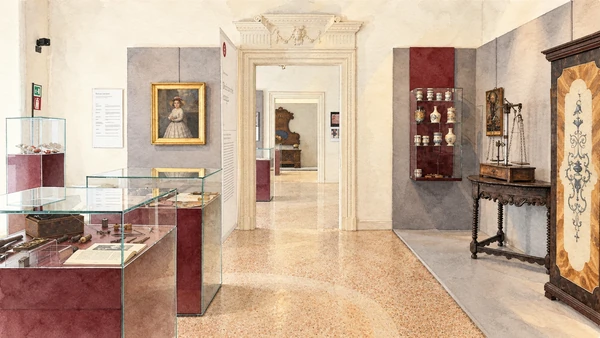
Watercolour: Udine establishing view

Friuli Venezia Giulia · Guide 03

Udine

Civic loggias, a castle hill and an unusually rich network of collections connect the city’s Friulian identity with Venetian art and everyday life.

Plan the route
Udine10 chapters · history, culture and landscape

Why this place matters

Begin with the spaces between the museums.

Udine is a city of short connections: the castle hill rises above the civic square, arcaded streets lead towards another open gathering place, and museums occupy buildings with histories of their own. The monumental setting is only part of the story. Ethnographic collections, modern painting and ordinary urban routes place the city within a wider Friulian landscape. Select a few interiors and leave time to walk between them; the changes of scale are part of the visit.

The guide separates documented history from suggestions for reading the site. Named buildings and landscape relationships follow institutional sources; the illustrations are editorial interpretations, not measured surveys or records of current access.

Civic loggias, a castle hill and an unusually rich network of collections connect the city’s Friulian identity with Venetian art and everyday life.
The route

Plan your visit

Use Piazza Libertà as an orientation point. The castle museums form one substantial visit; the cathedral and Oratorio della Purità can be grouped separately. Casa Cavazzini, the diocesan museum and the ethnographic museum should be chosen according to interest and opening, not treated as a single compulsory sequence.

Civic centre

Piazza Libertà and the Lionello loggia

Use Piazza Libertà as an orientation point.

Castle hill

Architecture and collections

Sacred art

Cathedral, Purità and the patriarchal palace

Lower city

Matteotti, Casa Cavazzini and Borgo Grazzano

Ten chapters

Explore the places

The chapters connect history and terrain. Use the route notes to choose visits and plan transfers between separate sites.

  1. 01Piazza Libertà
  2. 02Loggia del Lionello
  3. 03The castle hill
  4. 04Collections at the castle
  5. 05The cathedral
  6. 06Oratorio della Purità
  7. 07Museo Diocesano and Gallerie del Tiepolo
  8. 08Casa Cavazzini
  9. 09Piazza Matteotti and the lower streets
  10. 10Museo Etnografico del Friuli
01

The inhabited landscape

Piazza Libertà

The square brings together civic architecture and the approach to the castle hill. Its different edges reward a slow circuit: look across the space before following the route uphill.

Today

This remains an inhabited place. Use pedestrian routes, keep entrances clear and check municipal mobility notices for any restricted area.

History

Udine’s civic centre records the city’s long relationship with the Venetian Republic, while its role within the Patria del Friuli reaches into an earlier political setting. Those layers are visible in the ensemble rather than in one isolated monument.

How to read this place

Compare the open square with the sheltered arcades and the rising ground behind. Avoid reducing Udine to a smaller Venice: the hill, watercourses and inland urban routes give the city a different geography.

What to notice

  • Compare the open square with the sheltered arcades and the rising ground behind.
  • Avoid reducing Udine to a smaller Venice: the hill, watercourses and inland urban routes give the city a different geography.
Udine · PromoTurismoFVG
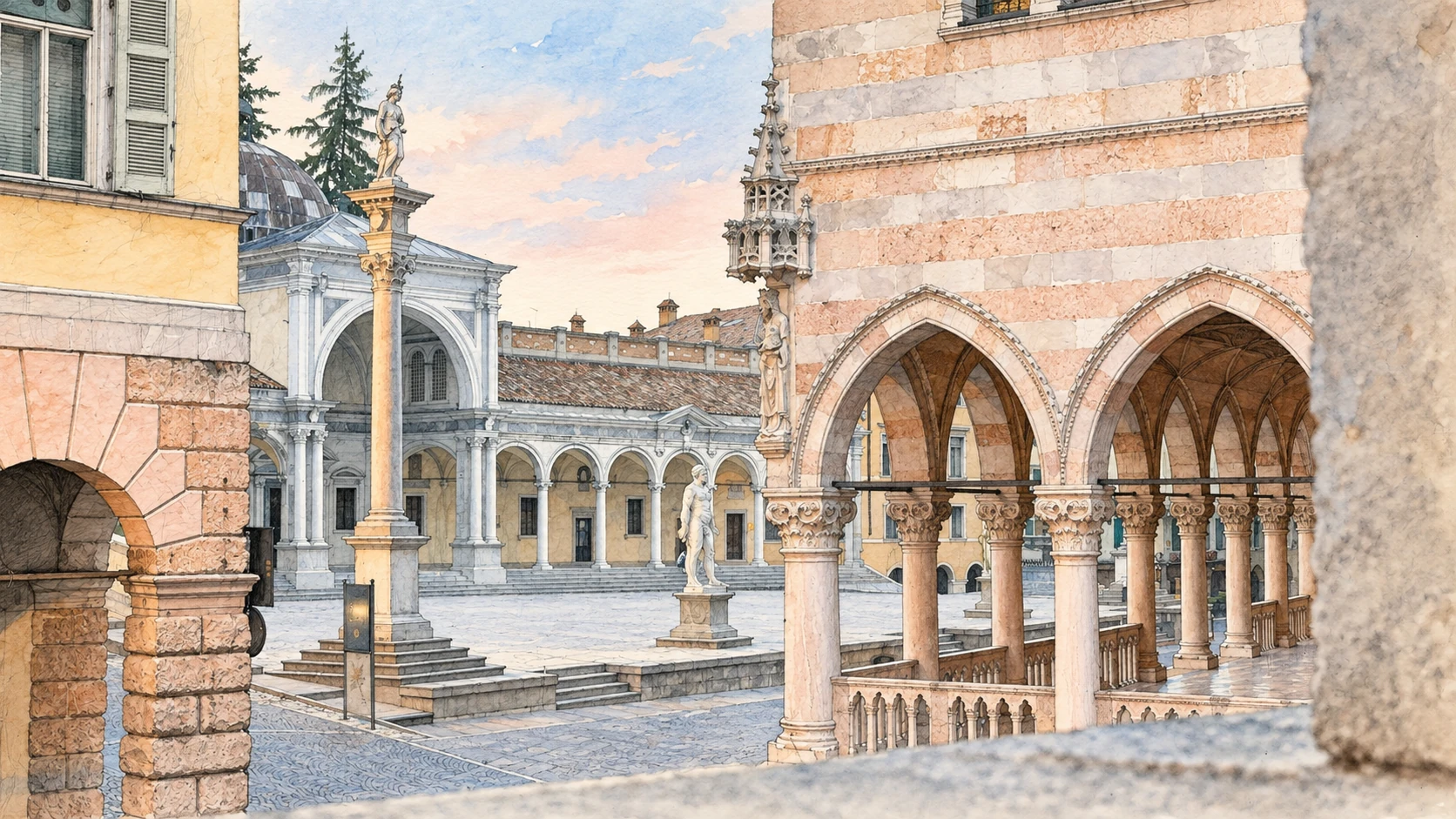
Watercolour: Udine actual Piazza Libertà civic ensemble with clock tower and loggias
Piazza LibertàEditorial watercolour · AI-generated · 2026
02

The inhabited landscape

Loggia del Lionello

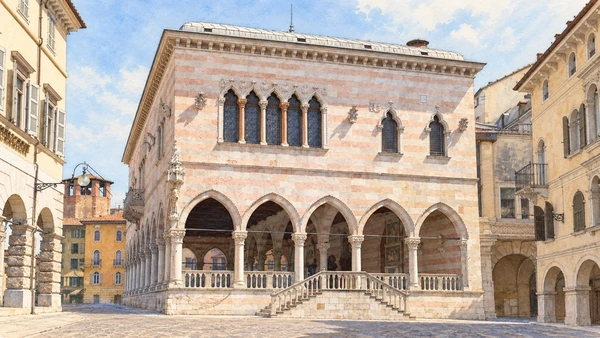
The open arcade provides a place to read civic architecture at close range. Coloured stone, columns and upper openings turn a public building into part of the square’s daily experience.

Today

This remains an inhabited place. Use pedestrian routes, keep entrances clear and check municipal mobility notices for any restricted area.

History

The regional heritage catalogue records the loggia as a palace with a history of public and administrative use. Its fabric reflects successive contributions and interventions; its present appearance should not be assigned to one architect or one untouched phase.

How to read this place

Follow the relationship between the open ground floor and the enclosed rooms above. Compare the rhythm of the arches with the neighbouring square. Public access to the loggia does not imply access to working municipal interiors.

What to notice

  • Follow the relationship between the open ground floor and the enclosed rooms above.
  • Compare the rhythm of the arches with the neighbouring square.
  • Public access to the loggia does not imply access to working municipal interiors.
ERPAC FVG · Loggia del Lionello
Watercolour: Udine Loggia del Lionello authentic pink and white stone Gothic arcade and upper window groups
Loggia del LionelloEditorial watercolour · AI-generated · 2026
03

Evidence and interpretation

The castle hill

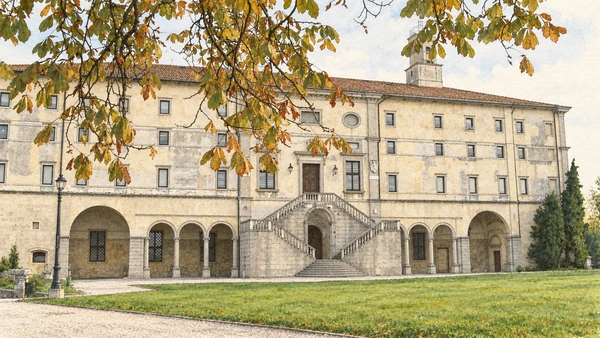
The climb changes how the city is understood. From the hill, the lower streets become a pattern, while the castle building gives the museums a setting tied to government and representation.

Today

Check the institution’s current opening, booking arrangements and accessible route. Individual rooms, exhibitions and approaches may have separate conditions.

History

The castle served patriarchal and later Venetian administrative power before becoming a home for civic collections. Its museum uses belong to a later chapter than the political functions of the hill.

How to read this place

Separate the exterior walk and outlook from the museum visit. Confirm the available step-free approach with the institution if required; an accessible gallery and the route up a hill are different questions.

What to notice

  • Separate the exterior walk and outlook from the museum visit.
  • Confirm the available step-free approach with the institution if required; an accessible gallery and the route up a hill are different questions.
Musei del Castello · PromoTurismoFVG
Watercolour: Udine actual castle long pale facade and central entrance on its hill
The castle hillEditorial watercolour · AI-generated · 2026
04

Evidence and interpretation

Collections at the castle

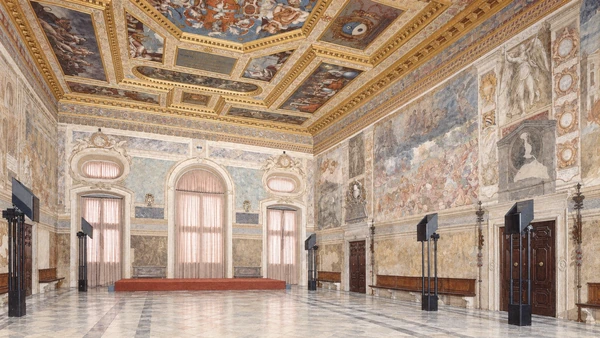
Several collections share this address. Archaeology, older painting, photography and the Risorgimento offer different ways to read the city and its region; choose a focus rather than trying to give every object equal attention.

Today

Check the institution’s current opening, booking arrangements and accessible route. Individual rooms, exhibitions and approaches may have separate conditions.

History

The art collection contains works by local and Venetian artists from the later Middle Ages into the nineteenth century. Photographic holdings preserve another kind of evidence, recording the work of photographers active in the region during the nineteenth and twentieth centuries.

How to read this place

Compare an artwork’s original function with its present display. A photograph also needs a date, maker and context; it is not a neutral window into an entire period. Ask which galleries and temporary exhibitions are included in the current route.

What to notice

  • Compare an artwork’s original function with its present display.
  • A photograph also needs a date, maker and context; it is not a neutral window into an entire period.
  • Ask which galleries and temporary exhibitions are included in the current route.
Musei del Castello · PromoTurismoFVG
Watercolour: Salone del Parlamento in Udine castle with its decorated walls
Collections at the castleEditorial watercolour · AI-generated · 2026
05

Worship and memory

The cathedral

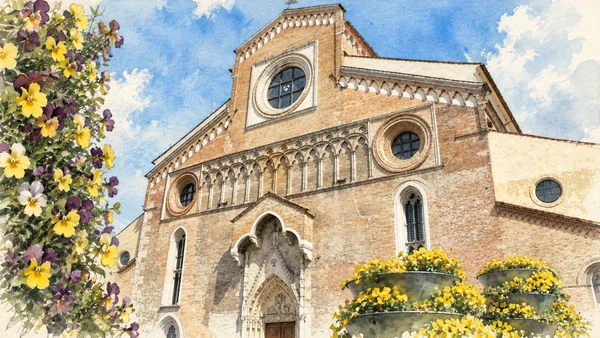
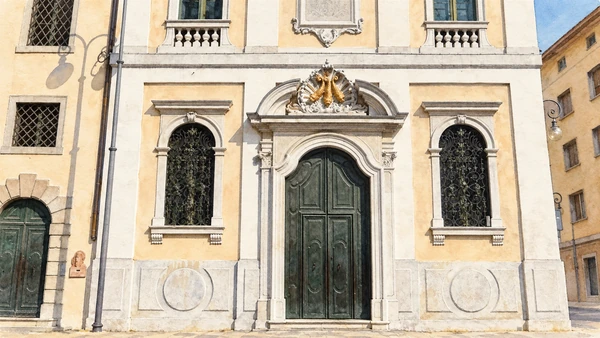
The brick façade and broad bell tower give the cathedral a presence distinct from the more open civic loggias. The interior introduces a different decorative character, shaped by later patronage.

Today

Worship and local religious life continue here. Visitor access may pause for services; consult the church or managing institution before planning an interior visit.

History

Construction began in the thirteenth century, followed by enlargement and repeated changes. The rich interior includes later Baroque interventions and works by artists associated with the region and Venice. The exterior seen today also reflects restoration.

How to read this place

Compare the portal, brickwork and tower before entering. Inside, identify the specific works and phases through the cathedral’s interpretation. Do not assume that a medieval-looking façade dates every element of the present visit.

What to notice

  • Compare the portal, brickwork and tower before entering.
  • Inside, identify the specific works and phases through the cathedral’s interpretation.
  • Do not assume that a medieval-looking façade dates every element of the present visit.
Duomo di Udine · PromoTurismoFVG
Watercolour: Udine cathedral authentic brick Gothic facade and massive low octagonal bell tower
The cathedralEditorial watercolour · AI-generated · 2026
06

Worship and memory

Oratorio della Purità

Beside the cathedral, a smaller sacred space concentrates attention on painting and the relationship between wall and ceiling. It deserves a separate pause rather than being treated as an incidental room of the larger church.

Today

Worship and local religious life continue here. Visitor access may pause for services; consult the church or managing institution before planning an interior visit.

History

The building was converted from a theatre into a religious setting in the later 1750s. Giambattista Tiepolo and his son Giandomenico contributed different parts of the decoration, linking the oratory with the city’s wider Tiepolo itinerary.

How to read this place

Distinguish the contributions of father and son. Observe how the ceiling changes the perceived height and openness of the room. Confirm the oratory’s own visiting arrangements; proximity to the cathedral does not guarantee identical access.

What to notice

  • Distinguish the contributions of father and son.
  • Observe how the ceiling changes the perceived height and openness of the room.
  • Confirm the oratory’s own visiting arrangements; proximity to the cathedral does not guarantee identical access.
Oratorio della Purità di Udine · PromoTurismoFVG
Watercolour: Udine Oratorio della Purità actual decorated sacred interior with Tiepolo ceiling
Oratorio della PuritàEditorial watercolour · AI-generated · 2026
07

Evidence and interpretation

Museo Diocesano and Gallerie del Tiepolo

The patriarchal palace combines collecting with a decorated residence. Staircase, reception rooms and library reveal how painting and learning contributed to ecclesiastical representation.

Today

Check the institution’s current opening, booking arrangements and accessible route. Individual rooms, exhibitions and approaches may have separate conditions.

History

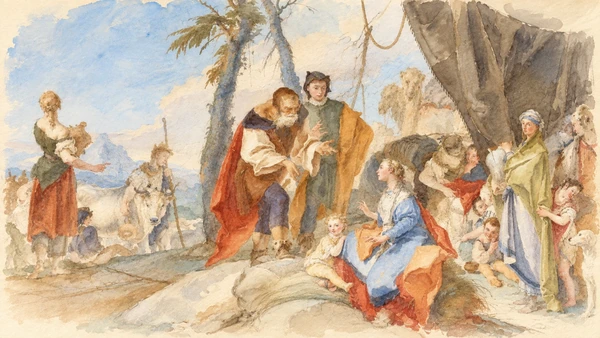
Giambattista Tiepolo worked here for Patriarch Dionisio Dolfin in the 1720s. The museum also presents religious wooden sculpture and other material that broadens the visit beyond the best-known frescoes.

How to read this place

Read a painted scene in relation to the room and its patron. A ceiling designed for a staircase requires a different viewpoint from a framed work in a gallery. Follow the museum’s guidance for the library and rooms available on the day.

What to notice

  • Read a painted scene in relation to the room and its patron.
  • A ceiling designed for a staircase requires a different viewpoint from a framed work in a gallery.
  • Follow the museum’s guidance for the library and rooms available on the day.
Museo Diocesano e Gallerie del Tiepolo di Udine · PromoTurismoFVG
Watercolour: Detail of Tiepolo painting in the patriarchal palace collection at Udine
Museo Diocesano and Gallerie del TiepoloEditorial watercolour · AI-generated · 2026
08

Evidence and interpretation

Casa Cavazzini

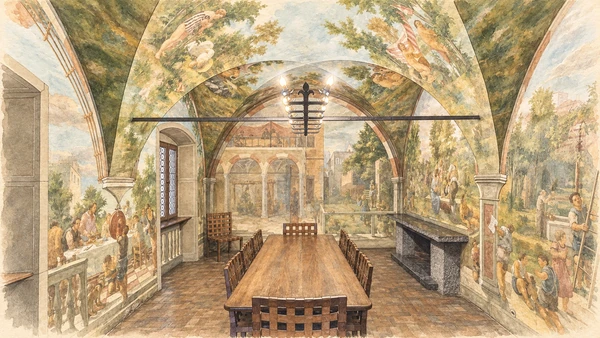
A historic house contains modern and contemporary art without erasing its earlier layers. The building and the collection can be read together: domestic surfaces, revealed painting and redesigned circulation all contribute to the encounter.

Today

Check the institution’s current opening, booking arrangements and accessible route. Individual rooms, exhibitions and approaches may have separate conditions.

History

The museum includes works by Dino, Mirko and Afro Basaldella, together with the Astaldi and FRIAM collections. The latter connects American artists’ donations with the aftermath of the 1976 Friuli earthquake. Restoration based on a project by Gae Aulenti also revealed medieval frescoes.

How to read this place

Distinguish work created for the house from art collected for later display. Do not assume that every collection is exhibited in full at the same time. Use the current museum programme to choose between permanent holdings and temporary exhibitions.

What to notice

  • Distinguish work created for the house from art collected for later display.
  • Do not assume that every collection is exhibited in full at the same time.
  • Use the current museum programme to choose between permanent holdings and temporary exhibitions.
Casa Cavazzini. Museo d’arte moderna e contemporanea · PromoTurismoFVG
Watercolour: The frescoed dining room preserved in Casa Cavazzini, Udine
Casa CavazziniEditorial watercolour · AI-generated · 2026
09

The inhabited landscape

Piazza Matteotti and the lower streets

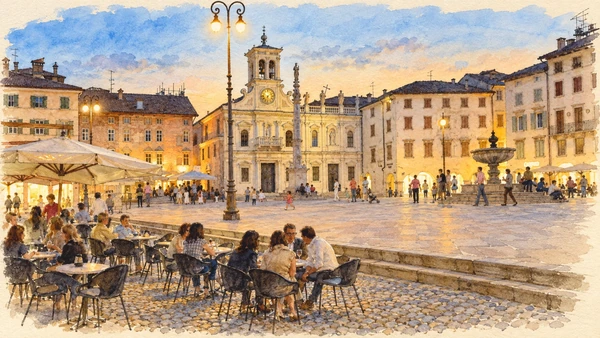
The arcaded square offers a different rhythm from the formal civic ensemble near the hill. It is a place to observe how shops, cafés, routes and public space work together.

Today

This remains an inhabited place. Use pedestrian routes, keep entrances clear and check municipal mobility notices for any restricted area.

History

Udine’s historic centre retains a network of medieval streets and watercourses alongside later buildings and uses. The square’s continuing social life belongs to the history of the city as much as its major collections.

How to read this place

Compare the scale of this square with Piazza Libertà. Notice where routes narrow under arcades and reopen into daylight. Businesses and homes remain in use; a slow circuit should respect entrances and the ordinary movement of residents.

What to notice

  • Compare the scale of this square with Piazza Libertà.
  • Notice where routes narrow under arcades and reopen into daylight.
  • Businesses and homes remain in use; a slow circuit should respect entrances and the ordinary movement of residents.
Udine · PromoTurismoFVG
Watercolour: Udine actual Piazza Matteotti with arcaded historic buildings and open central square
Piazza Matteotti and the lower streetsEditorial watercolour · AI-generated · 2026
10

Evidence and interpretation

Museo Etnografico del Friuli

Palazzo Giacomelli in Borgo Grazzano shifts attention towards domestic life, textiles, work and shared practices. The museum makes familiar objects available for historical questioning.

Today

Check the institution’s current opening, booking arrangements and accessible route. Individual rooms, exhibitions and approaches may have separate conditions.

History

The institution builds on the collecting associated with Gaetano Perusini and Luigi and Andreina Ciceri. Its themes include household life, the hearth, religious practice, music and clothing, interpreted through objects and documentary material.

How to read this place

Ask who used an object, where it came from and when it entered the collection. Avoid treating one garment or room as a timeless description of every Friulian household. The surrounding neighbourhood provides a living setting beyond the museum display.

What to notice

  • Ask who used an object, where it came from and when it entered the collection.
  • Avoid treating one garment or room as a timeless description of every Friulian household.
  • The surrounding neighbourhood provides a living setting beyond the museum display.
Museo Etnografico del Friuli · PromoTurismoFVG
Watercolour: Udine Museo Etnografico del Friuli actual Palazzo Giacomelli exterior or documented collection room
Museo Etnografico del FriuliEditorial watercolour · AI-generated · 2026

The territory through time

A short chronology

A concise chronology linking the documented sites to the wider story.

  1. Udine develops an important role within the Patria del Friuli.

  2. Construction begins on the cathedral.

  3. Civic architecture and administration acquire enduring links with Venice.

  4. Giambattista Tiepolo works in the patriarchal palace.

  5. The former theatre beside the cathedral becomes the Oratorio della Purità.

  6. Civic and ethnographic collections gain new public settings.

  7. Earthquake recovery inspires the donations represented by the FRIAM collection.

  8. Museums and inhabited urban spaces connect regional memory with contemporary life.

Before your visit

Practical information

01

Plan separate days

Choose a manageable set of visits and allow for transport, booked entries and the return journey.

02

Use the exact place name

Friuli Venezia Giulia contains separate valleys, towns and coastal approaches; some guides also include nearby places in Slovenia. Confirm the precise locality and route rather than treating nearby names as one destination.

03

Check the institution

Opening hours, tickets, exhibitions and religious access change. Use the linked managing institution shortly before visiting.

04

Check the actual terrain

Steps, gradients and uneven ground vary between the individual sites. Use current route information, weather and closures for the option you choose.

05

Arrange accessible visits

Historic interiors and outdoor approaches can include steps, gradients or uneven surfaces. Ask about the specific route instead of assuming an entire destination is step-free.

06

Respect work and residence

Farms, workshops, churches and historic streets remain in use. Follow signs, keep entrances clear and ask permission before entering private spaces.

Method and sources

Sources and image credits

Prepared on 9 September 2026 from the institutional sources linked below. Historical claims are separated from editorial observations and itinerary suggestions. Older institutional brochures are used for stable cultural context, never as current timetables. Prices, transport schedules, trail status and admission are deliberately left to the responsible operators. Illustrations are not photographs, measured reconstructions or evidence of current conditions.

The eleven images are AI-generated editorial watercolours guided by photographic references. They interpret named places and are not photographs or substitutes for measured plans. Opening hours, tickets, accessible routes, temporary exhibitions and conservation work can change; consult the linked official pages shortly before visiting.

Illustration references and credits