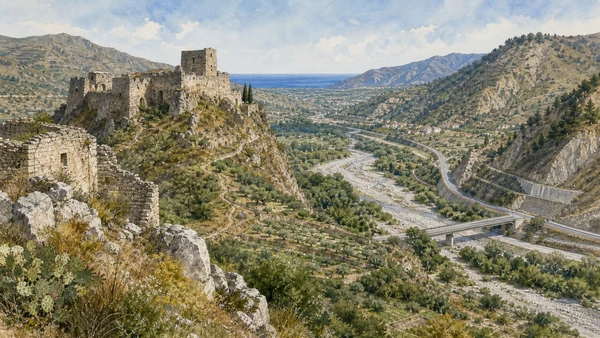
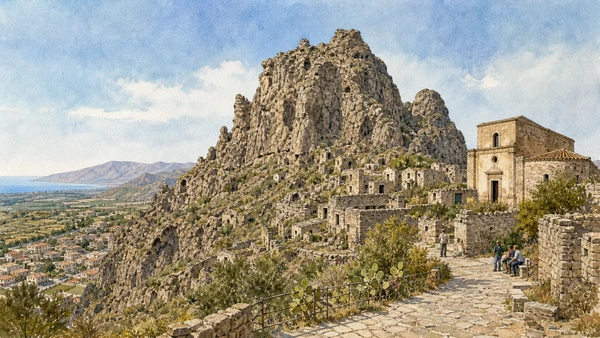
Original documentary watercolour panorama for Locri and the Grecanic Area: Complete Guide, with accurate Calabrian architecture, landscape and lived context

Calabria Guide 02 · Greek city, Indigenous landscapes, Byzantine coast, living minority language, abandoned villages and Aspromonte valleys

Locri and the
Greek-speaking south

A three-day Ionian route separating ancient Locri from later Greek-Calabrian language communities while connecting archaeology, hill towns and difficult mountain valleys.

Plan the route
Locri and the Grecanic Area · Calabria10 chapters · one complete route

Why this route must be read in layers

Ancient Greek Locri and today’s Grecanic area have distinct histories within the same landscape.

Locri Epizefiri was a Greek polis with sanctuaries, walls, residential quarters and later Roman phases. Its archaeology must be read through excavated contexts rather than through generic claims about Magna Graecia.

Greek-Calabrian language and ritual survive through particular communities such as Bova and the wider Bovesia. They are living minority traditions shaped by modern schooling, migration and cultural work, not untouched remnants isolated from history.

Aspromonte valleys contain villages affected by earthquakes, floods, landslides and relocation. Old settlements such as Roghudi require current access checks and should never be approached as abandoned scenery without regard for risk and community memory.

Use one day for Locri’s archaeology, one for Bova and coastal collections, and a separately planned mountain day governed by road, fire and weather conditions.

The route

Plan your visit

Begin at the archaeological park and museums, move south along the Ionian corridor, then climb only by authorised roads and paths into language communities and Aspromonte valleys.

Early morning

Locri Epizefiri and the Marasà sanctuary · Centocamere · Casino Macrì

Move in the documented order: Locri Epizefiri and the Marasà sanctuary; then Centocamere: houses, workshops and urban production; then Casino Macrì: Roman Locri and the archaeology museum. Recheck live access and transport before entering a controlled site.

Late morning

Palazzo Nieddu · Bova Marina · Bova

Move in the documented order: Palazzo Nieddu: Indigenous communities before the colony; then Bova Marina: synagogue, archaeology and the coastal plain; then Bova: capital of contemporary Greek-Calabrian cultural work. Recheck live access and transport before entering a controlled site.

Afternoon

Gallicianò · Roghudi Vecchio · Amendolea valley and castle

Move in the documented order: Gallicianò: language, worship and a small mountain community; then Roghudi Vecchio: relocation, hazard and memory; then Amendolea valley and castle: routes between coast and Aspromonte. Recheck live access and transport before entering a controlled site.

Late afternoon

Pentedattilo

Move in the documented order: Pentedattilo: rock, relocation and selective revival. Recheck live access and transport before entering a controlled site.

Ten chapters

Explore the places

The order follows terrain, institutions and present-day movement. Use the index to return to a chapter without reducing the route to isolated monuments.

  1. 01Locri Epizefiri and the Marasà sanctuary
  2. 02Centocamere: houses, workshops and urban production
  3. 03Casino Macrì: Roman Locri and the archaeology museum
  4. 04Palazzo Nieddu: Indigenous communities before the colony
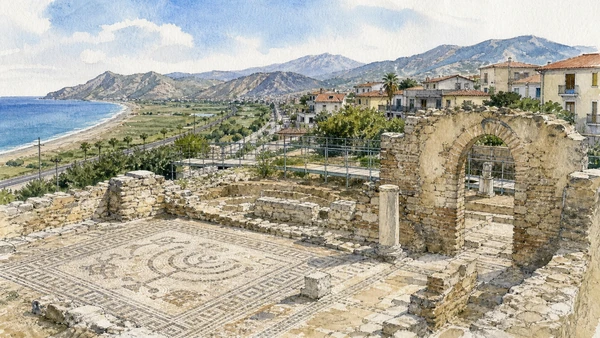
  5. 05Bova Marina: synagogue, archaeology and the coastal plain
  6. 06Bova: capital of contemporary Greek-Calabrian cultural work
  7. 07Gallicianò: language, worship and a small mountain community
  8. 08Roghudi Vecchio: relocation, hazard and memory
  9. 09Amendolea valley and castle: routes between coast and Aspromonte
  10. 10Pentedattilo: rock, relocation and selective revival
01

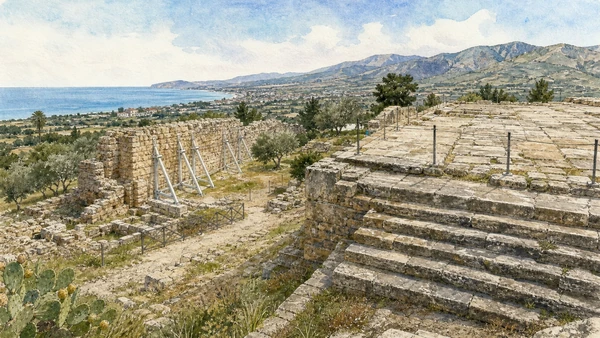
Temple remains, walls and landscape recover the scale of a polis that extended far beyond one monument.

Locri Epizefiri and the Marasà sanctuary

Temple remains, walls and landscape recover the scale of a polis that extended far beyond one monument. The site becomes clearer when its surviving fabric, later alterations and present use are read together.

Today

Archaeological access may be limited to protected viewpoints, scheduled openings or guided routes. Stay outside barriers, distinguish original material from supports and reconstruction, and verify the official opening notice.

History

Locri was founded by Greek settlers in the late eighth or seventh century BCE; sanctuaries and urban areas developed through distinct phases before Roman control.

How to read this place

Begin with the temple platform and orientation. Then compare city walls and coastal plain with modern supports compared with ancient masonry; the differences are evidence, not visual noise.

What to notice

  • the temple platform and orientation
  • city walls and coastal plain
  • modern supports compared with ancient masonry
Ministero della Cultura · National Archaeological Park of Locri Epizefiri
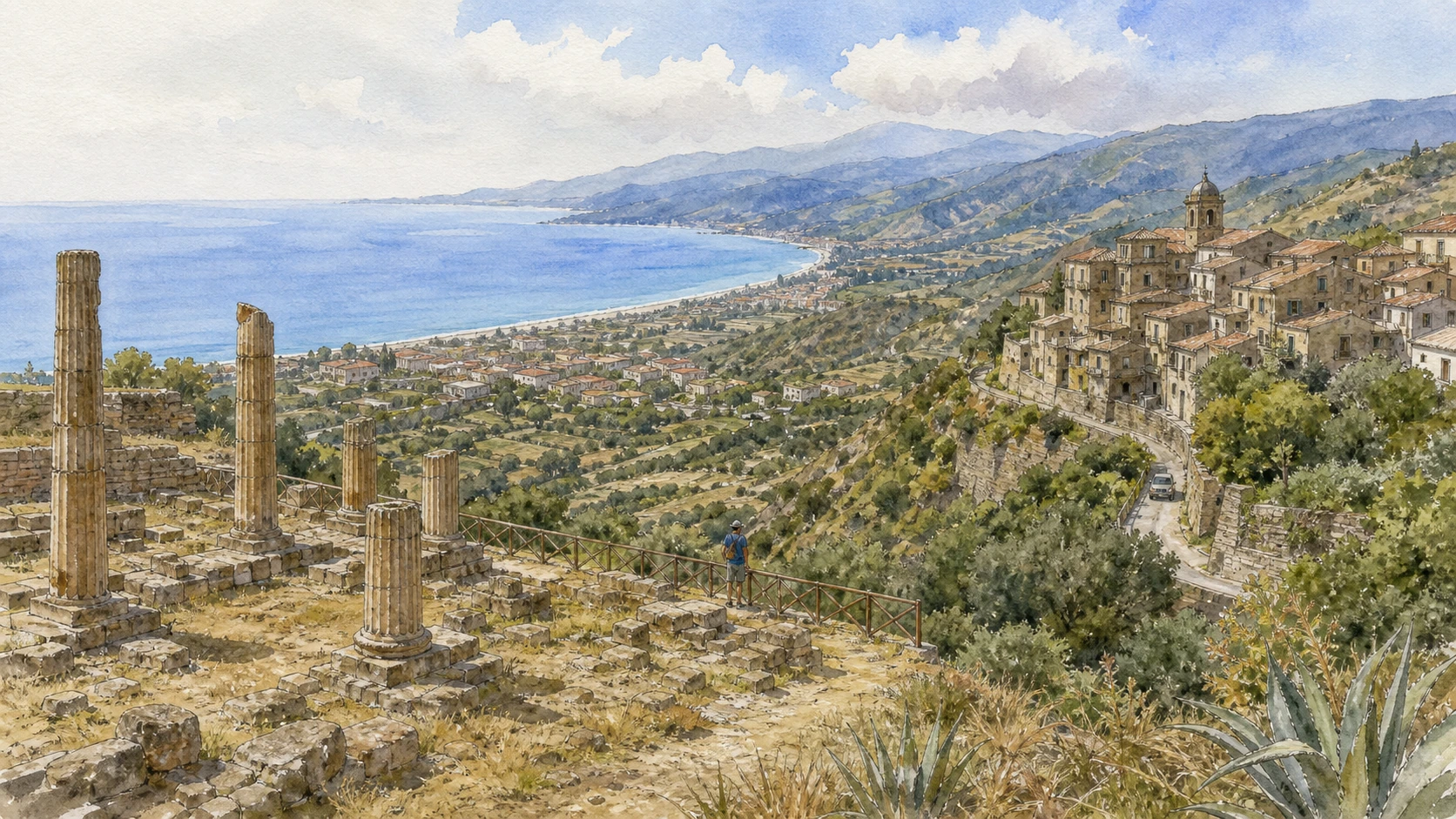
Original documentary watercolour of Locri Epizefiri and the Marasà sanctuary in Locri and the Grecanic Area · Calabria, showing accurate architecture, landscape, people and present-day use
Locri Epizefiri and the Marasà sanctuaryOriginal Merlintravel documentary watercolour · 2026
02

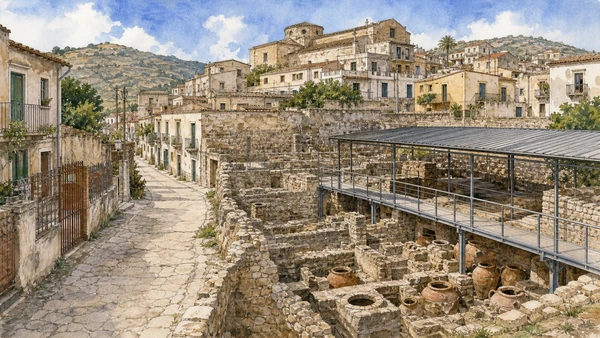
Excavated blocks reveal domestic space, craft activity and street organisation inside the Greek city.

Centocamere: houses, workshops and urban production

Excavated blocks reveal domestic space, craft activity and street organisation inside the Greek city. The site becomes clearer when its surviving fabric, later alterations and present use are read together.

Today

Archaeological access may be limited to protected viewpoints, scheduled openings or guided routes. Stay outside barriers, distinguish original material from supports and reconstruction, and verify the official opening notice.

History

The district preserves evidence for building, ceramics and urban change; its name is modern and should not be mistaken for an ancient designation.

How to read this place

Begin with street and property divisions. Then compare workshop traces and domestic rooms with protective presentation over fragile remains; the differences are evidence, not visual noise.

What to notice

  • street and property divisions
  • workshop traces and domestic rooms
  • protective presentation over fragile remains
Ministero della Cultura · National Archaeological Park of Locri Epizefiri
Original documentary watercolour of Centocamere: houses, workshops and urban production in Locri and the Grecanic Area · Calabria, showing accurate architecture, landscape, people and present-day use
Centocamere: houses, workshops and urban productionOriginal Merlintravel documentary watercolour · 2026
03

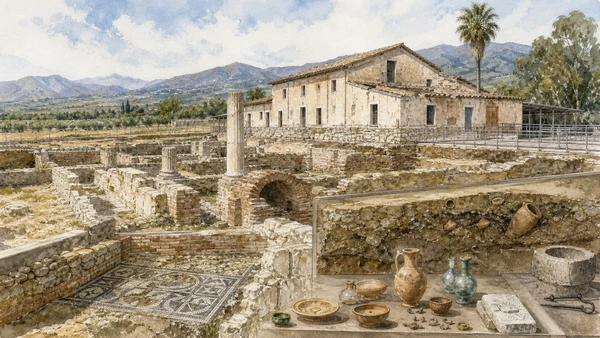
A later rural building and museum displays help distinguish Roman transformation from the earlier Greek city.

Casino Macrì: Roman Locri and the archaeology museum

A later rural building and museum displays help distinguish Roman transformation from the earlier Greek city. The site becomes clearer when its surviving fabric, later alterations and present use are read together.

Today

Opening, ticketing, room access and temporary displays can change. Check the institution’s official notice shortly before visiting, use the designated entrance and allow for security or conservation controls.

History

Roman structures reused and altered parts of the ancient urban area; later agricultural occupation added another layer to the archaeological landscape.

How to read this place

Begin with roman building phases. Then compare objects tied to documented contexts with the later casino within the excavation area; the differences are evidence, not visual noise.

What to notice

  • Roman building phases
  • objects tied to documented contexts
  • the later casino within the excavation area
Ministero della Cultura · National Archaeological Park of Locri Epizefiri
Original documentary watercolour of Casino Macrì: Roman Locri and the archaeology museum in Locri and the Grecanic Area · Calabria, showing accurate architecture, landscape, people and present-day use
Casino Macrì: Roman Locri and the archaeology museumOriginal Merlintravel documentary watercolour · 2026
04

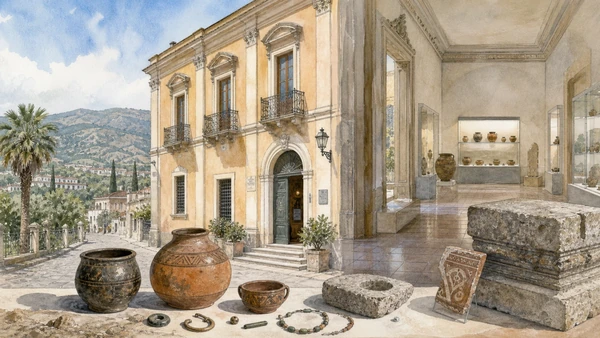
Collections restore the pre-Greek and protohistoric populations of the Locrian territory to the regional narrative.

Palazzo Nieddu: Indigenous communities before the colony

Collections restore the pre-Greek and protohistoric populations of the Locrian territory to the regional narrative. The site becomes clearer when its surviving fabric, later alterations and present use are read together.

Today

Opening, ticketing, room access and temporary displays can change. Check the institution’s official notice shortly before visiting, use the designated entrance and allow for security or conservation controls.

History

The museum in a nineteenth-century palace complements the archaeological park by presenting evidence from the territory and communities that preceded Greek settlement.

How to read this place

Begin with chronology before colonisation. Then compare local finds and their provenance with the reused civic building that houses the collection; the differences are evidence, not visual noise.

What to notice

  • chronology before colonisation
  • local finds and their provenance
  • the reused civic building that houses the collection
Ministero della Cultura · Museo di Palazzo Nieddu del Rio
Original documentary watercolour of Palazzo Nieddu: Indigenous communities before the colony in Locri and the Grecanic Area · Calabria, showing accurate architecture, landscape, people and present-day use
Palazzo Nieddu: Indigenous communities before the colonyOriginal Merlintravel documentary watercolour · 2026
05

Late-antique remains and museum collections complicate any simple transition from ancient Greek to Byzantine Calabria.

Bova Marina: synagogue, archaeology and the coastal plain

Late-antique remains and museum collections complicate any simple transition from ancient Greek to Byzantine Calabria. The site becomes clearer when its surviving fabric, later alterations and present use are read together.

Today

Archaeological access may be limited to protected viewpoints, scheduled openings or guided routes. Stay outside barriers, distinguish original material from supports and reconstruction, and verify the official opening notice.

History

The coastal area preserves evidence including a late-antique synagogue and earlier settlement phases, demonstrating religious and cultural plurality around the Ionian routes.

How to read this place

Begin with mosaic and architectural remains. Then compare museum interpretation and original context with modern settlement around the protected site; the differences are evidence, not visual noise.

What to notice

  • mosaic and architectural remains
  • museum interpretation and original context
  • modern settlement around the protected site
Ministero della Cultura · National museums in Calabria
Original documentary watercolour of Bova Marina: synagogue, archaeology and the coastal plain in Locri and the Grecanic Area · Calabria, showing accurate architecture, landscape, people and present-day use
Bova Marina: synagogue, archaeology and the coastal plainOriginal Merlintravel documentary watercolour · 2026
06

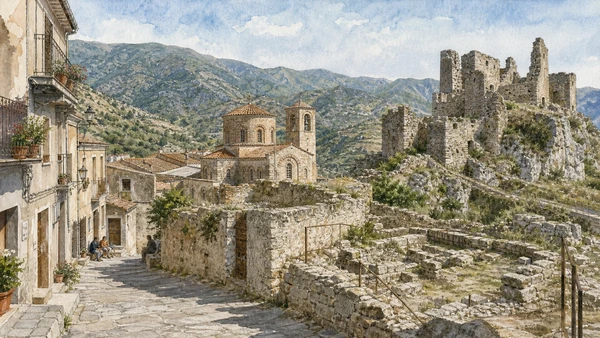
Language museum, cathedral, palaces and rural collections occupy a hill town that remains inhabited and institutionally active.

Bova: capital of contemporary Greek-Calabrian cultural work

Language museum, cathedral, palaces and rural collections occupy a hill town that remains inhabited and institutionally active. The site becomes clearer when its surviving fabric, later alterations and present use are read together.

Today

The area is inhabited and worked, not staged for visitors. Keep doorways, pavements, cycle lanes and deliveries clear, ask before photographing people and use current municipal mobility information.

History

Bova developed through medieval and later phases and now plays a central role in preserving and teaching Greek of Calabria without claiming uninterrupted isolation from wider change.

How to read this place

Begin with the hill-town street pattern. Then compare language displays and community use with castle ruins and churches within the present town; the differences are evidence, not visual noise.

What to notice

  • the hill-town street pattern
  • language displays and community use
  • castle ruins and churches within the present town
Regione Calabria · Bova and the Greek-Calabrian language
Original documentary watercolour of Bova: capital of contemporary Greek-Calabrian cultural work in Locri and the Grecanic Area · Calabria, showing accurate architecture, landscape, people and present-day use
Bova: capital of contemporary Greek-Calabrian cultural workOriginal Merlintravel documentary watercolour · 2026
07

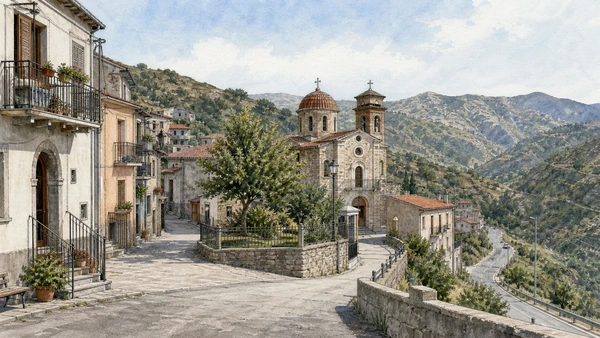
A compact village route connects Greek-Calabrian cultural initiatives, religious life and difficult road access.

Gallicianò: language, worship and a small mountain community

A compact village route connects Greek-Calabrian cultural initiatives, religious life and difficult road access. The site becomes clearer when its surviving fabric, later alterations and present use are read together.

Today

The area is inhabited and worked, not staged for visitors. Keep doorways, pavements, cycle lanes and deliveries clear, ask before photographing people and use current municipal mobility information.

History

The community belongs to the Grecanic area and has experienced strong demographic change; cultural visibility today is partly the result of organised recovery and teaching.

How to read this place

Begin with inhabited houses and public thresholds. Then compare religious spaces and bilingual signs with the road and valley that shape everyday access; the differences are evidence, not visual noise.

What to notice

  • inhabited houses and public thresholds
  • religious spaces and bilingual signs
  • the road and valley that shape everyday access
Regione Calabria · Bova and the Greek-Calabrian language
Original documentary watercolour of Gallicianò: language, worship and a small mountain community in Locri and the Grecanic Area · Calabria, showing accurate architecture, landscape, people and present-day use
Gallicianò: language, worship and a small mountain communityOriginal Merlintravel documentary watercolour · 2026
08

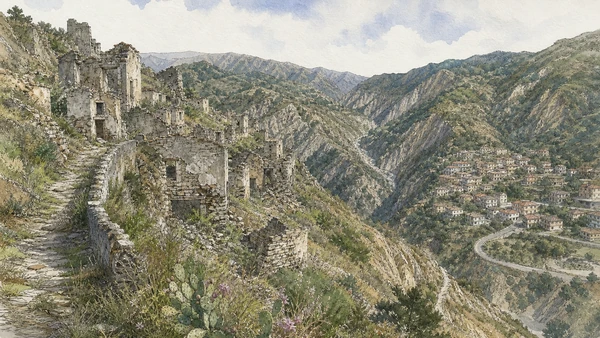
The old settlement above the Amendolea valley must be understood through abandonment, risk and the lives of relocated residents.

Roghudi Vecchio: relocation, hazard and memory

The old settlement above the Amendolea valley must be understood through abandonment, risk and the lives of relocated residents. The site becomes clearer when its surviving fabric, later alterations and present use are read together.

Today

Weather, water levels, trail conditions and seasonal services can alter the route. Use official transport and park information, remain on authorised paths and do not enter farms, vineyards or private gardens without permission.

History

Floods, landslides and unstable access contributed to the twentieth-century relocation of residents; the old village is not a freely accessible open-air attraction.

How to read this place

Begin with the settlement’s position above the gorge. Then compare damaged paths and structures from a safe distance with the relationship to the newer community; the differences are evidence, not visual noise.

What to notice

  • the settlement’s position above the gorge
  • damaged paths and structures from a safe distance
  • the relationship to the newer community
Aspromonte National Park · Official site
Original documentary watercolour of Roghudi Vecchio: relocation, hazard and memory in Locri and the Grecanic Area · Calabria, showing accurate architecture, landscape, people and present-day use
Roghudi Vecchio: relocation, hazard and memoryOriginal Merlintravel documentary watercolour · 2026
09

River bed, fortified ridge, farms and mountain roads show how the Grecanic area connects rather than isolates communities.

Amendolea valley and castle: routes between coast and Aspromonte

River bed, fortified ridge, farms and mountain roads show how the Grecanic area connects rather than isolates communities. The site becomes clearer when its surviving fabric, later alterations and present use are read together.

Today

Weather, water levels, trail conditions and seasonal services can alter the route. Use official transport and park information, remain on authorised paths and do not enter farms, vineyards or private gardens without permission.

History

The castle guarded a strategic valley route through medieval and later periods; earthquakes and changing communications altered the settlement below.

How to read this place

Begin with castle ridge and river corridor. Then compare cultivated terraces and dry channels with modern road engineering through unstable ground; the differences are evidence, not visual noise.

What to notice

  • castle ridge and river corridor
  • cultivated terraces and dry channels
  • modern road engineering through unstable ground
Aspromonte National Park · Official site
Original documentary watercolour of Amendolea valley and castle: routes between coast and Aspromonte in Locri and the Grecanic Area · Calabria, showing accurate architecture, landscape, people and present-day use
Amendolea valley and castle: routes between coast and AspromonteOriginal Merlintravel documentary watercolour · 2026
10

The dramatic rock settlement combines abandoned fabric, restored spaces, events and nearby inhabited communities.

Pentedattilo: rock, relocation and selective revival

The dramatic rock settlement combines abandoned fabric, restored spaces, events and nearby inhabited communities. The site becomes clearer when its surviving fabric, later alterations and present use are read together.

Today

The area is inhabited and worked, not staged for visitors. Keep doorways, pavements, cycle lanes and deliveries clear, ask before photographing people and use current municipal mobility information.

History

Earthquakes, migration and relocation reduced the old village; later cultural projects reused selected buildings without reversing the full demographic history.

How to read this place

Begin with the rock silhouette and village plan. Then compare stabilised buildings and ruined fabric with visitor use beside signs of relocation; the differences are evidence, not visual noise.

What to notice

  • the rock silhouette and village plan
  • stabilised buildings and ruined fabric
  • visitor use beside signs of relocation
Regione Calabria · Official tourism
Original documentary watercolour of Pentedattilo: rock, relocation and selective revival in Locri and the Grecanic Area · Calabria, showing accurate architecture, landscape, people and present-day use
Pentedattilo: rock, relocation and selective revivalOriginal Merlintravel documentary watercolour · 2026

Calabria through time

A short chronology

From Indigenous and Greek landscapes to Byzantine continuity, Norman institutions, earthquakes, migration, protected parks and contemporary cultural recovery.

  1. Caves, shelters and river valleys preserve evidence of long human occupation before permanent coastal cities.

  2. Indigenous Oenotrian landscapes encounter Greek settlement; Rhegion, Sybaris, Kroton and Locri develop as distinct poleis.

  3. Coastal cities establish sanctuaries, workshops, farms and exchange systems while maintaining different relations with inland communities.

  4. Bruttian power expands across the interior and contests Greek territories before Roman intervention.

  5. Roman roads, colonies, estates and ports reorganise older urban and rural systems across the peninsula.

  6. Byzantine administration, monastic networks and Greek liturgy remain especially influential in southern and Ionian Calabria.

  7. Norman conquest reshapes bishoprics, castles and monasteries while incorporating Greek and Latin institutions.

  8. Swabian, Angevin and Aragonese rule modifies fortifications, towns and routes; Albanian-speaking communities settle in several northern districts.

  9. Coastal towers and inland refuges respond to maritime raids while feudal estates and religious houses organise land and labour.

  10. A devastating earthquake sequence transforms settlements throughout central and southern Calabria and prompts new planning and reconstruction.

  11. French rule suppresses feudal institutions and many religious houses before Bourbon restoration.

  12. Italian unification is followed by administrative change, conflict over land and accelerating migration.

  13. The Messina Strait earthquake and tsunami destroy much of Reggio Calabria and neighbouring communities, shaping modern reconstruction.

  14. Land reform, roads, dams, tourism, internal migration and emigration transform cities, plateaux and both coastlines.

  15. National parks, archaeological networks, minority-language initiatives and cultural recovery operate alongside fire, erosion, depopulation and climate risk.

Before your visit

Practical information

01

Check the live page

Opening hours, reservation systems, restoration, exhibitions and transport can change. Recheck the linked official institution shortly before departure.

02

Separate worship and tourism

Churches and sanctuaries remain religious spaces. Services, funerals and community use take priority over visitor itineraries.

03

Plan real distances

Locri and the Grecanic Area · Calabria combines dense urban routes with lakes, valleys and dispersed towns. Do not compress distant chapters into an unsafe or superficial day.

04

Keep thresholds open

Arcades, station halls, markets, courtyards, workshops and residential streets must continue to function while you observe or photograph them.

05

Use current mobility data

Check the responsible rail, navigation, bus, road or park operator on the day; replacement services and weather can change an otherwise sound route.

06

Read change honestly

Restoration, reconstruction, adaptive reuse and new development have all shaped the landscape visible today.

Method and sources

Sources and image credits

This guide uses official museum, ministry, regional-tourism, park and UNESCO documentation checked on 1 September 2026. It separates Greek, Indigenous, Roman, Byzantine and later phases instead of using Magna Graecia as a generic label, distinguishes surviving fabric from post-earthquake reconstruction, and treats worship, minority languages, farming, fishing, residence and public movement as part of the evidence. Every chapter links its principal institutional source; tickets, closures, weather, fire risk, sea conditions, trails and transport must always be verified again on the day of the visit.

All ten images are original Merlintravel editorial watercolours based on documented present-day conditions. They are illustrations, not substitutes for archaeological plans. Opening hours, tickets, accessible routes, temporary exhibitions and conservation work can change; consult the linked official pages shortly before visiting.