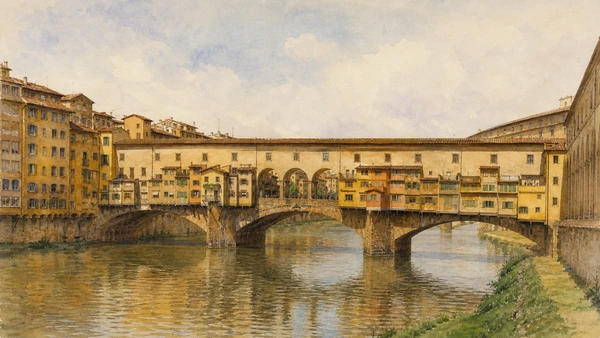
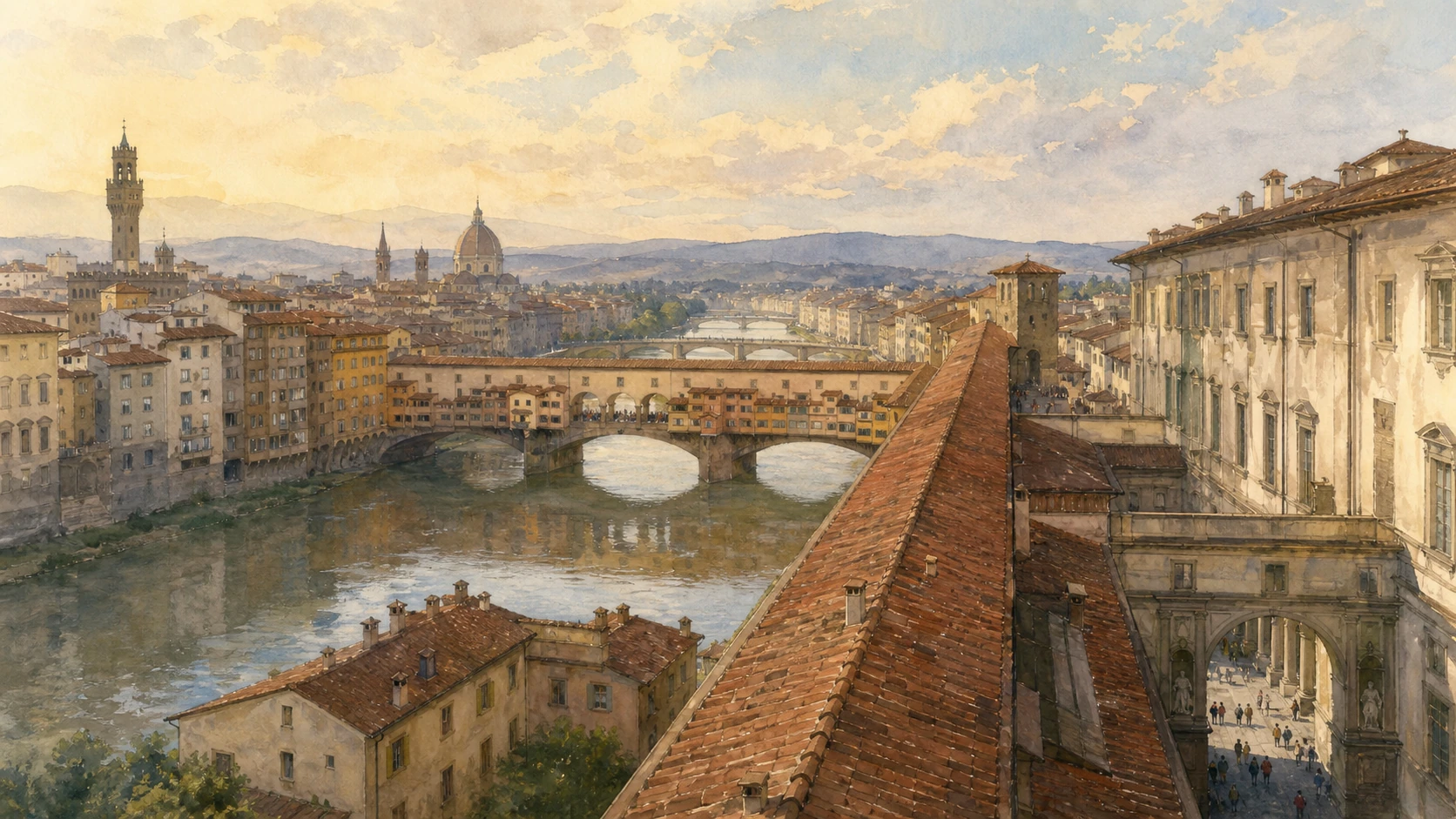
Original documentary watercolour panorama of the Uffizi, Arno, Vasari Corridor and Ponte Vecchio

Florence Guide 03 · Collection, court passage and river economy

Uffizi, Vasari Corridor
& Ponte Vecchio

A documented route from Vasari’s administrative palace through the chronological galleries and Medici collecting rooms, then above and across the Arno to the goldsmith bridge and Pitti threshold.

Plan the route
Uffizi · Arno · Florence10 chapters · one full day

Why this museum district matters

The Uffizi is not simply a container for famous paintings: offices, gallery corridors, a dynastic cabinet, an elevated passage and a working bridge formed one Medici landscape of administration, collecting and movement.

Cosimo I commissioned Giorgio Vasari to unite Florence’s magistracies in a new palace beside Palazzo Vecchio. The name Uffizi meant offices. Its disciplined wings created a bright public axis toward the Arno while upper spaces gradually received ancient sculpture, family portraits and rare objects. Under Francesco I, the east corridor and Tribuna became a privileged collecting environment. Only later did successive regimes turn this courtly apparatus into the public museum visitors recognise today.

The collections should therefore be read chronologically and spatially. Giotto’s Ognissanti Maestà still belongs to the culture of a church altar even when compared in a museum room. Botticelli’s large mythologies came from Medici-associated domestic settings. Leonardo’s unfinished Adoration, Michelangelo’s Doni Tondo and Raphael’s Madonna of the Goldfinch reveal different Florentine experiments, patrons and object histories. The Tribuna organised rarity through materials, geometry and controlled access rather than modern art-historical categories.

The route continues beyond the galleries. Built rapidly in 1565, the Vasari Corridor carried the court from the Uffizi over streets, shops and the river toward Pitti and Boboli. Its current visit is a separately reserved, staff-accompanied, one-way route ending on the Oltrarno side; it is not a shortcut back to the museum. Below it, Ponte Vecchio remains commercial urban fabric. Goldsmith windows, river views, wartime survival and daily congestion belong to its history as much as the postcard silhouette.

Move in layers: begin with the palace made for government, follow the collection’s chronology, read the Tribuna as a system, and only then cross from controlled court passage to the bridge’s open commercial life.

The route

Plan your visit

Use an early Uffizi reservation, keep at least two unhurried hours before any separately booked Corridor slot, and finish outside on Ponte Vecchio and the riverbanks. The museum and Corridor should never be planned as interchangeable tickets.

Before opening

Uffizi courtyard and Arno axis

Read the Doric façade, modular wings, niches, Loggia dei Lanzi connection and opening toward the river before entering the security queue.

Morning

Chronological galleries

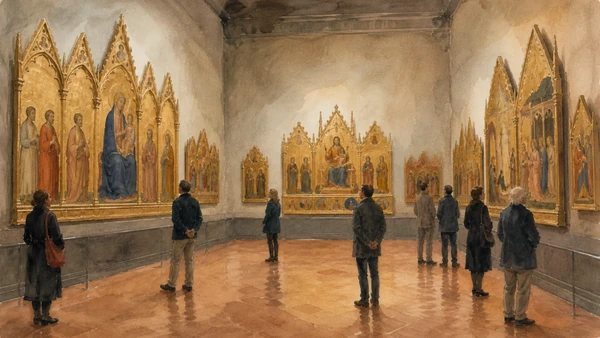
Begin with late-medieval altarpieces, then follow Botticelli, Leonardo, Michelangelo and Raphael without turning the route into a greatest-hits sprint.

Early afternoon

Tribuna and Vasari Corridor

Study the Medici collecting rooms, then report to the designated Corridor meeting point only if a separate timed reservation has been secured.

Late afternoon

Ponte Vecchio and Oltrarno exit

After the one-way Corridor route, or by walking outside from the Uffizi, compare elevated court movement with the shops and public street below.

Ten chapters

Explore the places

The route follows the Uffizi as architecture, collection and controlled passage. Use the index to return to a room without separating paintings from the Medici systems that gathered, displayed and moved them.

  1. 01Vasari’s Uffizi: offices before museum
  2. 02The gallery corridors and the public museum
  3. 03Giotto and the late-medieval gallery
  4. 04Botticelli and Medici visual culture
  5. 05Leonardo, Michelangelo and Raphael rooms
  6. 06The Tribuna and Medici collecting systems
  7. 07From Loggia dei Lanzi to the Arno threshold
  8. 08The Vasari Corridor: history and current route
  9. 09Ponte Vecchio and the goldsmith economy
  10. 10Arno views, wartime survival and museum logistics
01

A sixteenth-century administrative headquarters created a new urban prospect between Florence’s communal government and the Arno

Vasari’s Uffizi: offices before museum

The building’s first purpose explains its name, repetitive façade and position: Cosimo I wanted dispersed magistracies gathered beside the seat of ducal power.

Today

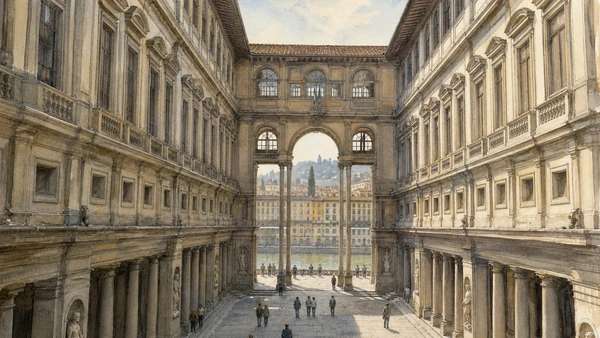
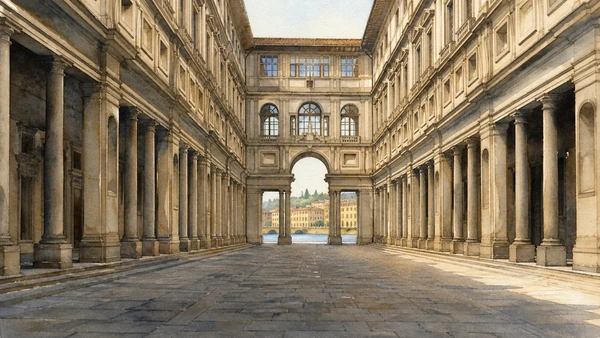
Two long wings frame the Piazzale degli Uffizi and open south toward the river. Arcaded ground floors, regular upper windows and the raised loggia establish a controlled rhythm, while the western side links visually with the Loggia dei Lanzi and Piazza della Signoria. Entrances, ticket checks and queues now occupy the base, but the courtyard remains a public street as well as a museum threshold.

History

Shortly after 1550 Cosimo I ordered Giorgio Vasari to bring courts, guild-related offices and administrative departments under one roof. Construction unfolded mainly from 1560 to 1580; after Vasari and Cosimo died in 1574, Francesco I and Bernardo Buontalenti carried the project to completion. The palace replaced a more fragmented medieval district with a bright, modular architecture whose Doric language connected order with princely justice.

How to read this place

Stand near Piazza della Signoria and look through the courtyard before walking it. Repeated three-storey modules conceal rooms of different dimensions, made possible by continuous vaults and structural devices within the walls. The apparent regularity therefore belongs to the public face of government, not to a simple row of identical offices. Follow the sightline south: the river was incorporated into the political composition.

What to notice

  • Paired wings forming a narrow ceremonial urban space
  • Doric ground-floor order associated with justice and authority
  • Open southern view joining administrative palace to the Arno
Uffizi Galleries · The Uffizi Palace
Original documentary watercolour of the Uffizi courtyard and Vasari's modular palace façade
Vasari’s Uffizi: offices before museumOriginal Merlintravel documentary watercolour · 2026
04

Large mythological paintings associated with a Medici branch moved from elite domestic settings into the centre of a public Renaissance canon

Botticelli and Medici visual culture

Primavera and the Birth of Venus should be read as materially different objects with uncertain commissions, later recorded together at Castello, not as illustrations of one simple myth.

Today

The large Botticelli paintings occupy renewed rooms within the Uffizi route. Primavera, painted on poplar, and the Birth of Venus, painted on canvas, are protected as individual works while displayed in deliberate dialogue. The installation completed in 2026 places the two monumental paintings facing one another in airtight cases designed to improve conservation and visual access. Visitor density still rewards a slow approach from the side.

History

Primavera dates to about 1480 and was recorded in the Via Larga house of Lorenzo di Pierfrancesco de’ Medici’s heirs before moving to Villa di Castello. The Birth of Venus dates to about 1485; a Medici commission is probable but not documented, and Vasari described it at Castello in 1550. Their mythological poetry, classical references, botany, luxury and domestic scale belong to late-fifteenth-century elite culture rather than a museum called the Renaissance.

How to read this place

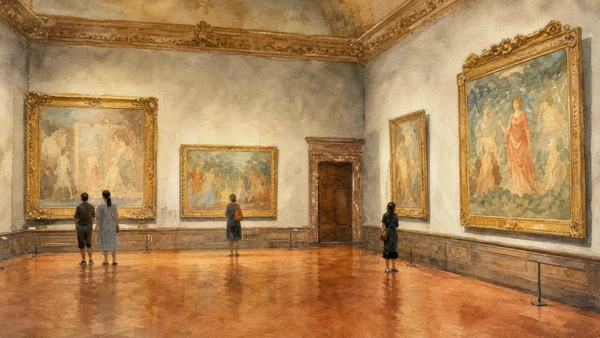
Begin with support, dimensions and viewing distance before decoding figures. In Primavera, move across the orange grove and plant species without pretending that scholarship has fixed one complete meaning. For the Birth of Venus, distinguish the modern title from the depicted arrival on Cyprus. Note gilded details and the lighter canvas support. Use the official records to separate evidence from attractive but unproven commissioning stories.

What to notice

  • Different supports: wood for Primavera and canvas for the Birth of Venus
  • Orange trees, flowers and classical poetry tied to Medici-associated culture
  • New 2026 cases and facing arrangement as a modern museum layer
Uffizi Galleries · New Botticelli Rooms
Original documentary watercolour of the renewed Botticelli gallery using abstract floral and marine colour references
Botticelli and Medici visual cultureOriginal Merlintravel documentary watercolour · 2026
05

Three works from Florence around 1500 reveal unfinished process, sculptural construction and repair rather than a single triumphant High Renaissance style

Leonardo, Michelangelo and Raphael rooms

The Adoration of the Magi, Doni Tondo and Madonna of the Goldfinch reward close comparison because their materials, patrons and later physical histories diverge sharply.

Today

Leonardo’s Adoration is shown as an unfinished panel after conservation completed in 2017. Michelangelo’s circular Holy Family survives with its elaborate frame in the Raphael and Michelangelo room. Raphael’s Madonna of the Goldfinch, reconstructed after a sixteenth-century house collapse, makes historical damage and modern conservation part of its object biography. Current rooms may rotate nearby works, but these official records anchor the route.

History

Augustinian canons commissioned Leonardo’s Adoration in 1481 for San Donato in Scopeto; he left for Milan before completing it. Michelangelo produced the Doni Tondo around 1505–1506 for the merchant Agnolo Doni and Maddalena Strozzi. Raphael painted the Madonna of the Goldfinch before February 1506 during his Florentine period; after the Nasi house collapsed in 1547, the panel broke into multiple fragments and was repaired.

How to read this place

In Leonardo, follow stages of thought rather than imagining a finished picture hidden beneath brown preparation. In Michelangelo, read twisting bodies, the circular format and carved frame as one forceful object. In Raphael, let glances and gestures establish the pyramid before studying the restored surface. The room demonstrates exchange among artists, yet individual commissions mattered more than a modern idea of three geniuses meeting for us.

What to notice

  • Leonardo’s varied levels of unfinished drawing and paint
  • Michelangelo’s circular panel and sculptural frame
  • Raphael’s composed intimacy across a historically shattered and restored support
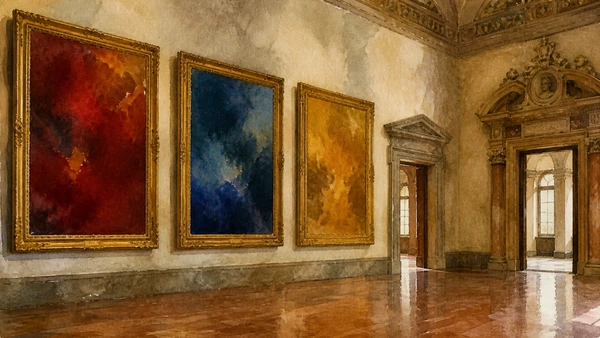
Uffizi Galleries · Michelangelo’s Doni Tondo
Original documentary watercolour of a Renaissance gallery with circular and rectangular frames and no copied artworks
Leonardo, Michelangelo and Raphael roomsOriginal Merlintravel documentary watercolour · 2026
06

Buontalenti’s octagonal cabinet condensed rare paintings, ancient sculpture, precious materials and cosmic symbolism into a controlled princely microcosm

The Tribuna and Medici collecting systems

The Tribuna matters less as a room of isolated masterpieces than as a designed system connecting geometry, matter, rarity and restricted court access.

Today

The small octagonal room remains one of the Uffizi’s most recognisable historic interiors. A high dome, shell decoration, coloured surfaces and precious-stone effects create a dense environment different from the neutral gallery. Access is regulated to protect fragile materials and manage the narrow space; sightlines may be controlled from the threshold. The current arrangement cannot be assumed to reproduce one immutable Medici display.

History

Francesco I asked Bernardo Buontalenti to create the Tribuna in the 1580s within the east corridor’s princely gallery. Its octagon and material programme have been read through the four elements: shell and mother-of-pearl, red textile, stone and light join objects gathered as exceptional productions of nature and art. Over centuries inventories, travel accounts and paintings such as Zoffany’s famous eighteenth-century view documented changing contents and reputations.

How to read this place

Look from enclosure outward. Begin with floor, walls, dome and windows before identifying individual objects. The room controlled who could see the collection and how rarity was related; it was neither a public salon nor a modern taxonomic museum. Reproductions of earlier arrangements are evidence for historical moments, not instructions to imagine every celebrated work permanently crowded together.

What to notice

  • Octagonal geometry separating the cabinet from long corridors
  • Shell, stone, textile and light forming a material programme
  • Restricted scale that turned viewing into courtly privilege
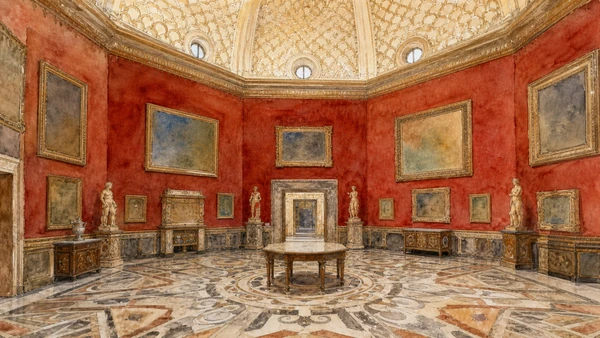
Uffizi Galleries · Gallery and Tribuna history
Original documentary watercolour of the octagonal Tribuna with shell dome and rich materials
The Tribuna and Medici collecting systemsOriginal Merlintravel documentary watercolour · 2026
07

At the southern end of the Uffizi courtyard, administrative geometry opens to water, bridges and the private territory of the grand-ducal residence

From Loggia dei Lanzi to the Arno threshold

The walk from Signoria through the Uffizi is an urban section through power: ceremonial loggia, offices, gallery, river view and controlled passage align without becoming one building.

Today

The Uffizi courtyard remains the most direct pedestrian approach from Piazza della Signoria to Lungarno Anna Maria Luisa de’ Medici. Through the southern opening, the Arno appears between monumental wings. Museum windows above repeat this connection at different heights, while the enclosed Vasari Corridor departs on a route visitors cannot enter without the separate timed supplement.

History

Vasari’s palace stood alongside the older Loggia della Signoria and extended the ducal administrative centre toward the river. The elevated Corridor, built in 1565 for the marriage celebrations of Francesco de’ Medici and Joanna of Austria, carried the ruling household from the Uffizi to Pitti without requiring an ordinary street crossing. The public courtyard below and privileged route above thus shared an axis but served different bodies.

How to read this place

Walk the entire courtyard at ground level after looking down from an upper window. Compare repetition below with the framed landscape above. At the river end, turn back toward Palazzo Vecchio: the palace tower closes the prospect differently from the open Arno. This movement clarifies why the Uffizi should be read as urban design, not only as the walls around a collection.

What to notice

  • Southern opening framing river light within the narrow courtyard
  • Backwards view toward Palazzo Vecchio’s tower
  • Separation between public ground route and controlled elevated Corridor
Uffizi Galleries · The connected museum complex
Original documentary watercolour of the Uffizi courtyard opening toward the Arno
From Loggia dei Lanzi to the Arno thresholdOriginal Merlintravel documentary watercolour · 2026
08

A 1565 court passage now operates as a reserved, staff-accompanied, accessible and strictly one-way museum route ending beyond the river

The Vasari Corridor: history and current route

The reopened Corridor is not an add-on room: its ticket, timing, meeting point, baggage rules and distant exit reshape the entire Uffizi day.

Today

Current access requires an Uffizi ticket that includes or is paired with the Vasari Corridor supplement and a reserved time. Visitors report to the Room D19 meeting point on the first floor five minutes before entry. Groups are accompanied, the visit lasts about forty-five minutes and the route is one way: it exits near the Buontalenti Grotto and continues to the Ammannati Courtyard at Pitti Palace. Large bags are prohibited, videos are not allowed and personal photography is restricted to non-professional use.

History

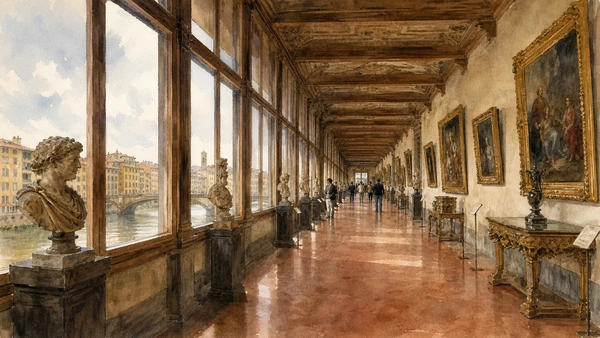
The roughly 760-metre historic passage was completed in only five months in 1565. It runs from the Uffizi along the Arno, crosses above shops on Ponte Vecchio, bends around the Mannelli tower, passes over Santa Felicita and enters the Boboli-Pitti area. From the 1970s until 2016 it displayed a large self-portrait collection. Modern work introduced safety, accessibility, climate control and renewed attention to its seventy-three windows.

How to read this place

Treat windows, bends and changed street levels as the principal collection. The passage made surveillance, comfort and dynastic continuity physical; its value is not a secret shortcut. Keep essential belongings with you because retrieving items from the Uffizi cloakroom requires returning by street after the Oltrarno exit. Do not schedule an immediate museum return or assume Boboli entry is automatically included.

What to notice

  • Long one-way sequence punctuated by seventy-three city windows
  • Sharp bend around the privately owned Mannelli tower
  • Exit on the Pitti-Boboli side, not back inside the Uffizi
Uffizi Galleries · Vasari Corridor access rules
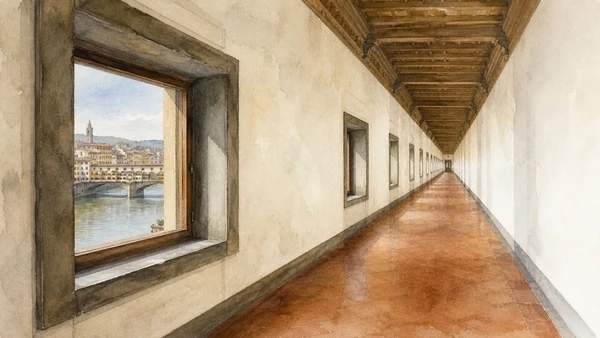
Original documentary watercolour of the long windowed interior of the Vasari Corridor
The Vasari Corridor: history and current routeOriginal Merlintravel documentary watercolour · 2026
09

A medieval bridge carrying shops and a ducal passage still works as a commercial street, public crossing and inhabited river façade

Ponte Vecchio and the goldsmith economy

The bridge’s identity comes from continuous use: changing trades, property, court intervention and retail adaptation produced the silhouette tourists inherit.

Today

Ponte Vecchio carries a pedestrian street lined largely with jewellery and goldsmith shops. Small openings at the centre reveal the Arno, while shop backs project irregularly over the bridge structure. Above the eastern side, parts of the Vasari Corridor appear as a more continuous band. The bridge is freely crossed, but intense crowds, deliveries and narrow shop thresholds make early morning or evening the clearest time to study it.

History

The crossing occupies the line of older Roman and medieval bridges; the present stone bridge is generally associated with reconstruction after the 1333 flood. Shops long housed food trades, including butchers. In 1593 Ferdinando I ordered those activities removed and favoured goldsmiths, reshaping smell, prestige and the court’s route beneath the Corridor. The bridge survived the German destruction of Florence’s other historic bridges in 1944, though approaches and surrounding buildings were devastated.

How to read this place

Look from Lungarno before crossing so structural arches, projecting shops and elevated Corridor can be separated. On the bridge, notice where the shop wall opens to public river views and how commercial display compresses movement. The goldsmith tradition is historically important but not a frozen guild museum: contemporary shops, ownership and products continue to change.

What to notice

  • Three main arches carrying a street rather than a simple deck
  • Irregular shop projections forming the inhabited river façade
  • Elevated Corridor legible above the eastern shop line
FeelFlorence · Ponte Vecchio
Original documentary watercolour exterior of Ponte Vecchio with shops, arches and the Vasari Corridor
Ponte Vecchio and the goldsmith economyOriginal Merlintravel documentary watercolour · 2026
10

River views and famous silhouettes are inseparable from flood, wartime rupture, queues, timed admission and the physical demands of a long museum day

Arno views, wartime survival and museum logistics

A responsible route ends by reconnecting beauty with infrastructure: the museum, bridge and Corridor remain vulnerable, regulated urban systems.

Today

The Uffizi currently publishes Tuesday-to-Sunday opening from 08:15 to 18:30, with the ticket office closing at 17:30; Monday, 1 January and 25 December are closed except for announced special openings. The ordinary Uffizi ticket and the Corridor supplement are separate choices. Security lines, compulsory cloakroom storage for bulky items and a two-floor collection make an early timed entry and light bag the most reliable plan.

History

The Arno repeatedly shaped and damaged Florence, including the catastrophic 1966 flood that transformed conservation practice. In August 1944 retreating German forces destroyed bridges and buildings along the river but Ponte Vecchio remained standing, with access routes blocked by demolitions. Later restoration, flood protection, crowd management and museum expansion are not interruptions to history; they are how the district continues to survive.

How to read this place

Finish on Lungarno degli Archibusieri or the Oltrarno bank and compare the bridge from a distance. Mark which fabric belongs to bridge, shops, Corridor and later repair. Within the museum, allow at least three hours rather than promising complete coverage. If using the Corridor, schedule it at least two hours after Uffizi admission as the official rules advise and accept that the day ends on the far bank.

What to notice

  • River-level view separating bridge arches from shop and Corridor layers
  • Memorial and rebuilt fabric around the 1944 approaches
  • Practical sequence of timed admission, cloakroom, galleries and distant Corridor exit
Uffizi Galleries · Current hours, tickets and services
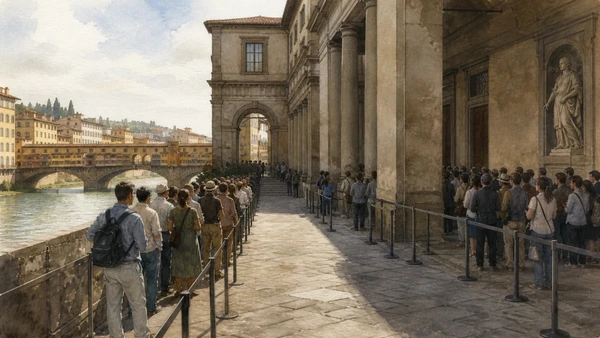
Original documentary watercolour of an early-morning Uffizi arrival with ordered visitor queues
Arno views, wartime survival and museum logisticsOriginal Merlintravel documentary watercolour · 2026

The Uffizi and river crossing through time

A short chronology

From the Roman bridge line to the modern museum, wartime survival, conservation and the reopened Vasari Corridor.

  1. A bridge crossing serves Florentia near the site later occupied by Ponte Vecchio.

  2. After a destructive Arno flood, the medieval stone bridge takes the form associated with present Ponte Vecchio.

  3. Cosimo I plans to concentrate Florentine magistracies beside Palazzo Vecchio.

  4. Construction of Vasari’s Uffizi palace begins.

  5. The Vasari Corridor is completed rapidly for the Medici-Habsburg marriage celebrations.

  6. Cosimo I and Giorgio Vasari die while Uffizi work remains underway.

  7. Buontalenti develops the east gallery and Tribuna for Francesco I’s collection.

  8. Ferdinando I removes older food trades from Ponte Vecchio and favours goldsmiths.

  9. Anna Maria Luisa de’ Medici’s Family Pact helps bind the dynastic collections to Florence.

  10. Under Peter Leopold, the Uffizi opens to the public in the modern museum sense.

  11. Florence serves as capital of Italy and the historic centre adapts to national institutions and traffic.

  12. Ponte Vecchio survives wartime bridge demolitions while its approaches suffer severe destruction.

  13. The Arno flood damages Florence and drives an international conservation response.

  14. The Vasari Corridor houses a large display of the Uffizi self-portrait collection.

  15. The reopened Corridor and renewed galleries introduce new safety, access and conservation arrangements.

Before your visit

Practical information

01

Reserve through the official channel

The Uffizi is heavily timed, and a Corridor visit requires a distinct reservation or eligible combined ticket.

02

Keep the first two hours open

Official rules recommend a Corridor slot at least two hours after Uffizi admission so the gallery is not reduced to a rush.

03

Carry only a light bag

Bulky items cannot enter the Corridor, and returning to the Uffizi cloakroom after the Pitti exit requires a street walk.

04

Follow rooms, not masterpieces

Chronology, supports and original settings make the museum intelligible when individual works are crowded or temporarily moved.

05

Expect a different final bank

The Corridor is one way and ends in the Pitti-Boboli area; it does not return visitors to the Uffizi.

06

Cross Ponte Vecchio outside too

The public street, shop fronts and river façades provide information the elevated court route deliberately changes.

Method and sources

Sources and image credits

This guide uses current official material from the Uffizi Galleries and the Comune di Firenze’s FeelFlorence service, checked on 28 August 2026. It distinguishes Vasari’s administrative palace from the later public museum; original church and domestic settings from modern gallery display; documented object histories from commissioning hypotheses; the Tribuna’s changing arrangements from a fixed reconstruction; the historic Corridor length from the longer modern managed route; the standard Uffizi ticket from the separately reserved Corridor supplement; and Ponte Vecchio’s commercial fabric from a frozen postcard image.

All ten images are original Merlintravel editorial watercolours based on documented present-day conditions. They are illustrations, not substitutes for archaeological plans. Opening hours, tickets, accessible routes, temporary exhibitions and conservation work can change; consult the linked official pages shortly before visiting.