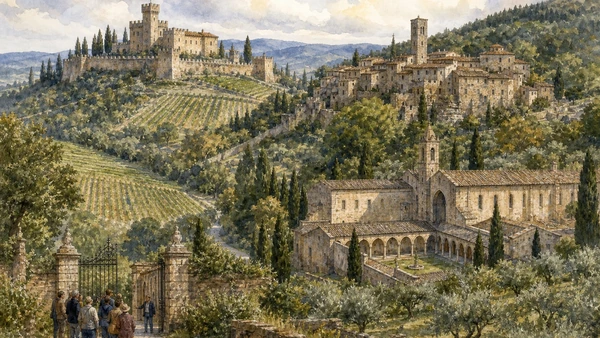
Original documentary watercolour of San Gimignano towers above vineyards, olives and the wooded hills toward Chianti

Tuscany Guide 05 · Tower city, painted rooms, pilgrimage and regulated wine landscapes

San Gimignano & Chianti:
Power in Stone and Soil

A documented route from a compact World Heritage town of towers, squares and fresco cycles to two different wine territories: Vernaccia’s municipal hills and Chianti Classico’s fortified border landscape between Florence and Siena.

Plan the route
San Gimignano to Gaiole · Val d’Elsa and Chianti10 chapters · two or three days

Why skyline and wine need separate evidence

San Gimignano is not a surviving medieval Manhattan and Chianti is not one continuous vineyard: both landscapes join family power, public institutions, farming, regulation, conflict, decline and modern tourism.

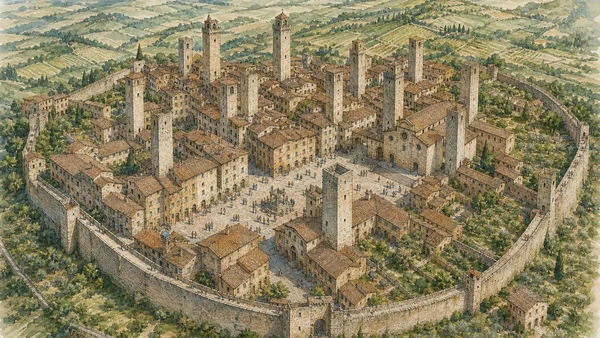
UNESCO records perhaps seventy-two tower-houses at San Gimignano’s medieval height and fourteen survivors today. The skyline matters because rival families, merchants and civic government used height, enclosure and public space to express different kinds of authority. Decline after plague and submission to Florence in 1353 limited later rebuilding, but the town was never sealed outside time. Houses, orchards, worship and municipal services still occupy the historic centre.

The Collegiata and Sant’Agostino preserve fourteenth- and fifteenth-century painting in the architectural spaces for which it was made. Palazzo Comunale adds council chambers, civic imagery, a picture gallery and the climb of Torre Grossa. These are separate institutions gathered by a current pass, not one interchangeable visual experience. The Via Francigena explains movement through the town, while Vernaccia explains the farmed slopes around it.

Chianti Classico lies farther east and extends across eight municipal territories. Its castles, parish churches, market towns and woods record the long Florence-Siena frontier. Modern denomination rules distinguish Chianti Classico from Chianti wine and connect Sangiovese, production boundaries and the Black Rooster mark. A tasting can illuminate place only when transport, labour, origin and appointment access are taken seriously.

Give San Gimignano a full day with an early or late civic walk and timed interiors. Use a separate day for one coherent Chianti arc—Castellina and Radda, or Gaiole with castles—rather than treating every hill road as a tasting itinerary.

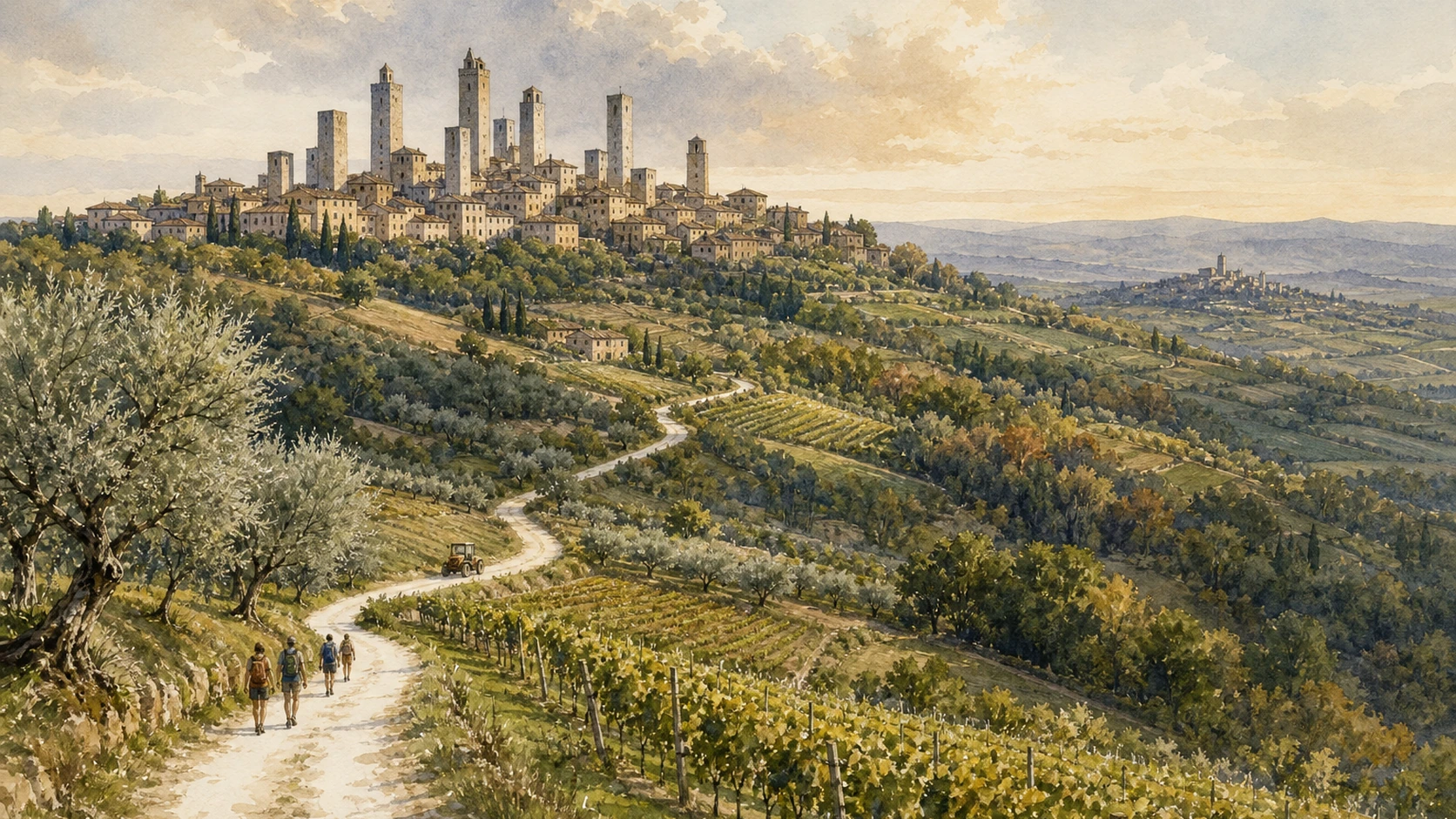
The route

Plan your visit

San Gimignano can be walked but not responsibly rushed. Chianti requires route choice, bookings and a driver plan. The guide therefore moves from close urban reading to agricultural and territorial comparison.

Early morning

Enter before the excursion peak

Read walls, Piazza della Cisterna and tower bases while deliveries and resident movement are still visible.

Late morning

Choose civic and sacred depth

Use the Collegiata and Palazzo Comunale rather than collecting only viewpoints; climb Torre Grossa if access and fitness fit.

Afternoon

Sant’Agostino, Rocca and vines

Leave the central crowd for frescoes, a quieter urban edge and a documented Vernaccia interpretation.

Separate day

One Chianti triangle arc

Link two towns and one booked estate or castle. A sober driver, shuttle or walking plan is part of the itinerary.

Ten chapters

Explore the places

The guide reads San Gimignano through towers, squares, frescoes, civic government, worship and pilgrimage before moving into Vernaccia agriculture and the distinct historical, geological and settlement system of Chianti Classico.

  1. 01Towers and walls: skyline is not the whole town
  2. 02Collegiata and Santa Fina: fresco is architecture
  3. 03Palazzo Comunale and Torre Grossa: civic height
  4. 04Sant’Agostino: frescoes beyond the main square
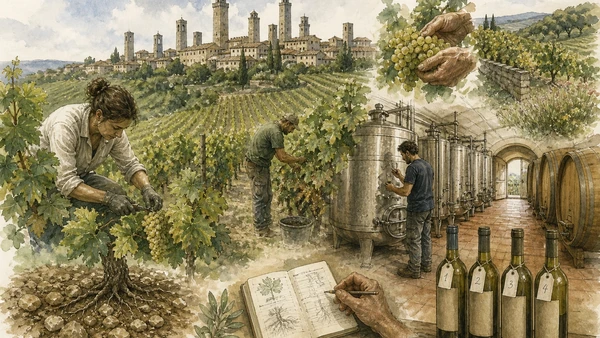
  5. 05Vernaccia: vineyard, document and controlled origin
  6. 06Via Francigena: arrival explains the ridge town
  7. 07Chianti Classico: soil, Sangiovese and boundary
  8. 08Castellina, Radda and Gaiole: three civic forms
  9. 09Castles and Badia: border defence becomes estate
  10. 10Visitor pressure and mobility: heritage has a carrying rhythm
01

Fourteen surviving tower-houses retain the memory of family competition, but squares, wells, walls, palaces and orchards complete the urban evidence

Towers and walls: skyline is not the whole town

San Gimignano’s vertical identity grew from private power inside a communal city; the surviving profile is exceptional precisely because most towers and many functions changed.

Today

The historic centre is pedestrian in large part but shared with residents, authorised vehicles, worship and business. Piazza della Cisterna and Piazza Duomo can become extremely crowded between late morning and mid-afternoon. Walk secondary lanes and wall edges without turning doorways or private courtyards into viewing platforms. Only designated towers are visitable; a tower visible above a shop or home is not automatically public.

History

San Gimignano became an independent commune in 1199 and prospered on trade and the Francigena. Noble and merchant families constructed tower-houses, perhaps seventy-two in total according to the World Heritage record. Public authority also shaped height and squares. Plague, famine and submission to Florence in 1353 brought contraction. Limited later renewal helped preserve a compact urban layout within two wall rings, while only fourteen towers survived.

How to read this place

Look at tower bases where they meet domestic palaces and streets. Compare private vertical markers with civic Torre Grossa. Find wells, orchards and unbuilt edges inside the walls. The skyline is evidence of conflict and survival, not a literal model of a complete thirteenth-century city.

What to notice

  • Tower bases integrated with houses and palaces
  • Two principal squares performing different civic roles
  • Orchards and secondary open plots within the defensive fabric
UNESCO World Heritage Centre · Historic Centre of San Gimignano
Original documentary watercolour aerial of San Gimignano towers, squares, double walls and internal orchards
Towers and walls: skyline is not the whole townOriginal Merlintravel documentary watercolour · 2026
02

A restrained Romanesque exterior opens into one of Tuscany’s most complete programmes of painting in its original religious setting

Collegiata and Santa Fina: fresco is architecture

Old and New Testament cycles, Last Judgment, chapels and liturgy form a spatial argument; they are not isolated images arranged like a neutral gallery.

Today

The Collegiata is an active church with paid cultural access outside worship. The San Gimignano Pass can combine it with civic museums, but service times and capacity still govern entry. Photography and group rules should be checked on site. The Santa Fina Chapel is small and deserves quiet attention rather than a rapid queue through its Ghirlandaio cycle.

History

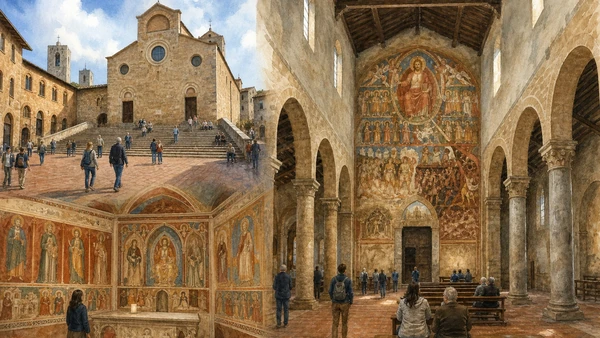
The church was consecrated in 1148, altered in 1239 and expanded by Giuliano da Maiano in 1460. Fourteenth-century Sienese painters covered the nave walls with biblical cycles, while Taddeo di Bartolo painted the Last Judgment in 1393. The Santa Fina Chapel, developed by Giuliano and Benedetto da Maiano with Domenico Ghirlandaio’s 1475 frescoes, brought Renaissance design into the older painted church.

How to read this place

Begin with the exterior stair and façade to understand the church’s place in Piazza Duomo. Inside, follow narrative sequence, architectural divisions and viewing direction before selecting a favourite scene. Distinguish painted narrative, sculpted altar and later restoration. The word cathedral is commonly used, but the building is a collegiate church.

What to notice

  • Narrative cycles organised along opposite nave walls
  • Last Judgment occupying an architectural threshold
  • Santa Fina Chapel joining painting, sculpture and local cult
Visit Tuscany · Collegiate Church of San Gimignano
Original documentary watercolour of Piazza Duomo, the Collegiata interior, biblical frescoes and Santa Fina Chapel
Collegiata and Santa Fina: fresco is architectureOriginal Merlintravel documentary watercolour · 2026
03

Council rooms, civic painting, picture gallery and the town’s highest tower explain public authority alongside family towers

Palazzo Comunale and Torre Grossa: civic height

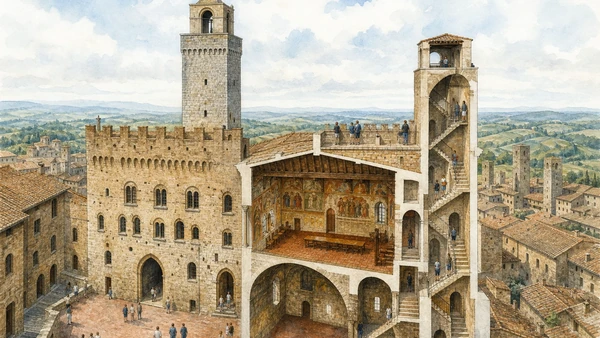
The 54-metre Torre Grossa is not simply the best panorama; it belongs to a museum route through government, commissioned imagery and the institutional city.

Today

Palazzo Comunale, Pinacoteca and Torre Grossa follow seasonal hours and a timed last entry. The published San Gimignano Pass is valid for three days and also covers the Collegiata complex and other civic sites, but temporary closures or capacity can affect individual spaces. The tower climb involves sustained stairs and exposure; it is not universally accessible.

History

The Palazzo Comunale developed from the late thirteenth century. The council room remembers Dante’s 1299 embassy and preserves courtly imagery and Lippo Memmi’s Maestà. Memmo di Filippuccio’s paintings in the Podestà rooms depict public and domestic themes. Torre Grossa was completed in the early fourteenth century and asserted communal presence within a skyline otherwise associated with powerful families.

How to read this place

Move from courtyard to council chamber before climbing. Compare civic commissions with sacred frescoes across the square. From the tower, identify walls, other tower-houses, orchards and agricultural slopes rather than using the panorama only for photographs. Height should return the visitor to urban structure.

What to notice

  • Council imagery made for a governing interior
  • Civic tower contrasted with private family towers
  • Panorama connecting enclosed town to working countryside
Musei San Gimignano · Palazzo Comunale and Torre Grossa
Original documentary watercolour cutaway of Palazzo Comunale, council chamber, Torre Grossa stairs and town panorama
Palazzo Comunale and Torre Grossa: civic heightOriginal Merlintravel documentary watercolour · 2026
04

A plain brick exterior and quiet northern quarter protect major painting without reproducing the ceremonial density of Piazza Duomo

Sant’Agostino: frescoes beyond the main square

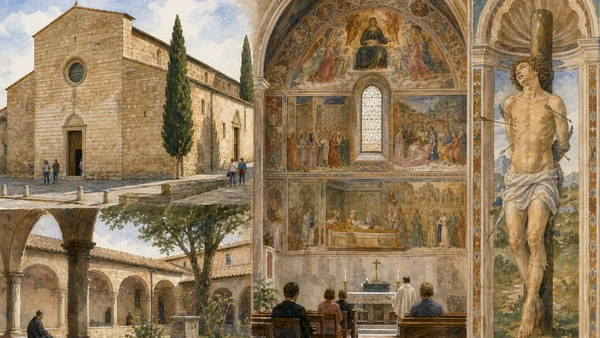
Benozzo Gozzoli’s Saint Augustine cycle and Saint Sebastian belong to an active church and convent environment whose quieter setting changes how they are encountered.

Today

Sant’Agostino remains a church; worship, community use and custodial arrangements take priority over tourism. Entry patterns should be confirmed locally, and respectful dress, silence and photography limits apply. The adjoining cloister and convent areas are not automatically open because they are visible from the church precinct.

History

The church was built in the later thirteenth century with a restrained Romanesque-Gothic exterior. Benozzo Gozzoli painted the life of Saint Augustine in the choir in 1464–1465, alongside a major Saint Sebastian image. Other works connect local, Sienese and Florentine production. The complex demonstrates that San Gimignano’s artistic importance extends beyond the civic and collegiate centre.

How to read this place

Notice the contrast between exterior mass and painted interior. Follow Augustine’s cycle as sequence rather than isolated episodes, identifying how architecture frames the narrative. Compare Gozzoli here with works seen elsewhere in town, but do not treat the church as a duplicate museum included by default in every ticket.

What to notice

  • Restrained masonry concealing a dense painted programme
  • Narrative cycle read around the choir
  • Active religious use continuing beside heritage viewing
Visit Tuscany · Sant’Agostino, San Gimignano
Original documentary watercolour of Sant'Agostino exterior, cloister and Benozzo Gozzoli frescoes
Sant’Agostino: frescoes beyond the main squareOriginal Merlintravel documentary watercolour · 2026
05

The white wine is tied to vineyards within one municipality, while its medieval fame and modern DOCG rules belong to different evidence systems

Vernaccia: vineyard, document and controlled origin

Vernaccia di San Gimignano connects written medieval trade, modern research, farm labour and traceable production; literary mention does not replace a current label.

Today

DOCG Vernaccia di San Gimignano uses grapes from hilly vineyards within the municipality and at least 85 percent of the named variety under the current rules. Bottles carry controlled identification. Winery visits and the consortium’s Wine Experience require their own hours or bookings. Tasting should follow a transport plan and include water, food and measured pours.

History

A 1276 tax record documents Vernaccia trade, and Dante later mentioned the wine in Purgatorio. Production changed over centuries rather than remaining a fixed recipe. Vernaccia became Italy’s first DOC wine in 1966, its consortium was founded in 1972, and DOCG recognition followed in 1993. Recent regulation and research define permitted varieties, territory, yield and cellar practice.

How to read this place

Begin in the vineyard: slope, soil, exposure, pruning and work matter more than the skyline label. In a cellar, ask about vintage and reserve rather than assuming all Vernaccia is identical. Separate the history of the word, the grape, the regulated wine and the promotional identity.

What to notice

  • Vineyards located inside the San Gimignano production zone
  • Government identification supporting traceability
  • Labour and cellar control behind the historic name
Vernaccia di San Gimignano Consortium · Production regulations
Original documentary watercolour of Vernaccia vineyard work, cellar practice and San Gimignano skyline
Vernaccia: vineyard, document and controlled originOriginal Merlintravel documentary watercolour · 2026
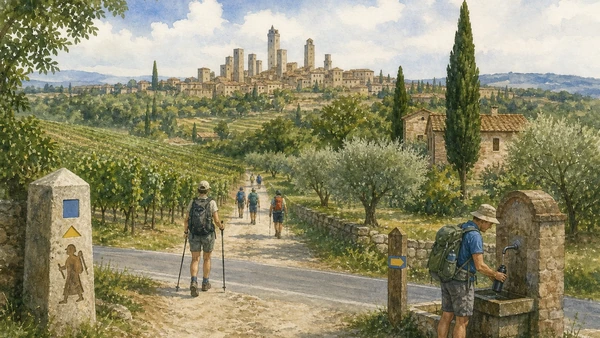
06

San Gimignano prospered as a relay point because people, goods, hospitality and risk moved through it; today’s trail is managed travel, not a medieval simulation

Via Francigena: arrival explains the ridge town

Walking into San Gimignano makes gates, water, lodging and markets legible, but a modern stage requires verified routing, road care, weather planning and lawful access.

Today

Official stages connect Gambassi Terme, San Gimignano and Monteriggioni. Distances, accommodation and water should be checked against the current route, not a social-media shortcut. Some sections share roads or cross agricultural land on defined rights of way. Summer heat and storms can make a nominal stage unsafe; luggage transfer does not remove the need for footwear and water.

History

The route toward Rome linked San Gimignano to pilgrims and commerce in the central Middle Ages. Hospitality, religious foundations and taxes participated in the town’s growth. The modern Francigena is a reconstructed and signposted cultural itinerary using surviving roads and later connections; it is not a single untouched pavement inherited from one historical date.

How to read this place

Approach a gate on foot if practical, then identify how the main street connects entry, squares and exit. Outside the walls, observe mixed farming and settlement rather than searching only for towers. Treat route markers as operational guidance and historic interpretation as a separate layer.

What to notice

  • Gate and main street aligned with through-movement
  • Water and hospitality as route infrastructure
  • Modern signed stage crossing a changing agricultural landscape
Visit Tuscany Via Francigena · San Gimignano point
Original documentary watercolour of walkers, road crossing and water point on the Via Francigena approaching San Gimignano
Via Francigena: arrival explains the ridge townOriginal Merlintravel documentary watercolour · 2026
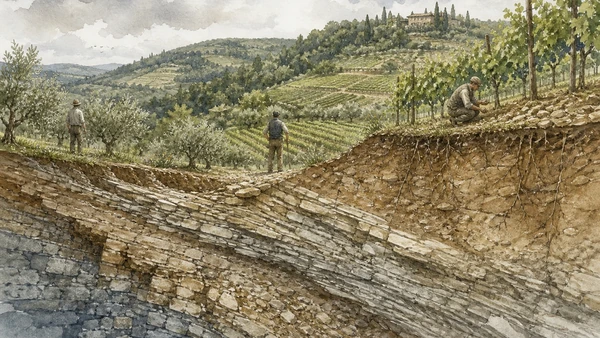
07

Chianti Classico is a regulated production zone of 71,800 hectares, not a synonym for every Tuscan vineyard or every bottle labelled Chianti

Chianti Classico: soil, Sangiovese and boundary

Wooded ridges, elevation, rocky soils, vineyard choices and a legally defined area create variation within the denomination; the Black Rooster marks origin rules, not one taste.

Today

The zone covers all of Castellina, Gaiole, Greve and Radda and parts of four other municipalities. Current rules require at least 80 percent Sangiovese and all production phases within the territory. Annata, Riserva and Gran Selezione are regulated categories. A tasting room may explain these distinctions, but access to a vineyard, cellar or estate is by permission or booking.

History

The name Chianti appears for wine in a 1398 document. Cosimo III defined a production area in 1716. Bettino Ricasoli’s nineteenth-century experiments foregrounded Sangiovese. Producers founded the consortium in Radda in 1924, using the historic Black Rooster of the Chianti League. Chianti Classico became an autonomous DOCG in 1996 and is legally distinct from Chianti wine.

How to read this place

Compare slope, stone, forest edge and altitude before discussing flavour. Read the producer and denomination, not only the word Chianti. The common claim that one baron’s recipe created today’s wine compresses experimentation, regulation and later change into a convenient legend.

What to notice

  • Vineyard blocks interrupted by woods and olive groves
  • Rocky soils and elevation varying across the zone
  • Black Rooster identifying Chianti Classico rather than generic Chianti
Chianti Classico Consortium · Production zone
Original documentary watercolour cutaway of Chianti rocky soils, Sangiovese vines, olives and wooded ridges
Chianti Classico: soil, Sangiovese and boundaryOriginal Merlintravel documentary watercolour · 2026
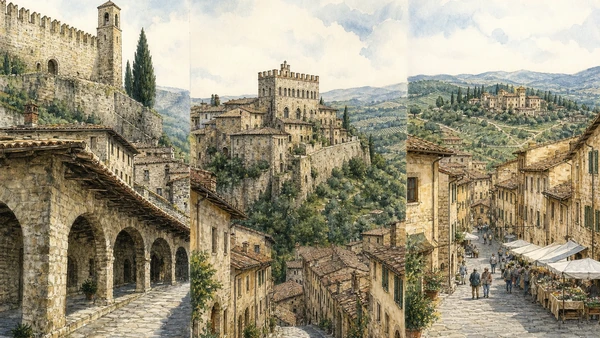
08

Castellina, Radda and Gaiole differ because fortress, administrative capital and open market served the frontier in different ways

Castellina, Radda and Gaiole: three civic forms

The so-called Chianti triangle is useful only if it preserves differences: enclosed ridge towns are not interchangeable with a market settlement in the valley road system.

Today

Castellina’s fortress and Via delle Volte, Radda’s walled centre and municipal buildings, and Gaiole’s street-square can each be read on foot. Parking belongs outside the smallest cores. Museums, churches and Casa del Chianti Classico use separate access. Markets and resident services can change traffic patterns; a café table is not proof that a town exists only for visitors.

History

The three territories formed the historic Chianti League under Florentine control, but performed different roles. Radda became an administrative centre, Castellina a fortified position toward Siena, and Gaiole a market serving a constellation of castles and rural settlements. War repeatedly altered fortifications before estates and wine economies transformed many sites in later centuries.

How to read this place

Compare approach, gate, central space and relation to surrounding castles. In Castellina, use covered routes to read defence; in Radda, read government and enclosure; in Gaiole, read exchange rather than searching for a wall that its market form did not require.

What to notice

  • Castellina fortress and covered defensive passage
  • Radda ridge enclosure and civic authority
  • Gaiole linear market space linked to rural castles
Visit Tuscany · Touring the Chianti area
Original documentary watercolour triptych of Castellina, Radda and Gaiole showing their different urban forms
Castellina, Radda and Gaiole: three civic formsOriginal Merlintravel documentary watercolour · 2026
09

Fortresses, villages, villas, former monasteries and wine estates share the landscape but not one ownership model or public-access rule

Castles and Badia: border defence becomes estate

Brolio, Volpaia, Meleto, Montegrossi and Badia a Coltibuono record conflict, religious landholding, residence and production; their present uses require specific verification.

Today

Some complexes offer gardens, museums, guided rooms, tastings or accommodation; others are private dwellings, active estates or ruins. Gates and websites define access more reliably than a map icon. Book one site deeply rather than entering multiple driveways. Wine events and weddings can close spaces normally offered to visitors.

History

The Florence-Siena frontier produced castles, outposts and fortified villages. Brolio was repeatedly besieged and rebuilt; Volpaia retained a village form while production entered its buildings; Meleto became a residence and estate; Montegrossi survives largely as ruin. Badia a Coltibuono grew from a monastic foundation and later became a private agricultural property. Peace converted some military sites without erasing their earlier fabric.

How to read this place

Identify defensive position before later garden, villa façade or cellar. Distinguish an inhabited fortified village from a single castle and a former abbey from an active monastery. The most responsible visit follows the property’s current invitation, not the romance of an open gate.

What to notice

  • Ridge positions controlling routes between Florence and Siena
  • Later estate functions inserted into defensive fabric
  • Private, guided and public areas clearly separated
Visit Tuscany · Touring castles in Chianti
Original documentary watercolour of Brolio, Volpaia and Badia a Coltibuono within vineyards, olives and woods
Castles and Badia: border defence becomes estateOriginal Merlintravel documentary watercolour · 2026
10

A World Heritage town and a global wine brand concentrate coaches, cars, housing conversion and image-making across places with small resident populations

Visitor pressure and mobility: heritage has a carrying rhythm

Crowding is not solved by finding a secret alley or private vineyard; it is reduced by timing, legal parking, fewer stops, local stays and transport that respects residents and alcohol safety.

Today

Use official car parks and shuttle systems outside San Gimignano’s walls. Visit early, late or overnight and keep doors, steps and service lanes open. In Chianti, do not combine repeated tastings with driving; use a sober driver, booked transfer, walking base or cycling plan appropriate to steep gravel. E-bikes do not remove road skill, heat or wine impairment.

History

UNESCO identifies rising tourism and changes to traditional building use as vulnerabilities at San Gimignano. Municipal rules address traffic, public ground, commerce and visual change. Chianti’s hospitality economy has adapted castles, villages and farm estates, sometimes sustaining conservation and sometimes intensifying conversion. Neither territory is preserved by visitor spending alone; resident life and agricultural work are core values.

How to read this place

Compare a crowded gate at noon with an inhabited lane at dawn or evening without claiming one is more authentic. Notice deliveries, schools, waste collection, workers and vineyard operations. A good itinerary leaves capacity for ordinary life and spends time rather than merely occupying space.

What to notice

  • Coach and car pressure concentrated outside small gates
  • Resident and service movement continuing through heritage streets
  • Sober transport connecting booked rural visits
UNESCO World Heritage Centre · Tourism and management
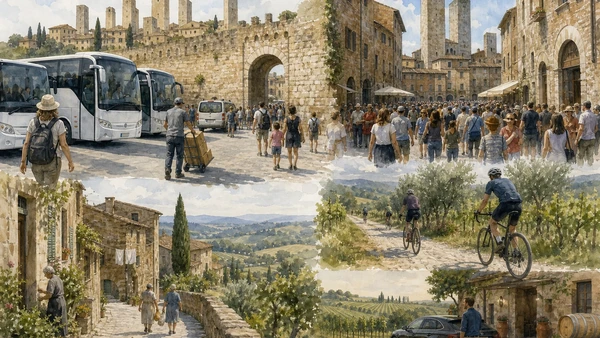
Original documentary watercolour of shuttle arrival, crowded gate, inhabited lanes, cyclists and sober winery transport
Visitor pressure and mobility: heritage has a carrying rhythmOriginal Merlintravel documentary watercolour · 2026

San Gimignano and Chianti through power, movement and cultivation

A short chronology

From early routes and communes to tower competition, fresco commissions, Florentine control, wine regulation, World Heritage protection and current visitor management.

  1. San Gimignano’s fortified settlement is documented before communal independence.

  2. Francigena traffic, trade and family power support urban growth and tower construction.

  3. The Collegiate Church is consecrated.

  4. San Gimignano becomes an independent commune.

  5. Communal tax records document Vernaccia trade.

  6. The core of Palazzo Comunale develops beside the Collegiata.

  7. Dante visits San Gimignano as a Florentine political envoy.

  8. Torre Grossa is completed as the town’s principal civic tower.

  9. San Gimignano passes under Florentine control after demographic and economic crisis.

  10. A notarial document uses Chianti as the name of a wine.

  11. Gozzoli and Ghirlandaio create major San Gimignano fresco cycles.

  12. Cosimo III defines the historic Chianti wine-producing boundary.

  13. Producers found the Chianti protection consortium in Radda and choose the Black Rooster.

  14. Vernaccia becomes DOC then DOCG; Chianti Classico becomes an autonomous DOCG.

  15. UNESCO inscription and modern management confront growing visitor and land-use pressure.

Before your visit

Practical information

01

Start before coaches

An early arrival reveals resident and delivery rhythms and gives tower bases and squares room to be read.

02

Use the pass selectively

Three-day validity supports depth; it is not a challenge to enter every included room in one afternoon.

03

Climb only one tower

Torre Grossa offers the civic context. Private towers and other viewpoints have separate access or no public entry.

04

Walk a verified stage

Use current Francigena routing, water and road information; do not improvise across vineyard rows.

05

Know the wine name

Vernaccia di San Gimignano, Chianti Classico and Chianti are distinct regulated products and territories.

06

Separate tasting from driving

Choose a sober driver, transfer or walking base before confirming rural appointments.

Method and sources

Sources and image credits

This guide uses current official material from UNESCO, Comune and Musei Civici di San Gimignano, Visit Tuscany, the Vernaccia di San Gimignano Consortium and Chianti Classico Consortium checked on 28 August 2026. It distinguishes surviving towers from a complete medieval skyline; private tower-house from civic tower; collegiate church from cathedral title; painting in original worship setting from detached museum object; town pass from universal access; literary wine reference from current DOCG; municipal Vernaccia territory from Chianti Classico; historical route from untouched medieval road; production zone from generic Tuscan scenery; Chianti Classico from Chianti wine; documented Black Rooster history from the boundary-race legend; fortified village from private castle; former abbey from active monastery; and visitor spending from resident and agricultural viability.

All ten images are original Merlintravel editorial watercolours based on documented present-day conditions. They are illustrations, not substitutes for archaeological plans. Opening hours, tickets, accessible routes, temporary exhibitions and conservation work can change; consult the linked official pages shortly before visiting.