Watercolour: Modena establishing view

Emilia-Romagna · Guide 03

Modena

A cathedral city shaped by communal life, Este patronage, performance, food knowledge and the design of machines.

Plan the route
Modena10 chapters · history, culture and landscape

Why this place matters

Start with the square, then follow the institutions.

Modena’s central monuments work together: the cathedral, tower and Piazza Grande connect worship, public time and civic authority. Beyond that ensemble, the Este court left a palace and collections, while theatres, markets and manufacturing gave later generations different ways to represent the city. These histories overlap without becoming interchangeable. A museum collection is not the same as a preserved court interior; a working market is not an unchanged survival from the Middle Ages. The guide uses buildings and objects to trace those distinctions, with separate arrangements for restricted interiors and specialist visits.

The guide separates documented history from suggestions for reading the site. Named buildings and landscape relationships follow institutional sources; the illustrations are editorial interpretations, not measured surveys or records of current access.

A cathedral city shaped by communal life, Este patronage, performance, food knowledge and the design of machines.
The route

Plan your visit

Begin with the cathedral, Piazza Grande and the Ghirlandina area. Book any tower, palace or acetaia visit before arranging the rest of the day. The gallery and theatre deserve their own time; the Enzo Ferrari Museum is a separate walk or transfer from the central square.

Central ensemble

Cathedral, Piazza Grande and Ghirlandina

Begin with the cathedral, Piazza Grande and the Ghirlandina area.

Este patronage

Ducal Palace and Galleria Estense

City institutions

San Pietro and the municipal theatre

Production

Market, acetaia and Enzo Ferrari Museum

Ten chapters

Explore the places

The chapters connect history and terrain. Use the route notes to choose visits and plan transfers between separate sites.

  1. 01The cathedral: architecture and sculpture
  2. 02Piazza Grande: civic space
  3. 03Ghirlandina: a tower for church and city
  4. 04The Ducal Palace
  5. 05Galleria Estense: collecting after the court
  6. 06San Pietro and the art of terracotta
  7. 07The Pavarotti–Freni Municipal Theatre
  8. 08Mercato Albinelli
  9. 09The municipal acetaia
  10. 10Museo Enzo Ferrari: industrial memory
01

Worship and memory

The cathedral: architecture and sculpture

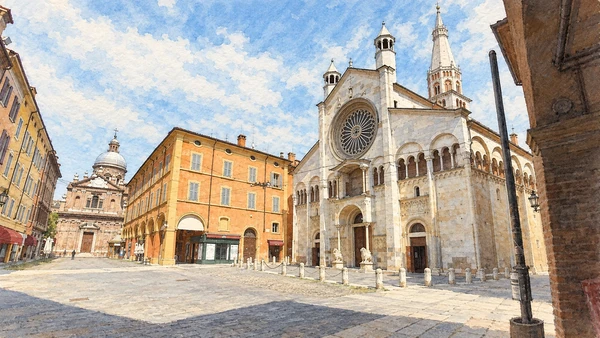
The pale facade, projecting porch and carved surfaces invite attention at two scales. Stand back to read the building, then approach individual reliefs and portals. Sculpture is woven into the architectural order rather than added as a separate display.

Today

Worship and local religious life continue here. Visitor access may pause for services; consult the church or managing institution before planning an interior visit.

History

The cathedral’s foundation stone was laid in 1099. Lanfranco’s architecture and the sculpture associated with Wiligelmo form its early Romanesque core. Later work by the Campionesi masters altered features including the rose window and entrances, so the visible building records more than one campaign.

How to read this place

Compare the main facade with the flank facing Piazza Grande. Look for the changes in material and scale around different portals. Some exposed sculptures are replacements made to protect originals; the cathedral museums provide a further setting for understanding the surviving material.

What to notice

  • Compare the main facade with the flank facing Piazza Grande.
  • Look for the changes in material and scale around different portals.
  • Some exposed sculptures are replacements made to protect originals; the cathedral museums provide a further setting for understanding the surviving material.
The Cathedral OF MODENA
Watercolour: Modena Cathedral west facade with rose window and projecting porch in its urban setting
The cathedral: architecture and sculptureEditorial watercolour · AI-generated · 2026
02

The inhabited landscape

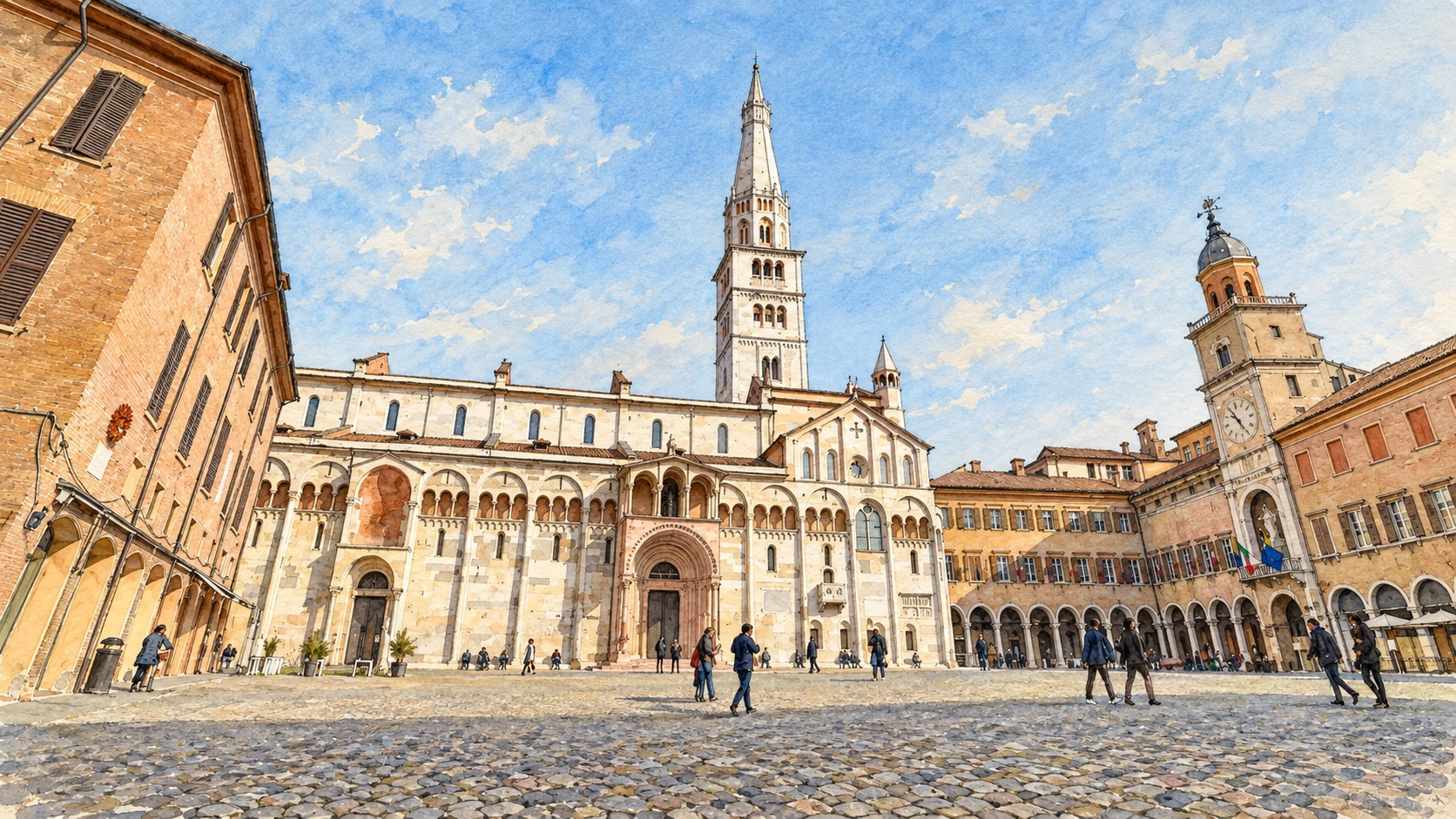
Piazza Grande: civic space

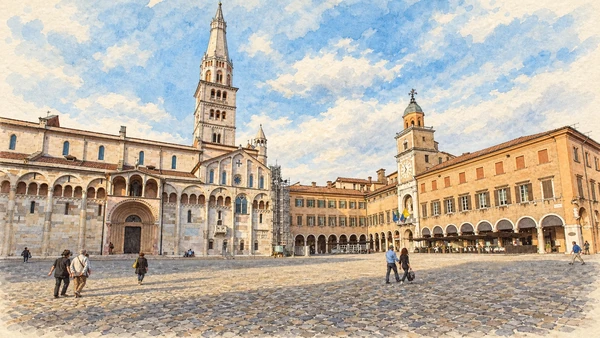
The square brings the cathedral and municipal buildings into one public setting. Its open paving and surrounding arcades make the relationship between institutions easy to see, while the space continues to support movement, meeting and cultural activity.

Today

This remains an inhabited place. Use pedestrian routes, keep entrances clear and check municipal mobility notices for any restricted area.

History

Trade, civic government, religious ceremony and the public administration of justice all formed part of the square’s history. Its uses changed again in the twentieth century. The cathedral, Ghirlandina and square were jointly inscribed on the UNESCO World Heritage List in 1997.

How to read this place

Read the entrances and covered edges as well as the open centre. Consider how a market or ceremony would occupy the space without imagining either as a permanent fixture. The square’s present appearance is one stage in a long history of changing public use.

What to notice

  • Read the entrances and covered edges as well as the open centre.
  • Consider how a market or ceremony would occupy the space without imagining either as a permanent fixture.
  • The square’s present appearance is one stage in a long history of changing public use.
Piazza Grande
Watercolour: Modena Piazza Grande, cathedral flank and municipal arcades around a broad paved square
Piazza Grande: civic spaceEditorial watercolour · AI-generated · 2026
03

Evidence and interpretation

Ghirlandina: a tower for church and city

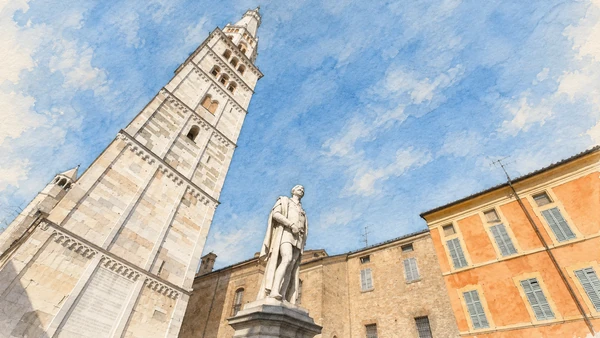
The tower is a landmark from many streets, but its lower surfaces and sculptural details reward a closer view. The transition from square shaft to pointed upper structure makes its stages of construction visible in the silhouette.

Today

Consult the current booking arrangements. The official visitor route reaches the Torresani Room; access to the top is not part of the ordinary visit. Check the stair route and suitability in advance.

History

Built as the cathedral’s bell tower, the Ghirlandina also served civic purposes, marking time and safeguarding documents and symbolic objects. Its construction extended across successive medieval campaigns, with the octagonal pinnacle completed in the early fourteenth century.

How to read this place

Compare the tower’s vertical rhythm with the horizontal arcades of the cathedral. The visitor route ends at a designated level rather than continuing unrestricted to the spire. Distinguish a displayed copy of a historic object from the original using the site’s labels.

What to notice

  • Compare the tower’s vertical rhythm with the horizontal arcades of the cathedral.
  • The visitor route ends at a designated level rather than continuing unrestricted to the spire.
  • Distinguish a displayed copy of a historic object from the original using the site’s labels.
Ghirlandina belltower
Watercolour: Ghirlandina Modena viewed from below beside a statue and ochre urban buildings
Ghirlandina: a tower for church and cityEditorial watercolour · AI-generated · 2026
04

Evidence and interpretation

The Ducal Palace

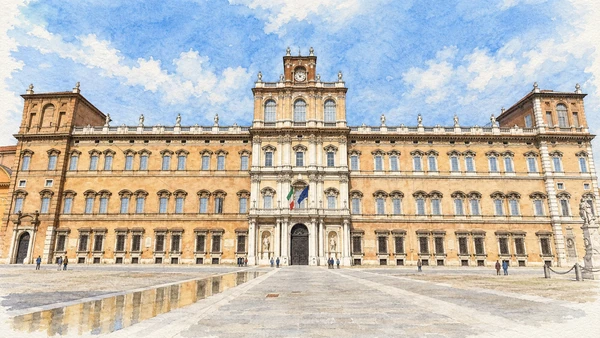
The long facade addresses Piazza Roma with a scale quite different from the communal square. Raised pavilions, regular windows and sculptural accents give the building a controlled public presence before any interior is entered.

Today

Interior visits require an organised guided tour and advance arrangements through the tourist office. Availability follows the requirements of the Military Academy; confirm the specific visit before travelling.

History

Construction began in 1634 to designs by Bartolomeo Avanzini. The palace housed the Este court and later became the headquarters of the Military Academy. Its ceremonial rooms therefore belong to a building with an active institutional role, not an unrestricted historic-house museum.

How to read this place

Read the central emphasis and the balance of the wings from the square. An authorised interior tour can connect that exterior order with courtyard, stairs and apartments. Follow the exact route offered and distinguish the history of the ducal residence from the later military collections.

What to notice

  • Read the central emphasis and the balance of the wings from the square.
  • An authorised interior tour can connect that exterior order with courtyard, stairs and apartments.
  • Follow the exact route offered and distinguish the history of the ducal residence from the later military collections.
Ducal Palace – Military Academy
Watercolour: Palazzo Ducale Modena, long symmetrical baroque facade facing Piazza Roma
The Ducal PalaceEditorial watercolour · AI-generated · 2026
05

Evidence and interpretation

Galleria Estense: collecting after the court

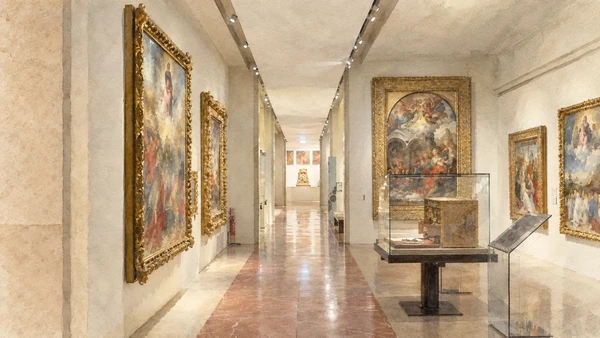
Paintings, sculpture and smaller objects make the gallery a place to study collecting as well as individual works. The present museum setting arranges material for public interpretation, often very differently from the rooms in which it was first owned.

Today

Check the institution’s current opening, booking arrangements and accessible route. Individual rooms, exhibitions and approaches may have separate conditions.

History

The collection is rooted in Este patronage and the transfer of the court to Modena. Sales, acquisitions and later museum organisation altered what remained together. Since 1894 the gallery has occupied the Palazzo dei Musei, an eighteenth-century building adapted to cultural institutions.

How to read this place

Choose a small number of works and read their provenance alongside their subjects. Compare a portrait’s function in a court with its place in a modern gallery. The illustration records a gallery setting, without implying that every work in the collection is always displayed in the same room.

What to notice

  • Choose a small number of works and read their provenance alongside their subjects.
  • Compare a portrait’s function in a court with its place in a modern gallery.
  • The illustration records a gallery setting, without implying that every work in the collection is always displayed in the same room.
Galleria Estense
Watercolour: Galleria Estense Modena, pale gallery interior with framed paintings and a glass display case
Galleria Estense: collecting after the courtEditorial watercolour · AI-generated · 2026
06

Worship and memory

San Pietro and the art of terracotta

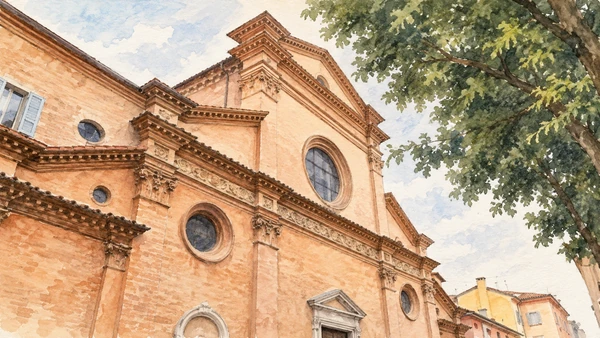
The warm facade introduces a church rich in local Renaissance work. Its decorative frieze and round windows establish an architectural rhythm outside, while sculpture inside offers a closer encounter with modelling, surface and scale.

Today

Worship and local religious life continue here. Visitor access may pause for services; consult the church or managing institution before planning an interior visit.

History

The present church was reconstructed from the late fifteenth century and consecrated in 1518. Works by Antonio Begarelli connect the interior with Modena’s tradition of terracotta sculpture. The age of the monastic foundation should be kept separate from the date of the standing church.

How to read this place

Compare the facade’s architectural terracotta with the larger sculptural figures inside, where access permits. Notice how placement against a pillar or within a chapel affects the way a figure is seen. Use the church’s interpretation to identify artists and later interventions.

What to notice

  • Compare the facade’s architectural terracotta with the larger sculptural figures inside, where access permits.
  • Notice how placement against a pillar or within a chapel affects the way a figure is seen.
  • Use the church’s interpretation to identify artists and later interventions.
San Pietro Apostolo Abbey
Watercolour: San Pietro Apostolo Modena, oblique study of terracotta facade and circular windows
San Pietro and the art of terracottaEditorial watercolour · AI-generated · 2026
07

Evidence and interpretation

The Pavarotti–Freni Municipal Theatre

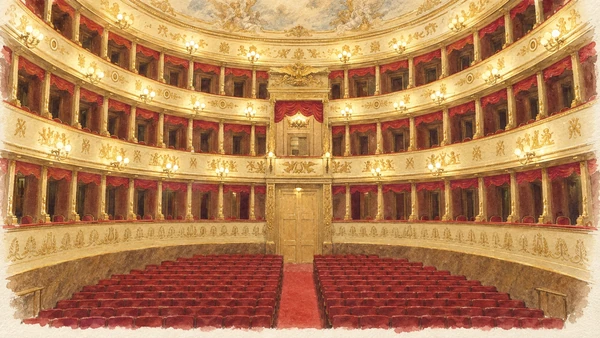
An opera house organises a public around stage, seating and circulation. The curved auditorium and stacked boxes express a social arrangement as well as an acoustic and visual one, while backstage work remains largely outside the spectator’s view.

Today

Check the theatre’s programme for performances and the tourist office for guided visits. A box-office opening does not by itself mean that the auditorium is available for sightseeing.

History

Designed by Francesco Vandelli, the theatre opened in 1841. Its construction formed part of the nineteenth-century city’s ambitions for public representation and performance. The present name honours singers associated with Modena, while the building’s history extends beyond individual careers.

How to read this place

Compare the modest scale of the street frontage with the auditorium inside. Read the relationship between stalls, boxes and stage rather than treating the room simply as decoration. A performance and a guided architectural visit offer different access and should be planned separately.

What to notice

  • Compare the modest scale of the street frontage with the auditorium inside.
  • Read the relationship between stalls, boxes and stage rather than treating the room simply as decoration.
  • A performance and a guided architectural visit offer different access and should be planned separately.
Pavarotti – FRENI Municipal Theatre of Modena
Watercolour: Pavarotti–Freni Theatre Modena, curved auditorium with gilded box fronts and red seating
The Pavarotti–Freni Municipal TheatreEditorial watercolour · AI-generated · 2026
08

The inhabited landscape

Mercato Albinelli

The covered market concentrates food retail within a purpose-built interior near Piazza Grande. Counters, roof structure and service areas reveal how shopping is organised, while the people working here give the place its daily rhythm.

Today

This remains an inhabited place. Use pedestrian routes, keep entrances clear and check municipal mobility notices for any restricted area.

History

Opened in 1931, the market belongs to the modern history of the city’s food distribution. Its historic character should not be confused with medieval origins. The central fountain and Giuseppe Graziosi’s fruit-bearing figure form part of its architectural identity.

How to read this place

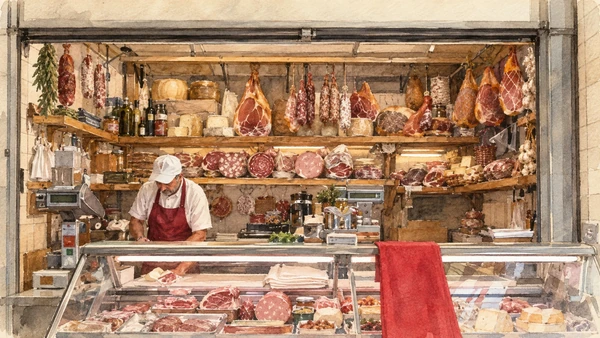
Look at the relation between a stall, its storage and the shared aisle. The illustrated delicatessen counter shows a working retail setting rather than a still life detached from its context. Ask before photographing staff or private work areas, and check individual traders for current products.

What to notice

  • Look at the relation between a stall, its storage and the shared aisle.
  • The illustrated delicatessen counter shows a working retail setting rather than a still life detached from its context.
  • Ask before photographing staff or private work areas, and check individual traders for current products.
Mercato Albinelli in Modena
Watercolour: Mercato Albinelli Modena, delicatessen counter with cheese, cured meats and an adult vendor
Mercato AlbinelliEditorial watercolour · AI-generated · 2026
09

Materials and work

The municipal acetaia

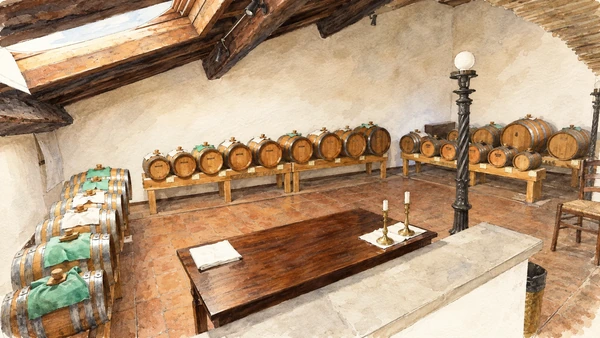
Small barrels occupy the attic of the town hall, giving a local production tradition an unusually civic setting. Their scale and arrangement make the acetaia more intimate than a large industrial cellar.

Today

Visits are guided and require booking. The official information identifies the attic route as unsuitable for wheelchair access; ask the tourist office about alternatives and the exact approach before arranging a visit.

History

Established in 2003, the municipal acetaia was created to explain and sustain knowledge of traditional balsamic vinegar. It is a modern educational and production project within a historic building; neither the age of the palace nor the wider tradition dates these particular barrels to the distant past.

How to read this place

Read the rows of barrels as part of a managed process that depends on time, care and repeated work. Let the guide explain the terminology of the products rather than treating every balsamic vinegar as equivalent. The attic’s access conditions matter as much as its central location.

What to notice

  • Read the rows of barrels as part of a managed process that depends on time, care and repeated work.
  • Let the guide explain the terminology of the products rather than treating every balsamic vinegar as equivalent.
  • The attic’s access conditions matter as much as its central location.
Acetaia comunale di Modena
Watercolour: Municipal acetaia Modena, small wooden barrels beneath a sloping attic roof
The municipal acetaiaEditorial watercolour · AI-generated · 2026
10

Evidence and interpretation

Museo Enzo Ferrari: industrial memory

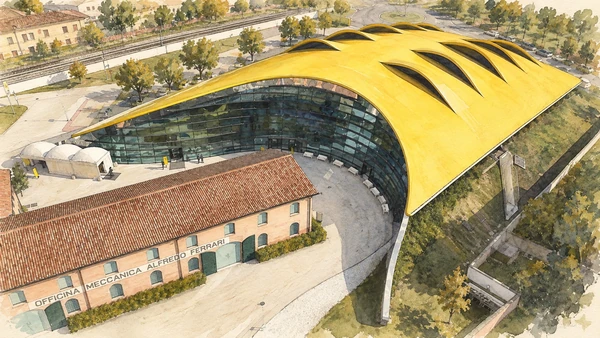
A sweeping yellow roof stands beside the smaller historic building associated with the Ferrari family. Their juxtaposition makes the museum an architectural encounter between an earlier workshop setting and contemporary exhibition design.

Today

Check the institution’s current opening, booking arrangements and accessible route. Individual rooms, exhibitions and approaches may have separate conditions.

History

The modern exhibition building was designed by Jan Kaplický and Future Systems. The museum presents a history associated with Enzo Ferrari and automotive production, while changing exhibitions determine which vehicles and themes are visible on a particular visit.

How to read this place

Compare the modest tiled-roof building with the curved glazed exhibition hall. Read vehicles as designed and manufactured objects, with materials and technical choices behind their appearance. This is the Modena museum; the Ferrari museum at Maranello is a different site and requires a separate journey.

What to notice

  • Compare the modest tiled-roof building with the curved glazed exhibition hall.
  • Read vehicles as designed and manufactured objects, with materials and technical choices behind their appearance.
  • This is the Modena museum; the Ferrari museum at Maranello is a different site and requires a separate journey.
Enzo Ferrari museum
Watercolour: Museo Enzo Ferrari Modena, flowing yellow roof beside the historic tiled-roof workshop building
Museo Enzo Ferrari: industrial memoryEditorial watercolour · AI-generated · 2026

The territory through time

A short chronology

A concise chronology linking the documented sites to the wider story.

  1. The foundation stone of the new cathedral is laid.

  2. Successive campaigns develop the cathedral and Ghirlandina.

  3. The rebuilt church of San Pietro is consecrated.

  4. Construction begins on the Ducal Palace.

  5. The new municipal theatre opens.

  6. Galleria Estense is installed in the Palazzo dei Musei.

  7. Mercato Albinelli opens.

  8. Cathedral, Ghirlandina and Piazza Grande enter the UNESCO World Heritage List.

Before your visit

Practical information

01

Plan separate days

Choose a manageable set of visits and allow for transport, booked entries and the return journey.

02

Use the exact place name

Emilia-Romagna contains separate cities, hill routes and coastal approaches. Confirm the precise locality and route rather than treating nearby names as one destination.

03

Check the institution

Opening hours, tickets, exhibitions and religious access change. Use the linked managing institution shortly before visiting.

04

Check the actual terrain

Steps, gradients and uneven ground vary between the individual sites. Use current route information, weather and closures for the option you choose.

05

Arrange accessible visits

Historic interiors and outdoor approaches can include steps, gradients or uneven surfaces. Ask about the specific route instead of assuming an entire destination is step-free.

06

Respect work and residence

Farms, workshops, churches and historic streets remain in use. Follow signs, keep entrances clear and ask permission before entering private spaces.

Method and sources

Sources and image credits

Prepared on 9 September 2026 from the institutional sources linked below. Historical claims are separated from editorial observations and itinerary suggestions. Older institutional brochures are used for stable cultural context, never as current timetables. Prices, transport schedules, trail status and admission are deliberately left to the responsible operators. Illustrations are not photographs, measured reconstructions or evidence of current conditions.

The eleven images are AI-generated editorial watercolours guided by photographic references. They interpret named places and are not photographs or substitutes for measured plans. Opening hours, tickets, accessible routes, temporary exhibitions and conservation work can change; consult the linked official pages shortly before visiting.

Illustration references and credits