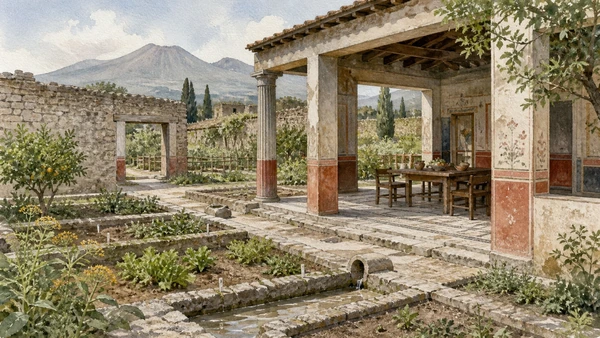
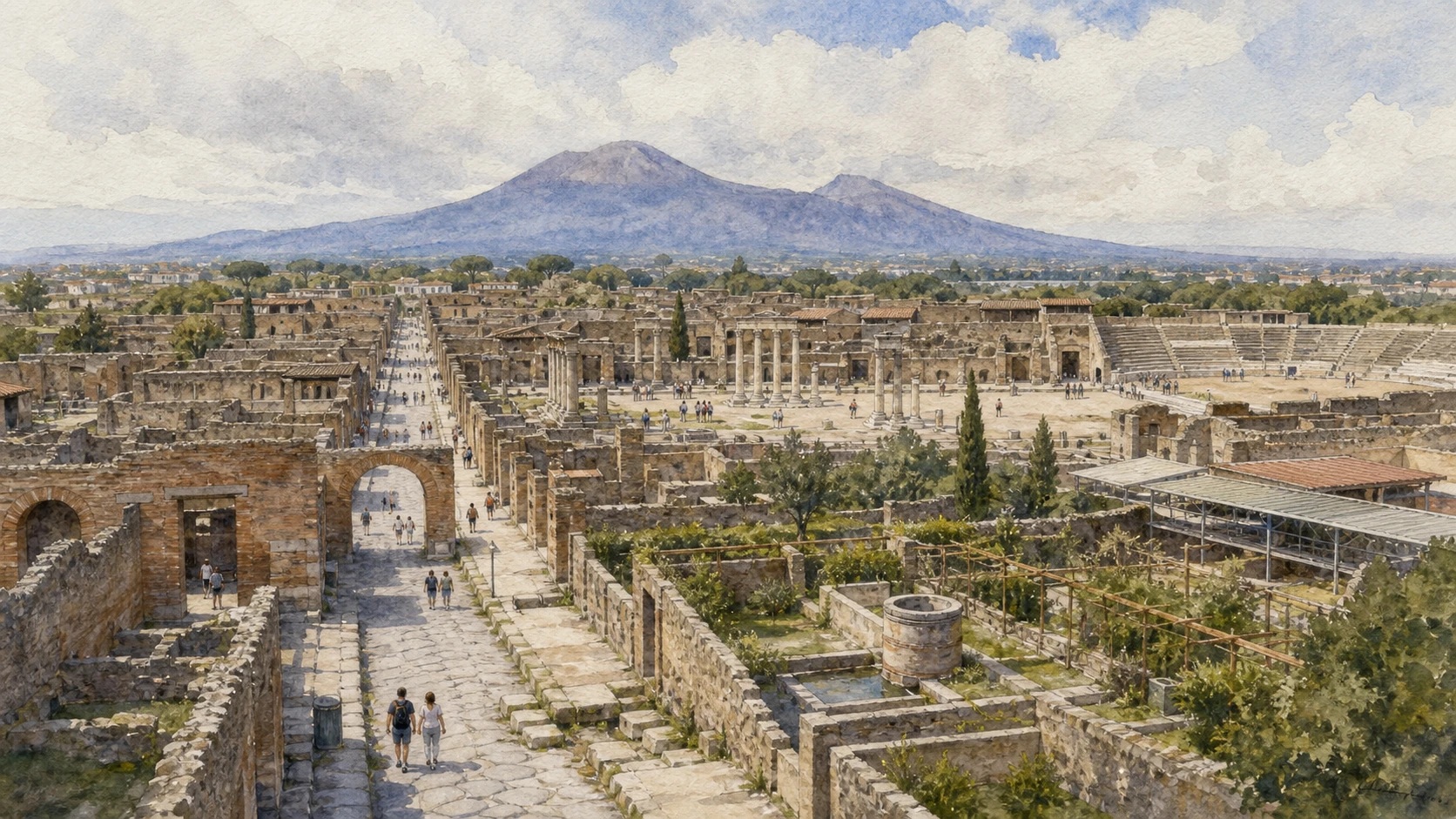
Original documentary watercolour panorama for Pompeii Archaeological Park: City, Houses and Conservation — Complete Guide, showing landscape, heritage and present-day use

Campania Guide 02 · Street system, public institutions, houses, food, water and conservation

Pompeii:
City, Houses & Conservation

A city-scale route through Pompeii that connects gates, streets, Forum, theatres, amphitheatre, houses, shops, baths, water systems, gardens, casts and current conservation instead of treating the site as one frozen day.

Plan the route
Campania · Italy10 chapters · one to three days

Why this Campania landscape must be read in layers

Pompeii is an excavated city under continuous research and care: eruption, burial, discovery, clearance, restoration and present visitor management all shape what can be seen.

The city had centuries of life before 79 CE. Its walls, streets, houses and sanctuaries reflect Oscan, Samnite, Greek, Roman colonial and imperial phases, while rebuilding after earthquakes continued until the eruption.

Objects and wall paintings now in Naples or on-site storage once belonged to specific rooms and activities. Open buildings rotate because conservation, staffing and research change daily access; a complete guide follows systems rather than promising every famous house.

Pompeii’s named-ticket and capacity rules, baggage limits and entrance arrangements are live safety conditions. Check the official park site shortly before visiting for current arrangements.

Enter early through the gate that suits the route, read streets before interiors and leave time for conservation displays: the city becomes more precise when gaps and closures are treated as evidence.

The route

Plan your visit

Use a single broad circuit through civic, theatrical, domestic and service zones, choosing open houses from the official daily list rather than repeatedly crossing the site for one unavailable room.

Early morning

Walls, gates and streets · The Forum · Theatres and entertainment district

Follow the documented sequence: Walls, gates and streets: the urban frame; then The Forum: government, worship and exchange; then Theatres and entertainment district: performance beside worship. Recheck current access, transport and weather before departure.

Late morning

Amphitheatre and palaestra · Houses · Painted rooms and mosaics

Follow the documented sequence: Amphitheatre and palaestra: mass spectacle at the edge; then Houses: atrium, garden and unequal domestic life; then Painted rooms and mosaics: decoration in context. Recheck current access, transport and weather before departure.

Afternoon

Shops and food counters · Baths, fountains and water · Gardens and cultivated plots

Follow the documented sequence: Shops and food counters: production, service and street economy; then Baths, fountains and water: urban infrastructure; then Gardens and cultivated plots: food, scent and display. Recheck current access, transport and weather before departure.

Late afternoon

Casts, excavation and conservation

Follow the documented sequence: Casts, excavation and conservation: Pompeii after discovery. Recheck current access, transport and weather before departure.

Ten chapters

Explore the places

The order follows terrain, chronology and current movement. Use the index without detaching monuments from the living landscape and infrastructure that sustain them.

  1. 01Walls, gates and streets: the urban frame
  2. 02The Forum: government, worship and exchange
  3. 03Theatres and entertainment district: performance beside worship
  4. 04Amphitheatre and palaestra: mass spectacle at the edge
  5. 05Houses: atrium, garden and unequal domestic life
  6. 06Painted rooms and mosaics: decoration in context
  7. 07Shops and food counters: production, service and street economy
  8. 08Baths, fountains and water: urban infrastructure
  9. 09Gardens and cultivated plots: food, scent and display
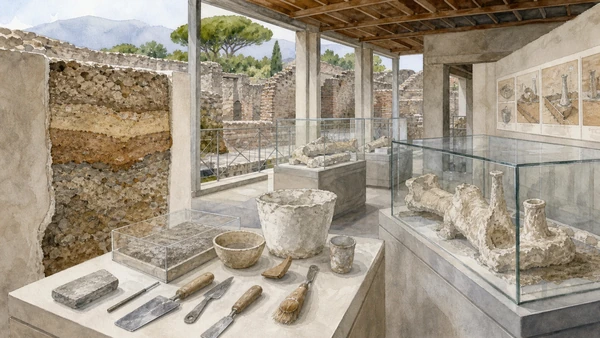
  10. 10Casts, excavation and conservation: Pompeii after discovery
01

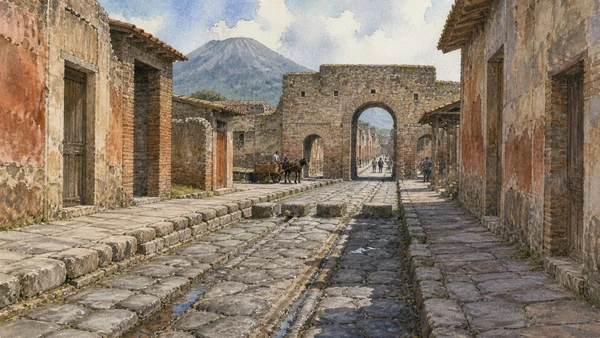
Fortification, road surfaces, stepping stones and wheel ruts preserve movement at city scale

Walls, gates and streets: the urban frame

Pompeii is clearest when entered as a network rather than a sequence of interiors.

Today

Choose the entrance from the official map and expect long uneven routes, heat and limited shade. Small bag rules and site closures are enforced.

History

Walls and gates developed across pre-Roman and Roman phases. Streets channelled people, animals, carts, drainage and water while neighbourhoods changed around them.

How to read this place

Follow one street continuously and compare paving, sidewalks, thresholds and cross-streets. Ruts and stepping stones need contextual rather than picturesque reading.

What to notice

  • Gate controlling entry and regional roads
  • Basalt paving carrying wheels and water
  • Sidewalk height protecting pedestrians
Pompeii Archaeological Park · How to visit
Original documentary watercolour of Walls, gates and streets: the urban frame in Campania, showing accurate heritage, terrain and present-day use
Walls, gates and streets: the urban frameOriginal Merlintravel documentary watercolour · 2026
02

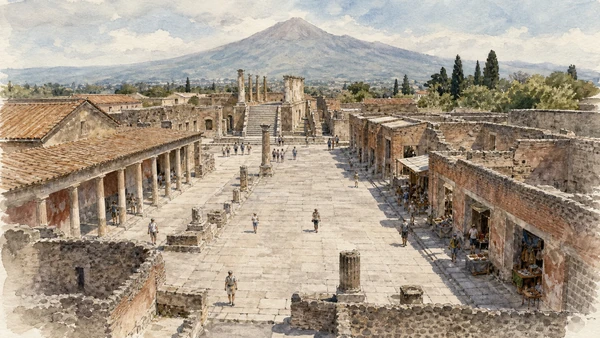
A long civic square concentrated temples, administration, markets and public ceremony

The Forum: government, worship and exchange

Its present openness results from ancient planning and modern excavation.

Today

The paving is exposed and crowded near main routes. Use the edges, do not climb bases and check temporary barriers around conservation.

History

The Forum evolved from earlier civic space and was monumentalised under Roman rule. Buildings around it served cult, justice, municipal administration, food distribution and commerce.

How to read this place

Walk the perimeter before the centre and identify entrances by function. Vesuvius views are later visual context, not the sole reason for the square’s orientation.

What to notice

  • Long paved room enclosed by public buildings
  • Temple platform anchoring a principal axis
  • Administrative and market functions sharing the perimeter
Pompeii Archaeological Park · Official portal
Original documentary watercolour of The Forum: government, worship and exchange in Campania, showing accurate heritage, terrain and present-day use
The Forum: government, worship and exchangeOriginal Merlintravel documentary watercolour · 2026
03

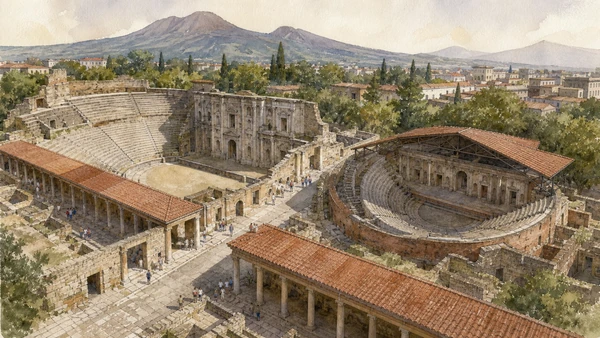
Large and small theatres, porticoes and a sanctuary formed a specialised public quarter

Theatres and entertainment district: performance beside worship

Acoustics, seating and crowd control can be read without staging an imagined spectacle.

Today

Stone steps are steep and exposed; event setups can alter access. Remain off restricted stage structures.

History

Performance buildings developed over several phases and were adapted to Roman forms. Their relation to the Temple of Isis and porticoes shows that urban districts served several institutions at once.

How to read this place

Compare seating capacity, roof evidence and stage architecture in the two theatres. Follow entrances to reconstruct audience separation.

What to notice

  • Two theatres serving different scales
  • Stage buildings framing controlled views
  • Portico organising movement and shelter
Pompeii Archaeological Park · Official portal
Original documentary watercolour of Theatres and entertainment district: performance beside worship in Campania, showing accurate heritage, terrain and present-day use
Theatres and entertainment district: performance beside worshipOriginal Merlintravel documentary watercolour · 2026
04

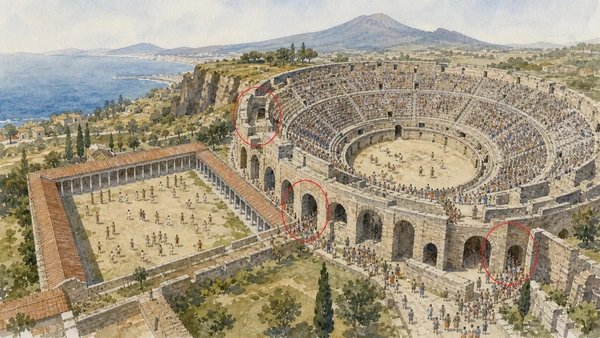
A large arena and exercise ground occupy the less densely built eastern city

Amphitheatre and palaestra: mass spectacle at the edge

Location, crowd routes and social order explain the complex better than gladiator imagery alone.

Today

The amphitheatre may use one-way access and has steep steps. Large events or conservation can close parts of the route.

History

Built in the Roman colonial period, the amphitheatre is among the earliest surviving permanent examples. Inscriptions and ancient evidence record patronage and conflict among spectators.

How to read this place

Circle the exterior and identify how crowds entered different seating sectors. Compare the arena with the adjacent open palaestra.

What to notice

  • Edge location accommodating mass crowds
  • Vaulted entrances distributing spectators
  • Palaestra creating a separate exercise landscape
Pompeii Archaeological Park · Official portal
Original documentary watercolour of Amphitheatre and palaestra: mass spectacle at the edge in Campania, showing accurate heritage, terrain and present-day use
Amphitheatre and palaestra: mass spectacle at the edgeOriginal Merlintravel documentary watercolour · 2026
05

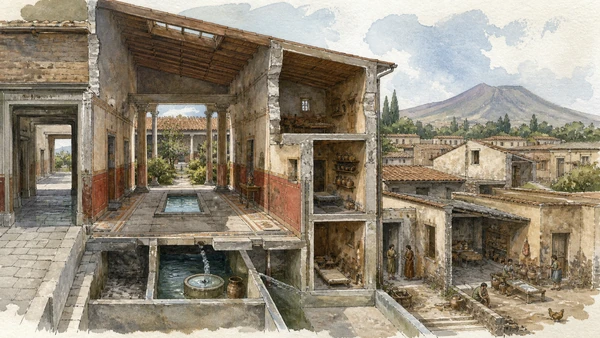
Elite houses combine reception, water, service, decoration and changing family strategies

Houses: atrium, garden and unequal domestic life

The famous atrium is one element in a varied domestic system.

Today

Only a rotating set of houses is open. Follow the official daily list, respect thresholds and never cross conservation barriers.

History

Properties were combined, subdivided and redecorated over generations. Earthquake repair, shops and rental spaces complicate the idealised single-family house model.

How to read this place

Read entrance, sight line, water basin, rooms, garden and service areas in order. Compare one large house with a modest property.

What to notice

  • Entrance axis controlling first impressions
  • Atrium water system serving light and collection
  • Service and rental spaces complicating elite display
Pompeii Archaeological Park · Open buildings
Original documentary watercolour of Houses: atrium, garden and unequal domestic life in Campania, showing accurate heritage, terrain and present-day use
Houses: atrium, garden and unequal domestic lifeOriginal Merlintravel documentary watercolour · 2026
06

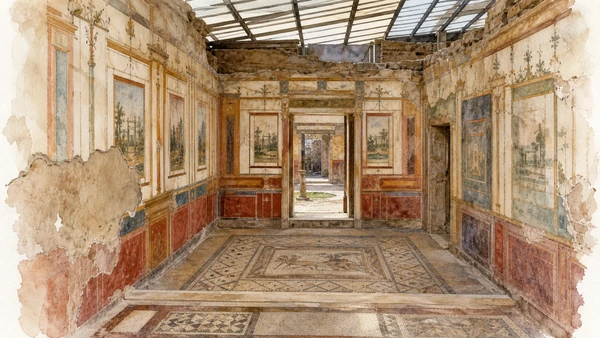
Colour, architecture and myth organised movement and status inside buildings

Painted rooms and mosaics: decoration in context

A room programme is more informative than one detached masterpiece.

Today

Light and capacity controls protect fragile surfaces. Do not touch walls or lean across low barriers.

History

Decorative campaigns changed with fashion, patronage and repairs. Excavation exposure then created new deterioration, prompting roofs, monitoring and periodic closure.

How to read this place

Follow borders and painted architecture around the whole room. Note repairs, missing panels and the relation to floor mosaic and doorway.

What to notice

  • Painted architecture expanding a confined room
  • Mosaic floors marking thresholds and status
  • Protective roofs mediating modern survival
Pompeii Archaeological Park · Official portal
Original documentary watercolour of Painted rooms and mosaics: decoration in context in Campania, showing accurate heritage, terrain and present-day use
Painted rooms and mosaics: decoration in contextOriginal Merlintravel documentary watercolour · 2026
07

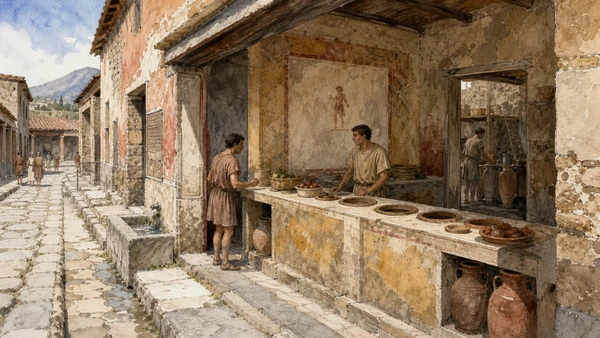
Open-fronted units and masonry counters record commerce but do not all represent the same business

Shops and food counters: production, service and street economy

Finds and installations are needed before naming a thermopolium or menu.

Today

Many counters are visible from streets even when interiors close. Keep openings clear and do not place objects on ancient surfaces.

History

Shops, workshops and bars occupied house fronts and independent units. Vessels, residues and equipment help identify activities, while ownership and labour often remain uncertain.

How to read this place

Compare counter openings, back rooms, water access and street position. Avoid saying every inset jar held hot food.

What to notice

  • Open frontage connecting business to street
  • Counters fitted with storage vessels
  • Back rooms revealing work and supply
Pompeii Archaeological Park · Official portal
Original documentary watercolour of Shops and food counters: production, service and street economy in Campania, showing accurate heritage, terrain and present-day use
Shops and food counters: production, service and street economyOriginal Merlintravel documentary watercolour · 2026
08

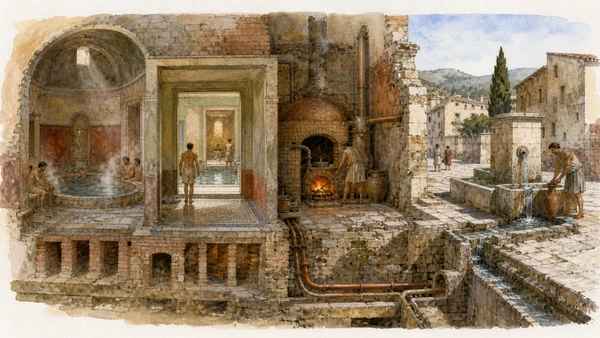
Public bathing depended on aqueduct, tanks, boilers, labour and carefully sequenced rooms

Baths, fountains and water: urban infrastructure

Fountains and pipes connect domestic comfort to municipal systems.

Today

Bath interiors can be slippery, dark and capacity-limited. Outdoor fountains are archaeological objects, not drinking-water guarantees.

History

Earlier wells and cisterns were supplemented by aqueduct supply. Distribution towers, lead pipes and street fountains served public and private users unequally.

How to read this place

Trace cold, warm and hot rooms, then look for service corridors and furnace position. Outside, map fountains against street intersections.

What to notice

  • Room sequence controlling temperature and movement
  • Furnace and boiler supporting visible luxury
  • Distribution points revealing municipal water
Pompeii Archaeological Park · Official portal
Original documentary watercolour of Baths, fountains and water: urban infrastructure in Campania, showing accurate heritage, terrain and present-day use
Baths, fountains and water: urban infrastructureOriginal Merlintravel documentary watercolour · 2026
09

Open spaces inside and near houses supported dining, religion, production and visual control

Gardens and cultivated plots: food, scent and display

Planting reconstructions must be tied to excavation and environmental evidence.

Today

Reconstructed gardens are managed research displays. Stay on paths and do not pick fruit, flowers or soil samples.

History

Root cavities, pollen, carbonised material, planting containers and frescoes allow cautious reconstruction of ancient horticulture. Vineyards and orchards also formed part of the urban economy.

How to read this place

Look for beds, channels, dining rooms and garden sight lines. Distinguish ancient evidence from modern species and maintenance choices.

What to notice

  • Planting beds reconstructed from archaeological traces
  • Dining rooms opening toward controlled greenery
  • Urban cultivation linking household and economy
Pompeii Archaeological Park · Official portal
Original documentary watercolour of Gardens and cultivated plots: food, scent and display in Campania, showing accurate heritage, terrain and present-day use
Gardens and cultivated plots: food, scent and displayOriginal Merlintravel documentary watercolour · 2026
10

Plaster casts and exposed buildings record modern archaeological decisions as well as ancient deaths

Casts, excavation and conservation: Pompeii after discovery

Ethics, documentation and care must replace disaster spectacle.

Today

Casts and exhibitions can move; conservation areas are restricted. Treat human remains and death displays with restraint.

History

Systematic excavation developed under Bourbon rule and changed methods over time. Giuseppe Fiorelli’s casting technique captured voids left by decomposed bodies; later archaeology prioritised context and preventive conservation.

How to read this place

Read each cast label for findspot and method, then look at drainage, roofs and scaffolding that keep the site open today.

What to notice

  • Cast preserving a void rather than an intact body
  • Excavation edges revealing modern method
  • Roofs and monitoring supporting long-term care
Pompeii Archaeological Park · Regulations
Original documentary watercolour of Casts, excavation and conservation: Pompeii after discovery in Campania, showing accurate heritage, terrain and present-day use
Casts, excavation and conservation: Pompeii after discoveryOriginal Merlintravel documentary watercolour · 2026

The landscape through time

A short chronology

A documented sequence from ancient settlement and environmental formation to modern conservation, mobility and resident life.

  1. The settlement is enclosed by substantial walls and develops within wider Campanian exchange.

  2. Samnite-period building and urban change reshape houses and public space.

  3. Pompeii expands monumental buildings, houses and regional commerce.

  4. A Roman colony is established after the Social War.

  5. The amphitheatre and other colonial institutions transform the eastern city.

  6. Aqueduct supply, public buildings and elite houses continue to develop.

  7. A major earthquake damages the city and begins extensive rebuilding.

  8. Vesuvius buries Pompeii during a complex eruption whose precise calendar date remains debated.

  9. Works for the Sarno canal cross buried structures without systematic excavation.

  10. Bourbon-sponsored excavation begins at Pompeii.

  11. Giuseppe Fiorelli assumes direction and advances systematic recording.

  12. Plaster casting of eruption victims is introduced.

  13. Allied bombing damages parts of the archaeological site.

  14. Pompeii joins Herculaneum and Torre Annunziata on the UNESCO World Heritage List.

  15. Large-scale conservation, new excavation and controlled visitor capacity reshape the public site.

Before your visit

Practical information

01

Use only official tickets

Avoid resellers and verify timed-entry, named-ticket or same-day rules on the managing institution’s current site.

02

Keep a weather alternative

Heat, wind, sea state, volcanic conditions and heavy rain can change exposed archaeological, coastal and mountain routes.

03

Respect protected land

Stay on open paths, do not remove stone, plants or archaeological material and follow marine or park zoning.

04

Plan realistic transport

Rail, bus, ferry and road congestion vary sharply by season; do not combine distant chapters without a live connection check.

05

Protect resident access

Homes, farms, markets and working harbours are not sets; keep gates, lanes and deliveries clear and photograph people only with consent.

06

Separate fact from tradition

Legends and local narratives are identified as cultural evidence and are not substituted for archaeological, geological or archival proof.

Method and sources

Sources and image credits

This guide uses current documentation from the managing archaeological park, museum, ministry, UNESCO property, civil-protection authority, protected-area body or transport institution, checked on 29 August 2026. Claims are cross-checked against at least one second primary or institutional source where available. The guide separates current access from durable history and distinguishes surviving fabric from reconstruction, restoration, legend and promotional simplification.

All ten images are original Merlintravel editorial watercolours based on documented present-day conditions. They are illustrations, not substitutes for archaeological plans. Opening hours, tickets, accessible routes, temporary exhibitions and conservation work can change; consult the linked official pages shortly before visiting.