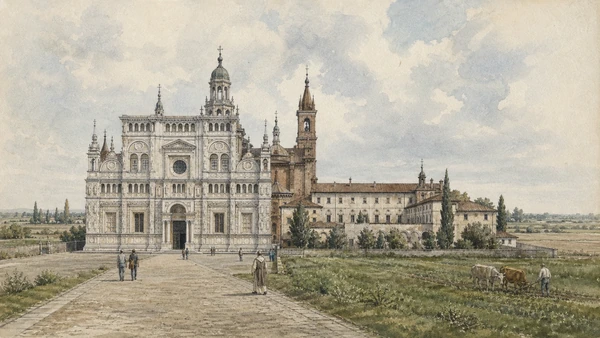
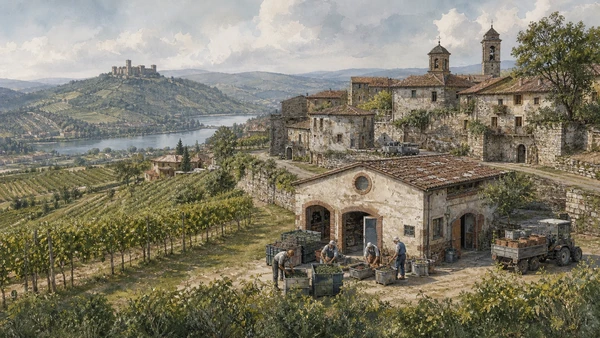
Original documentary watercolour panorama for Pavia, the Certosa and Oltrepò Pavese: Complete Guide, with accurate Lombardy architecture, landscape and lived context

Lombardy Guide 06 · Roman grid, Lombard capital, basilicas, university, castle, monastery, Ticino and vineyard hills

Pavia, the Certosa
& Oltrepò Pavese

A multi-day guide through Pavia’s Roman and Lombard urban memory, major basilicas, university and civic museums, followed by the Certosa’s monastic complex, the Ticino river and the viticultural hills south of the Po.

Plan the route
Pavia, Certosa and Oltrepò · Lombardy10 chapters · one complete route

Why this route must be read in layers

Pavia’s political importance is larger than its present scale suggests: Roman Ticinum, Lombard kings, medieval coronations, a historic university and Visconti patronage occupy a compact city linked to river and agricultural territories.

The Roman street grid remains a useful orientation, but the strongest surviving monuments are later. San Michele and San Pietro in Ciel d’Oro connect architecture, burial and contested historical memory to Pavia’s role as a capital and royal city.

University colleges, collections and the Visconti Castle reveal parallel institutions of study and government. The covered bridge and Ticino edge show how war, reconstruction, flood risk and everyday movement reshape a familiar emblem.

The Certosa is a distinct monastic and museum visit outside the city. Oltrepò Pavese lies farther south across the Po and must be treated as a productive hill territory rather than an easy final stop.

Use one day for Pavia, a separate reserved visit for the Certosa and another route for Oltrepò; verify rail, bus and winery access instead of assuming short map distances mean easy connections.

The route

Plan your visit

Begin with Pavia’s grid, churches, university and castle, then follow the Ticino before assigning separate time to the Certosa and Oltrepò landscape.

Early morning

Roman Ticinum · San Michele Maggiore · San Pietro in Ciel d’Oro

Move in the documented order: Roman Ticinum: the grid beneath modern Pavia; then San Michele Maggiore: Romanesque basilica and royal ceremony; then San Pietro in Ciel d’Oro: Augustine, Boethius and burial memory. Recheck live access and transport before entering a controlled site.

Late morning

University of Pavia · Visconti Castle and Civic Museums · Pavia Cathedral and the vanished Civic Tower

Move in the documented order: University of Pavia: courtyards, teaching and long institutional memory; then Visconti Castle and Civic Museums: court, archaeology and collection; then Pavia Cathedral and the vanished Civic Tower. Recheck live access and transport before entering a controlled site.

Afternoon

Ponte Coperto · Ticino river and Borgo Ticino · Certosa di Pavia

Move in the documented order: Ponte Coperto: reconstruction of a river emblem; then Ticino river and Borgo Ticino: city, floodplain and movement; then Certosa di Pavia: monastery, mausoleum and museum. Recheck live access and transport before entering a controlled site.

Late afternoon

Oltrepò Pavese

Move in the documented order: Oltrepò Pavese: vines, castles and productive hills. Recheck live access and transport before entering a controlled site.

Ten chapters

Explore the places

The order follows terrain, institutions and present-day movement. Use the index to return to a chapter without reducing the route to isolated monuments.

  1. 01Roman Ticinum: the grid beneath modern Pavia
  2. 02San Michele Maggiore: Romanesque basilica and royal ceremony
  3. 03San Pietro in Ciel d’Oro: Augustine, Boethius and burial memory
  4. 04University of Pavia: courtyards, teaching and long institutional memory
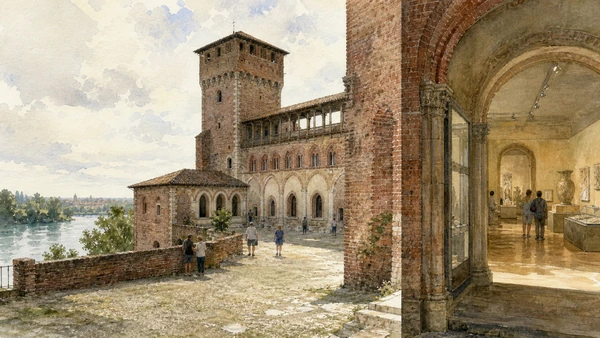
  5. 05Visconti Castle and Civic Museums: court, archaeology and collection
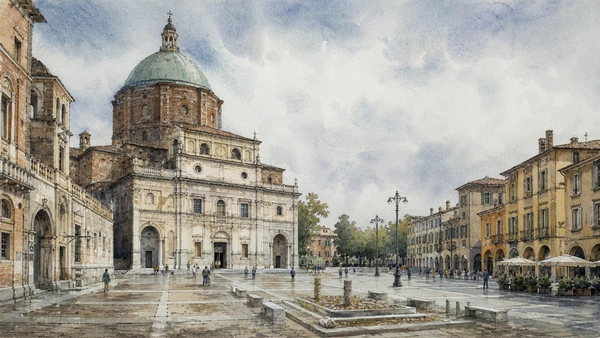
  6. 06Pavia Cathedral and the vanished Civic Tower
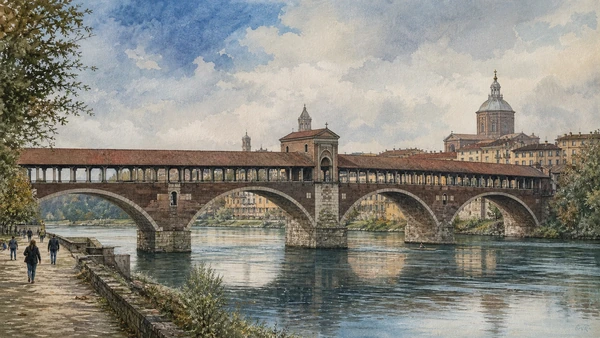
  7. 07Ponte Coperto: reconstruction of a river emblem
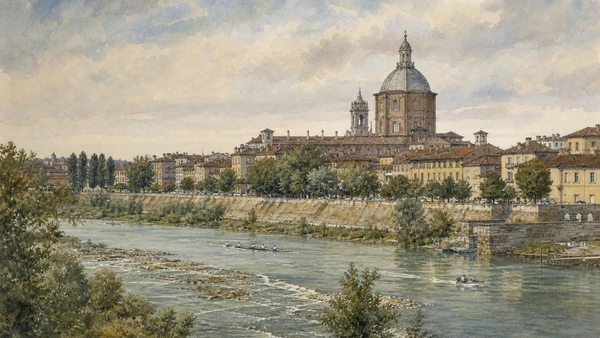
  8. 08Ticino river and Borgo Ticino: city, floodplain and movement
  9. 09Certosa di Pavia: monastery, mausoleum and museum
  10. 10Oltrepò Pavese: vines, castles and productive hills
01

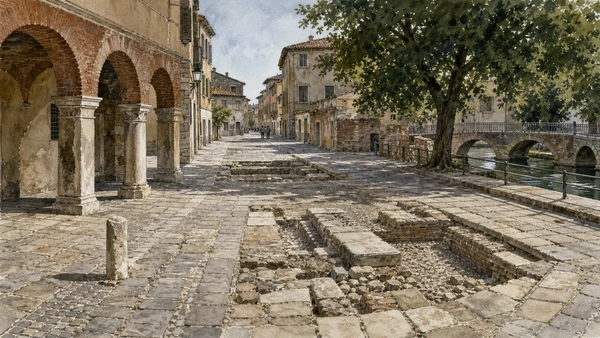
Long orthogonal streets and the crossing near the civic centre preserve the organising logic of the Roman town.

Roman Ticinum: the grid beneath modern Pavia

Long orthogonal streets and the crossing near the civic centre preserve the organising logic of the Roman town. The site becomes clearer when its surviving fabric, later alterations and present use are read together.

Today

The area is inhabited and worked, not staged for visitors. Keep doorways, pavements, cycle lanes and deliveries clear, ask before photographing people and use current municipal mobility information.

History

Ticinum developed at a strategic river crossing and road junction; later medieval and modern buildings retained much of the street framework while obscuring ancient structures.

How to read this place

Begin with the long alignment of strada nuova. Then compare regular cross streets with changes in level and surviving archaeological evidence; the differences are evidence, not visual noise.

What to notice

  • the long alignment of Strada Nuova
  • regular cross streets
  • changes in level and surviving archaeological evidence
Visit Pavia · Official destination site
Original documentary watercolour of Roman Ticinum: the grid beneath modern Pavia in Pavia, Certosa and Oltrepò · Lombardy, showing accurate architecture, landscape, people and present-day use
Roman Ticinum: the grid beneath modern PaviaOriginal Merlintravel documentary watercolour · 2026
02

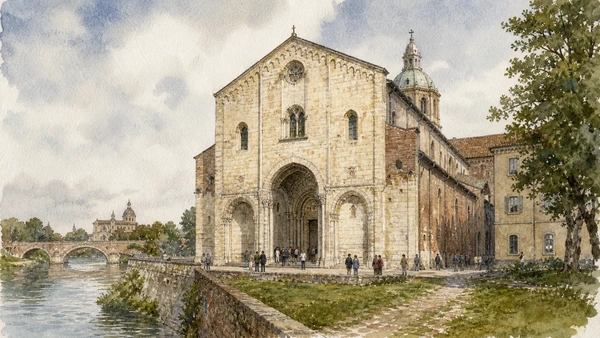
Sandstone façade, sculpted fabric and elevated presbytery form a major medieval church associated with coronations.

San Michele Maggiore: Romanesque basilica and royal ceremony

Sandstone façade, sculpted fabric and elevated presbytery form a major medieval church associated with coronations. The site becomes clearer when its surviving fabric, later alterations and present use are read together.

Today

This is an active religious place as well as a historic building. Services, ceremonies and conservation can interrupt tourist access; dress appropriately, remain quiet and never treat a booked visit as priority over worship.

History

An earlier royal church preceded the present Romanesque building, which became a setting for important ceremonies including the coronation of Frederick Barbarossa as king of Italy.

How to read this place

Begin with the weathered sandstone façade. Then compare nave supports and elevated sanctuary with restoration around fragile sculpture; the differences are evidence, not visual noise.

What to notice

  • the weathered sandstone façade
  • nave supports and elevated sanctuary
  • restoration around fragile sculpture
Diocese of Pavia · Basilica San Michele
Original documentary watercolour of San Michele Maggiore: Romanesque basilica and royal ceremony in Pavia, Certosa and Oltrepò · Lombardy, showing accurate architecture, landscape, people and present-day use
San Michele Maggiore: Romanesque basilica and royal ceremonyOriginal Merlintravel documentary watercolour · 2026
03

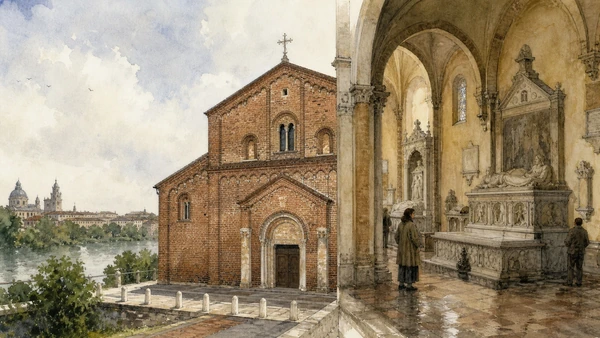
A Romanesque basilica houses major tomb traditions linking late antiquity, Lombard patronage and medieval scholarship.

San Pietro in Ciel d’Oro: Augustine, Boethius and burial memory

A Romanesque basilica houses major tomb traditions linking late antiquity, Lombard patronage and medieval scholarship. The site becomes clearer when its surviving fabric, later alterations and present use are read together.

Today

This is an active religious place as well as a historic building. Services, ceremonies and conservation can interrupt tourist access; dress appropriately, remain quiet and never treat a booked visit as priority over worship.

History

The site has early Christian origins and was renewed under Lombard and later medieval patronage. Relics and monuments associated with Augustine and Boethius shaped pilgrimage and intellectual memory.

How to read this place

Begin with brick façade and basilican structure. Then compare the ark of saint augustine with crypt and burial traditions explained by the church; the differences are evidence, not visual noise.

What to notice

  • brick façade and basilican structure
  • the Ark of Saint Augustine
  • crypt and burial traditions explained by the church
Basilica di San Pietro in Ciel d’Oro · Official site
Original documentary watercolour of San Pietro in Ciel d'Oro: Augustine, Boethius and burial memory in Pavia, Certosa and Oltrepò · Lombardy, showing accurate architecture, landscape, people and present-day use
San Pietro in Ciel d’Oro: Augustine, Boethius and burial memoryOriginal Merlintravel documentary watercolour · 2026
04

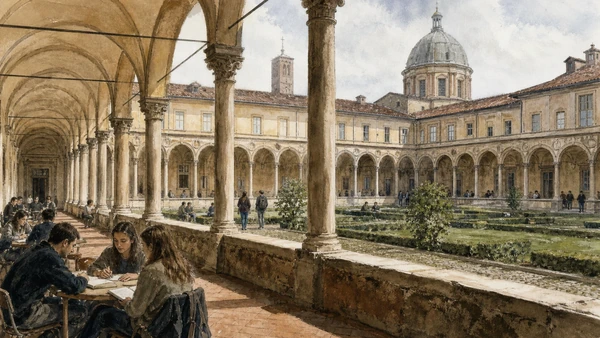
Historic courts and collections preserve a university embedded in the centre rather than isolated on one campus.

University of Pavia: courtyards, teaching and long institutional memory

Historic courts and collections preserve a university embedded in the centre rather than isolated on one campus. The site becomes clearer when its surviving fabric, later alterations and present use are read together.

Today

Opening, ticketing, room access and temporary displays can change. Check the institution’s official notice shortly before visiting, use the designated entrance and allow for security or conservation controls.

History

The university’s formal foundation dates to the fourteenth century, with later reforms and scholars expanding law, medicine, science and humanities across multiple buildings.

How to read this place

Begin with the sequence of historic courtyards. Then compare memorials to teachers and students with active teaching spaces with controlled access; the differences are evidence, not visual noise.

What to notice

  • the sequence of historic courtyards
  • memorials to teachers and students
  • active teaching spaces with controlled access
Università di Pavia · Museums and heritage
Original documentary watercolour of University of Pavia: courtyards, teaching and long institutional memory in Pavia, Certosa and Oltrepò · Lombardy, showing accurate architecture, landscape, people and present-day use
University of Pavia: courtyards, teaching and long institutional memoryOriginal Merlintravel documentary watercolour · 2026
05

A fortified residence now houses civic collections within architecture tied to Visconti territorial power.

Visconti Castle and Civic Museums: court, archaeology and collection

A fortified residence now houses civic collections within architecture tied to Visconti territorial power. The site becomes clearer when its surviving fabric, later alterations and present use are read together.

Today

Opening, ticketing, room access and temporary displays can change. Check the institution’s official notice shortly before visiting, use the designated entrance and allow for security or conservation controls.

History

Galeazzo II Visconti commissioned the castle in the fourteenth century as a residence connected to a large park and court culture; warfare removed part of the complex.

How to read this place

Begin with the square plan and corner towers. Then compare courtyard arcades with museum objects tied to pavia’s urban history; the differences are evidence, not visual noise.

What to notice

  • the square plan and corner towers
  • courtyard arcades
  • museum objects tied to Pavia’s urban history
Comune di Pavia · Musei Civici
Original documentary watercolour of Visconti Castle and Civic Museums: court, archaeology and collection in Pavia, Certosa and Oltrepò · Lombardy, showing accurate architecture, landscape, people and present-day use
Visconti Castle and Civic Museums: court, archaeology and collectionOriginal Merlintravel documentary watercolour · 2026
06

A large Renaissance and later church stands beside the memory of a medieval tower whose 1989 collapse remains part of the square.

Pavia Cathedral and the vanished Civic Tower

A large Renaissance and later church stands beside the memory of a medieval tower whose 1989 collapse remains part of the square. The site becomes clearer when its surviving fabric, later alterations and present use are read together.

Today

This is an active religious place as well as a historic building. Services, ceremonies and conservation can interrupt tourist access; dress appropriately, remain quiet and never treat a booked visit as priority over worship.

History

The cathedral replaced earlier churches through a long campaign associated with major architects. The adjacent Civic Tower collapsed, causing deaths and permanently changing the city profile.

How to read this place

Begin with the cathedral’s central dome. Then compare long construction phases in the fabric with the memorial and open space left by the tower; the differences are evidence, not visual noise.

What to notice

  • the cathedral’s central dome
  • long construction phases in the fabric
  • the memorial and open space left by the tower
Diocese of Pavia · Cathedral
Original documentary watercolour of Pavia Cathedral and the vanished Civic Tower in Pavia, Certosa and Oltrepò · Lombardy, showing accurate architecture, landscape, people and present-day use
Pavia Cathedral and the vanished Civic TowerOriginal Merlintravel documentary watercolour · 2026
07

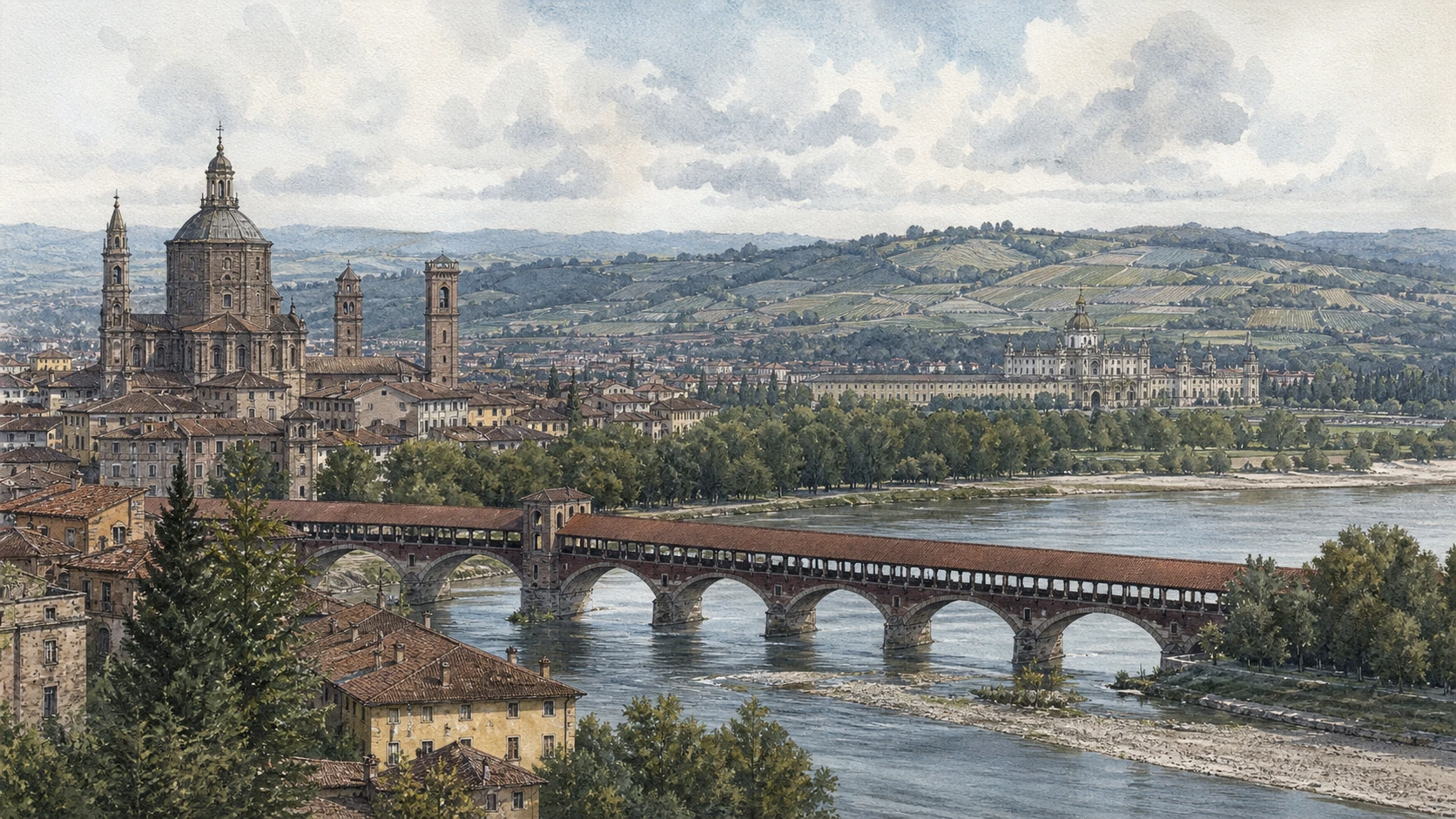
The present covered bridge is a post-war reconstruction near the site of the medieval crossing destroyed during bombing.

Ponte Coperto: reconstruction of a river emblem

The present covered bridge is a post-war reconstruction near the site of the medieval crossing destroyed during bombing. The site becomes clearer when its surviving fabric, later alterations and present use are read together.

Today

The exterior can usually be read from public space, but events, works and crowd management may change circulation. Keep access routes open and verify any interior visit with the responsible institution.

History

A historic covered bridge linked Pavia to Borgo Ticino for centuries. Wartime damage and demolition were followed by a new bridge opened on a slightly shifted alignment.

How to read this place

Begin with the roofed arcade and central chapel. Then compare the relation to the older bridge remains with river levels and floodplain on both banks; the differences are evidence, not visual noise.

What to notice

  • the roofed arcade and central chapel
  • the relation to the older bridge remains
  • river levels and floodplain on both banks
Visit Pavia · Official destination site
Original documentary watercolour of Ponte Coperto: reconstruction of a river emblem in Pavia, Certosa and Oltrepò · Lombardy, showing accurate architecture, landscape, people and present-day use
Ponte Coperto: reconstruction of a river emblemOriginal Merlintravel documentary watercolour · 2026
08

Embankments, gravel, boats, habitat and houses connect the historic centre to a dynamic river corridor.

Ticino river and Borgo Ticino: city, floodplain and movement

Embankments, gravel, boats, habitat and houses connect the historic centre to a dynamic river corridor. The site becomes clearer when its surviving fabric, later alterations and present use are read together.

Today

Weather, water levels, trail conditions and seasonal services can alter the route. Use official transport and park information, remain on authorised paths and do not enter farms, vineyards or private gardens without permission.

History

The river supported crossing, trade, milling and settlement while floods and modern infrastructure repeatedly altered banks and access.

How to read this place

Begin with active channel and seasonal gravel. Then compare embankment and bridge structures with borgo ticino’s inhabited edge; the differences are evidence, not visual noise.

What to notice

  • active channel and seasonal gravel
  • embankment and bridge structures
  • Borgo Ticino’s inhabited edge
Parco Lombardo della Valle del Ticino
Original documentary watercolour of Ticino river and Borgo Ticino: city, floodplain and movement in Pavia, Certosa and Oltrepò · Lombardy, showing accurate architecture, landscape, people and present-day use
Ticino river and Borgo Ticino: city, floodplain and movementOriginal Merlintravel documentary watercolour · 2026
09

Church, cloisters, cells and extraordinary marble façade form a complex founded by the Visconti and transformed across centuries.

Certosa di Pavia: monastery, mausoleum and museum

Church, cloisters, cells and extraordinary marble façade form a complex founded by the Visconti and transformed across centuries. The site becomes clearer when its surviving fabric, later alterations and present use are read together.

Today

This is an active religious place as well as a historic building. Services, ceremonies and conservation can interrupt tourist access; dress appropriately, remain quiet and never treat a booked visit as priority over worship.

History

Gian Galeazzo Visconti founded the monastery in the late fourteenth century. Carthusian and later Cistercian communities, artists, suppression and state management shaped its fabric and access.

How to read this place

Begin with the façade’s dense sculptural programme. Then compare church and dynastic tombs with cloisters leading toward monastic cells; the differences are evidence, not visual noise.

What to notice

  • the façade’s dense sculptural programme
  • church and dynastic tombs
  • cloisters leading toward monastic cells
Direzione regionale Musei Lombardia · Certosa di Pavia
Original documentary watercolour of Certosa di Pavia: monastery, mausoleum and museum in Pavia, Certosa and Oltrepò · Lombardy, showing accurate architecture, landscape, people and present-day use
Certosa di Pavia: monastery, mausoleum and museumOriginal Merlintravel documentary watercolour · 2026
10

Apennine foothills south of the Po combine regulated wine zones, villages, woodland and routes requiring deliberate transport.

Oltrepò Pavese: vines, castles and productive hills

Apennine foothills south of the Po combine regulated wine zones, villages, woodland and routes requiring deliberate transport. The site becomes clearer when its surviving fabric, later alterations and present use are read together.

Today

Weather, water levels, trail conditions and seasonal services can alter the route. Use official transport and park information, remain on authorised paths and do not enter farms, vineyards or private gardens without permission.

History

Long viticulture and estate organisation were reshaped by modern appellations, cooperatives and market change; depopulation and climate pressure affect higher areas.

How to read this place

Begin with vineyard exposure and elevation. Then compare working cellars and village form with the transition from plain to wooded ridge; the differences are evidence, not visual noise.

What to notice

  • vineyard exposure and elevation
  • working cellars and village form
  • the transition from plain to wooded ridge
Consorzio Tutela Vini Oltrepò Pavese
Original documentary watercolour of Oltrepò Pavese: vines, castles and productive hills in Pavia, Certosa and Oltrepò · Lombardy, showing accurate architecture, landscape, people and present-day use
Oltrepò Pavese: vines, castles and productive hillsOriginal Merlintravel documentary watercolour · 2026

Lombardy through time

A short chronology

From prehistoric settlement and Roman routes to communes, regional states, industrial transformation, heritage protection and climate-sensitive mobility.

  1. Settlements, ritual places and rock imagery document long human occupation from Alpine valleys to the Po plain.

  2. Camuni, Celts, Etruscan networks and other communities develop distinct territories before Roman expansion.

  3. Roman roads, colonies and municipia integrate the region while retaining different local settlement patterns.

  4. Cities, villas, farms, sanctuaries and Alpine routes connect the Po basin to transalpine and imperial systems.

  5. Christian institutions, new burial landscapes and political change reshape Roman urban centres.

  6. Lombard rule establishes courts, duchies and monasteries whose material traces survive unevenly across the region.

  7. Castles, monasteries, parishes and landed powers organise countryside, lakes and mountain routes.

  8. Communal cities expand public buildings, cathedrals, walls, trade and conflict across the Lombard plain.

  9. Visconti and then Sforza power links Milan to fortified towns, courts, canals and agricultural territories.

  10. Venetian expansion incorporates much of eastern Lombardy, creating a durable political and architectural frontier.

  11. The Peace of Lodi stabilises a territorial balance whose borders continue to shape cities and landscapes.

  12. Spanish and Austrian governments reorganise defence, taxation, institutions and infrastructure in different parts of Lombardy.

  13. Napoleonic and Austrian administrations alter civic institutions, roads, collections and territorial government before unification.

  14. Railways, factories, hydropower, migration, tourism, war and resistance transform urban and Alpine societies.

  15. Reconstruction, industrial growth, deindustrialisation, heritage protection, mass mobility and climate pressure repeatedly reshape the region.

Before your visit

Practical information

01

Check the live page

Opening hours, reservation systems, restoration, exhibitions and transport can change. Recheck the linked official institution shortly before departure.

02

Separate worship and tourism

Churches and sanctuaries remain religious spaces. Services, funerals and community use take priority over visitor itineraries.

03

Plan real distances

Pavia, Certosa and Oltrepò · Lombardy combines dense urban routes with lakes, valleys and dispersed towns. Do not compress distant chapters into an unsafe or superficial day.

04

Keep thresholds open

Arcades, station halls, markets, courtyards, workshops and residential streets must continue to function while you observe or photograph them.

05

Use current mobility data

Check the responsible rail, navigation, bus, road or park operator on the day; replacement services and weather can change an otherwise sound route.

06

Read change honestly

Restoration, reconstruction, adaptive reuse and new development have all shaped the landscape visible today.

Method and sources

Sources and image credits

This guide uses official museum, ministry, municipal, transport, park and UNESCO documentation checked on 29 August 2026. It separates durable historical interpretation from access details that can change, distinguishes surviving fabric from restoration or reconstruction, and treats worship, work, residence and public movement as part of the evidence. Every chapter links its principal institutional source; tickets, closures, weather and transport must always be verified again on the day of the visit.

All ten images are original Merlintravel editorial watercolours based on documented present-day conditions. They are illustrations, not substitutes for archaeological plans. Opening hours, tickets, accessible routes, temporary exhibitions and conservation work can change; consult the linked official pages shortly before visiting.