Illustrated guide · Narni
Cliff, water
and the city below
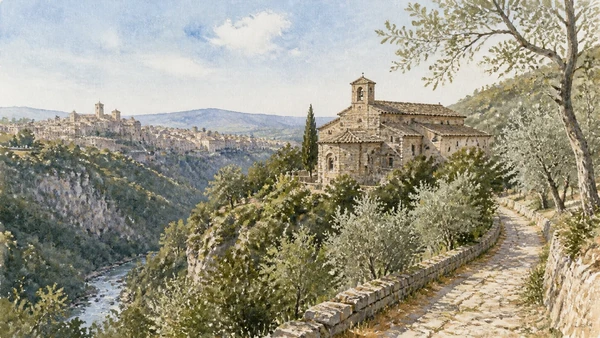
Ten places through which to read Umbrian Nequinum, Roman Narnia, a medieval commune and the hidden systems connecting the limestone ridge to the Nera valley.
Explore the placesPreface
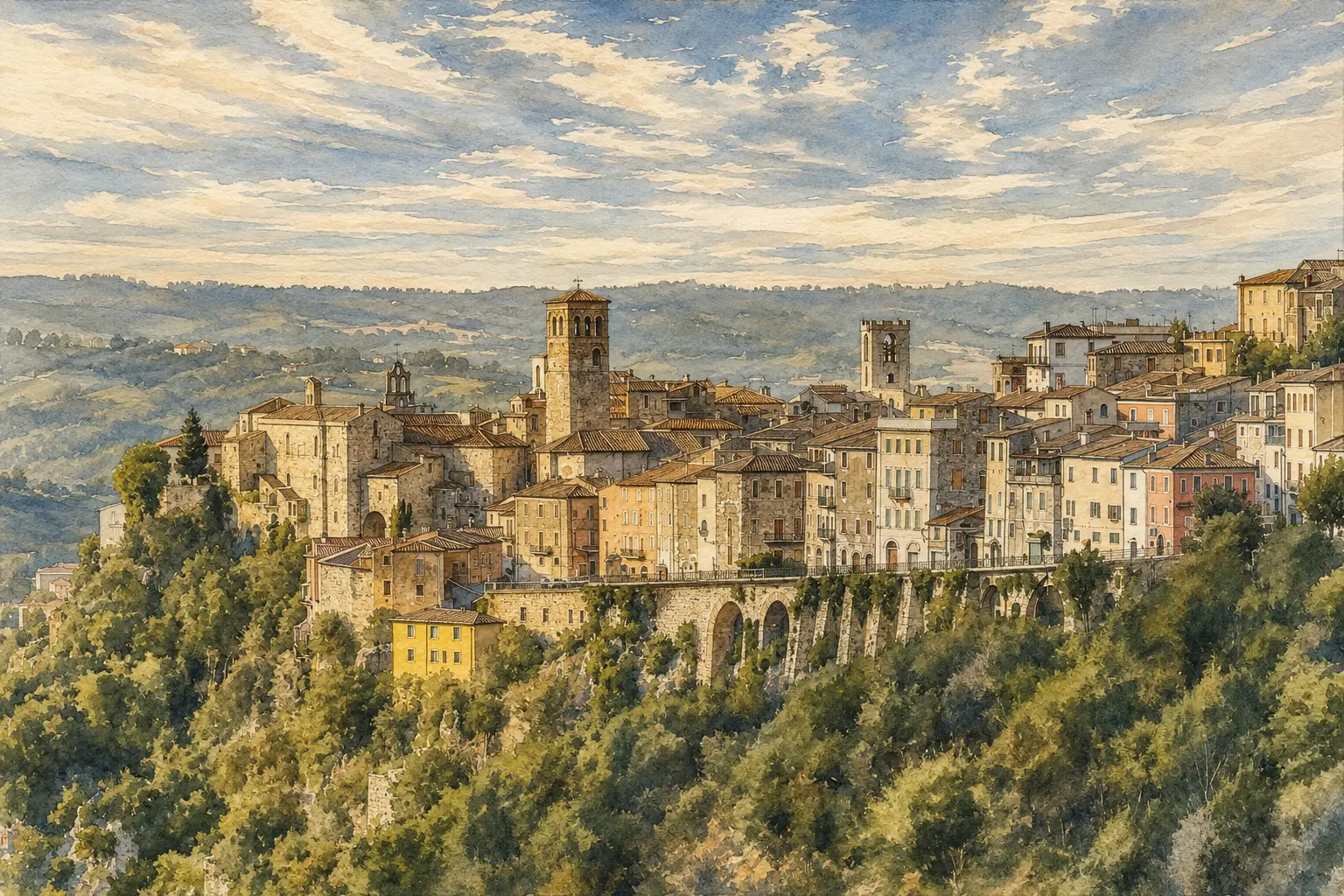
Narni is built on a boundary between stone and water.
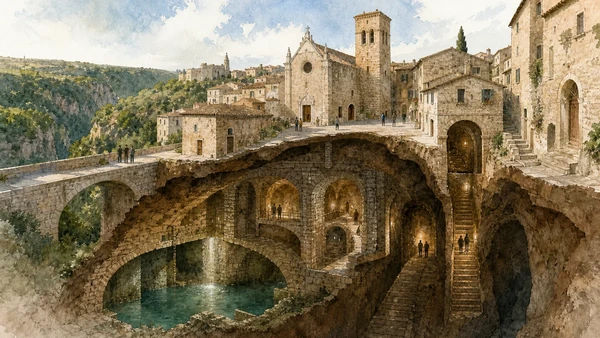
The historic centre stands compact on a limestone spur, while Roman bridges, an aqueduct, abbeys and the emerald Nera occupy the landscape below. Beneath the streets, cisterns, churches and tribunal rooms form a second route through the town.
In forty-two years of living in Umbria, Narni has always seemed less immediately legible than the famous northern hill towns. That is precisely its strength: it asks the visitor to connect the ridge, underground spaces and gorge rather than collect isolated monuments.
This guide begins in the civic and sacred centre, descends beneath it, climbs to the fortress and then follows Roman engineering into the surrounding valley.
Narni is not one hidden city, but a network of visible and invisible routes.

One destination
Narni,
ridge and gorge.
The selection balances the medieval centre with Roman infrastructure and the natural corridor of the Nera. The underground route is explained precisely, without turning documented spaces into generic mystery.
The selection
Ten places,
one story
A route through the upper town followed by the fortress and a deliberate descent into the Roman and natural landscape of the Nera Gorge.
The patron and the ancient city
Cathedral of San Giovenale
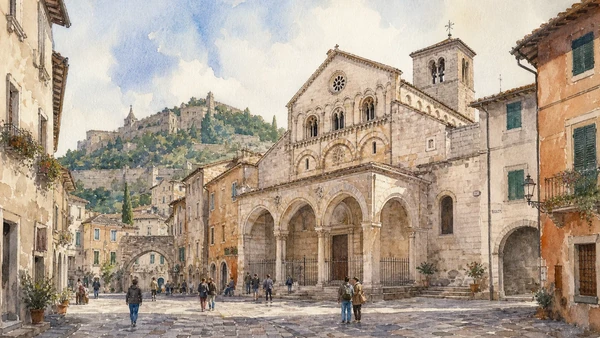
A Romanesque cathedral preserves the early shrine of Narni's patron within a much larger medieval and later church.

The place today
The cathedral opens onto Piazza Cavour through a Renaissance portico. Inside, naves, chapels and later decoration surround the small shrine and crypt associated with Saint Juvenal. The contrast between the broad church and the more ancient sacred space makes the building's long development visible.
The historical chapter
Construction began around the tomb of San Giovenale in the eleventh century, and the church was consecrated in 1145. Romanesque portals and the patron's shrine belong to the medieval campaign; chapels, porch and interior decoration were added over later centuries as the cathedral remained Narni's principal religious institution.
What to notice
- The Renaissance porch in front of the Romanesque façade
- The early shrine embedded within the later church
- Columns and chapels recording successive enlargements
The communal centre
Piazza dei Priori and civic palaces
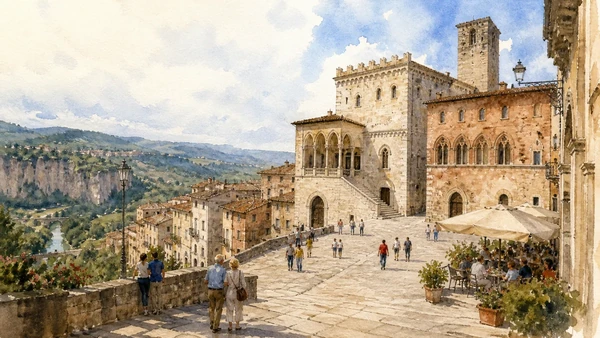
Town Hall, Priori loggia and theatre frame the political space of medieval Narni above the Roman forum.

The place today
The irregular piazza is dominated by the former Palazzo del Podestà, now Town Hall, and by the Loggia dei Priori with the raised Loggia del Banditore. Roman and medieval fragments are set into the palace walls. Nearby, Teatro Manini continues the square's role as a place of public assembly.
The historical chapter
The Town Hall was formed in the late thirteenth century by purchasing and combining several tower-houses on the site of the Roman forum. The Priori complex and its loggia developed as communal offices. Their layered construction shows how Narni created public architecture by absorbing the fortified residences of local families.
What to notice
- Roman inscriptions and medieval sculpture reused on the façades
- The elevated Loggia del Banditore
- Different building lines inherited from earlier tower-houses
The collections of Narnia
Eroli Palace and Civic Museum
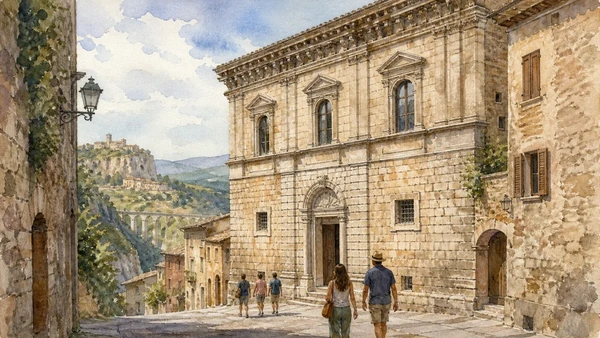
Archaeology and painting bring Umbrian Nequinum, Roman Narnia and Renaissance religious art into one civic collection.

The place today
The museum occupies Palazzo Eroli behind the Town Hall. Its archaeological section includes finds from pre-Roman and Roman Narni; the picture gallery preserves major works including an Annunciation by Benozzo Gozzoli and the Coronation of the Virgin by Ghirlandaio. The palace also houses the municipal library.
The historical chapter
The present palace reflects the union of historic residences of the Eroli family. The civic collections developed from local antiquarian study, excavations and works transferred from religious institutions. Their value lies in connecting objects to Narni's territory rather than presenting them as detached masterpieces.
What to notice
- Material from Umbrian Nequinum before Roman conquest
- Roman inscriptions tied to the Via Flaminia
- Renaissance paintings displayed beside the local history that commissioned them
The documented city below
Narni Underground
A guided route joins a rediscovered church, Roman water systems and rooms used by the Inquisition tribunal.

The place today
The visit begins from the gardens of San Bernardo and enters the church of Santa Maria della Rupe, cisterns, tunnels and spaces connected to the former Dominican complex. The final rooms include a tribunal chamber and a cell covered with the graffiti of prisoner Giuseppe Andrea Lombardini. Access is guided and timed.
The historical chapter
The underground spaces were created and reused in different periods: Roman hydraulic infrastructure, medieval religious rooms and early modern tribunal functions do not belong to a single hidden-city phase. The route was rediscovered from 1977 onward by local explorers and researched through archives, inscriptions and material evidence.
What to notice
- The transition between spaces of very different date and function
- Graffiti in the cell interpreted with archival evidence
- Water collection as the earliest logic beneath the ridge
Romanesque Narni
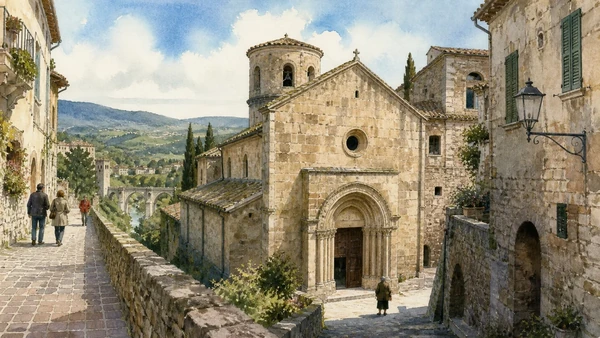
Santa Maria Impensole
A compact church built over older structures preserves one of southern Umbria's most distinctive Romanesque interiors.

The place today
The church is reached through narrow streets and presents a low, simple façade with a carved portal. Inside, short columns and rounded arches divide three naves above a crypt. Reused ancient elements and the limited height create an unusually dense space.
The historical chapter
The present church was consecrated in 1175, probably over an earlier religious building and Roman structures. Its name may refer to being 'in pensili', built above substructures. The interior combines local medieval construction with spolia from the ancient city.
What to notice
- The low proportions of the nave
- Reused columns and varied capitals
- The crypt reinforcing the sense of a church built over earlier levels
The fortress above the ridge
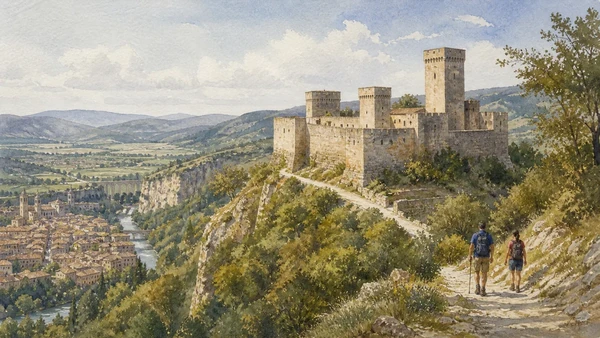
Albornoz Fortress
A restored fourteenth-century stronghold commands the city, the Via Flaminia and the routes between Umbria and Lazio.

The place today
The Rocca stands at Narni's highest point. Visitors can enter the garden, courtyard and interior rooms, where displays interpret the fortress and territory. From the walls, the compact centre, Nera valley and distant ridges form a strategic panorama.
The historical chapter
Cardinal Albornoz ordered the fortress in the second half of the fourteenth century as part of the papal reconquest of central Italy. It was adapted by later governors and military authorities, then declined before restoration. Its architecture belongs to a regional system of fortresses rather than an isolated castle.
What to notice
- The square courtyard and dominant keep
- Papal and castellan coats of arms
- Road corridors visible from the highest walls
The Via Flaminia crosses the Nera
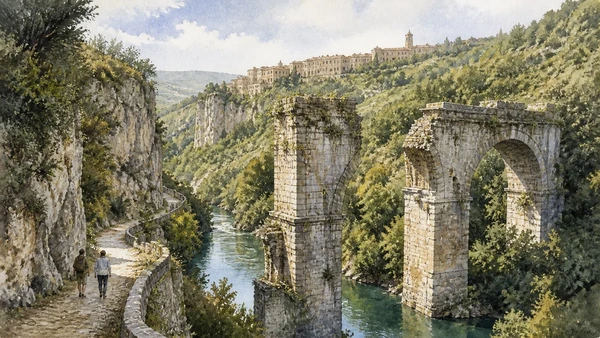
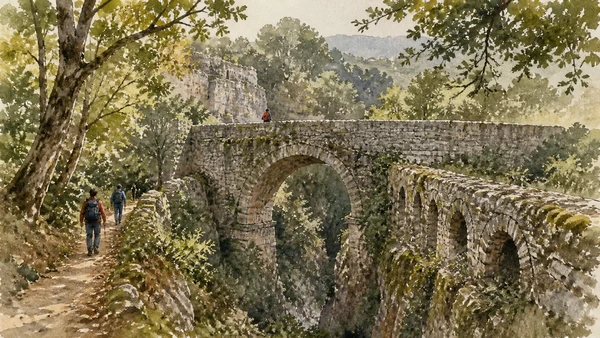
Augustus Bridge and Nera Gorge
One immense surviving arch marks a Roman crossing, while a modern trail follows the river towards Stifone.

The place today
The bridge survives as a dramatic stone arch and ruined piers beside the Nera. From nearby, the cycle-pedestrian route enters the gorge along the former railway, passing woodland, industrial archaeology and intensely coloured water towards Stifone.
The historical chapter
The bridge carried the Via Flaminia across the river in the Augustan period. Floods and structural collapse destroyed most spans, but the surviving arch conveys the scale of Roman road engineering. The gorge later powered mills and industry, while the abandoned railway has been repurposed as a landscape route.
What to notice
- The height of the surviving Roman arch
- Piers indicating the original multi-span crossing
- The river as transport barrier, power source and modern recreational corridor
Roman water in the hills
Formina Aqueduct and Ponte Cardona
A long Roman hydraulic route uses tunnels and bridges to carry spring water to the ridge of Narnia.

The place today
Walking itineraries follow parts of the aqueduct from the countryside towards Narni. Ponte Cardona is the last of its bridge structures and lies near a marker traditionally identifying the geographic centre of Italy. Some internal aqueduct visits operate only by reservation and season.
The historical chapter
The Formina aqueduct was engineered in the Roman period to bring water over many kilometres from upland springs to Narnia. Its route combines channels cut into rock, tunnels and bridge crossings while maintaining a controlled gradient. Continued repair allowed sections to serve the town long after antiquity.
What to notice
- The almost imperceptible hydraulic gradient
- Ponte Cardona carrying the channel across a ravine
- Inspection openings and rock-cut sections along the route
An abbey facing the city
Abbey of San Cassiano
Across the gorge, a fortified-looking Benedictine complex occupies a terrace with direct visual command of Narni.

The place today
The abbey stands on the opposite side of the Nera and is reached by road or guided hiking routes. Its church, walls and tower-like masses emerge from woodland, offering a powerful view back towards Narni and the Augustus Bridge.
The historical chapter
The foundation is medieval, with origins traditionally placed in the tenth century and important Romanesque phases. Its strategic appearance reflects both monastic enclosure and the exposed terrain. Restoration recovered a complex that had undergone long periods of alteration and abandonment.
What to notice
- The compact silhouette against the wooded slope
- Romanesque church elements within later fortification
- The reciprocal view between abbey and Narni ridge
Silence beyond Narnia
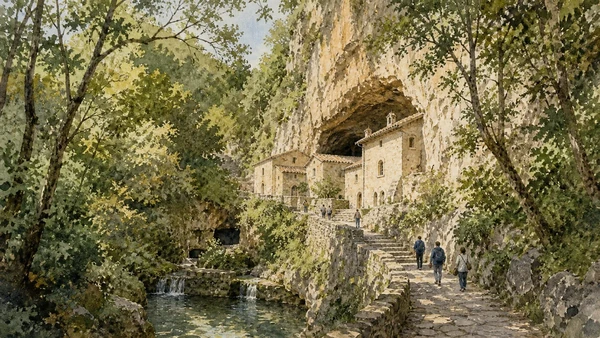
Sacred Cave of Saint Francis
A Franciscan hermitage near Sant'Urbano preserves caves, chapels and a woodland setting connected to retreat.

The place today
The sanctuary lies about twelve kilometres from Narni in the Umbro-Sabini hills. Church, cloister, simple cells and the cave associated with Francis are arranged within forest. Its distance from the centre makes it a separate excursion rather than the final stop of an urban walk.
The historical chapter
Franciscan tradition connects Francis with retreat here in the early thirteenth century. The complex expanded around earlier hermit spaces, especially from the fourteenth and fifteenth centuries. Surviving architecture therefore belongs to a gradual community history built around an older devotional memory.
What to notice
- The cave integrated into the sanctuary route
- Small-scale cloister and cells
- Forest and spring water as essential parts of the hermitage
The city through time
Eight dates for orientation
An essential chronology showing how ancient foundations, medieval institutions and later transformations overlap.
Rome conquers Nequinum and establishes the Latin colony of Narnia.
The Via Flaminia bridge and Formina aqueduct monumentalise Roman infrastructure.
San Giovenale and Santa Maria Impensole take their Romanesque form.
Tower-houses are combined to create the communal palace.
The Albornoz Fortress reinforces papal control over the ridge.
Religious and tribunal spaces beneath San Domenico acquire new functions.
Local exploration and research reveal the route now known as Narni Underground.
Gorge, aqueduct and former railway are connected through cultural and outdoor itineraries.
Before your visit
Practical information,
without turning it into promises
Upper town
The centre is compact but steep, with steps and stone paving. Parking and lifts reduce some climbs but do not remove accessibility constraints.
Book underground
Narni Underground is a guided visit with fixed capacity. Reserve ahead, especially on weekends and holidays.
Separate excursions
Formina, San Cassiano, the gorge and the Sacred Cave require extra time, suitable footwear and current route checks.
Single ticket
The Narnia Pass combines Eroli Palace and the fortress. Prices and inclusions can change; verify the official tourism portal.
Sources
The guide relies primarily on Turismo Narni, the municipal tourism portal, together with the official regional source. Underground phases are separated by date and function, and devotional traditions are distinguished from surviving material evidence.
- Turismo Narni · official portal ↗
- Umbria Tourism · Narni ↗
- Narni Underground · official information ↗
- Municipality of Narni ↗
The hero image and all ten attraction images are original Merlintravel watercolours, not photographs. Opening hours, tickets, worship schedules, restoration works and path access can change; always consult the linked official pages shortly before visiting.