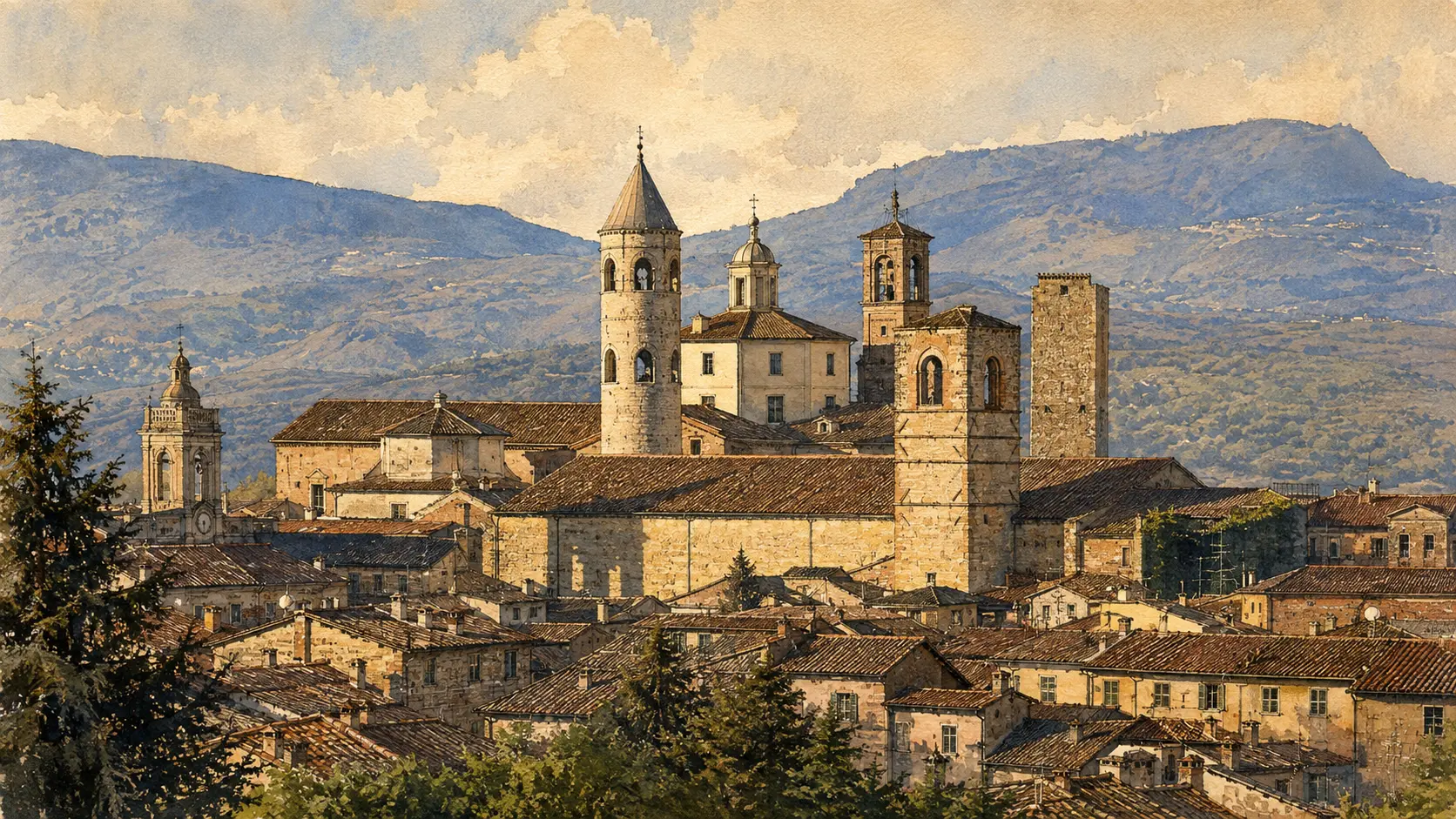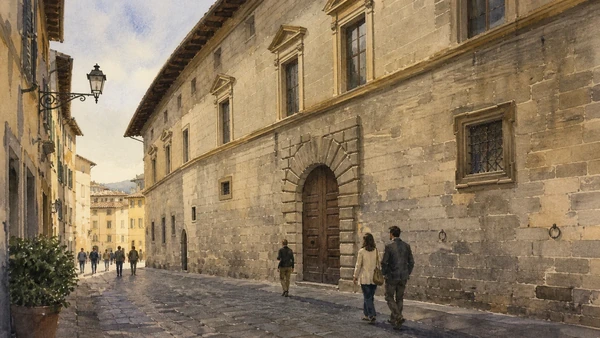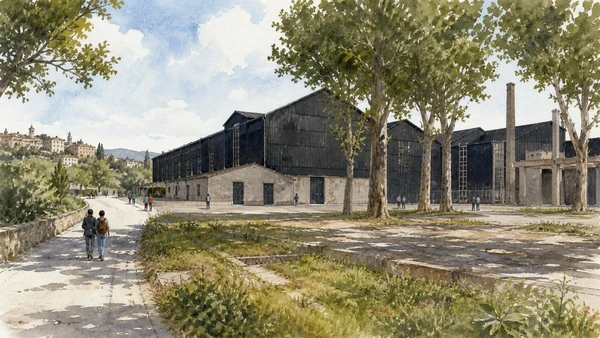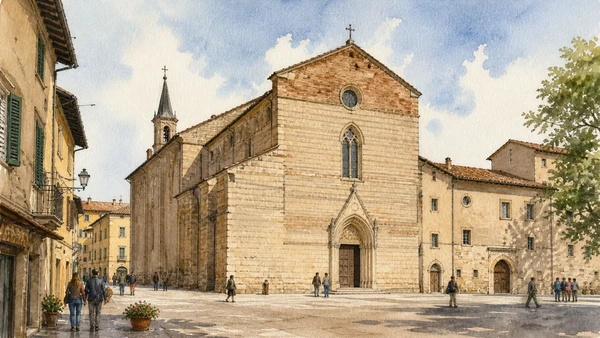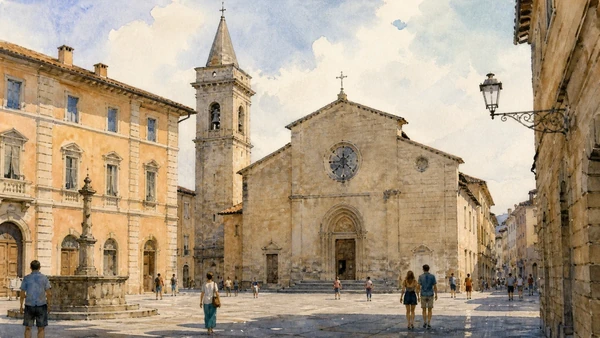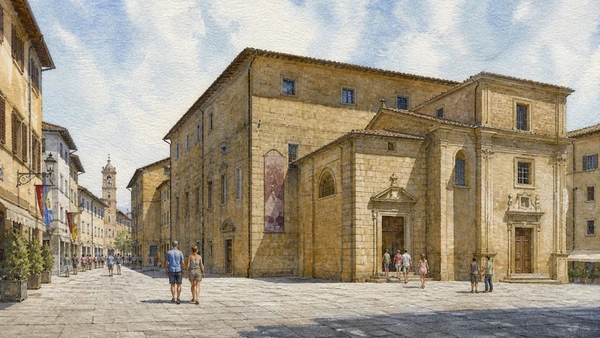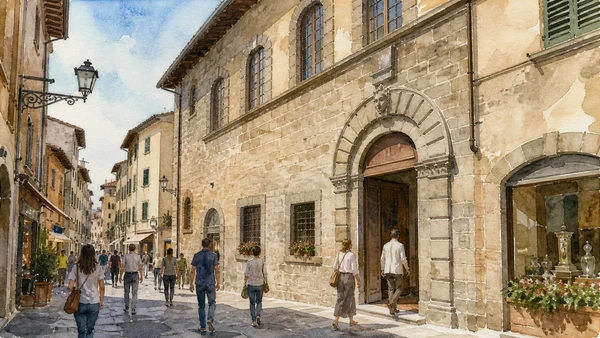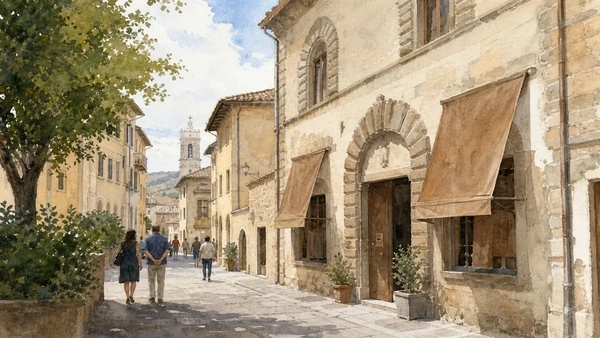
Documentary watercolour panorama of Città di Castello with its cathedral tower and historic centre

Illustrated guide · Città di Castello

Renaissance walls
and Burri’s matter

Ten places through which to read Roman Tifernum, the Vitelli city, centuries of craft and one of the most powerful modern artistic legacies in Italy.

Explore the places
Ancient Tifernum Tiberinum · Upper Tiber

Preface

Città di Castello changes the expected image of Umbria.

Here the medieval town was decisively reshaped by Renaissance palaces, and the strongest artistic voice may belong not to a fresco painter but to Alberto Burri, whose work fills a noble residence and the monumental sheds of a former tobacco complex.

After forty-two years in Umbria, I value this northern city for its independence of tone. It faces Tuscany across the Upper Tiber, preserves printing and weaving traditions, and refuses to reduce its identity to one century.

This guide moves from cathedral and commune to the Vitelli and Burri, then follows the workshops that connect humanist culture with the continuing discipline of making.

Città di Castello is where Umbrian history becomes material, surface and work.

One destination

Città di Castello,
art across centuries.

The selection deliberately places Renaissance painting beside Burri, and monumental palaces beside printing and weaving. The city's identity emerges from continuity of production rather than from a single preserved period.

The selection

Ten places,
one story

A route through the historic centre followed by the Ex Seccatoi outside it, linking civic and sacred architecture with workshops and modern art.

  1. 01Cathedral of Saints Floridus and Amanzio
  2. 02Palazzo dei Priori and Civic Tower
  3. 03Palazzo Vitelli alla Cannoniera and Civic Art Gallery
  4. 04Palazzo Albizzini — Burri Collection
  5. 05Ex Seccatoi del Tabacco — Burri Collection
  6. 06Church of San Domenico
  7. 07Church of San Francesco
  8. 08Cathedral Museum
  9. 09Grifani Donati Printing Museum
  10. 10Tela Umbra
01

The sacred centre of Tiferno

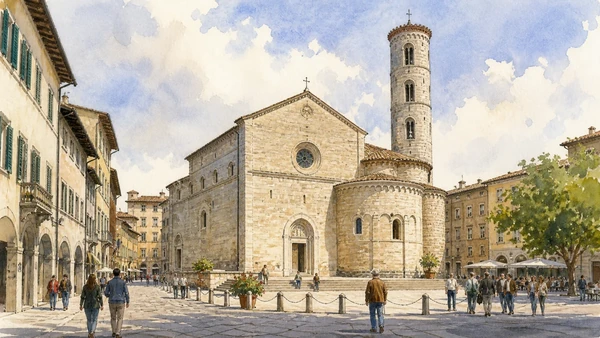
Cathedral of Saints Floridus and Amanzio

A composite cathedral and cylindrical bell tower preserve medieval structure beneath Renaissance and later renewal.

Original documentary watercolour showing Cathedral of Saints Floridus and Amanzio in its Citta di Castello urban or landscape context
Cathedral of Saints Floridus and AmanzioCathedral of Saints Floridus and Amanzio · original Merlintravel watercolour

The place today

The cathedral stands near Piazza Gabriotti with a broad Renaissance façade left incomplete in its upper section. The interior combines a single large space, chapels and artworks from several periods. Beside it, the distinctive round bell tower rises from an early medieval base and remains the city's clearest skyline marker.

The historical chapter

The cathedral developed over an early Christian and medieval religious centre associated with Saint Floridus. Major rebuilding occurred from the eleventh century and again during the Renaissance, when the church assumed much of its present scale. Earthquakes and later restoration produced the layered building visible today.

What to notice

  • The cylindrical campanile beside the later church
  • Unfinished upper façade
  • Medieval and Renaissance fabric meeting around the apse and crypt
Umbria Tourism · Città di Castello
02

The medieval commune

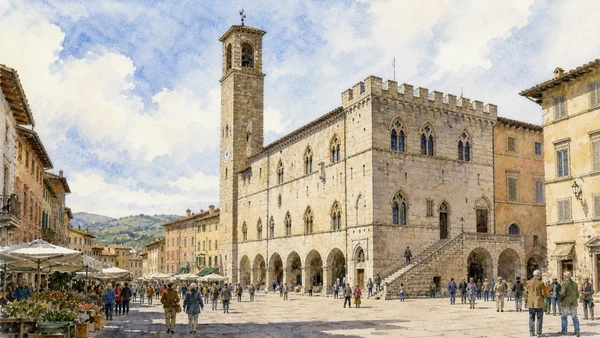
Palazzo dei Priori and Civic Tower

A Gothic palace and tower define the secular centre of the city before the Renaissance expansion of the Vitelli.

Original documentary watercolour showing Palazzo dei Priori and Civic Tower in its Citta di Castello urban or landscape context
Palazzo dei Priori and Civic TowerPalazzo dei Priori and Civic Tower · original Merlintravel watercolour

The place today

The Town Hall presents a severe stone façade with mullioned windows and a strong horizontal cornice. Nearby, the Civic Tower rises above Piazza Gabriotti and can be read in direct relation to the cathedral tower. Together they establish the classic medieval tension between communal and episcopal authority.

The historical chapter

Palazzo dei Priori was built in the fourteenth century and is associated with Angelo da Orvieto. The tower belongs to the communal city that developed after the eleventh and twelfth centuries. Later changes removed or altered defensive crowns, but both buildings continue their civic function and visual rivalry with the cathedral.

What to notice

  • Regular Gothic windows on the palace façade
  • The two towers representing civic and religious centres
  • Local sandstone darkened by age and weather
Umbria Tourism · Città di Castello
03

The Renaissance city

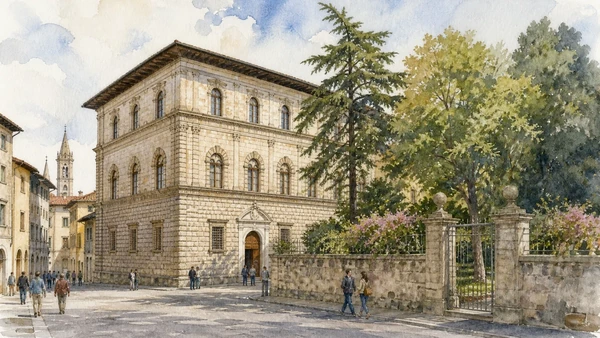
Palazzo Vitelli alla Cannoniera and Civic Art Gallery

A frescoed family palace houses paintings by Signorelli, Raphael and artists shaped by the Upper Tiber's Renaissance courts.

Original documentary watercolour showing Palazzo Vitelli alla Cannoniera and Civic Art Gallery in its Citta di Castello urban or landscape context
Palazzo Vitelli alla Cannoniera and Civic Art GalleryPalazzo Vitelli alla Cannoniera and Civic Art Gallery · original Merlintravel watercolour

The place today

The gallery occupies rooms, stairs and a garden within the palace. The collection includes works by Luca Signorelli, Raffaello, Andrea and Giovanni della Robbia, Pomarancio and local masters. Exterior and interior fresco decoration helps visitors read the building itself as part of the collection.

The historical chapter

The Vitelli family built the palace in the first half of the sixteenth century as one of several residences reshaping Città di Castello. Architectural and painted decoration expressed their military and political power. The civic gallery later brought together works from churches, suppressed institutions and municipal ownership.

What to notice

  • Painted façades and rooms designed as a unified statement
  • Raphael's youthful banner in its local context
  • Signorelli's strong connection with the Upper Tiber territory
Municipal tourism portal · Civic Art Gallery
04

Burri within the old city

Palazzo Albizzini — Burri Collection

A Renaissance palace provides a measured sequence for Burri's sacks, combustions, plastics, woods and cretti.

Original documentary watercolour showing Palazzo Albizzini — Burri Collection in its Citta di Castello urban or landscape context
Palazzo Albizzini — Burri CollectionPalazzo Albizzini — Burri Collection · original Merlintravel watercolour

The place today

The collection occupies many rooms of Palazzo Albizzini, following Burri's development through major cycles and materials. The restrained architecture and controlled installation allow surface, scale and interval to become part of the viewing experience. This is not a general modern art museum but an artist-specific environment.

The historical chapter

The Fondazione acquired and restored the palace to house works donated by Burri, opening the collection in 1981. The artist participated closely in selection and display. His choice to place radical post-war work within his birthplace created a dialogue with the Renaissance city without forcing stylistic harmony.

What to notice

  • Sack seams and repairs treated as pictorial structure
  • Combustion transforming plastic and wood
  • Spacing between works as part of Burri's installation logic
Fondazione Burri · Palazzo Albizzini
05

Monumental art in industrial space

Ex Seccatoi del Tabacco — Burri Collection

Former tobacco-drying sheds hold Burri's largest cycles in spaces whose scale he helped redefine.

Original documentary watercolour showing Ex Seccatoi del Tabacco — Burri Collection in its Citta di Castello urban or landscape context
Ex Seccatoi del Tabacco — Burri CollectionEx Seccatoi del Tabacco — Burri Collection · original Merlintravel watercolour

The place today

The black-painted industrial buildings stand outside the centre and contain monumental works from Burri's later career. Vast rooms allow series such as Il Viaggio, Orsanmichele and the black Cellotex works to unfold as complete environments. The site also preserves archives and documentation.

The historical chapter

The sheds were built for tobacco processing and served emergency functions after the 1966 Florence flood. Burri transformed them into a permanent exhibition site, opened in 1990. Their industrial history and severe exterior became inseparable from his late work and from the city's modern cultural geography.

What to notice

  • Scale impossible within a conventional palace museum
  • Black exterior unifying separate industrial volumes
  • Cycles installed as complete spatial narratives
Fondazione Burri · Ex Seccatoi
06

A vast mendicant interior

Church of San Domenico

The largest church in the city preserves Gothic spatial clarity and memories of works dispersed to major museums.

Original documentary watercolour showing Church of San Domenico in its Citta di Castello urban or landscape context
Church of San DomenicoChurch of San Domenico · original Merlintravel watercolour

The place today

San Domenico has a plain unfinished façade and an immense single nave with timber roof, chapels and surviving frescoes. The scale is deliberately open and suited to preaching. Works once made for the church are now elsewhere, so interpretation requires connecting the present architecture with dispersed collections.

The historical chapter

The Dominicans built the church mainly between the late fourteenth and early fifteenth centuries. Its convent became an important religious and intellectual institution. Suppressions and transfers removed major artworks, including Raphael's Mond Crucifixion, now in London, leaving the building as evidence of the original monumental setting.

What to notice

  • The unadorned exterior concealing a vast nave
  • Timber roof spanning the preaching space
  • Empty or altered settings that once held Renaissance altarpieces
Umbria Tourism · Città di Castello
07

The absent Raphael

Church of San Francesco

A medieval Franciscan foundation, later transformed, remains tied to Raphael's Marriage of the Virgin.

Original documentary watercolour showing Church of San Francesco in its Citta di Castello urban or landscape context
Church of San FrancescoChurch of San Francesco · original Merlintravel watercolour

The place today

The church's interior is largely Baroque, with chapels and decoration overlaying the medieval structure. A copy recalls Raphael's Marriage of the Virgin, painted for the church but now in the Brera Gallery in Milan. The Vitelli chapel adds an important Renaissance architectural layer.

The historical chapter

The Franciscans established the church in the thirteenth century. In 1504 the young Raphael completed the Marriage of the Virgin for the Albizzini chapel, demonstrating his rapid artistic maturity. Later remodelling and the removal of the altarpiece changed the experience, but the commission remains essential to the city's art history.

What to notice

  • Later interior concealing the medieval mendicant form
  • The original location and scale of Raphael's altarpiece
  • Vitelli patronage visible in the Renaissance chapel
Umbria Tourism · Città di Castello
08

Treasures of the diocese

Cathedral Museum

Early Christian silver, medieval sculpture and Renaissance painting preserve the religious history of the Upper Tiber.

Original documentary watercolour showing Cathedral Museum in its Citta di Castello urban or landscape context
Cathedral MuseumCathedral Museum · original Merlintravel watercolour

The place today

The museum stands beside the cathedral and displays liturgical objects, paintings and sculpture from the diocesan territory. The Treasure of Canoscio, a group of sixth-century silver vessels, is the most exceptional ensemble. Other works include pieces associated with Pinturicchio and local Renaissance production.

The historical chapter

The museum gathers objects preserved by the cathedral or transferred from churches for security and conservation. The Canoscio treasure was discovered in the nineteenth century near a rural shrine and documents early Christian liturgy during the transition from late antiquity to the early Middle Ages.

What to notice

  • Silver vessels designed for early Christian worship
  • Objects retaining inscriptions and signs of use
  • A regional collection read beside the cathedral that safeguarded it
Umbria Tourism · Città di Castello
09

Ink, type and continuity

Grifani Donati Printing Museum

A working historic print shop preserves presses, type and craft knowledge in the rooms where generations practised them.

Original documentary watercolour showing Grifani Donati Printing Museum in its Citta di Castello urban or landscape context
Grifani Donati Printing MuseumGrifani Donati Printing Museum · original Merlintravel watercolour

The place today

The museum-workshop contains hand presses, movable type, tools, printed sheets and archives. Demonstrations make the sequence from composition to inking and impression intelligible. Its strength lies in continuity of place and practice rather than in machines displayed as silent objects.

The historical chapter

The Grifani Donati printing house was established in 1799 and continued across generations. Its survival documents the importance of printing in a city with strong humanist, administrative and commercial traditions. Museum activity now combines preservation with practical education.

What to notice

  • Cases of movable type organised by hand
  • Mechanical differences between historic presses
  • Printed ephemera recording everyday civic life
Grifani Donati · official website
10

Weaving as social design

Tela Umbra

Hand looms, local fibres and a remarkable social enterprise connect early twentieth-century reform with living textile craft.

Original documentary watercolour showing Tela Umbra in its Citta di Castello urban or landscape context
Tela UmbraTela Umbra · original Merlintravel watercolour

The place today

The workshop and collection preserve hand weaving on traditional looms, producing linen textiles with designs rooted in local practice. Visitors can understand warp, weft, pattern and finishing within an active environment rather than a reconstructed demonstration.

The historical chapter

Alice Hallgarten Franchetti founded Tela Umbra in 1908 to provide skilled, dignified work and education for women in the Upper Tiber. The project united social reform, craft quality and regional design. Its continuing activity gives Città di Castello a rare institution where heritage remains economically productive.

What to notice

  • Rhythm and physical coordination of hand looms
  • Natural linen structure before finishing
  • Social history inseparable from the objects produced
Tela Umbra · official website

The city through time

Eight dates for orientation

An essential chronology showing how ancient foundations, medieval institutions and later transformations overlap.

  1. Tifernum Tiberinum develops as a Roman municipium in the Upper Tiber valley.

  2. The Canoscio treasure documents early Christian worship in the territory.

  3. Palazzo dei Priori and civic towers consolidate the medieval commune.

  4. The Vitelli reshape the city through palaces, chapels and artistic patronage.

  5. Raphael paints the Marriage of the Virgin for San Francesco.

  6. The Grifani Donati printing house begins its long activity.

  7. Alice Hallgarten Franchetti founds Tela Umbra.

  8. Burri's collections open at Palazzo Albizzini and the Ex Seccatoi.

Before your visit

Practical information,
without turning it into promises

01

Two Burri sites

Palazzo Albizzini is central; the Ex Seccatoi are outside the historic core. Check combined tickets and opening times before planning the route.

02

Working crafts

Grifani Donati and Tela Umbra are active institutions with specific visit arrangements. Reserve where requested.

03

Historic centre

The centre is relatively level by Umbrian standards and largely walkable, with traffic restrictions and stone paving.

04

Dispersed artworks

Some famous works were removed from their original churches. Use the civic and cathedral museums to reconstruct their local context without expecting every original in situ.

Sources

The guide was checked against the Fondazione Burri, the municipal tourism portal, institutional museums and the official craft organisations. Works now in external collections are clearly identified so their historical setting is not confused with their current location.

The hero image is an illustration, not a photograph. Opening hours, tickets, worship schedules, restoration works and path access can change; always consult the linked official pages shortly before visiting.