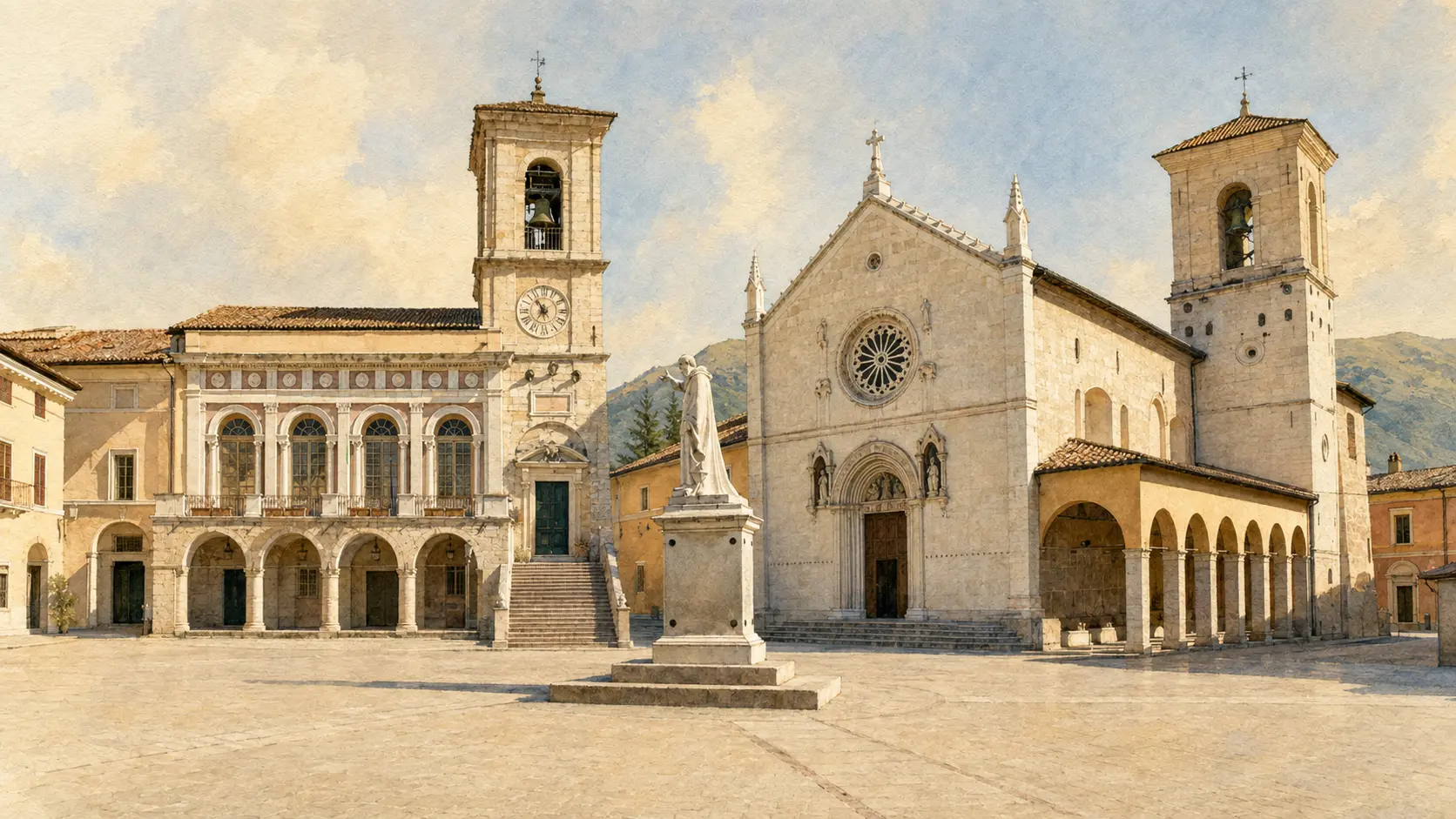
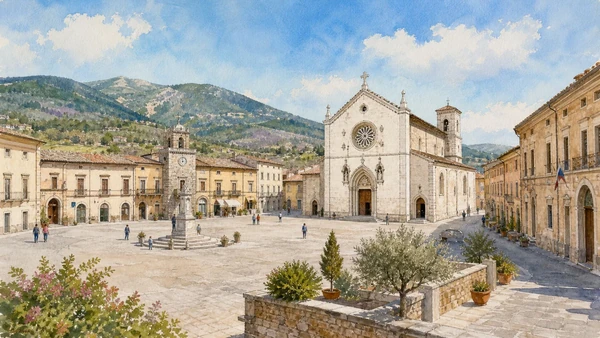
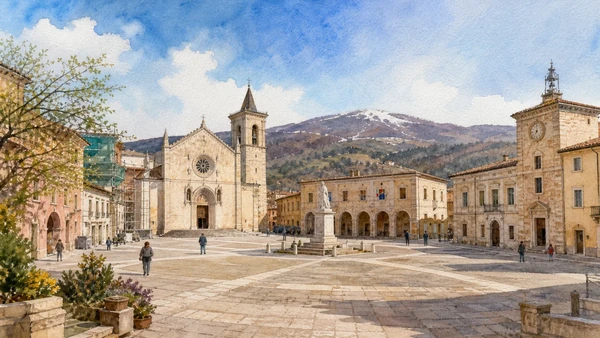
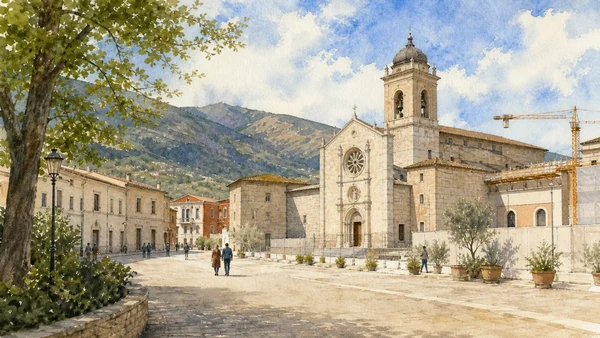
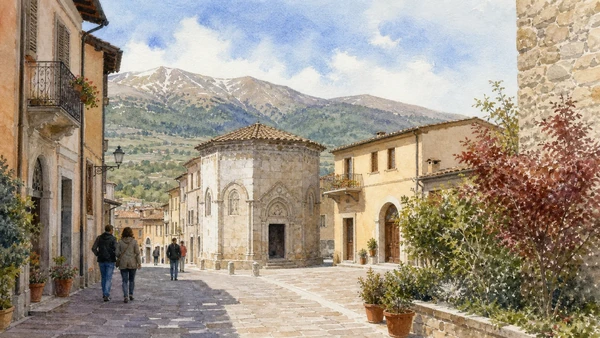
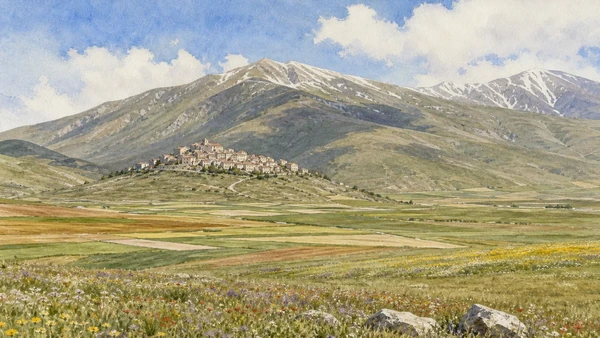
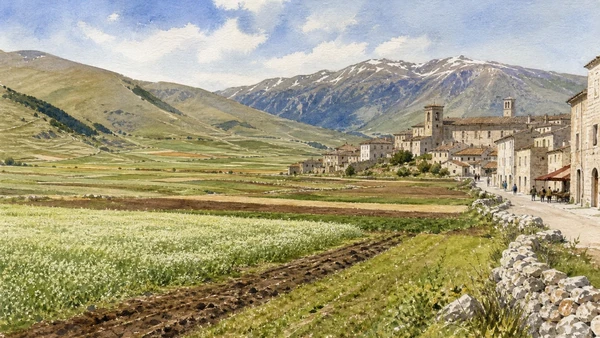
Documentary watercolour of Norcia with the reconstructed Basilica of Saint Benedict and the Sibillini Mountains

Illustrated guide · Norcia

Rebirth, stone
and high plains

Ten places through which to read the birthplace of Benedict, a resilient walled town and the mountain landscape whose seasons shape Norcia's culture and food.

Explore the places
Patria of Saint Benedict · Monti Sibillini

Preface

Norcia must be described in the present tense.

The earthquakes of 2016 are part of the city, but they are not its entire identity. The Basilica of Saint Benedict reopened in October 2025 after reconstruction; other buildings remain under restoration, and the work of return continues from one site to another.

After forty-two years in Umbria, I cannot treat Norcia as an image fixed before or after the earthquake. It is a living mountain community whose history, food, pastoral economy and relationship with the Sibillini have always required adaptation.

This guide therefore combines monuments with current status, and places the walled town within the plains, paths and productive landscape that give it meaning.

Norcia is not only what survived: it is what has returned and what is still returning.

One destination

Norcia,
memory and return.

The route distinguishes reopened, exterior-only and restoration sites as of August 2026. It then broadens from Piazza San Benedetto to Castelluccio, the national park and the food traditions grounded in mountain agriculture.

The selection

Ten places,
one story

A current-status route through Piazza San Benedetto and the wall circuit, followed by the highland landscape and food culture that cannot be separated from the city.

  1. 01Basilica of Saint Benedict
  2. 02Piazza San Benedetto and the saint's monument
  3. 03La Castellina and the civic-diocesan collections
  4. 04Co-Cathedral of Santa Maria Argentea
  5. 05Tempietto
  6. 06San Francesco complex
  7. 07City walls and gates
  8. 08Castelluccio and the Pian Grande
  9. 09Monti Sibillini National Park
  10. 10Norcineria, black truffle and Castelluccio lentils
01

The church returned to the city

Basilica of Saint Benedict

Reopened in 2025, the reconstructed basilica is both a historic monument and a record of contemporary conservation after disaster.

Original documentary watercolour showing Basilica of Saint Benedict in its Norcia urban or landscape context
Basilica of Saint BenedictBasilica of Saint Benedict · original Merlintravel watercolour

The place today

The basilica once again closes the eastern side of Piazza San Benedetto. Its Gothic façade, rose window and portals survived the 2016 collapse and have been integrated with a reconstructed nave, roof, apse and Portico delle Misure. The interior is again a place of worship, so visitor access follows liturgical life and current sanctuary rules.

The historical chapter

The church grew over medieval structures traditionally associated with the birthplace of Benedict and Scholastica. It changed repeatedly after earlier earthquakes. On 30 October 2016, the nave and much of the complex collapsed. Reconstruction began in 2021, reusing catalogued original stone where possible and incorporating seismic reinforcement; the basilica reopened on 30 October 2025.

What to notice

  • Surviving medieval façade joined to reconstructed volumes
  • Recovered original stone distinguished within renewed work
  • The Portico delle Misure restored as part of the piazza ensemble
Umbria Tourism · Basilica of Saint Benedict
02

The civic and sacred centre

Piazza San Benedetto and the saint's monument

The central square gathers basilica, cathedral, Town Hall and Castellina in a space where restoration remains visible.

Original documentary watercolour showing Piazza San Benedetto and the saint's monument in its Norcia urban or landscape context
Piazza San Benedetto and the saint’s monumentPiazza San Benedetto and the saint’s monument · original Merlintravel watercolour

The place today

The statue of Saint Benedict stands at the centre, surrounded by the reopened basilica and buildings at different stages of recovery. Hoarding, work areas or restricted sections may still change the piazza's appearance. This is not a defect in the visit but direct evidence of the reconstruction process.

The historical chapter

The square developed as Norcia's main civic and religious focus. Its principal buildings belong to different periods: medieval and later sacred architecture, communal government and the sixteenth-century papal fortress-residence. The 2016 earthquake damaged the entire ensemble, making coordinated recovery a central task for the town.

What to notice

  • The statue organising views towards the basilica
  • Different construction phases across the four sides
  • Contemporary rebuilding visible beside restored historic fabric
Umbria Tourism · Piazza San Benedetto
03

A museum awaiting return

La Castellina and the civic-diocesan collections

Vignola's compact fortress-palace remains a key architectural presence while restoration prepares the return of displaced collections.

Original documentary watercolour showing La Castellina and the civic-diocesan collections in its Norcia urban or landscape context
La Castellina and the civic-diocesan collectionsLa Castellina and the civic-diocesan collections · original Merlintravel watercolour

The place today

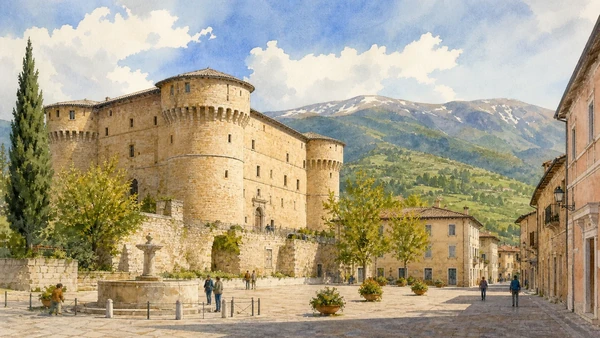
La Castellina occupies the western side of the piazza as a square fortified building with corner bastions and an internal courtyard. As of August 2026, the museum remains affected by restoration work and should not be assumed open; artworks are being safeguarded off site. Consult the municipality for verified access updates.

The historical chapter

Pope Julius III commissioned the building in 1554 as a residence for papal governors, on a design by Jacopo Barozzi da Vignola. It later served municipal functions and became the Civic and Diocesan Museum in 1967. The 2016 earthquake forced closure; a major conservation and seismic-upgrade project was launched in 2025 with completion targeted, not guaranteed, for late 2026.

What to notice

  • Four corner bastions framing a Renaissance residence
  • The central arcaded courtyard
  • Restoration status treated as part of current documentation
2016 Reconstruction Commissioner · La Castellina
04

The cathedral under reconstruction

Co-Cathedral of Santa Maria Argentea

The damaged cathedral remains a major part of Piazza San Benedetto and of Norcia's continuing recovery.

Original documentary watercolour showing Co-Cathedral of Santa Maria Argentea in its Norcia urban or landscape context
Co-Cathedral of Santa Maria ArgenteaCo-Cathedral of Santa Maria Argentea · original Merlintravel watercolour

The place today

The cathedral stands beside the basilica, but access and appearance are governed by active reconstruction. The 2016 earthquake caused catastrophic damage, and the site should be understood from designated public areas only. Recovered artworks and fragments are part of the wider conservation programme.

The historical chapter

The present church was built after the mid-sixteenth century when the earlier cathedral site changed, incorporating sacred memory from older phases. It was altered after later earthquakes. In 2016 the nave collapsed and the façade was severely compromised. Reconstruction planning has aimed to recover surviving material while providing modern seismic safety.

What to notice

  • Relationship with the basilica across the same piazza
  • Surviving masonry and reconstructed elements where visible
  • The importance of respecting a live building site
Municipality of Norcia · reconstruction updates
05

A small Gothic landmark

Tempietto

An exquisitely carved fourteenth-century shrine preserves a concentrated image of medieval Norcia.

Original documentary watercolour showing Tempietto in its Norcia urban or landscape context
TempiettoTempietto · original Merlintravel watercolour

The place today

The small stone building stands along Via Umberto and is read primarily from the exterior. Its pointed portal, reliefs, niches and miniature architectural details reward close inspection. Current barriers or conservation work may affect proximity.

The historical chapter

The Tempietto was built in 1354 by the local sculptor Vanni della Tuccia. Its exact original function has been discussed, but the inscription, sculpture and form securely identify it as a major example of local Gothic craftsmanship. Survival through repeated earthquakes gives the small monument particular significance.

What to notice

  • Dated inscription and sculpted portal
  • Miniature pinnacles, niches and relief figures
  • Scale contrasting with the large public buildings of the piazza
Umbria Tourism · Tempietto
06

A wounded mendicant complex

San Francesco complex

A Gothic church and former convent remain central to Norcia's cultural geography while post-earthquake recovery continues.

Original documentary watercolour showing San Francesco complex in its Norcia urban or landscape context
San Francesco complexSan Francesco complex · original Merlintravel watercolour

The place today

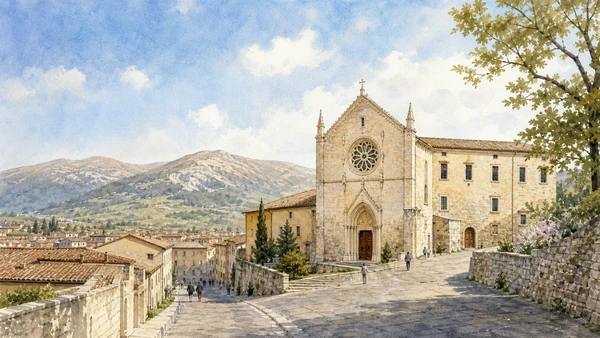
The complex is recognised by its stone façade and rose window, but access must be verified because damage and restoration have affected the church and adjoining spaces. The exterior can still be read as part of the route between the centre and walls.

The historical chapter

The Franciscans established the complex in the medieval town, with the church taking its principal Gothic form between the fourteenth and fifteenth centuries. It later served religious, cultural and civic functions. Damage in 2016 interrupted those uses and made structural recovery part of the wider reconstruction of Norcia.

What to notice

  • Gothic portal and rose window
  • Former convent buildings attached to the church
  • Visible conservation measures documenting current condition
Umbria Tourism · San Francesco complex
07

The heart-shaped enclosure

City walls and gates

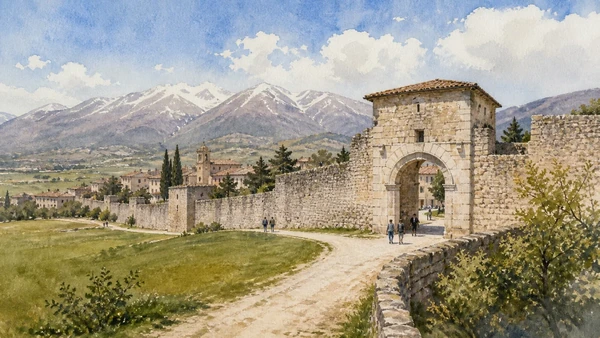
Norcia's compact wall circuit traces a distinctive shape against the plain and preserves the logic of a mountain town repeatedly rebuilt.

Original documentary watercolour showing City walls and gates in its Norcia urban or landscape context
City walls and gatesCity walls and gates · original Merlintravel watercolour

The place today

Much of the perimeter can be followed from roads and paths outside the centre. Gates such as Porta Romana and Porta Ascolana connect the town to regional routes. Earthquake damage and repair vary by section, so closures and work areas must be respected.

The historical chapter

The surviving circuit is largely medieval with later rebuilding after warfare and earthquakes. It enclosed a relatively level town compared with many Umbrian centres, while controlling routes towards Spoleto, the Marche and the highlands. Repeated repair is intrinsic to the walls' history rather than a modern interruption.

What to notice

  • The compact heart-like plan seen on maps and from surrounding slopes
  • Gate roads aligned with valleys and passes
  • Different masonry phases produced by repeated reconstruction
Umbria Tourism · Norcia city guide
08

The high village

Castelluccio and the Pian Grande

A high plateau, seasonal flowering and a village under reconstruction form one of Italy's most powerful mountain landscapes.

Original documentary watercolour showing Castelluccio and the Pian Grande in its Norcia urban or landscape context
Castelluccio and the Pian GrandeCastelluccio and the Pian Grande · original Merlintravel watercolour

The place today

The Pian Grande opens at about 1,300 metres below Monte Vettore. Agricultural plots, sinkholes, roads and grasslands change with snow, cultivation and summer flowering. Castelluccio was devastated in 2016 and remains a reconstruction area; access, parking and services must be checked before travel.

The historical chapter

Pastoralism and high-altitude cultivation shaped the plateau over centuries. The famous flowering combines wild plants with fields of lentils and other crops; it is not a planted ornamental display. Earthquakes transformed the village's built fabric, but farming and seasonal use of the plain continue.

What to notice

  • Patchwork produced by real agricultural parcels
  • Monte Vettore defining the eastern horizon
  • Reconstruction of Castelluccio distinct from the open access of the plain
Monti Sibillini National Park · official website
09

The city within the mountains

Monti Sibillini National Park

Trails, karst plains, beech woods and high ridges place Norcia within a protected Apennine ecosystem.

Original documentary watercolour showing Monti Sibillini National Park in its Norcia urban or landscape context
Monti Sibillini National ParkMonti Sibillini National Park · original Merlintravel watercolour

The place today

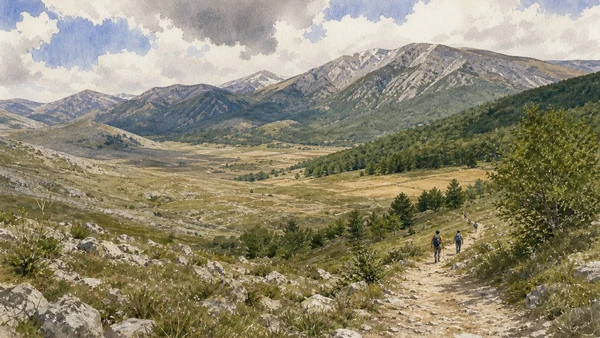
The municipal territory connects to routes across the Sibillini, from family walks to exposed mountain itineraries. Conditions change quickly with weather, snow, landslides and restoration of post-earthquake infrastructure. Official park maps and current notices are essential.

The historical chapter

The mountains have long supported grazing, forestry, pilgrimage, trade and seasonal movement. The national park, established in 1993, protects habitats and cultural landscapes across Umbria and Marche. Conservation therefore includes both wild ecology and human practices that created the open high plains.

What to notice

  • Transition from cultivated basin to high ridges
  • Pastoral structures and paths as cultural landscape
  • Wildlife and fragile habitats requiring low-impact behaviour
Monti Sibillini National Park · official website
10

The meaning of norcineria

Norcineria, black truffle and Castelluccio lentils

Food traditions translate mountain climate, pastoral work and preservation skills into the strongest everyday expression of Norcia's identity.

Original documentary watercolour showing Norcineria, black truffle and Castelluccio lentils in its Norcia urban or landscape context
Norcineria, black truffle and Castelluccio lentilsNorcineria, black truffle and Castelluccio lentils · original Merlintravel watercolour

The place today

Shops and producers offer cured pork, cheeses, legumes and truffle products, but quality and origin vary. Seek protected labels, transparent producers and seasonal dishes. Castelluccio lentils belong to a specific highland agricultural system; black truffle follows natural and regulated harvest cycles.

The historical chapter

The Italian word norcino reflects the historic reputation of specialised pork workers from Norcia and the surrounding Apennines. Cold, dry conditions favoured curing, while pastoralism, legumes and woodland products diversified the mountain economy. Modern protection and tourism have expanded markets without replacing the underlying skills and landscapes.

What to notice

  • Curing rooms and ageing as controlled processes
  • Labels identifying protected or local origin
  • Food read in relation to pasture, woodland and high-plain agriculture
Umbria Tourism · Norcia and local traditions

The city through time

Eight dates for orientation

An essential chronology showing how ancient foundations, medieval institutions and later transformations overlap.

  1. Sabine and Roman communities shape ancient Nursia and its highland territory.

  2. Tradition places the birth of Benedict and Scholastica in Norcia.

  3. Basilica, walls, Tempietto and mendicant complexes define the medieval town.

  4. Vignola designs La Castellina for papal governors.

  5. The Monti Sibillini National Park is established.

  6. A major earthquake devastates Norcia's churches and damages its civic centre.

  7. The Basilica of Saint Benedict is reconstructed with recovered material and seismic protection.

  8. The basilica reopens while the wider reconstruction of Norcia continues.

Before your visit

Practical information,
without turning it into promises

01

Check every site

Reconstruction makes older opening information unreliable. Use the municipality, diocese, regional portal and on-site instructions immediately before visiting.

02

Active work areas

Barriers protect both visitors and fragile buildings. Do not enter restricted zones or treat construction sites as informal viewpoints.

03

Mountain conditions

Castelluccio and the Sibillini require weather, road and trail checks. Snow, storms and temporary closures can change plans rapidly.

04

Support the community

Choose local guides, producers and accommodation where possible. Responsible spending is part of visiting a town still completing its recovery.

Sources

This guide uses sources current to August 2026 and distinguishes confirmed reopening from projected completion. The Basilica is reopened; La Castellina and Santa Maria Argentea should still be treated as restoration sites unless a newer official notice states otherwise.

The hero image is an illustration, not a photograph. Opening hours, tickets, worship schedules, restoration works and path access can change; always consult the linked official pages shortly before visiting.