Illustrated guide · Sicily
A theatre between
Etna and the sea
Ten places through which to read ancient Tauromenion, the medieval town, the landscape of the Ionian coast and the Taormina held in family memory.
Explore the placesA personal beginning
Taormina is where the Sicily of history meets the Sicily of my childhood.
My relatives were spread across different parts of the island, and travelling to Sicily meant setting out with my father to meet them. Taormina was where we came for the holidays: the place in which those family journeys opened onto the sea.
I do not want to turn memory into a detail I can no longer verify or have not yet chosen to make public. What remains certain is the relationship: my father, the journeys, the relatives and Taormina returning as the place of the family holiday.
This first Sicilian guide begins there, but it also looks beneath the familiar view. The theatre, the streets, the Roman structures, the fortified town and the coast belong to a history much longer than tourism.
One destination
Taormina,
layer by layer.
Taormina is often approached as a balcony over the Ionian Sea. The panorama is real, but it is only the surface of a city whose form was shaped by an ancient settlement on Mount Tauro, Greek and Roman public buildings, medieval fortifications and the international culture of travel that developed from the nineteenth century.
The guide follows the places that make those layers visible. It distinguishes the Greek origin of monuments from their Roman rebuilding, the documented medieval structures from romantic labels, and the historic landscape from practical conditions that can change.
The selection
Ten places,
one story
From the Ancient Theatre to Isola Bella, the guide moves through archaeology, medieval streets, modern travel culture and the coast without reducing Taormina to its panorama.
The landscape as part of the monument
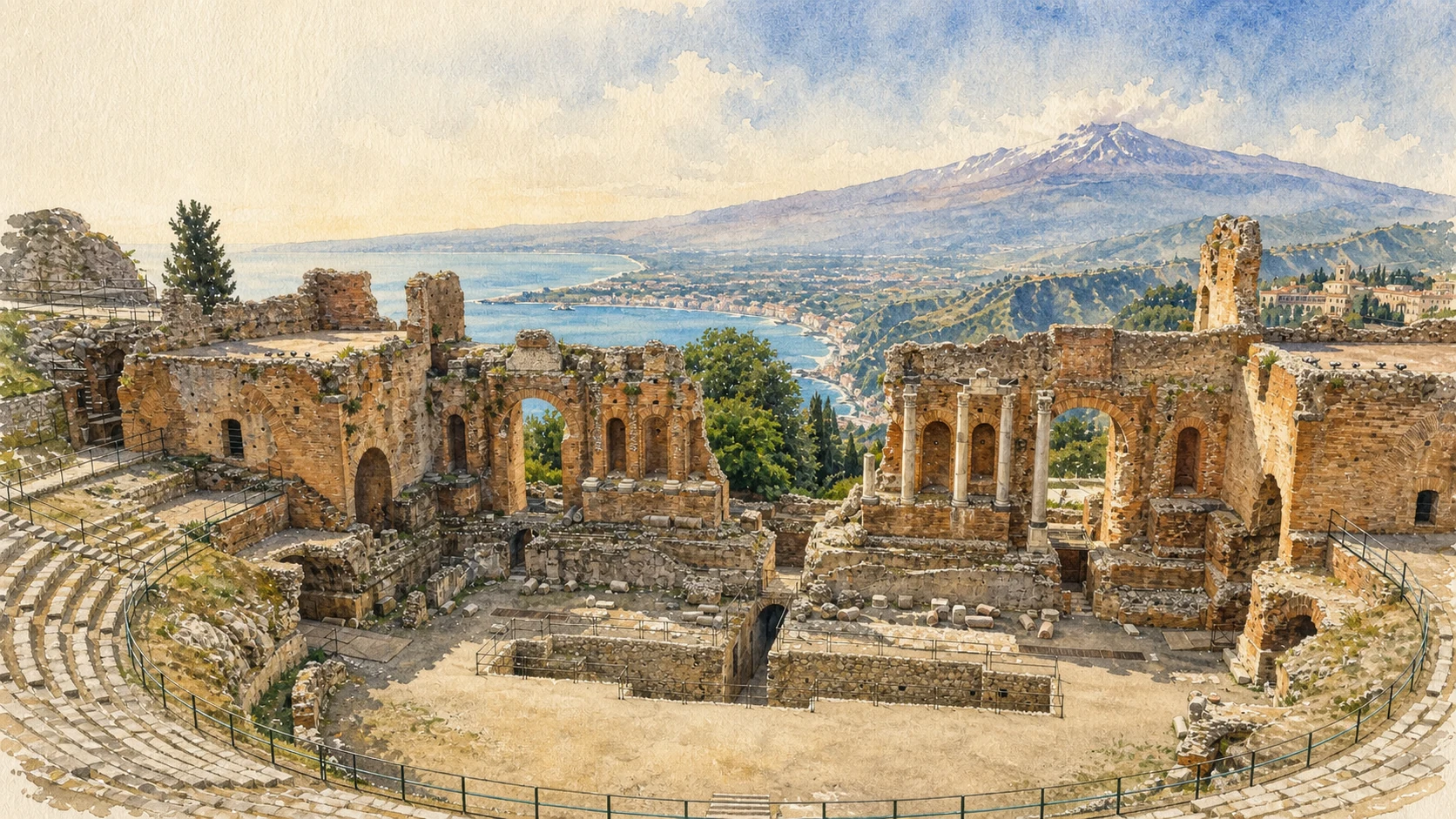
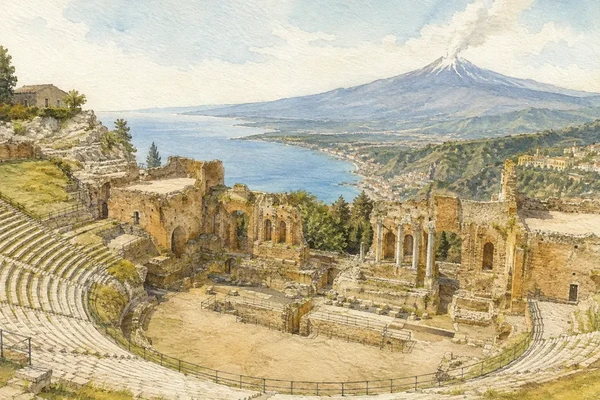
Ancient Theatre of Taormina
A Greek foundation transformed by Roman rebuilding, framed by the Ionian coast and Mount Etna.

The place today
The theatre occupies the crest of its hill and remains Taormina's defining monument. Its cavea, stage building and surviving openings create a sequence in which architecture and landscape are inseparable. The site is still used for cultural events, so temporary structures and access arrangements may alter the visitor experience.
The historical chapter
The original layout dates to the Hellenistic period, in the third or second century BC. The structure visible today belongs largely to Roman rebuilding, especially the major transformation of the first half of the second century AD. That distinction matters: calling it simply a Greek theatre hides the scale of the Roman intervention.
What to notice
- The relationship between the cavea, the stage building and the natural horizon
- The surviving lateral openings of the Roman scaenae frons
- Evidence of different construction phases rather than a single frozen monument
A smaller theatre inside the town
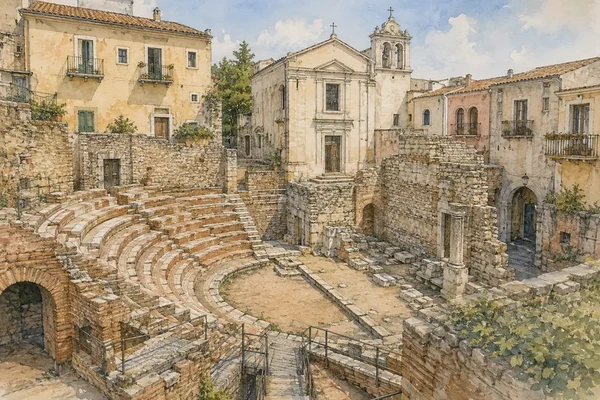
Odeon and the Hellenistic Temple
A Roman covered performance space built beside the remains of a third-century-BC temple.

The place today
The Odeon is partly concealed within the modern urban fabric near the Church of Saint Catherine. Its compact scale offers a useful counterpoint to the great theatre and makes the density of the ancient town more legible.
The historical chapter
A peripteral temple, dated by its Ionic decoration to around the middle of the third century BC, preceded the Roman building. In the late first or early second century AD, an odeon was constructed beside it. Together with Catania's, it is the only documented covered theatre of this type in Sicily.
What to notice
- The brick seating divided into wedges
- The relationship between the Roman theatre and the earlier temple
- How modern buildings preserve and obscure the ancient urban plan
Archaeology behind the present streets
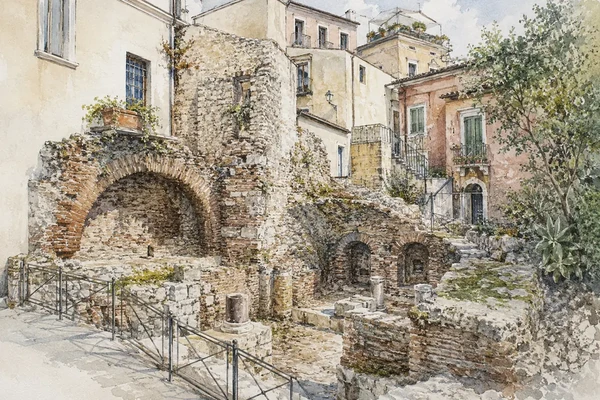
Roman Baths and the Hidden Ancient Town
Imperial-period structures embedded in courtyards and later houses reveal a city extending beyond its theatres.

The place today
The bath complex lies behind the modern buildings north of Piazza Vittorio Emanuele. Other brick walls and arches survive inside the later quarter known as the Zecca. The remains are less monumental than the theatre, but they are essential to understanding ancient Taormina as a lived city.
The historical chapter
The structures belong to the Roman imperial phase, when Tauromenium possessed baths, performance buildings and a reorganised civic landscape. Their incorporation into later buildings illustrates the continuous reuse of the urban site.
What to notice
- Roman brickwork incorporated into later walls
- The position of the baths in relation to the ancient civic centre
- The difference between an archaeological fragment and a reconstructed monument

A building made by successive centuries
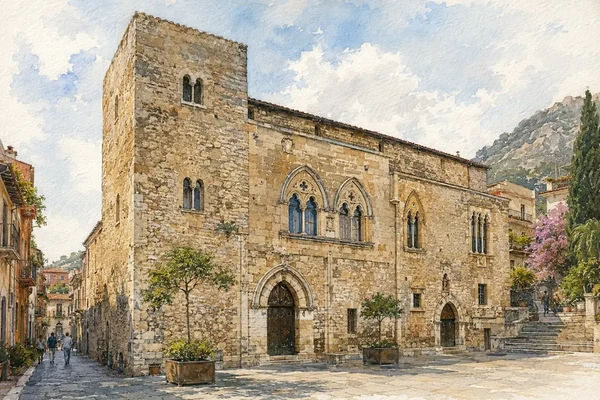
Palazzo Corvaja
A medieval civic complex in which an earlier tower and later Gothic spaces were joined rather than replaced.

The place today
Palazzo Corvaja stands beside Piazza Vittorio Emanuele and the Odeon. Its asymmetrical mass is the result of several building campaigns, making it one of the clearest places in which to read Taormina's medieval growth.
The historical chapter
Municipal documentation describes the complex as several connected bodies of different dates. An early tower forms the nucleus; a building added at the end of the thirteenth century and later spaces created the palace known today. The site is also associated with meetings of the Sicilian Parliament in the Aragonese period.
What to notice
- The contrast between the compact tower and the later wings
- The carved architectural details and changes in masonry
- The proximity of the palace to the ancient Odeon
The civic balcony of Taormina
Piazza IX Aprile and the Clock Tower
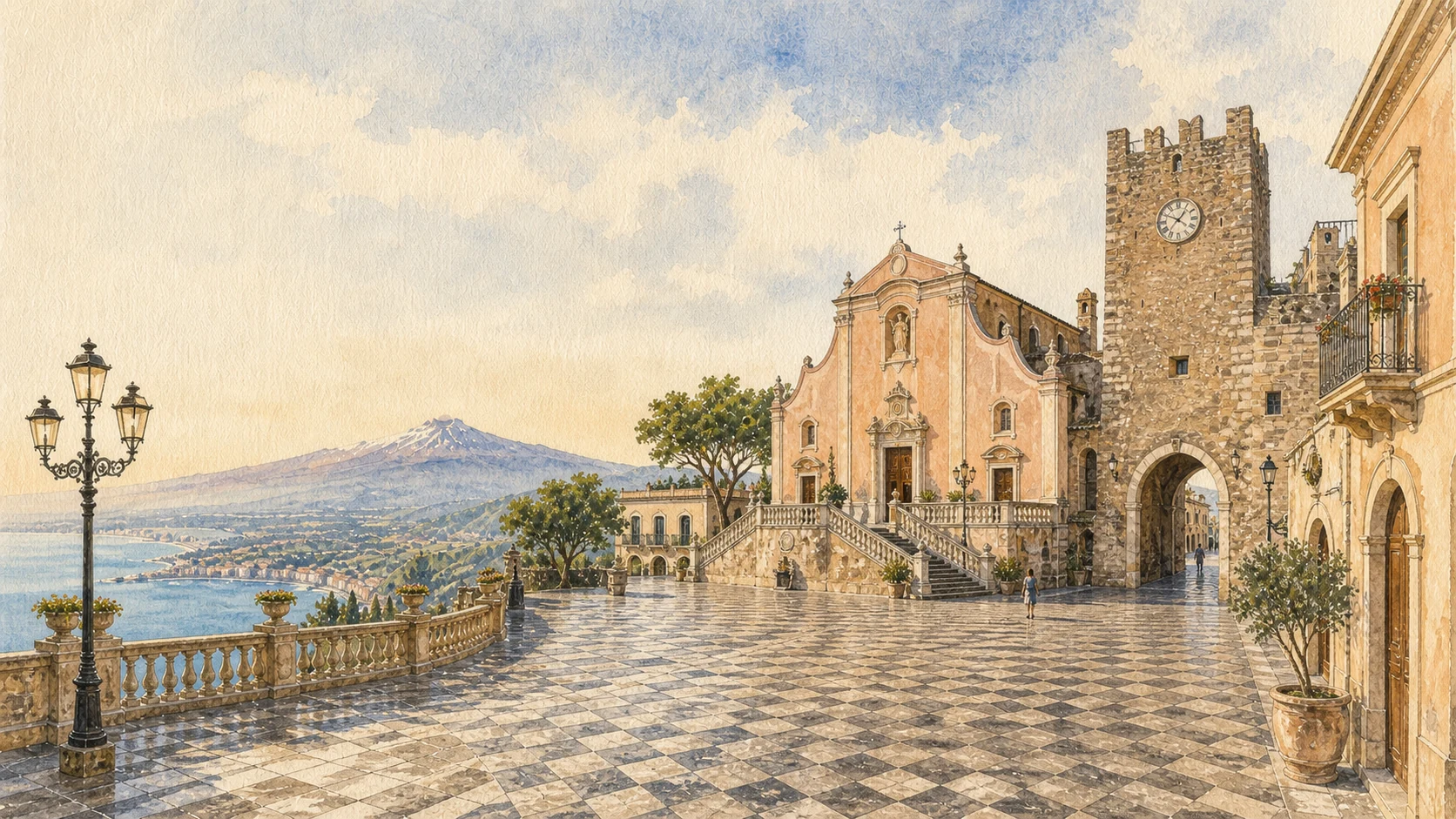
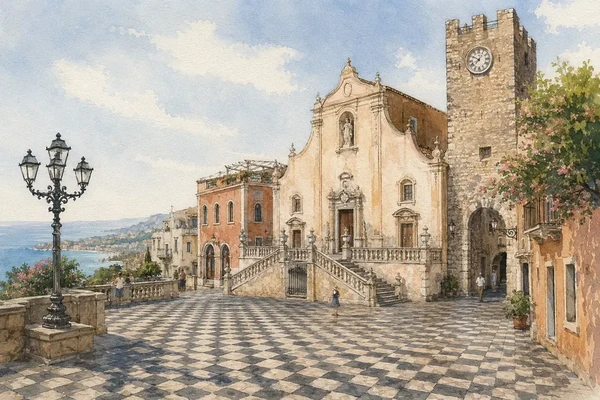
A panoramic square where medieval, Baroque and modern memories meet above the coast.

The place today
The square opens suddenly along Corso Umberto, with a broad view towards Etna and the Bay of Naxos. The former Church of Saint Augustine, now the municipal library, the Baroque Church of Saint Joseph and the Clock Tower frame a space that functions as Taormina's public terrace.
The historical chapter
The square was formerly named after Saint Augustine. Its present name recalls 9 April 1860, when a false report that Garibaldi had landed in Marsala circulated during a service; the actual landing took place the following month. The Clock Tower has medieval origins and was rebuilt more than once.
What to notice
- The view connecting the town to Naxos and Etna
- The different dates and functions of the buildings around the square
- How a mistaken report became part of civic memory
A church with the presence of a fortress
Cathedral and Piazza Duomo
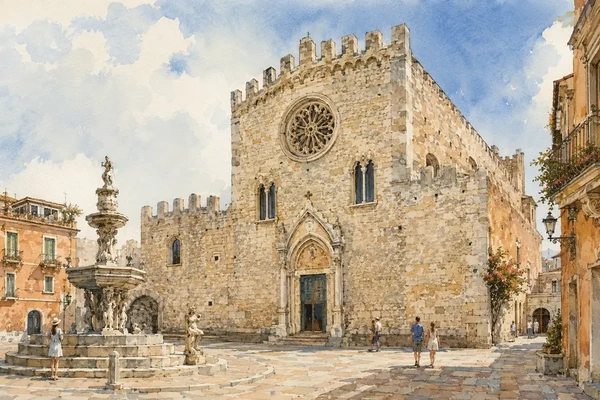
The medieval cathedral, its later portal and the seventeenth-century fountain form the western civic focus of the historic centre.

The place today
The cathedral of Saint Nicholas presents a compact, fortified exterior and a three-aisled interior. The square also contains the municipal palace and a fountain built in 1635, crowned by Taormina's emblematic centaur figure.
The historical chapter
The cathedral was built around 1400 over an earlier medieval church. Its structural character belongs to the late medieval town, while the principal portal was remodelled in 1636. Marble columns and a timber roof preserve further layers inside.
What to notice
- The battlement-like profile and restrained exterior
- The rose window and seventeenth-century portal
- The relationship between cathedral, fountain and municipal building
A historic palace with a contemporary cultural role
Palazzo Ciampoli
A medieval palace now used to bring archaeology, exhibitions and contemporary culture into the centre of Taormina.

The place today
Palazzo Ciampoli is managed within the regional archaeological park system and is used for exhibitions. Its role shows that heritage in Taormina is not confined to ancient ruins: historic buildings can become active spaces for interpreting the island.
The historical chapter
The palace belongs to the late medieval fabric of Taormina. Its later uses and current exhibition programme connect the architectural inheritance of the town to archaeological objects and contemporary artistic projects.
What to notice
- The palace's position within the western part of the historic centre
- The relationship between the historic envelope and changing exhibitions
- How regional heritage management extends beyond archaeological ruins
The strategic height above the town
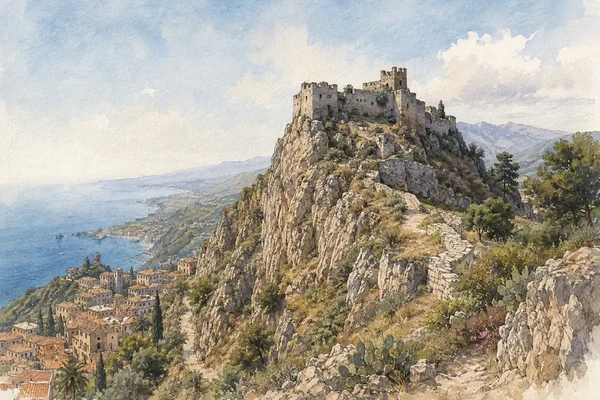
Monte Tauro and Castel Tauro
A fortified summit that connects the ancient acropolis, the Islamic conquest and later medieval rebuilding.

The place today
The castle occupies Monte Tauro above the historic centre and is reached on foot by steep routes. Its height explains the strategic logic of the settlement more clearly than any street-level view.
The historical chapter
The regional archaeological park associates the fortress with the Islamic capture of Taormina in 902 and records rebuilding between the thirteenth and fourteenth centuries after the Norman and Swabian phases. The summit had already served as the ancient acropolis.
What to notice
- The command of the Ionian coast and the passes inland
- Cisterns and defensive circulation within the compact enclosure
- The continuity of a strategic site across different political periods

The nineteenth-century culture of travel
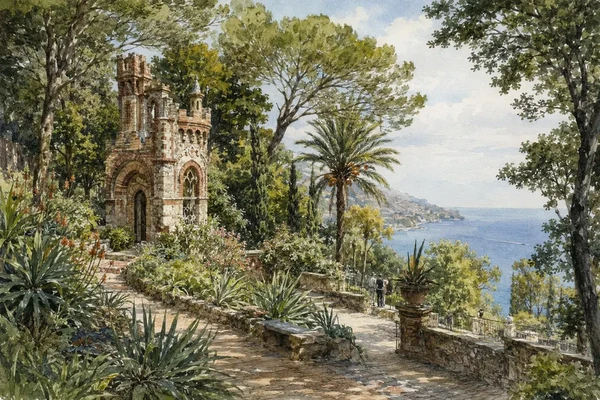
Trevelyan Park and the Public Garden
A historic garden that belongs to Taormina's transformation into an international destination.

The place today
The municipal garden occupies a long panoramic site planted with Mediterranean and exotic species. Its paths, terraces and fanciful structures offer a quieter reading of the coastline than the crowded central streets.
The historical chapter
The garden was created through the purchases and work of Florence Trevelyan, who settled in Taormina and married Salvatore Cacciola in 1890. It later entered municipal ownership. The park is part of the history of foreign residence and tourism that reshaped Taormina in the late nineteenth and early twentieth centuries.
What to notice
- The layered planting and panoramic terraces
- The unusual garden structures associated with Trevelyan
- The connection between private landscape-making and the public city
Where the hill town reaches the sea
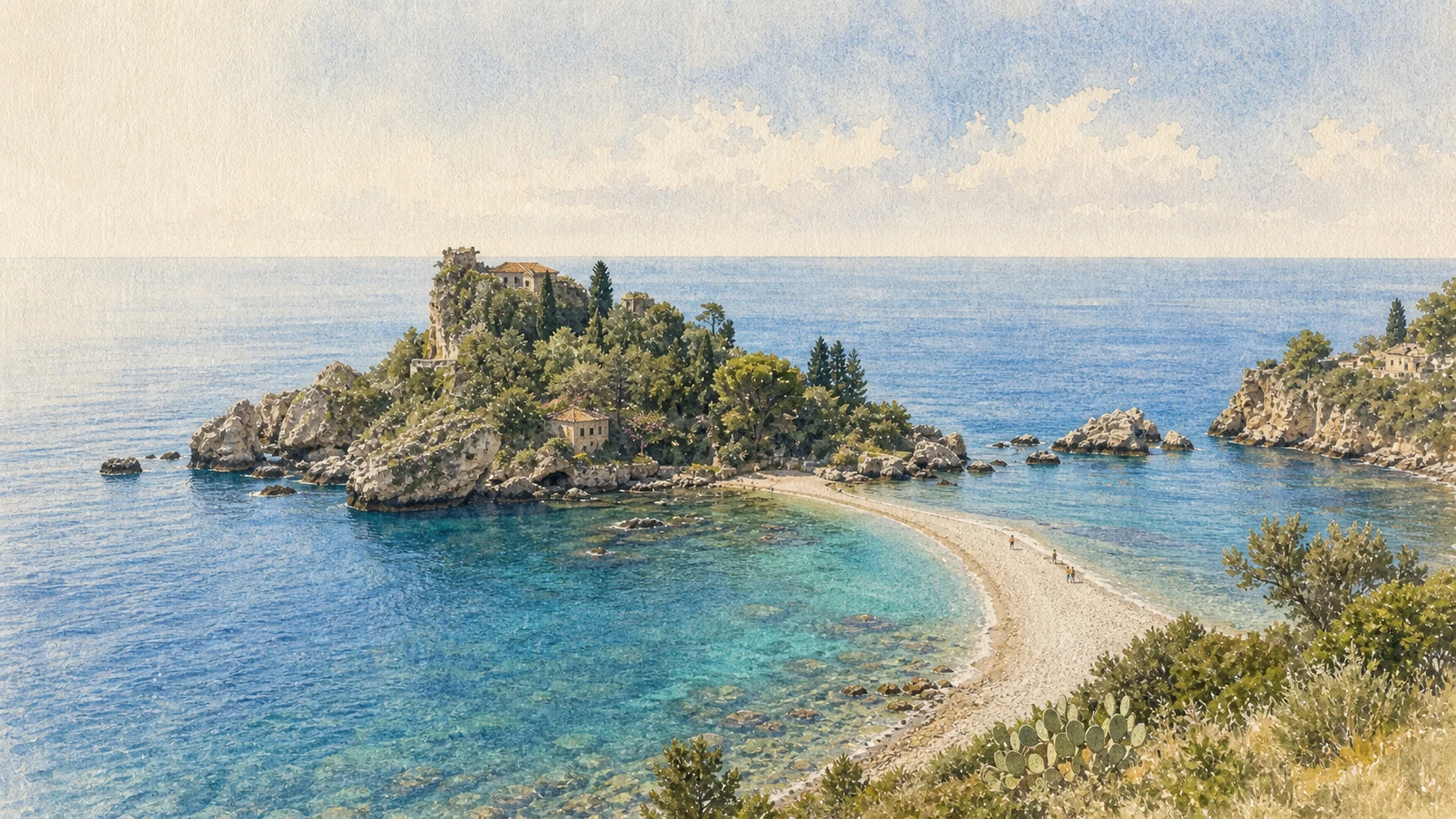
Isola Bella and the Bay
A small island, a tidal connection and a historic Mediterranean landscape below Taormina.

The place today
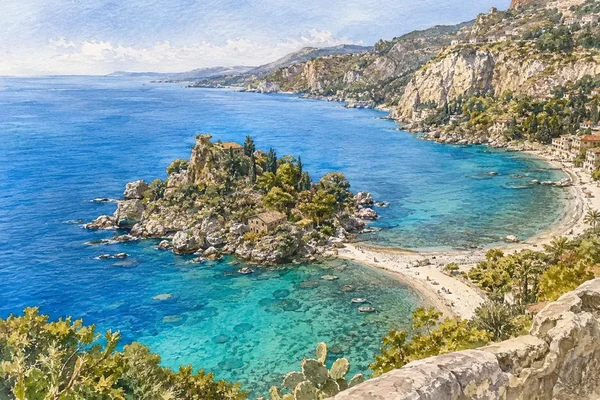
Isola Bella lies within its bay between Capo Sant'Andrea and Capo Taormina. A short strip connects it to the shore, emerging or disappearing with sea conditions. The island and the former villa are managed as part of the regional cultural landscape.
The historical chapter
Formerly known as the island of Santo Stefano, Isola Bella was transformed in the modern period through private landscape design and architecture before entering public heritage management. Its significance lies in the relationship between geology, vegetation, built structures and the view from Taormina above.
What to notice
- The changing connection between island and shore
- The relationship between the bay, the headlands and the town above
- The need to distinguish a protected landscape from a generic beach stop
The city through time
Ten dates for orientation
An essential chronology connecting Naxos, ancient Tauromenion, the fortified medieval town and the modern culture of travel.
The height of Mount Tauro was occupied before the definitive foundation of Greek Tauromenion; the exact early sequence must be described cautiously.
Naxos is founded below Taormina and becomes the first Greek colony documented in Sicily.
Andromachus gathers descendants and survivors of Naxos at Tauromenion, establishing the Greek city in its definitive form.
The first monumental phase of the Ancient Theatre and the temple later incorporated beside the Odeon belong to the Hellenistic city.
Roman Taormina develops the Odeon, baths and the major rebuilding of the Ancient Theatre.
Taormina falls during the Muslim conquest of Sicily; the fortified height remains central to the town's defence.
Norman, Swabian and Aragonese phases reshape the town, its fortress and its civic palaces.
The Cathedral of Saint Nicholas is built over an earlier medieval church.
Taormina develops as an international destination; gardens, residences, photography and travel culture transform its modern identity.
Taormina becomes the first destination in Merlintravel's Sicily chapter, linked to the founder's childhood holidays with his father.
Before your visit
Practical information,
without turning it into promises
Sequence
The historic centre is largely pedestrian, but the theatre, castle and coast occupy very different elevations. The guide must not imply that the entire route is level or effortless.
Archaeological access
The Ancient Theatre, Odeon, castle and Isola Bella are managed sites. Opening hours, event closures and access arrangements must be checked on the official park portal.
Landscape
Visibility of Etna varies with weather and atmospheric conditions. The view should never be promised as guaranteed.
Season
Heat and visitor density can materially change the experience. Practical advice will be checked close to publication rather than copied from generic travel guidance.
Sources
The guide separates personal memory from documentary claims. The Ancient Theatre, Odeon, Roman baths, Castel Tauro and Isola Bella are checked primarily against the Sicilian Region's Naxos and Taormina Archaeological Park. Municipal sources support the cathedral, civic squares and Trevelyan Park. Dates with competing traditions are presented conservatively.
- Sicilian Region · Naxos and Taormina Archaeological Park ↗
- Sicilian Region · Ancient Theatre ↗
- Sicilian Region · Odeon ↗
- Sicilian Region · Archaeological sites ↗
- Municipality of Taormina · History ↗
- Municipality of Taormina · Cathedral ↗
- Municipality of Taormina · Piazza IX Aprile ↗
- Municipality of Taormina · Trevelyan Park ↗
The hero image is an illustration, not a photograph. Opening hours, tickets, event closures, restoration works, sea conditions and access can change; always consult the linked official pages shortly before visiting.