Illustrated guide · Sicily
Where a temple
became a city
Ten places through which to read Syracuse from Corinthian Ortygia to the great Greek and Roman city, Byzantine and medieval stronghold, Baroque centre and living Mediterranean port.
Explore the placesA city that refuses a single beginning
Syracuse makes the history of Sicily physically unavoidable.
In Ortigia, a Greek temple is not displayed beside the cathedral: its columns are the cathedral wall. Across the water and on the mainland, theatres, quarries, tombs and fortifications expand that first island into the territory of a city that once faced Athens, Carthage and Rome.
The later centuries are not an epilogue. Byzantine worship, Arab conquest, Norman rebuilding, Frederick II's castle, the earthquake of 1693, Baroque façades, the cult of Lucia and the return of Greek drama all altered how Syracuse understands and uses its ancient ground.
Here, continuity is visible because transformation was never complete erasure.
One destination
Syracuse,
a city across water and rock.
Corinthian settlers founded Syracuse in 733 BC, beginning from Ortygia and rapidly extending onto the mainland. The resulting pentapolis joined harbours, sacred areas, residential districts, quarries, walls and the high Epipolae plateau. Its scale is therefore larger than either the island historic centre or the Neapolis archaeological park alone.
UNESCO recognises Syracuse together with the separate rocky necropolis of Pantalica as an exceptional record of Mediterranean cultures across three millennia. This guide remains within Syracuse itself and follows the places where that record is most legible; Pantalica receives its own guide rather than being compressed into a day-trip paragraph.
The selection
Ten places,
three thousand years
The route begins at Ortygia's northern threshold, crosses the sacred centre and freshwater edge, reaches the medieval fortress, then moves to the mainland for theatre, quarries, public monuments, museum collections, catacombs and the memory of Lucia.
- 01Ortigia and the Temple of Apollo
- 02Piazza Duomo and the Athena-Cathedral
- 03Fonte Aretusa and the Harbours of Ortigia
- 04Castello Maniace
- 05The Greek Theatre of Neapolis
- 06The Latomies and the Ear of Dionysius
- 07The Altar of Hieron II and the Roman Amphitheatre
- 08Paolo Orsi Archaeological Museum
- 09San Giovanni, San Marciano and the Catacombs
- 10Santa Lucia al Sepolcro and Caravaggio
The island threshold and the first monumental stone temple
Ortigia and the Temple of Apollo
At the entrance to Ortigia, an early Doric sanctuary introduces the sacred and urban organisation of the colony.

The place today
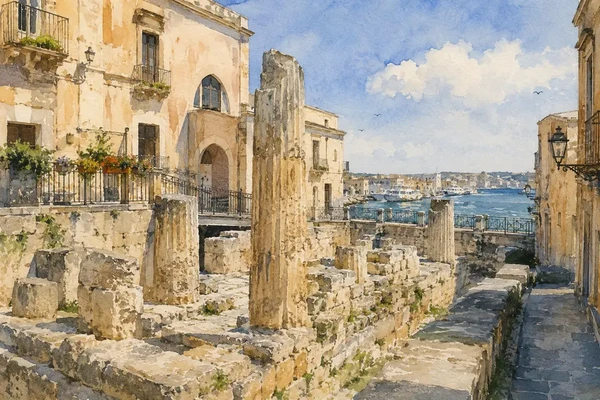
The ruins occupy a sunken open area near Largo XXV Luglio, close to the bridges connecting Ortigia to the mainland. Massive column drums, parts of the cella and the crepidoma define a broad rectangle whose eastern side carries a fragmentary builders' inscription. Around it, roads, market streets and later buildings make clear that the temple remained inside a continuously occupied city.
The historical chapter
Built in the early sixth century BC, the Temple of Apollo is the oldest monumental Doric temple in Sicily. Its builders translated timber construction into stone through closely spaced monolithic columns and a very heavy architrave. Later uses changed it repeatedly: Christian basilica, mosque under Islamic rule, Norman church, then structures incorporated into military and private buildings before twentieth-century excavation reopened the site.
What to notice
- The unusually close and irregular spacing of the archaic columns
- The inscription celebrating the making of the columns in stone
- Later wall lines demonstrating reuse rather than a single ancient phase
A Doric temple still carrying the walls of worship
Piazza Duomo and the Athena-Cathedral
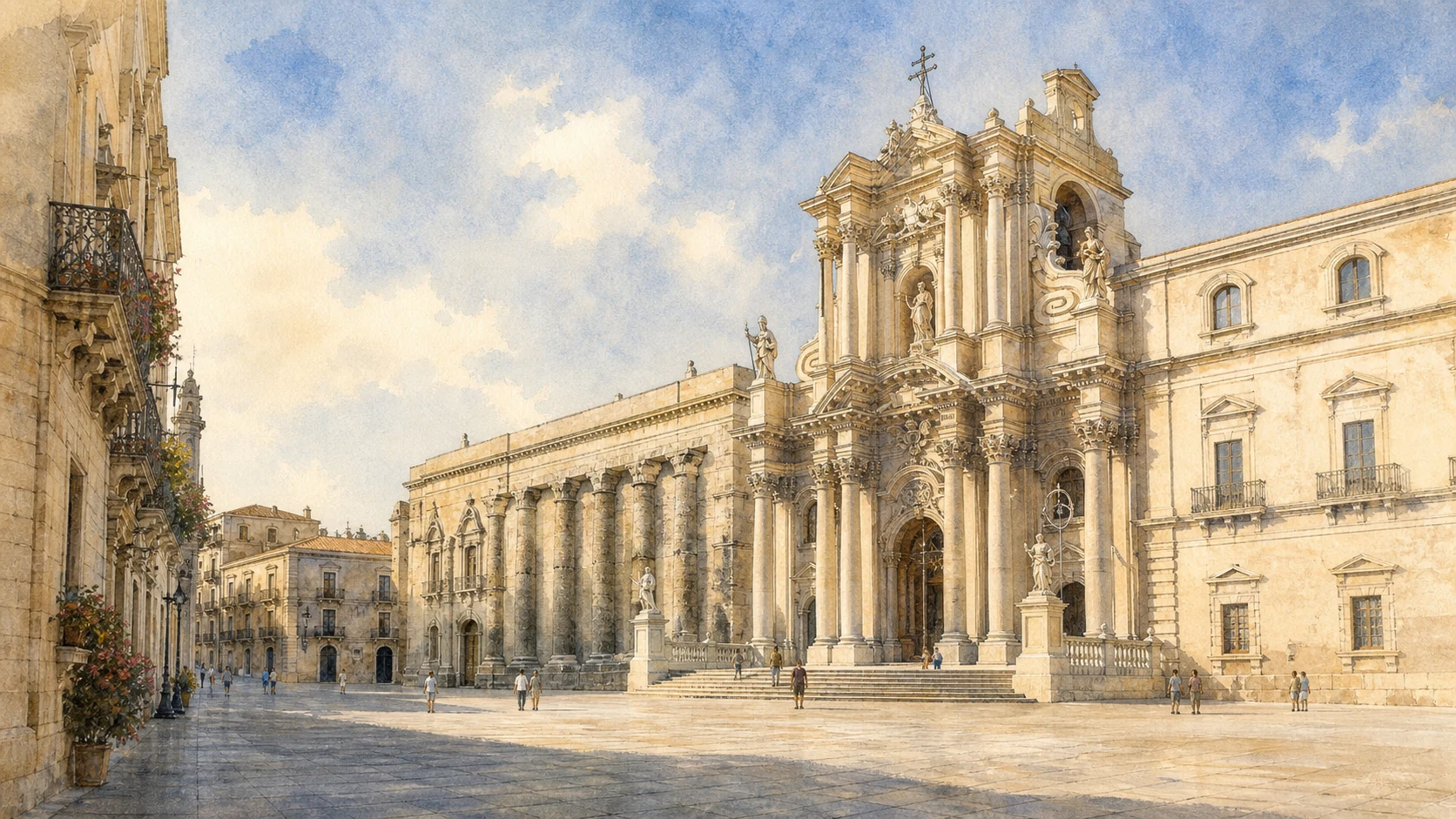
The Temple of Athena survives not as a ruin but as the structural body of the Cathedral of Syracuse.

The place today
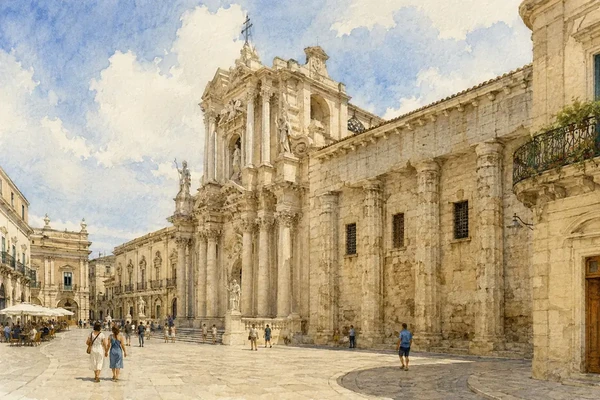
Piazza Duomo forms a long pale stone space enclosed by the Cathedral, Palazzo Vermexio, the Archbishop's Palace, Palazzo Beneventano del Bosco and Santa Lucia alla Badia. Along Via Minerva, Doric columns and the ancient stylobate remain exposed in the cathedral's northern wall. Inside, the former temple cella became the central nave while the space around it became side aisles.
The historical chapter
Gelon built the Temple of Athena after the victory over Carthage at Himera in 480 BC. In the Byzantine period, probably during the seventh century, the intercolumniations were closed and arches opened through the cella walls to form a Christian basilica. Norman, Baroque and later interventions continued the transformation. After the 1693 earthquake, Andrea Palma's façade gave the ancient structure its present ceremonial entrance.
What to notice
- Doric columns visible from both exterior wall and cathedral interior
- Cut arches that converted the ancient cella into a Christian nave
- The Baroque square organised around an area sacred since the colony's beginnings
Fresh water at the edge of a maritime city
Fonte Aretusa and the Harbours of Ortigia
A coastal spring, two harbours and the island shoreline explain why Ortygia became the permanent centre of Syracuse.

The place today
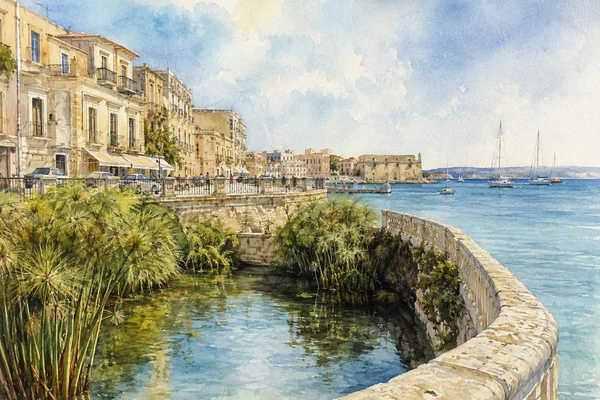
Fonte Aretusa opens as a freshwater basin immediately beside the sea on the western edge of Ortigia. Papyrus grows within its enclosed water, while the promenade looks across the Porto Grande toward the Plemmirio. Walking north along the island reveals the smaller Porto Piccolo and the narrow channels and bridges that reconnect Ortigia to the mainland.
The historical chapter
The spring was absorbed into Greek myth through the nymph Arethusa and the river-god Alpheios, but its urban importance was practical as well as sacred. Reliable freshwater and protected anchorage supported the earliest settlement and the later naval city. The Great Harbour became a decisive theatre of war during the Athenian expedition, while successive fortifications controlled the island's landward and seaward edges.
What to notice
- Freshwater papyrus growing within metres of the sea
- The Great Harbour's sheltered scale when viewed from the western promenade
- How the island's two harbour sides produce different streets and exposures
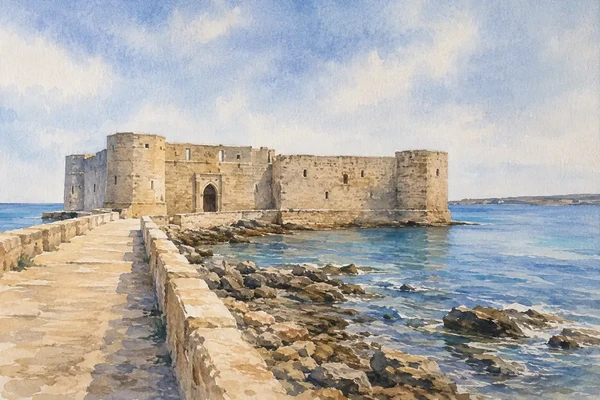
Frederick II's fortress at the tip of Ortigia
Castello Maniace
The castle turns the island's southern point into a controlled threshold between the Great Harbour and open sea.

The place today
A causeway leads from the urban fabric to the fortress complex and the later military battery. The square medieval core is entered through a pointed marble portal and organised around the surviving great hall, whose clustered columns once carried cross vaults. Bastions, gun positions and later barracks record centuries of military adaptation beyond the thirteenth-century building.
The historical chapter
The castle was built for Frederick II between 1232 and 1240, traditionally associated with the imperial architect Riccardo da Lentini. Its position protected the harbour and expressed royal authority at the end of Ortigia. Aragonese rulers used it as a residence; explosions, earthquakes and the needs of artillery altered the original form, which became the centre of a larger fortified system rather than remaining an isolated Swabian palace.
What to notice
- The marble portal contrasting with the limestone military mass
- Surviving column bases and vault logic inside the great hall
- Different masonry phases belonging to medieval castle, bastions and modern batteries

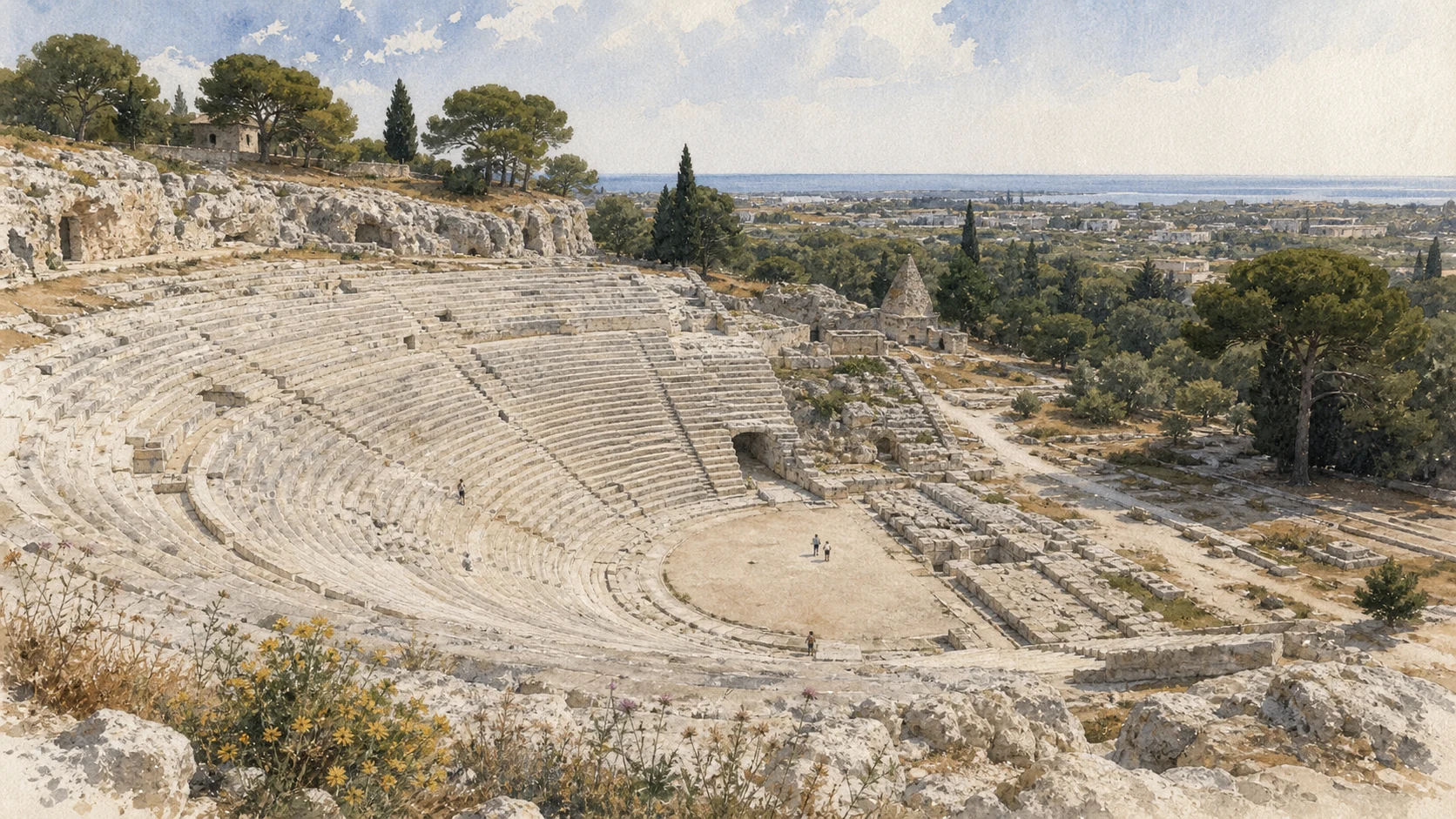
Drama, assembly and royal representation cut into rock
The Greek Theatre of Neapolis
One of the largest theatres of the Greek West preserves several phases and a modern performance tradition.

The place today
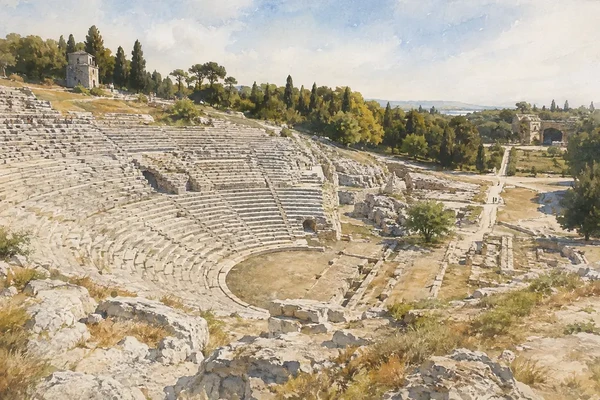
The cavea is cut into the southern slope of the Temenite hill and divided into nine sectors by stairs and a broad horizontal passage. Above it, a rock terrace carries inscriptions naming Zeus Olympios and members of Hieron II's family. Modern productions return drama to the site, but temporary stage structures and protective coverings can significantly change what a visitor sees.
The historical chapter
A theatre existed by the later fifth century BC and received works associated with Aeschylus and the political life of the polis. The present unified form belongs mainly to the third-century-BC programme of Hieron II. Roman intervention transformed the stage and orchestra for different spectacles, and later quarrying removed much of the upper seating and architectural decoration. The monument is therefore Greek in conception but visibly multi-period.
What to notice
- The cavea carved directly from the hill rather than assembled as a free-standing structure
- Names inscribed above the diazoma linking seating divisions to royal and divine identities
- Differences between ancient fabric and reversible equipment for current performances
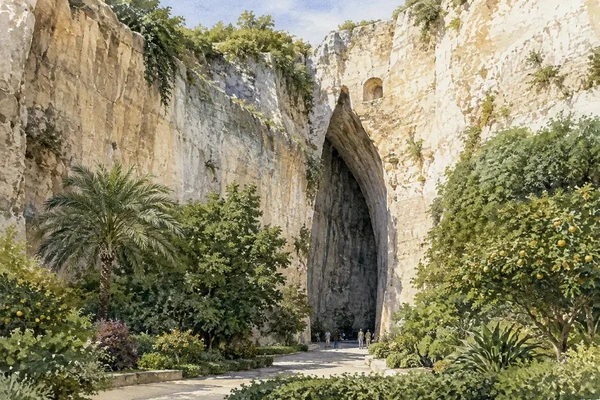
Quarries transformed into prison, garden and acoustic legend
The Latomies and the Ear of Dionysius
The cavities that supplied Syracuse with building stone became one of its most powerful historical landscapes.

The place today
The Latomia del Paradiso is now filled with dense vegetation, orange trees and towering quarry faces. Artificial caves open within it, including the S-shaped chamber called the Ear of Dionysius and the broad Grotta dei Cordari. Their cool, echoing interiors are only part of a larger extraction landscape whose original surfaces were changed by quarrying, collapse and later cultivation.
The historical chapter
The latomies provided limestone for the expanding city. After the Athenian defeat of 413 BC, ancient authors describe prisoners confined in the quarries under extreme conditions. The famous name Orecchio di Dionisio is much later and traditionally connected to Caravaggio and a story that the tyrant could overhear captives through the cave's acoustics. The legend should not replace the evidence of quarry labour and imprisonment.
What to notice
- Tool marks and sheer faces left by extraction of building blocks
- The Ear's curved plan and high vault producing complex echoes
- Vegetation and garden paths masking the former industrial character of the quarry
Public sacrifice and imperial spectacle on different scales
The Altar of Hieron II and the Roman Amphitheatre
Two vast monuments demonstrate how political ritual changed between Hellenistic kingdom and Roman city.

The place today
The altar survives primarily as an immense rock-cut base about two hundred metres long; its built superstructure was quarried away. Nearby, the Roman amphitheatre forms an ellipse sunk partly into the ground, with arena passages and seating supports. Their proximity encourages one route, but their functions, dates and architectural languages remain distinct.
The historical chapter
Hieron II erected the great altar in the third century BC for public sacrifices, probably connected with the festival of Zeus Eleutherios. Its ramps and scale allowed ritual involving large numbers of animals and participants. The amphitheatre belongs to Roman Syracuse and was used for spectacles of a different civic order. Spanish-period fortification works removed blocks from both ancient monuments, reducing their vertical form.
What to notice
- The altar's extraordinary horizontal length despite the loss of its masonry crown
- Twin access ramps and the rock-cut organisation of the sacrificial platform
- The amphitheatre's elliptical circulation compared with the Greek theatre's hillside geometry

The territory reconstructed through objects and excavation histories
Paolo Orsi Archaeological Museum
One of Europe's largest archaeological museums connects Syracuse to eastern Sicily before and after Greek colonisation.

The place today
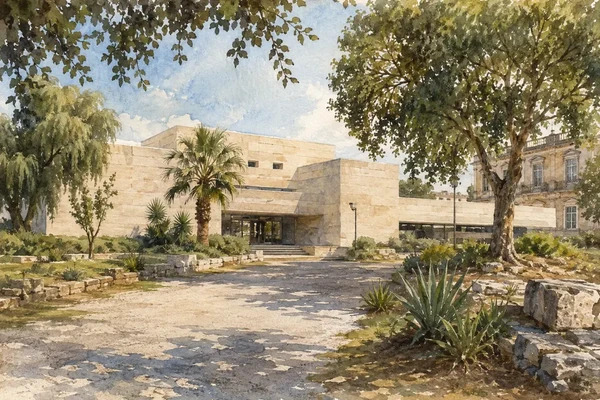
The museum occupies a modern building in the historic garden of Villa Landolina, between Neapolis and the catacomb landscape. Its sectors move from prehistory and protohistory to the Greek colonies, Syracuse and its subcolonies, Hellenised indigenous centres, Hellenistic and Roman life, early Christianity and numismatics. The route is extensive and cannot be treated as a short shelter from midday heat.
The historical chapter
Collections grew from excavations and antiquarian research conducted from the late eighteenth century onward, with Paolo Orsi's systematic work fundamental to their scientific organisation. The present building, designed by Franco Minissi between 1967 and 1986 and opened in 1988, transferred the museum from Piazza Duomo. Important works include the Venus Landolina and the Adelfia sarcophagus, each tied to a specific discovery history.
What to notice
- Objects arranged by territory and context rather than only by artistic prestige
- Comparisons between indigenous communities, colonists and later mixed cultural forms
- The architecture's branching plan designed for a large, expandable archaeological narrative
An early Christian city beneath later ruins
San Giovanni, San Marciano and the Catacombs
A basilica, crypt and underground cemetery preserve worship and burial from late Roman and Byzantine Syracuse.

The place today
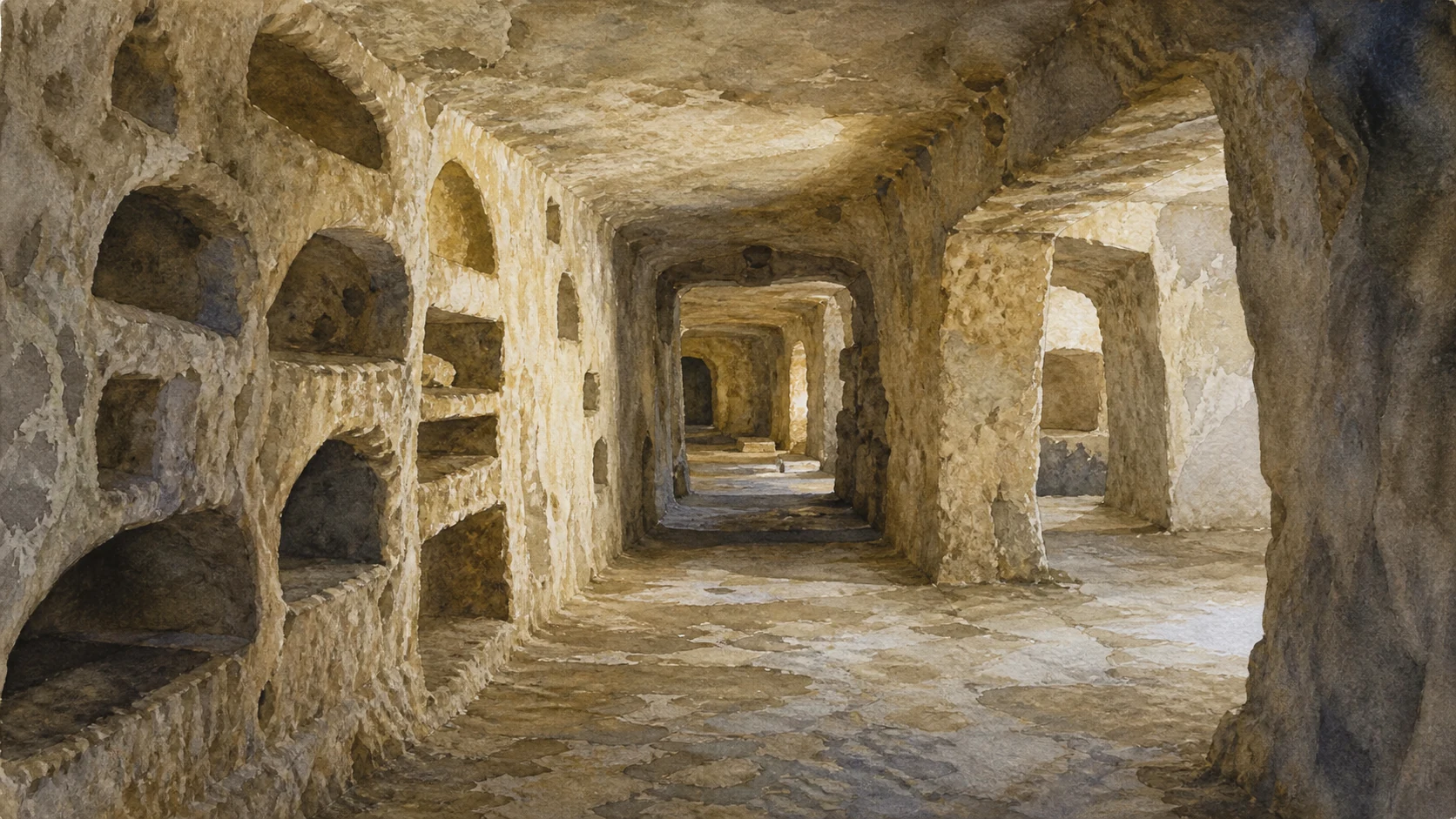
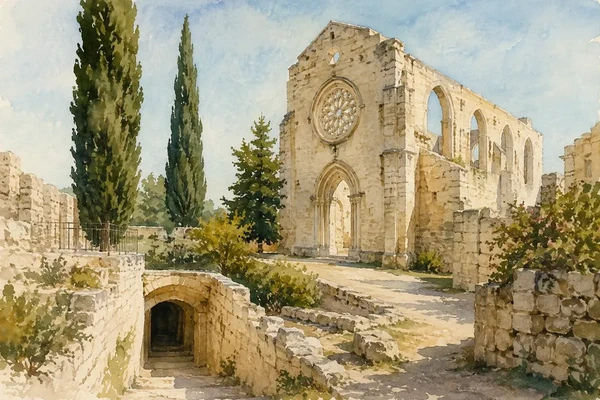
The roofless Basilica of San Giovanni stands above the entrance to a broad catacomb network organised around former water conduits and expanded galleries. Below the church, the crypt associated with San Marciano contains columns, later frescoes and a long cult history. Guided access follows only part of the underground system, where humidity, steps and narrow passages shape the visit.
The historical chapter
The catacombs developed mainly between the fourth and sixth centuries AD, adapting earlier hydraulic structures into communal burial corridors, rotundas and chambers. Tradition links the crypt to Marcian, regarded as Syracuse's first bishop, though its surviving architecture reflects several periods. Norman and later churches rose above the complex, and the 1693 earthquake contributed to the ruined form of the upper basilica.
What to notice
- The repeated arcosolia and burial niches organised along underground galleries
- Large rotundas created around prestigious tombs and reused spaces
- The vertical sequence from catacombs to crypt, ruined basilica and modern city
Civic devotion at the burial place of Syracuse's martyr
Santa Lucia al Sepolcro and Caravaggio
Basilica, octagonal sepulchre and Caravaggio's painting connect early Christian memory to Baroque art and living ritual.

The place today
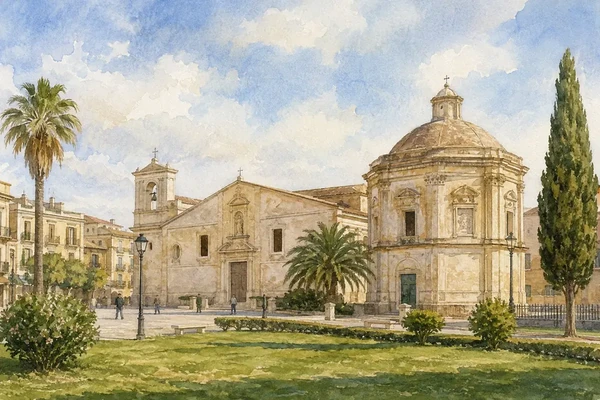
The basilica stands in the Borgata district beyond Ortigia, facing a broad square and the separate octagonal chapel of the Sepulchre. Inside, Caravaggio's Burial of Saint Lucy is displayed in the place for which it was painted. The low, spare composition should be seen in relation to the church, cult and burial tradition rather than only as an isolated masterpiece.
The historical chapter
A church dedicated to Lucia was established after the peace of Constantine near the remembered burial place, though repeated destruction and rebuilding altered the complex. The present basilica includes medieval and later phases. Caravaggio painted the Burial in 1608 during his Sicilian journey, setting the small human group beneath an overwhelming earthen void. The annual feasts continue to connect the extra-urban sanctuary with Ortigia and the wider city.
What to notice
- The enormous empty field above the figures in Caravaggio's composition
- The spatial separation between basilica and octagonal sepulchre
- How processions and relics connect several Lucian sites across Syracuse
The city through time
Ten dates for orientation
A chronology linking the Corinthian foundation to imperial power, conquest, religious transformation, reconstruction, archaeology and the modern recognition of a layered city.
Corinthian settlers found Syracuse on Ortygia; the settlement rapidly extends to mainland districts and develops into a pentapolis.
After Gelon's victory over Carthage at Himera, construction begins on the Doric Temple of Athena preserved within today's cathedral.
Syracuse defeats the Athenian expedition; surviving prisoners are confined in the city's stone quarries.
Under Hieron II, Neapolis receives a monumental programme including the enlarged theatre and the great public altar.
Roman forces capture Syracuse after a long siege; Archimedes is killed and the city enters Roman rule.
Byzantine Syracuse becomes an imperial centre under Constans II before the city falls to Aghlabid forces in 878.
Norman rule restores a Latin Christian political order and transforms major religious and defensive sites.
Frederick II builds Castello Maniace at the southern tip of Ortigia to control the harbour and project imperial authority.
The Val di Noto earthquake devastates Syracuse; Baroque rebuilding reshapes Piazza Duomo and many churches and palaces.
UNESCO inscribes Syracuse and the Rocky Necropolis of Pantalica as a serial World Heritage property.
Before your visit
Practical information,
without turning it into promises
Divide the city
Ortigia, Neapolis, the Paolo Orsi Museum and the Santa Lucia–catacomb area are separate urban zones. A complete visit needs more than one concentrated loop.
Check performance season
Ancient-drama productions can cover parts of the Greek Theatre with reversible scenery and seating protection. Verify dates if bare archaeological visibility is a priority.
Respect worship
The Cathedral and Lucian churches are active places of prayer. Dress and behaviour should suit the setting, and religious services may alter tourist access.
Treat underground sites separately
Catacombs, caves and archaeological interiors involve different steps, surfaces and guided-access rules. Confirm accessibility and current opening for each exact site.
Sources
The guide uses UNESCO for the serial property's scope and long cultural sequence, the Sicilian Region for Neapolis and the Paolo Orsi Museum, the Municipality's official UNESCO guide for Ortigia and urban history, the Archdiocese for the Cathedral, catacombs and Santa Lucia, and the Ministry of Culture catalogue for medieval and Baroque monuments. Pantalica is acknowledged but deliberately reserved for an autonomous guide.
- UNESCO World Heritage Centre · Syracuse and Pantalica ↗
- Municipality of Syracuse · The treasures of Italy and UNESCO ↗
- Sicilian Region · Archaeological Park of Syracuse ↗
- Sicilian Region · Museo Archeologico Regionale Paolo Orsi ↗
- Archdiocese of Syracuse · Cathedral Church ↗
- Archdiocese of Syracuse · Catacombs ↗
- Archdiocese of Syracuse · Basilica Santa Lucia al Sepolcro ↗
- Italian Ministry of Culture · Late Baroque Syracuse itinerary ↗
The hero image is an illustration, not a photograph or reconstruction. Opening hours, excavation access, temporary theatre installations, church services, underground routes, museum galleries and the location of artworks can change; consult the linked institutions shortly before visiting.