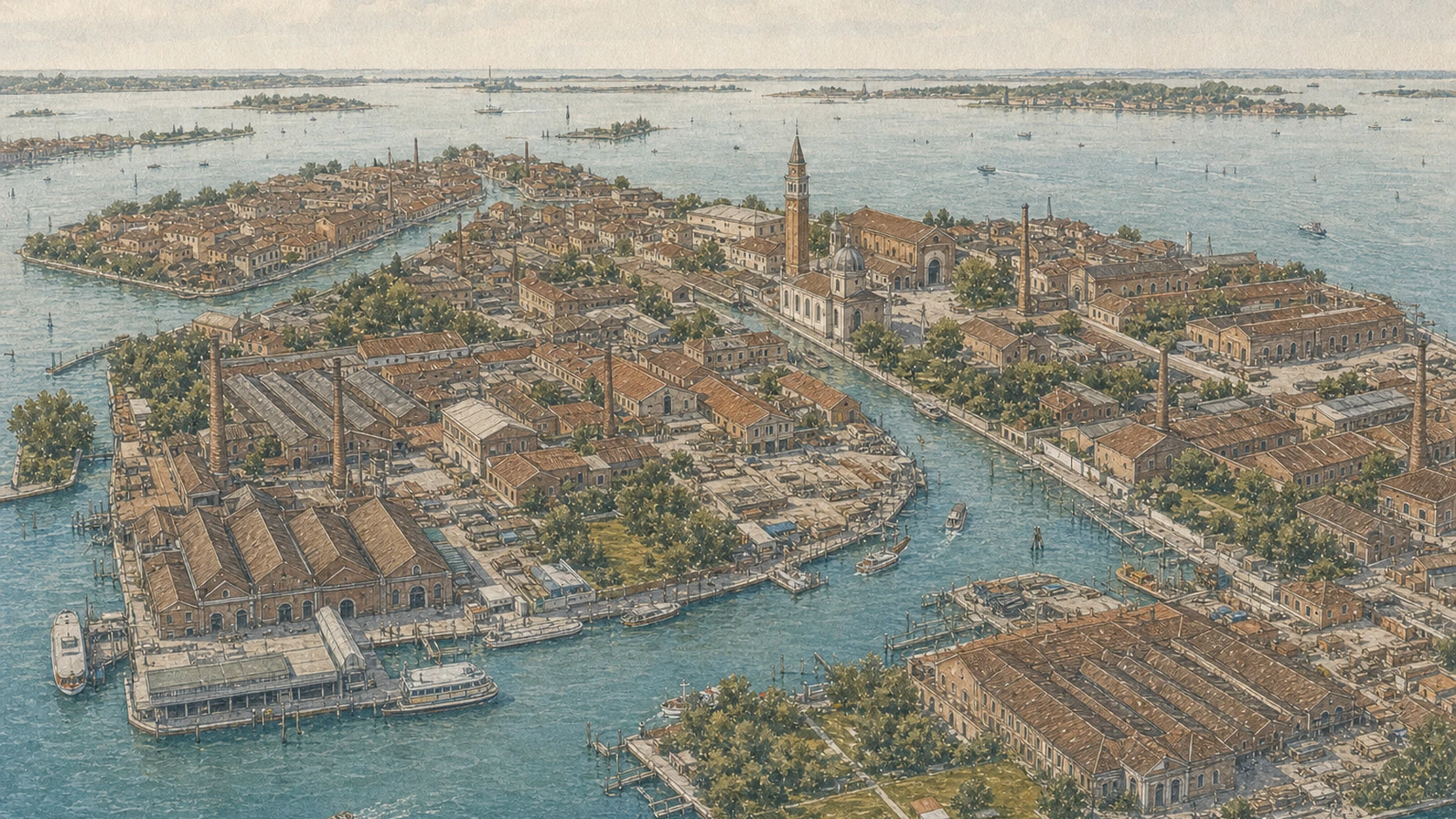
Original documentary watercolour panorama of Murano's canals, furnaces, churches, industrial buildings and northern lagoon

Venice Guide 08 · Material history, furnace labour, Romanesque art and provenance

Murano:
Glass & Island Life

A documented route through Murano as a working lagoon island, from public transport and the Glass Museum to Santi Maria e Donato, furnace teamwork, the Conterie, resident canals and origin-conscious buying.

Plan the route
Murano · Glass Museum · Faro10 chapters · one full day

Why this production island matters

Murano is not a showroom detached from Venice: it is an inhabited industrial island whose glass depends on heat, skilled teams, imported materials, water transport, design knowledge and credible provenance.

The Republic concentrated furnaces on Murano from the late thirteenth century through regulation often explained only as fire prevention. Control of fuel, labour, recipes and movement also mattered. Over centuries, makers refined cristallo, enamel, filigree, lattimo, mirrors, beads, murrine and countless forms shaped by international exchange. Techniques were never static, and the idea of one timeless Murano style obscures periods of crisis, revival and radical design collaboration.

The Glass Museum provides the essential chronology. Its collection begins with ancient glass that later makers studied, then follows Murano production from the fifteenth to twentieth centuries and into contemporary work. A furnace visit answers a different question: not what survives in a case, but how timing, gravity, heat and coordinated labour turn molten material into an object. A short sales demonstration cannot replace either historical collection or sustained workshop practice.

Murano also contains Romanesque architecture, parish art, industrial archaeology, homes and civic routes. Santi Maria e Donato preserves a celebrated mosaic pavement within active worship. The Conterie complex records bead manufacture at an industrial scale. Rio dei Vetrai and Faro expose daily deliveries, school movement, energy demand and connection to the northern lagoon. Responsible visitors should therefore spend as much time reading the island as choosing an object.

Ask who made a piece, where it was made and how its origin is documented; price, colour and the word Murano alone do not answer those questions.

The route

Plan your visit

Arrive by public boat, establish the historical sequence in the museum, read the basilica, then visit one named furnace. Use the later afternoon for the Conterie, resident canals and Faro rather than repeating shop interiors.

Early morning

Arrival and Glass Museum

Map the island at the landing and spend at least ninety minutes on technique, chronology and attribution.

Late morning

Santi Maria e Donato

Read the canal apse first, then enter quietly for the mosaic pavement if worship and access permit.

Early afternoon

Named furnace or workshop

Use a booked, identified producer; follow one object’s full team process and safety rules.

Late afternoon

Conterie, Rio dei Vetrai and Faro

Finish with industrial scale, resident infrastructure, documented provenance and the island’s lagoon logistics.

Ten chapters

Explore the places

The route follows transport, museum collections, Romanesque basilica, furnace teamwork, industrial bead production, parish art, resident canals, documented buying and the energy-dependent lagoon edge.

  1. 01Arrive through transport, not through a sales funnel
  2. 02Glass Museum: learn the sequence before the souvenir
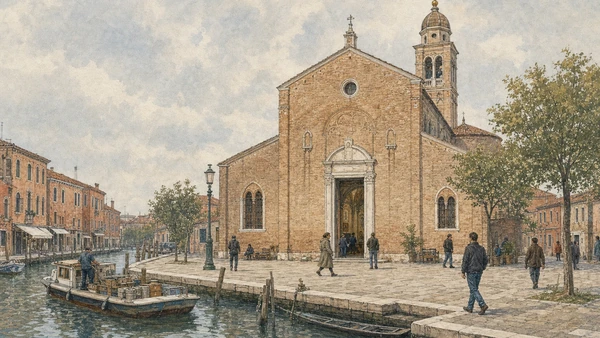
  3. 03Santi Maria e Donato outside: begin at the apse
  4. 04Inside the basilica: pavement as architecture
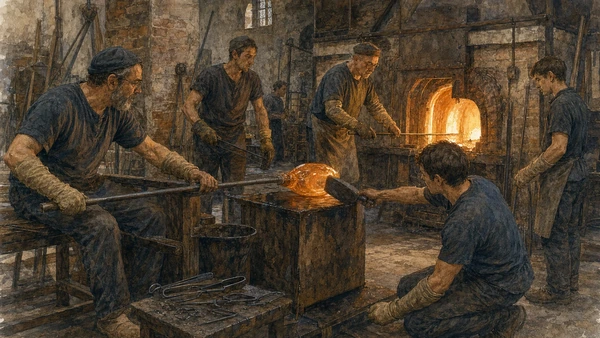
  5. 05Inside a furnace: watch the team, not only the flame
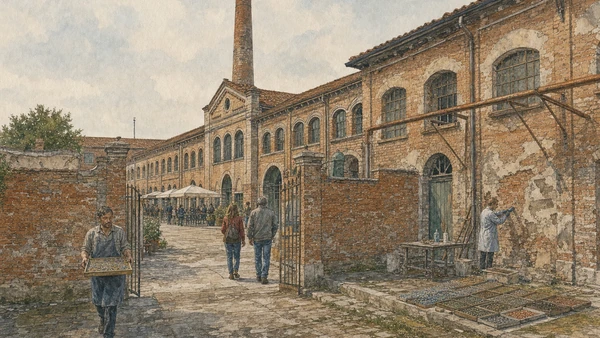
  6. 06The Conterie: beads, labour and an unfinished afterlife
  7. 07San Pietro Martire: parish, painting and relocation
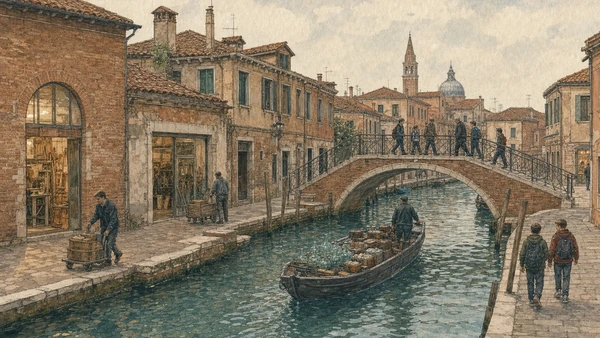
  8. 08Rio dei Vetrai: production inside a neighbourhood
  9. 09Buying glass: provenance before persuasion
  10. 10Faro and lagoon edge: heat on an island
01

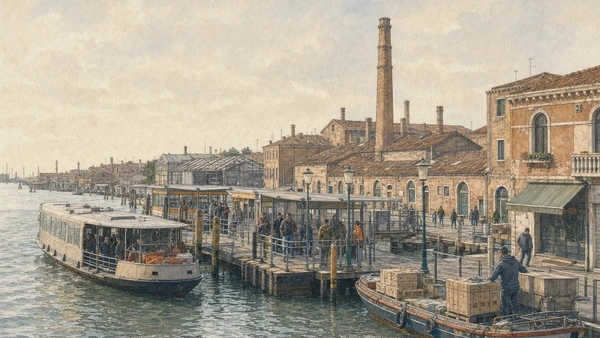
The vaporetto landing reveals an island supplied and inhabited by water before it reveals a visitor shopping route

Arrive through transport, not through a sales funnel

Public boats, deliveries, commuters and multiple stops explain Murano’s geography better than the first shop window.

Today

Murano has several vaporetto stops serving different islands and routes. Colonna is a common arrival from central Venice; Museo and Navagero can be more direct for the museum and basilica, while Faro connects onward into the northern lagoon. Landing areas combine queues, resident commuting, freight and accessible boarding. A free private boat offered by a showroom may carry commercial expectations that public transport does not.

History

Murano developed as a group of lagoon islands linked internally by canals and bridges. Raw materials, fuel, food and finished glass all depended on boats. The concentration of furnaces intensified those logistical needs. Modern public transport altered passenger movement but did not remove freight, waste, maintenance or tidal constraints from the island’s working edges.

How to read this place

Before choosing a direction, identify which island and canal you are on. Watch protected crates, fuel or service boats and the separation between boarding space and residential doors. Map Museo, the basilica and Faro rather than following the densest retail corridor automatically. The water network is the first chapter of production history.

What to notice

  • Multiple landings serving different parts of the island
  • Freight and public transport sharing constrained quays
  • Private showroom transfers carrying different expectations from public boats
AVM/Actv · Official public transport information
Original documentary watercolour of Murano Colonna vaporetto landing, commuters and delivery boats
Arrive through transport, not through a sales funnelOriginal Merlintravel documentary watercolour · 2026
02

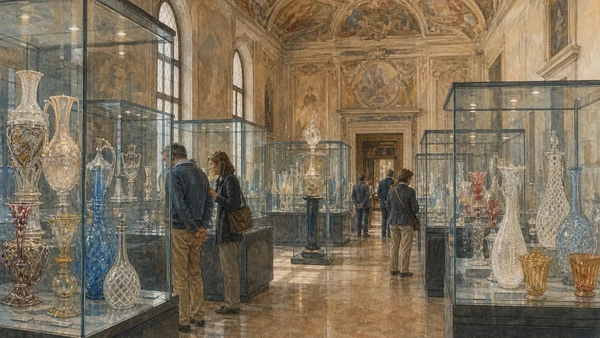
The world’s largest historical collection of Murano glass turns technical innovation into a chronology rather than a generic display of brilliance

Glass Museum: learn the sequence before the souvenir

Ancient precedents, Renaissance cristallo, beads, murrine, revival and modern design appear as related but distinct histories.

Today

The Museo del Vetro occupies Palazzo Giustinian, once the residence of the bishops of Torcello. The permanent route begins with archaeological glass and continues through major Murano production from the fifteenth to twentieth centuries, with contemporary donations and a Conterie space. Current tickets include single-museum and island-museum options. The building and frescoed portego are part of the visit, not neutral display containers.

History

The museum was founded in 1861 during Murano’s nineteenth-century recovery, and a drawing school followed in 1862. Historic objects became both civic archive and working resource for designers and glassmakers studying lost or neglected techniques. Donations from furnaces expanded the collection. Later reorganisation and enlargement added ancient glass, modern design and contemporary production to the original local mission.

How to read this place

Choose one object from four periods and record material, technique, function and attribution. Distinguish furnace, designer and master whenever labels allow. Compare an apparently simple form with the complexity of its stem, filigree or murrine section. Do not use transparency as a universal measure of quality: opacity, texture, mass and controlled irregularity may be deliberate technical choices.

What to notice

  • Chronological route from ancient precedents to modern design
  • Palazzo rooms and collections read together
  • Attribution separating furnace, designer and maker where known
Murano Glass Museum · Official collection route
Original documentary watercolour of historic Murano glass displayed inside Palazzo Giustinian
Glass Museum: learn the sequence before the souvenirOriginal Merlintravel documentary watercolour · 2026
03

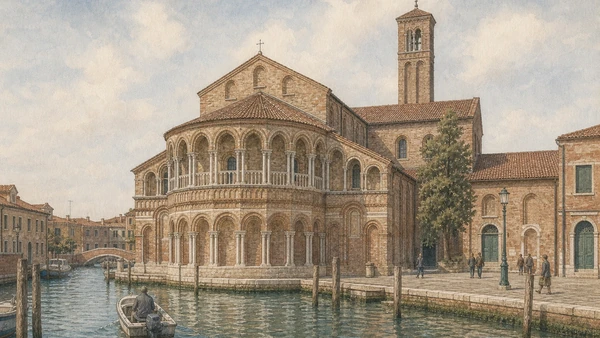
A two-storey Romanesque apse facing the canal anchors Murano in medieval lagoon architecture rather than glass commerce alone

Santi Maria e Donato outside: begin at the apse

Arcades, brick, reused stone and canal frontage create one of the lagoon’s strongest medieval exterior compositions.

Today

The basilica is an active parish church. Its canal-side apse can always be read from public space, while interior access follows worship and local opening conditions. The campo also serves residents and families. Groups should remain clear of doors, bridges and waterside movement, especially during services or parish events.

History

A church existed here in the early Middle Ages, and the present building preserves major work associated with the twelfth century and later alterations. The dedication joins the Virgin with Saint Donatus, whose relic tradition shaped the church’s identity. The apse’s superimposed arcades use brick and pale stone to create depth and rhythm visible from the water.

How to read this place

Approach along Rio di San Donato and study the exterior before seeking the front entrance. Count how columns, arches and blind openings change by level. Look for differences in material and repair rather than imagining an untouched Romanesque surface. The apse was designed to be seen in relation to the canal, boat movement and open light.

What to notice

  • Two levels of arcading around the canal-side apse
  • Brick and pale stone creating structural rhythm
  • Parish and residential activity sharing the waterfront
Comune di Venezia · Santi Maria e Donato as active community basilica
Original documentary watercolour of the Romanesque apse and canal setting of Santi Maria e Donato
Santi Maria e Donato outside: begin at the apseOriginal Merlintravel documentary watercolour · 2026
04

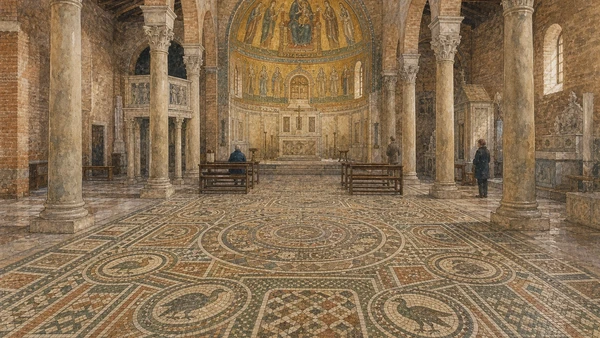
A twelfth-century mosaic pavement places geometric order, animals and devotional movement under the visitor’s feet rather than on a distant wall

Inside the basilica: pavement as architecture

The mosaic floor, columns and apse must be read as a sacred spatial sequence, not as decorative fragments for close-up photography.

Today

The interior remains a place of worship. Light and access can vary, and sensitive pavement areas may be protected. Photography rules should be confirmed locally. Visitors should move along permitted paths, avoid standing over liturgical movement and never touch tesserae or barriers. The famous bones displayed behind the altar belong to a devotional legend and should not replace study of the building.

History

The pavement is dated to the twelfth century and combines patterned fields with animal and symbolic imagery. Its materials, wear and restoration record long use. Archaeological fragments from the nearby church foundations also contribute to the Glass Museum’s account of medieval glass. The apse image and floor connect Murano to wider Adriatic and Byzantine visual networks.

How to read this place

Start at a distance to see how bands guide movement toward the presbytery. Then choose a single motif and examine the scale and colour variation of its tesserae. Compare stone and glass reflectivity under changing light. The animals belong to a coordinated decorative field and sacred route; their meanings depend on that wider setting.

What to notice

  • Mosaic bands organising movement through the nave
  • Animal and geometric motifs built from varied tesserae
  • Wear and conservation revealing centuries of use
Murano Glass Museum · Archaeological glass and San Donato context
Original documentary watercolour of the twelfth-century mosaic pavement and apse inside Santi Maria e Donato
Inside the basilica: pavement as architectureOriginal Merlintravel documentary watercolour · 2026
05

Molten glass rewards coordinated timing, embodied knowledge and division of labour more than the myth of one isolated master

Inside a furnace: watch the team, not only the flame

Gathering, shaping, reheating, adding elements, annealing and finishing form a chain in which several workers and tools matter.

Today

Furnaces are workplaces with heat, noise, narrow safe zones and commercial schedules. Reputable visits specify the company, duration, safety rules and whether the demonstration is part of normal production or staged for visitors. Do not cross barriers, distract workers at a critical moment or assume that every showroom operates the furnace being shown. Energy costs and emissions are material constraints, not abstract business details.

History

Murano’s techniques developed through guild organisation, family workshops, migration, secrecy claims and international exchange. The 1291 regulation concentrating furnaces on the island supported oversight as well as reducing urban fire risk. Masters became prominent, but production also depended on assistants, apprentices, cutters, engravers, bead makers, designers, chemists, packers and dealers.

How to read this place

Follow one object through the full demonstration. Count reheatings and identify who rotates, blows, shapes and prepares additions. Notice gravity and temperature rather than judging only the finished colour. Ask what happens after the hot shop: controlled annealing, cold working, grinding, inspection and packing can determine whether the object survives.

What to notice

  • Several workers coordinating one hot object
  • Repeated movement between furnace and bench
  • Annealing and cold work continuing after the visible performance
Consorzio Promovetro · Murano production and member companies
Original documentary watercolour of a coordinated team shaping molten glass inside a Murano furnace
Inside a furnace: watch the team, not only the flameOriginal Merlintravel documentary watercolour · 2026
06

The former bead works expand Murano’s history from individual prestige objects to industrial scale, repetitive labour and global trade

The Conterie: beads, labour and an unfinished afterlife

Long factory buildings and chimneys record mass production whose social and urban consequences differ from a small artistic furnace.

Today

The former Conterie complex contains restored, adapted and still-problematic areas rather than one fully open museum. Public access and uses vary. Walk only recognised routes and do not enter work or construction zones. Recent municipal records continue to address property use and building condition, demonstrating that industrial heritage is an active planning issue, not a completed conversion story.

History

Glass beads had been produced and traded for centuries, but nineteenth- and twentieth-century consolidation brought large workforces and specialised processes into the Conterie. Tiny objects moved through cutting, rounding, sorting and stringing before international sale. The complex’s decline left extensive industrial fabric whose conservation, housing, craft and commercial reuse have been negotiated over time.

How to read this place

Read repetition: window bays, long walls, chimney, courtyards and circulation imply organised production at scale. Compare this with the teamwork of a smaller hot shop. If adapted spaces are open, identify retained structure and new insertions. Avoid romantic ruin language; deteriorated fabric carries safety, housing and public-investment consequences.

What to notice

  • Repeated factory bays indicating industrial organisation
  • Chimney and yards linking heat, material and labour
  • Uneven conservation and reuse across one complex
Comune di Venezia · Former Conterie planning record
Original documentary watercolour of Murano's former Conterie factory, chimney, craft activity and conservation work
The Conterie: beads, labour and an unfinished afterlifeOriginal Merlintravel documentary watercolour · 2026
07

An active Dominican church preserves paintings transferred through suppression and institutional change, complicating the idea of an untouched island collection

San Pietro Martire: parish, painting and relocation

Bellini- and Tintoretto-related works belong to a church history shaped by rebuilding, suppression and transfer rather than a single original programme.

Today

San Pietro Martire remains a parish church near the island’s busiest route. Entry depends on worship and local opening conditions, which should be checked at the door. Market and delivery activity continue around the campo. Visitors must distinguish respectful cultural looking from museum behaviour: services, prayer and parish use take priority.

History

The Dominican church was rebuilt after fire and altered through later centuries. Following Napoleonic suppressions, works and furnishings from other religious institutions entered the building. Its important paintings therefore require provenance as well as attribution. The church also demonstrates that Murano participated in wider Venetian artistic networks beyond glass.

How to read this place

Begin with the nave and chapel sequence before isolating celebrated canvases. Read labels for original location and transfer history. Compare stone memorials, altars and later arrangements. Outside, connect church doors to canal, market and housing. The building is strongest when understood as a changing parish environment rather than an island branch of an art museum.

What to notice

  • Dominican church rebuilt and repeatedly altered
  • Paintings whose present location may follow institutional transfer
  • Canal-side parish life surrounding the cultural visit
Venezia Unica · Official city church information
Original documentary watercolour of San Pietro Martire, its canal-side campo and active parish entrance
San Pietro Martire: parish, painting and relocationOriginal Merlintravel documentary watercolour · 2026
08

Workshop doors and retail windows sit inside canals also used by homes, schools, freight, waste collection and everyday movement

Rio dei Vetrai: production inside a neighbourhood

The island’s glass economy cannot be separated from resident infrastructure or reduced to the hours when day visitors fill its main route.

Today

Rio dei Vetrai and nearby fondamenta mix workshops, shops, homes and public crossings. Delivery boats need moorings; residents need doors and bridges clear. Some premises make glass, some finish or sell it, and others retail objects made elsewhere. Visible proximity to a furnace is evidence only when the maker and production process are identified.

History

Murano’s settlement grew around canals that served both industry and domestic life. Production specialisation shaped building types and family networks, while retail frontage changed with mass tourism. Population pressure, building maintenance and the economics of furnaces now affect whether the island remains a place of production rather than only a brand name.

How to read this place

Look beyond displays to chimneys, loading doors, packing materials, resident shutters and school movement. Note the difference between a hot shop, a cold-working studio and a sales room. Move aside for trolleys and boats. An informed route values an ordinary working threshold as much as a spectacular object.

What to notice

  • Hot shops, finishing studios and retail rooms serving different functions
  • Homes and schools embedded in the same canal fabric
  • Freight movement visible at doors and moorings
Comune di Venezia · Murano urban-planning report
Original documentary watercolour of Rio dei Vetrai with workshops, residents, school movement and glass deliveries
Rio dei Vetrai: production inside a neighbourhoodOriginal Merlintravel documentary watercolour · 2026
09

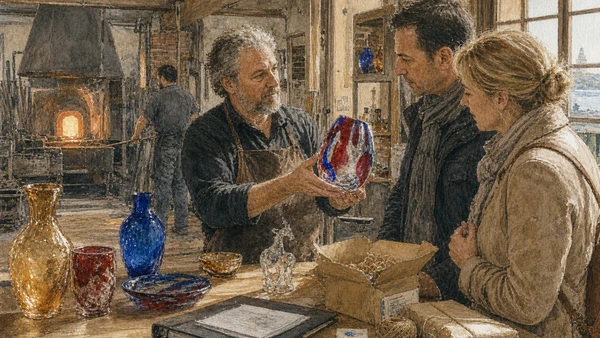
A credible purchase links object, maker, place, technique and documentation instead of relying on a familiar geographical word

Buying glass: provenance before persuasion

The regional Vetro Artistico® Murano mark is a protected origin tool, while invoices and clear maker attribution add practical evidence.

Today

The regional mark is managed by Consorzio Promovetro and available to authorised companies producing artistic glass on Murano under the scheme’s criteria. Its traceable label can be checked through a data-matrix code. Not every legitimate maker necessarily uses it, but buyers should still request the producer’s name, place of production, technique, invoice, returns policy and insured shipping terms. Claims such as Venetian style or Murano design are not proof of Murano manufacture.

History

Murano’s name acquired commercial power through centuries of technical reputation and international trade. Imitation, outsourced production and ambiguous labelling grew with global demand. Veneto established the collective mark through regional law in 1994 and entrusted its management to Promovetro in 2001. The system protects origin rather than guaranteeing personal taste, investment value or complete hand manufacture by one individual.

How to read this place

Ask one calm question at a time: Who is the producer? Where is the furnace? Which technique is used? Is the mark present and verifiable? What exactly appears on the invoice? Compare the answer with the object and workshop context. Leave if pressure replaces information. A smaller documented piece can carry more cultural integrity than an expensive anonymous object.

What to notice

  • Named producer and production address
  • Verifiable regional mark where the company uses it
  • Invoice, shipping and return documentation matching the object
Consorzio Promovetro · Vetro Artistico Murano origin mark
Original documentary watercolour of a Murano maker explaining an object and its documentation to careful buyers
Buying glass: provenance before persuasionOriginal Merlintravel documentary watercolour · 2026
10

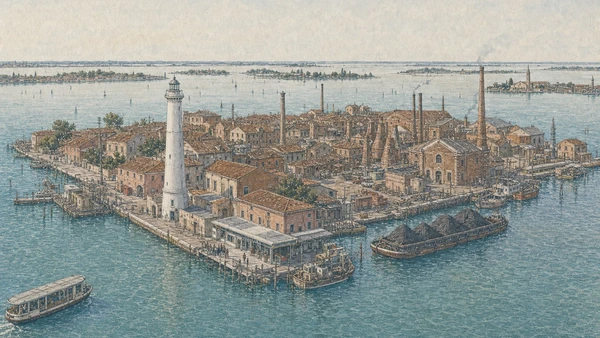
The lighthouse and northern edge expose the transport, fuel and environmental systems that the finished glass object usually hides

Faro and lagoon edge: heat on an island

Furnaces require reliable energy and material supply within a fragile water city, while residents depend on the same constrained transport network.

Today

Murano Faro is both a transport node and a broad lagoon viewpoint. Public boats connect Venice and other northern islands; service craft move fuel, materials and waste. Energy price and decarbonisation pressures affect furnaces whose technical continuity depends on sustained high heat. Visitors should not turn operational quays into viewpoints or block resident boarding while waiting for an onward boat.

History

Glassmaking shifted from wood-fired furnaces through later fuel systems to modern gas-dependent production. Each transition changed furnace design, cost and environmental impact. Murano’s island location helped organise and control manufacture but also made supply vulnerable. The lighthouse and chimneys express different forms of navigation and energy infrastructure within one lagoon landscape.

How to read this place

From the edge, connect the visible sequence: landing, cargo boat, chimney, workshop roof, housing and low lagoon horizon. Ask what enters and leaves the island besides visitors. The view corrects the myth of immaterial artistry: glass begins with minerals and heat, passes through labour and transport, and leaves with a measurable environmental footprint.

What to notice

  • Public and service boats sharing the Faro node
  • Furnace chimneys within an inhabited skyline
  • Open lagoon revealing dependence on water transport and weather
UNESCO World Heritage Centre · Venice and its Lagoon
Original documentary watercolour of Murano Faro, furnace chimneys, utility boats and the northern lagoon
Faro and lagoon edge: heat on an islandOriginal Merlintravel documentary watercolour · 2026

Murano through time

A short chronology

From medieval settlement and the furnace decree to Renaissance cristallo, industrial beads, design collaboration, origin protection and today’s production pressures.

  1. Murano’s islands consolidate settlement, parish life and lagoon exchange.

  2. Major rebuilding gives Santi Maria e Donato its Romanesque form and mosaic pavement.

  3. Venetian regulation orders glass furnaces to concentrate on Murano, reinforcing safety and state oversight.

  4. Organised production and long-distance trade establish a strong Murano glassmaking community.

  5. Angelo Barovier’s cristallo and enamelled glass strengthen Murano’s European technical leadership.

  6. Filigree, lattimo, ice glass, mirrors and other techniques diversify high-value production.

  7. The fall of the Republic begins a severe institutional and commercial crisis for island furnaces.

  8. Historicist revival, new firms and international promotion renew production and technical study.

  9. The Glass Museum and its associated drawing school create an archive for both public memory and makers.

  10. Conterie production expands the industrial scale of Murano bead manufacture and export.

  11. Murano is incorporated into the Comune di Venezia and its civic museum joins the municipal system.

  12. Furnaces collaborate intensively with artists and designers, producing major modern glass languages.

  13. Veneto regional law establishes the Vetro Artistico Murano collective origin mark.

  14. The renewed Glass Museum expands its display areas and contemporary programme.

  15. Extended museum hours coexist with continuing debates over energy, authenticity, housing and production continuity.

Before your visit

Practical information

01

Use public transport for a neutral arrival

Choose the stop for your route and be cautious with free private transfers tied to a showroom visit.

02

Start with the museum

Chronology and technique make later demonstrations and purchases easier to evaluate.

03

Book a named furnace

Confirm producer, duration, language, accessibility, safety and whether production or a staged demonstration will be shown.

04

Respect active churches

Santi Maria e Donato and San Pietro Martire serve communities; services and parish needs override cultural access.

05

Verify rather than accuse

Ask for maker, origin and documentation. The protected mark is useful evidence, but its absence alone does not settle authenticity.

06

Leave room for residents and freight

Keep landings, bridges, moorings and workshop doors clear, especially around Colonna, Rio dei Vetrai and Faro.

Method and sources

Sources and image credits

This guide uses current official information from Fondazione Musei Civici di Venezia, Consorzio Promovetro, Comune di Venezia, AVM/Actv and UNESCO, checked on 28 August 2026. It distinguishes museum object from retail stock; material technique from style label; master from production team; furnace demonstration from ordinary work; Murano manufacture from generic Venetian branding; regional origin certification from subjective quality; artisan hot shop from industrial bead factory; Romanesque church from glass attraction; and visitor movement from the resident, freight and energy systems that sustain the island.

All ten images are original Merlintravel editorial watercolours based on documented present-day conditions. They are illustrations, not substitutes for archaeological plans. Opening hours, tickets, accessible routes, temporary exhibitions and conservation work can change; consult the linked official pages shortly before visiting.