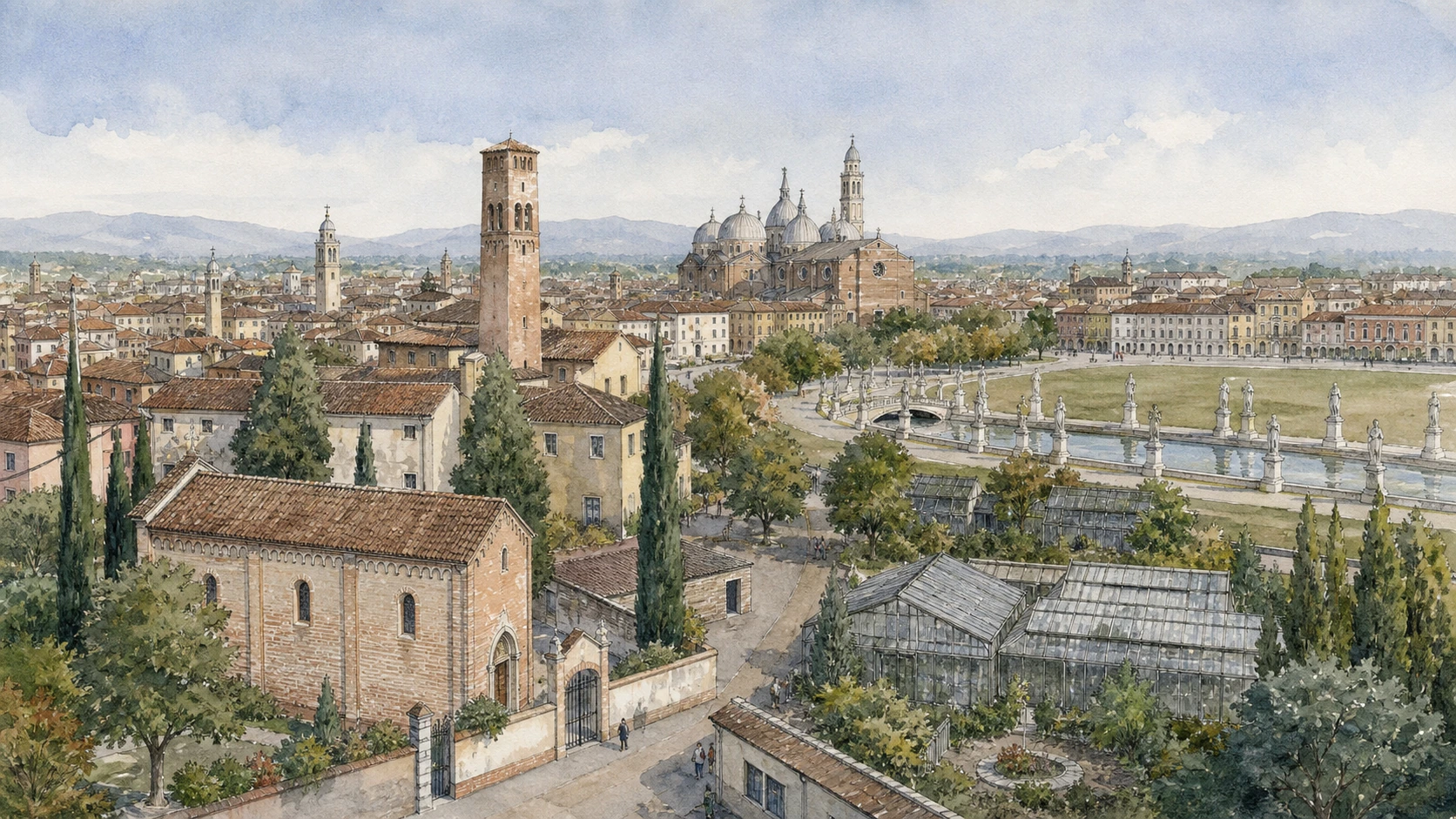
Original documentary watercolour panorama of Padua connecting Scrovegni Chapel, civic towers, Basilica of Saint Anthony and Prato della Valle

Veneto Guide 03 · Fresco, commune, pilgrimage, university science and public space

Padua: Fresco City,
University & Civic Space

A documented route across Padua that joins Giotto and the fourteenth-century fresco cycles to the Basilica of Saint Anthony, Palazzo della Ragione, Palazzo Bo, the Botanical Garden and Prato della Valle as active institutions rather than isolated masterpieces.

Plan the route
Scrovegni Chapel to Prato della Valle · Padua10 chapters · one full day

Why Padua must be read as a connected city

Padua is not a single Giotto room followed by a pilgrimage church: it is a commune, university city and network of painted, scientific and ritual spaces whose access still reflects different institutions.

The Scrovegni Chapel belongs to a conservation system of timed entry and controlled climate. Its relationship with the Eremitani complex and civic museums begins a wider UNESCO property of eight fourteenth-century fresco sites. Palazzo della Ragione, the Baptistery, Saint Anthony’s complex and other painted rooms show that innovation occurred under different patrons and in different civic, religious and dynastic settings.

Palazzo della Ragione and the market squares connect government, trade and the continuing life of the centre. Nearby Palazzo Bo represents a university founded in 1222 whose teaching spaces, anatomical theatre and academic ceremonies remain part of an active institution. The Botanical Garden extends that history into living collections and biodiversity research rather than functioning as a decorative park.

South of the centre, the Basilica of Saint Anthony and Santa Giustina sustain worship and pilgrimage; Prato della Valle is both designed hydraulic space and everyday civic ground. The route therefore requires reservations, respect for liturgy and enough time to move between distinct systems instead of chasing a checklist of famous interiors.

Reserve the Scrovegni Chapel first, place Palazzo della Ragione and Palazzo Bo around that time, then use the Basilica, Botanical Garden, Prato della Valle and Santa Giustina as a coherent southern sequence.

The route

Plan your visit

The route begins in the Scrovegni–Eremitani precinct, crosses the civic market centre, enters university spaces and then continues south through pilgrimage, botanical science and the great open geometry of Prato della Valle.

Early morning

Scrovegni and Eremitani

Arrive before the reserved slot, follow climate-entry instructions and keep the chapel connected to the neighbouring museum and church.

Late morning

Commune and markets

Read Palazzo della Ragione between Piazza delle Erbe and Piazza della Frutta, then continue to the Baptistery.

Early afternoon

University and pilgrimage

Use an official Palazzo Bo visit and enter the Basilica of Saint Anthony according to worship-led rules.

Late afternoon

Garden and Prato

Finish at the Botanical Garden, Prato della Valle and Santa Giustina, allowing for separate closing times.

Ten chapters

Explore the places

The route connects fresco cycles, commune, pilgrimage, university teaching, markets and botanical science. Use the index without treating institutions with separate access as one attraction.

  1. 01Scrovegni Chapel: Giotto inside a conservation system
  2. 02Eremitani and the Civic Museums: survival after destruction
  3. 03Palazzo della Ragione: commune above the market
  4. 04Cathedral Baptistery: theology around the font
  5. 05Palazzo Bo: knowledge inside an active institution
  6. 06Basilica of Saint Anthony: pilgrimage before spectacle
  7. 07Prato della Valle: designed emptiness, active city
  8. 08Botanical Garden: science that still grows
  9. 09Santa Giustina: scale beyond the Santo
  10. 10The Ghetto and market streets: Padua at human scale
01

A small chapel supports a revolutionary painted cycle through strict conservation, reserved entry and disciplined looking

Scrovegni Chapel: Giotto inside a conservation system

The frescoes are inseparable from the controlled visit that protects them; a timed ticket is part of the monument’s present life.

Today

Reservations, early arrival and a climate-adjustment chamber govern entry. The official visit is brief and photography rules can change. The chapel sits inside a museum precinct rather than on an open street, so missed slots may not be recoverable and accessible arrangements should be requested in advance.

History

Enrico Scrovegni commissioned the chapel in the early fourteenth century. Giotto’s cycle organised biblical narrative, virtues, vices and the Last Judgement across the architecture, developing a powerful new treatment of space, emotion and human presence. Later acquisition, restoration and environmental monitoring created the modern conservation regime.

How to read this place

Stand first at the threshold to understand the complete painted envelope, then follow registers rather than jumping between famous scenes. Compare simulated architecture with the real barrel vault and windows. The controlled duration rewards a prepared sequence, not hurried image collection.

What to notice

  • Narrative registers wrapping one architectural volume
  • Painted fictive space responding to real windows and vault
  • Climate control becoming visible preventive conservation
Turismo Padova · Scrovegni Chapel
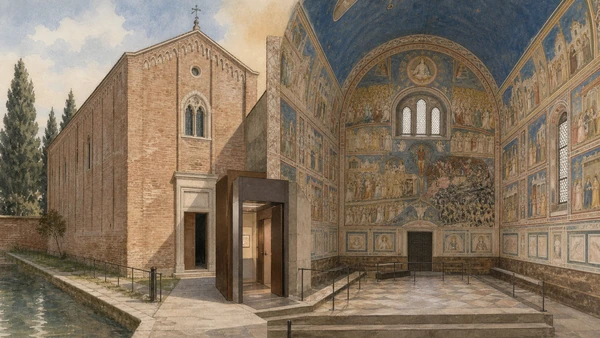
Original documentary watercolour of the Scrovegni Chapel exterior and Giotto's painted interior within its conservation route
Scrovegni Chapel: Giotto inside a conservation systemOriginal Merlintravel documentary watercolour · 2026
02

Church, archaeological collections and civic galleries place damaged fresco, recovered fragments and long urban history side by side

Eremitani and the Civic Museums: survival after destruction

The precinct explains both Padua’s deep archaeological record and the fragility of frescoes shattered during the Second World War.

Today

The museums and church have separate access and may not share identical hours. The Eremitani church remains a place of worship; the Ovetari Chapel’s reconstructed fragments require patient looking. Museum routes extend from archaeology to medieval and later art, so a selective plan is more useful than a rapid complete circuit.

History

The Augustinian church developed from the thirteenth century and received major fourteenth- and fifteenth-century fresco programmes. A 1944 bombing destroyed much of the Ovetari Chapel, including works associated with Mantegna; fragments, photographs and restoration enabled partial reconstruction. The nearby former monastery became the principal civic museum complex.

How to read this place

Read absence as evidence. Compare surviving fresco zones with reconstructed fields and resist calling the chapel restored to its original state. In the archaeological galleries, use objects to reconstruct Roman Patavium and earlier settlement before returning to the medieval city outside.

What to notice

  • Surviving and reconstructed fresco fragments kept distinguishable
  • Former monastery adapted to civic collections
  • Archaeology extending the city story before the medieval centre
Turismo Padova · Eremitani Civic Museums
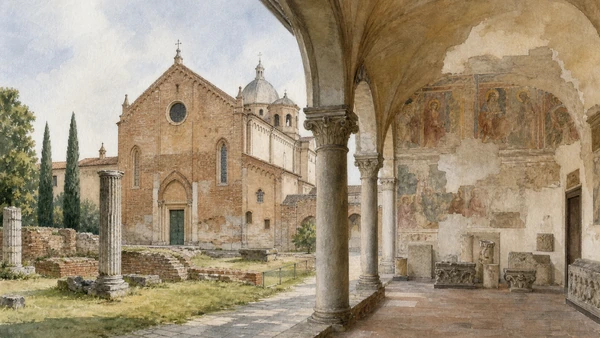
Original documentary watercolour of the Eremitani church, Ovetari fragments and archaeological museum cloister
Eremitani and the Civic Museums: survival after destructionOriginal Merlintravel documentary watercolour · 2026
03

A vast timber-roofed hall rises above daily markets and preserves civic measurement, justice and painted cosmology

Palazzo della Ragione: commune above the market

The Salone is not detached from the two market squares below; government, commerce and urban time developed together.

Today

The ground-floor arcades and food shops remain active while the upper hall follows civic museum admission. Lifts and accessible entry should be checked on the official site. Markets make the surrounding squares busiest in the morning; later visits reveal the building’s exterior mass more clearly.

History

The communal palace developed in the thirteenth century and received its great roof and upper hall. An early Giotto cycle was lost in a fifteenth-century fire; the present astrological and calendrical paintings were created by later artists. The hall housed courts, administration and commercial measures, while markets continued below.

How to read this place

Walk between Piazza delle Erbe and Piazza della Frutta before ascending. Inside, use the great wooden horse, tribunal stone and painted sequence to distinguish civic objects from cosmological programme. The hall’s uninterrupted span is an engineering achievement and a political statement.

What to notice

  • Salone spanning the full market block
  • Painted calendar linking civic time to cosmos
  • Shops and measurement standards embedded in government architecture
Turismo Padova · Palazzo della Ragione
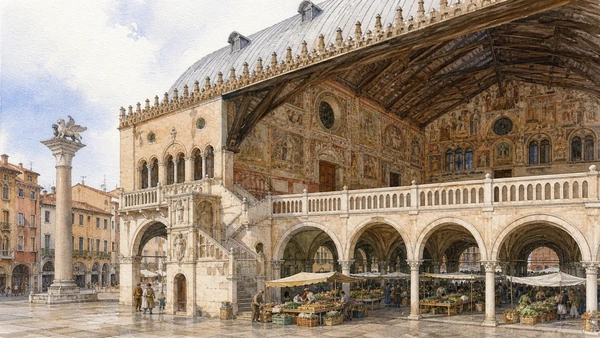
Original documentary watercolour of Palazzo della Ragione joining the market arcades to the painted Salone
Palazzo della Ragione: commune above the marketOriginal Merlintravel documentary watercolour · 2026
04

A compact baptistery preserves Giusto de’ Menabuoi’s complete painted cosmos beside an active cathedral

Cathedral Baptistery: theology around the font

The Baptistery is one of Padua’s key fourteenth-century fresco sites and must be distinguished from the larger cathedral next door.

Today

Visits use current diocesan or UNESCO fresco-city arrangements and may pause for liturgy. The room is small, the imagery dense and capacity limited. Begin with the dome from the centre, then move around the walls without standing in the access path.

History

The medieval baptistery was transformed under the patronage of Fina Buzzaccarini and the Carraresi court. Giusto de’ Menabuoi painted a unified cycle in the 1370s, with Christ and concentric saints dominating the dome above narratives and the baptismal setting. Restoration preserves the relationship between imagery, patronage and sacrament.

How to read this place

Let the circular architecture guide the reading. Start at the dome, descend through registers and finish at the font rather than searching immediately for portraits. Compare the visual density with Giotto’s more sequential chapel to understand different patrons and programmes within the UNESCO property.

What to notice

  • Concentric dome organised around Christ
  • Narrative walls surrounding baptismal space
  • Cathedral precinct joining worship and ticketed heritage
Turismo Padova · Cathedral Baptistery
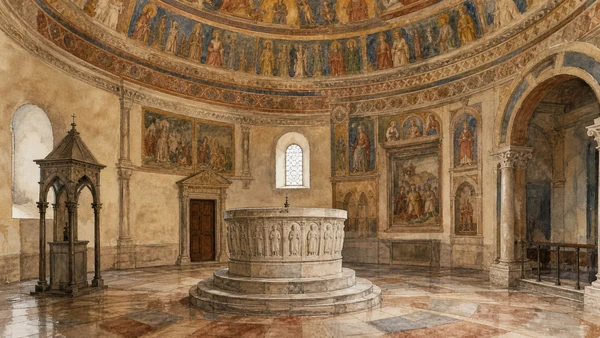
Original documentary watercolour of Padua Baptistery with Giusto de' Menabuoi's dome and baptismal font
Cathedral Baptistery: theology around the fontOriginal Merlintravel documentary watercolour · 2026
05

A working university contains ceremonial courtyards, historic teaching rooms and an anatomical theatre within continuing academic life

Palazzo Bo: knowledge inside an active institution

The historic university is not an unrestricted museum; official guided routes enter selected spaces around teaching and ceremonies.

Today

Palazzo Bo visits normally require an official guided booking, and routes can change with university activity. The anatomical theatre is narrow and vertically confined; accessible alternatives may use digital interpretation. Courtyards may be visible without granting access to teaching rooms.

History

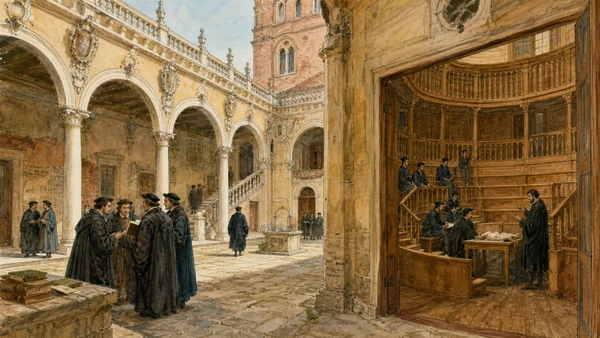
The University of Padua was founded in 1222 and consolidated around Palazzo Bo in the early modern period. The sixteenth-century anatomical theatre made repeated public dissection possible for medical teaching. Academic emblems, the Aula Magna and associations with figures such as Galileo record a corporate institution shaped by students, professors and the Venetian state.

How to read this place

Read the heraldic walls as university governance and identity, not decorative wallpaper. In the theatre, imagine sightlines and controlled access around the central table. Distinguish historical rooms from twentieth-century additions so the institution appears continuous rather than frozen in the Renaissance.

What to notice

  • Coats of arms covering university courtyards
  • Anatomical theatre organising spectators around one teaching body
  • Historic rooms embedded in present academic use
University of Padua · Palazzo Bo
Original documentary watercolour of Palazzo Bo courtyard, heraldic walls and anatomical theatre
Palazzo Bo: knowledge inside an active institutionOriginal Merlintravel documentary watercolour · 2026
06

Pilgrimage, Franciscan worship, relic devotion, tomb sculpture and major frescoes coexist in a basilica governed by religious practice

Basilica of Saint Anthony: pilgrimage before spectacle

The Santo is a living international shrine whose chapels, tomb and circulation cannot be treated as a conventional museum route.

Today

Entry is generally free, but worship, pilgrim queues, dress, photography restrictions and security determine the visit. Masses and devotions take priority. Cloisters and the museum follow their own hours. Move slowly at the tomb and never photograph people in prayer without permission.

History

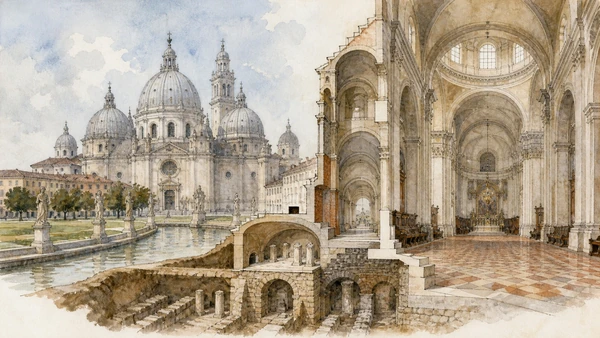
Construction began soon after Anthony’s death in 1231, incorporating an earlier church and expanding through multiple campaigns. Domes, chapels, Donatello’s high altar sculptures, the Saint’s tomb and later fresco cycles express changing patronage and pilgrimage. The Franciscan community continues to govern the complex.

How to read this place

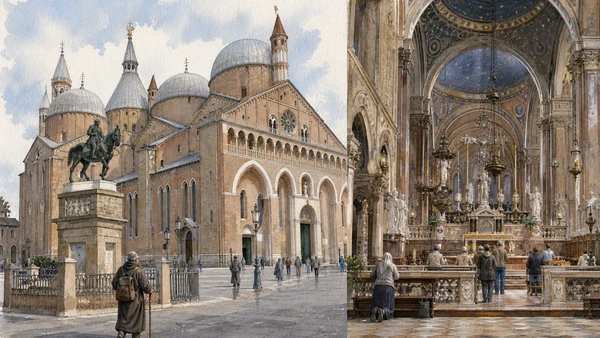
Begin outside by comparing domes, brick mass and equestrian monument, then enter without forcing a chronological line. Observe how circulation converges on the tomb. Distinguish works in active liturgical settings from museum objects and let present devotion remain visible in the interpretation.

What to notice

  • Multiple domes and chapels recording construction campaigns
  • Pilgrim circulation organised around the Saint’s tomb
  • Donatello works remaining within a living sanctuary
Turismo Padova · Basilica of Saint Anthony
Original documentary watercolour of the Basilica of Saint Anthony exterior, pilgrim circulation and active sanctuary
Basilica of Saint Anthony: pilgrimage before spectacleOriginal Merlintravel documentary watercolour · 2026
07

An immense elliptical island and canal convert former marshy ground into a civic landscape of water, statues and daily use

Prato della Valle: designed emptiness, active city

The Prato is not simply one of Europe’s largest squares; its scale depends on hydraulic design, bridges, trees and ordinary use.

Today

The space is open, exposed and used for markets, exercise, transit and events. The canal edges and stone bridges require care, while summer heat can be intense. Walk both the outer perimeter and the central Isola Memmia to understand scale rather than viewing it from one corner.

History

The area served Roman and later fair, religious and recreational uses but suffered from waterlogging. In the late eighteenth century Andrea Memmo promoted drainage and the elliptical design, with canal, bridges and statues representing prominent figures. Subsequent planting, restoration and events kept the space civic rather than monumental only.

How to read this place

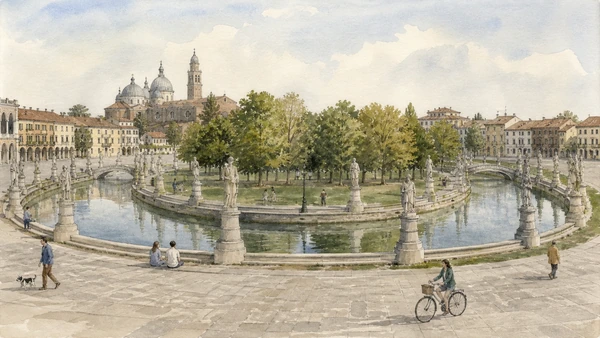
Enter across one bridge and follow the canal’s curve before crossing the island. Read statue choices as a historical canon, not a neutral list of greatness. Compare open ground with the façades of Santa Giustina and surrounding palaces to see how the Prato mediates between city and southern edge.

What to notice

  • Elliptical canal making water management visible
  • Bridges distributing movement onto Isola Memmia
  • Statue circuit constructing selective civic memory
Turismo Padova · Prato della Valle
Original documentary watercolour of Prato della Valle with elliptical canal, bridges, statues and everyday civic use
Prato della Valle: designed emptiness, active cityOriginal Merlintravel documentary watercolour · 2026
08

The world’s oldest university botanical garden in its original location connects medicinal teaching to living biodiversity research

Botanical Garden: science that still grows

The historic circular garden and modern biodiversity greenhouses belong to one evolving research institution, not to opposing old and new attractions.

Today

The garden uses timed opening, a ticket and conservation rules; glasshouses can be warm and routes vary with maintenance. Plant labels and seasonal states are part of the visit. The institution remains connected to university research, so collections should not be touched or treated as decorative props.

History

Founded in 1545 for the study of medicinal plants, the garden retained its original location and geometric core while receiving specimens through Venetian and global networks. It supported botany, medicine, acclimatisation and exchange. The twenty-first-century Garden of Biodiversity extended interpretation to climatic zones and planetary plant systems.

How to read this place

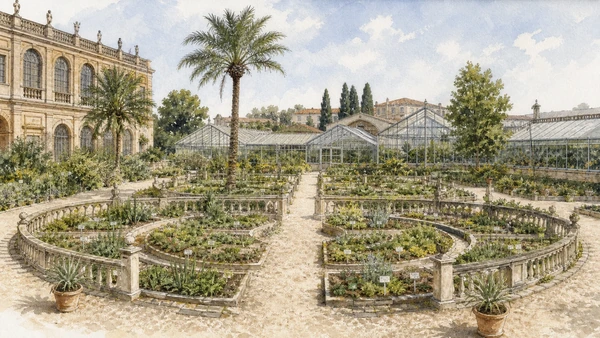
Start with the historic ring and reconstruct the controlled teaching collection before entering the greenhouses. Read labels as records of classification, provenance and changing science. Compare the monumental palms and practical beds to understand longevity, experiment and institutional care.

What to notice

  • Circular historic plan protecting a teaching collection
  • Old specimens recording centuries of exchange
  • Modern greenhouses extending research to global biomes
Turismo Padova · Botanical Garden
Original documentary watercolour of Padua Botanical Garden joining the 1545 circular beds to modern biodiversity greenhouses
Botanical Garden: science that still growsOriginal Merlintravel documentary watercolour · 2026
09

A vast Benedictine basilica anchors the southern city with martyr memory, monastic history and active worship

Santa Giustina: scale beyond the Santo

The basilica facing Prato della Valle provides a second, quieter account of Padua’s sacred and monastic geography.

Today

Santa Giustina is an active church and abbey; admission depends on liturgy and community schedules. The interior’s scale can make chapels seem distant, so choose a small number of features and respect restricted monastic areas. The broad forecourt is exposed in hot weather.

History

A cult site associated with the martyr Justina developed through early Christian and medieval phases. The present monumental basilica took shape mainly between the sixteenth and seventeenth centuries over earlier structures. Benedictine scholarship, relic traditions, Napoleonic suppression and later monastic restoration shaped the institution.

How to read this place

Read the façade and domes from across the Prato, then enter to compare the disciplined interior with Saint Anthony’s dense pilgrimage routes. Locate the earlier sacred core and major chapels without assuming every relic claim has identical historical evidence. Abbey life continues beyond the visitor path.

What to notice

  • Monumental domes closing the Prato’s southern edge
  • Earlier cult layers beneath a later basilica
  • Active Benedictine community extending the site beyond public space
Turismo Padova · Basilica of Santa Giustina
Original documentary watercolour of Santa Giustina across Prato della Valle and its vast Benedictine interior
Santa Giustina: scale beyond the SantoOriginal Merlintravel documentary watercolour · 2026
10

Narrow streets, former Jewish institutions, market routes and porticoes reveal the inhabited city between major monuments

The Ghetto and market streets: Padua at human scale

The centre’s smaller passages hold histories of Jewish residence, commerce and persecution that a monumental itinerary can otherwise miss.

Today

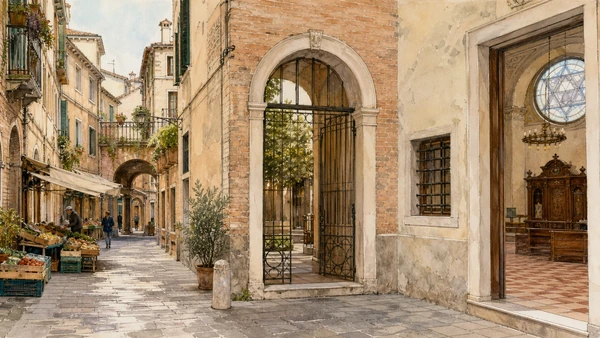
The former Ghetto is a lived neighbourhood with shops, homes and cultural institutions. The Jewish museum and synagogue use controlled schedules and security; do not photograph entrances or worshippers without permission. Market deliveries and bicycles require attention in narrow lanes.

History

Padua’s Jewish presence developed through changing legal conditions, economic roles and religious institutions. Venetian-era restrictions concentrated residence in a gated ghetto from the early seventeenth century until Napoleonic emancipation. Fascist racial laws and deportation brought renewed persecution; post-war community and museum work preserve names, objects and memory.

How to read this place

Follow thresholds from market squares into narrower streets and look for building height, courtyards and former gates without turning the area into picturesque confinement. Use Jewish community interpretation for terminology and memory. Present life and security are not obstacles to the story but part of responsible access.

What to notice

  • Narrow lanes recording regulated residence
  • Market routes linking minority history to the wider city
  • Living community and memorial institutions shaping present access
Museum of Jewish Padua · Official site
Original documentary watercolour of Padua's former Ghetto lanes, market thresholds and living Jewish institutions
The Ghetto and market streets: Padua at human scaleOriginal Merlintravel documentary watercolour · 2026

Padua through time

A short chronology

From Roman Patavium and medieval commune to Giotto, university science, Venetian rule and the coordinated care of a fresco city.

  1. Roman tradition places the birth of Livy in Patavium, already a major settlement.

  2. Early Christian worship and martyr cults develop around the cathedral and Santa Giustina areas.

  3. An earthquake damages the city and contributes to major rebuilding.

  4. The University of Padua is founded by scholars seeking greater intellectual freedom.

  5. Palazzo della Ragione and the Basilica of Saint Anthony develop as major civic and religious institutions.

  6. Giotto paints the Scrovegni Chapel.

  7. Multiple patrons commission the fresco cycles now coordinated as Padua Urbs Picta.

  8. Giusto de’ Menabuoi paints the Cathedral Baptistery under Carraresi patronage.

  9. Padua enters the Venetian Republic.

  10. The university Botanical Garden is founded for medicinal-plant teaching.

  11. The anatomical theatre at Palazzo Bo is completed.

  12. Venetian rule ends and political change affects religious and civic institutions.

  13. Padua joins the Kingdom of Italy.

  14. Bombing destroys much of the Eremitani’s Ovetari Chapel.

  15. Botanical Garden and fresco-cycle UNESCO recognition reinforce coordinated conservation and public access.

Before your visit

Practical information

01

Book Scrovegni first

The timed chapel slot should determine the rest of the day; arrive before the required admission time.

02

Treat frescoes as a network

Eight sites form the UNESCO property, but ownership, tickets and opening conditions remain distinct.

03

Respect worship

The Santo, Santa Giustina and cathedral buildings are active religious spaces before they are visitor attractions.

04

Enter Palazzo Bo officially

Historic university rooms are accessed on authorised guided routes around academic activity.

05

Allow for climate and heat

The chapel uses climate control, the greenhouses can be warm and Prato della Valle is highly exposed.

06

Keep the market visible

Palazzo della Ragione and surrounding squares are still commercial spaces, not empty medieval scenery.

Method and sources

Sources and image credits

This guide uses current official material from Turismo Padova, Comune di Padova, University of Padua, Basilica of Saint Anthony, the Jewish Museum and UNESCO, checked on 28 August 2026. It distinguishes a single Giotto chapel from the eight-site fresco property; active worship from museum access; university teaching from unrestricted tourism; botanical research from ornamental gardening; and Jewish community history from picturesque ghetto imagery.

All ten images are original Merlintravel editorial watercolours based on documented present-day conditions. They are illustrations, not substitutes for archaeological plans. Opening hours, tickets, accessible routes, temporary exhibitions and conservation work can change; consult the linked official pages shortly before visiting.