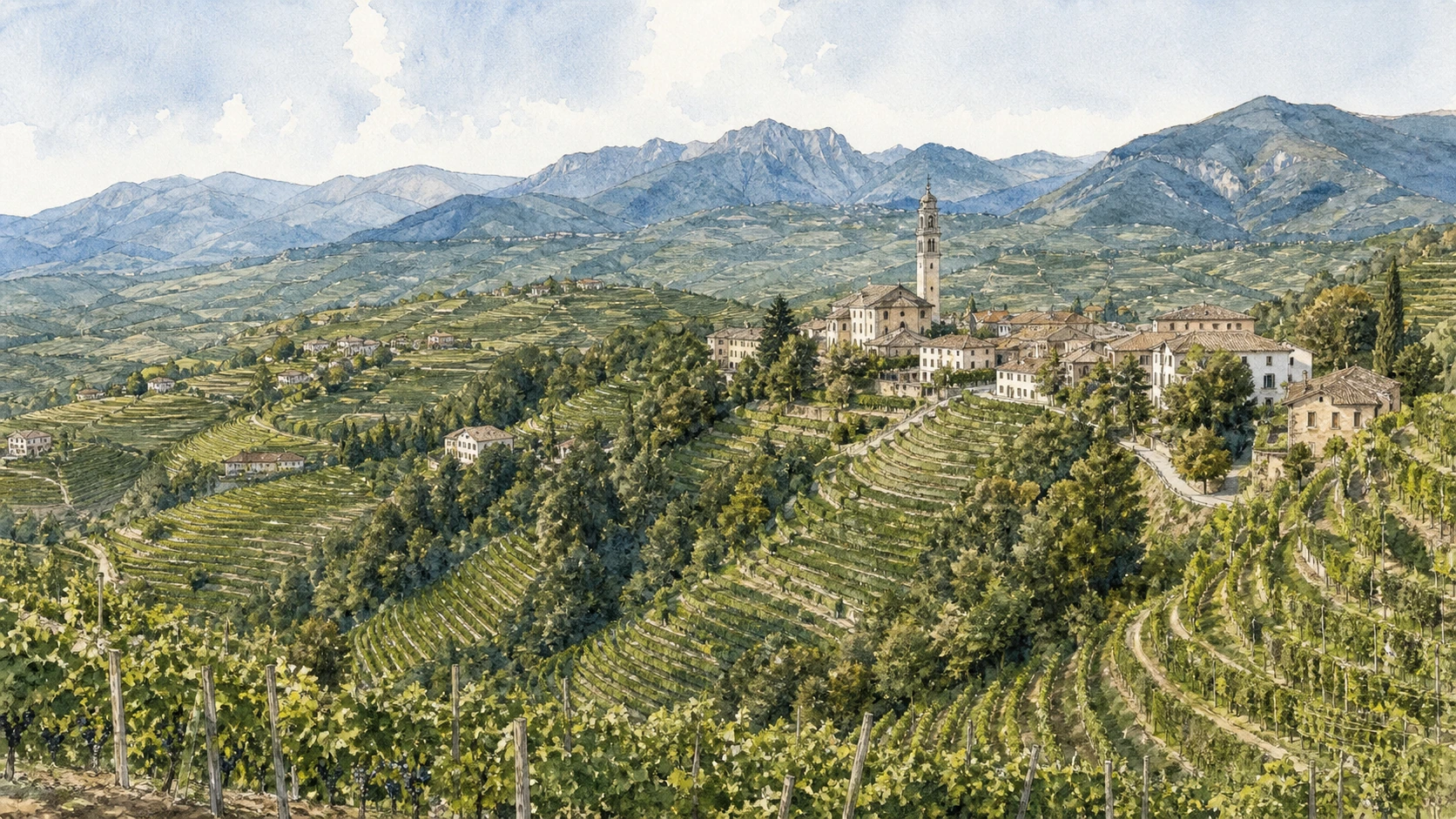
Original documentary watercolour panorama of the Conegliano Valdobbiadene Prosecco hills with steep vineyards, villages and distant Prealps

Veneto Guide 06 · Wine science, hand-worked slopes, villages, mills and living UNESCO landscape

The Prosecco Hills:
Conegliano to Valdobbiadene

A documented route across the Conegliano Valdobbiadene hills that joins the wine school and regulated DOCG to ciglioni, hand labour, Cartizze, village churches, Molinetto della Croda, Follina and the pressures of a globally recognised cultivated landscape.

Plan the route
Conegliano to Valdobbiadene · Treviso hills10 chapters · one or two days

Why the wine must be read through its landscape

The Prosecco Hills are not a brand landscape: villages, schools, growers, dry-stone and grassed banks, roads, woods and cellars sustain a difficult cultivated terrain whose wine is legally and geographically specific.

Conegliano is the cultural and scientific entry, with its castle hill and historic school of oenology. The DOCG applies to a defined fifteen-commune area and should be distinguished from the much larger Prosecco DOC. Labels, government seals, Rive and Cartizze are regulatory categories, not loose quality adjectives.

Between Conegliano and Valdobbiadene, narrow ridges and steep slopes require extensive hand work. The UNESCO property recognises a cultural landscape characterised by hogback hills, ciglioni, woodland and a mosaic of small plots. This is an evolving productive system rather than a preserved open-air museum.

Village churches, the Molinetto della Croda, Follina Abbey and former wool and water infrastructure prevent the route from becoming cellar tourism only. Traffic, events and tasting require planning; the driver must not drink, vineyards are private working land and the most valuable viewpoints are often reached on foot from authorised routes.

Begin in Conegliano, move slowly west by the official wine road, walk one authorised hill route, then finish in Valdobbiadene or Follina without attempting every tasting or viewpoint.

The route

Plan your visit

The circuit starts with Conegliano’s school and urban history, follows the historic wine road through San Pietro di Feletto and Refrontolo, crosses the central steep hills and reaches Cartizze, Valdobbiadene and Follina.

Morning

Conegliano and wine science

Read castle, town and school before entering the denomination as a landscape.

Midday

Eastern hills and Molinetto

Follow official roads, stop only where permitted and connect vineyards to water and village infrastructure.

Afternoon

Ciglioni and Cartizze

Walk one marked route and distinguish private plots from public paths.

Second day

Valdobbiadene and Follina

Add producer history, the abbey and former wool-water systems; assign a sober driver.

Ten chapters

Explore the places

The route connects wine education, appellation, terraced labour, villages, mills, abbeys and visitor pressure. Use the index without treating vineyards as a consumable backdrop.

  1. 01Conegliano: city before vineyard road
  2. 02The Wine School: knowledge behind the bubbles
  3. 03Read the label: denomination before brand
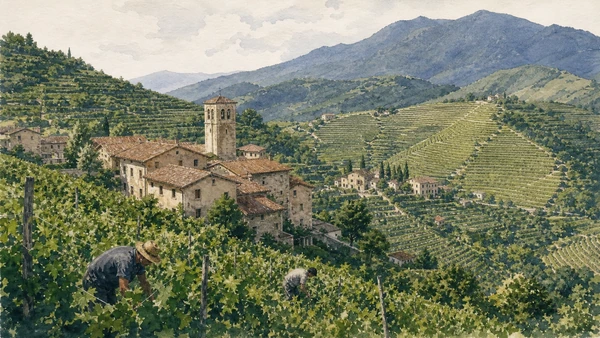
  4. 04Ciglioni: the architecture of cultivated slope
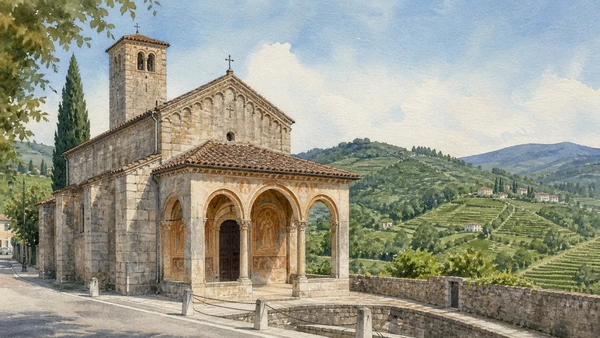
  5. 05San Pietro di Feletto: parish over the vineyards
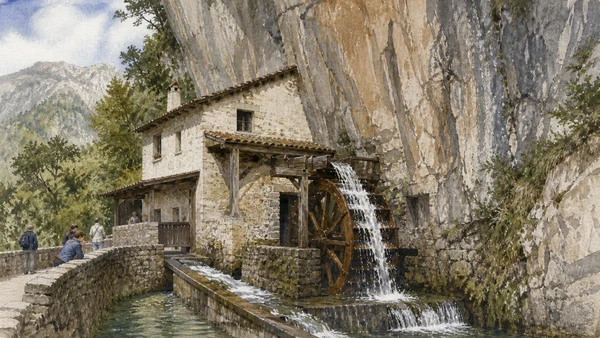
  6. 06Molinetto della Croda: water before wine tourism
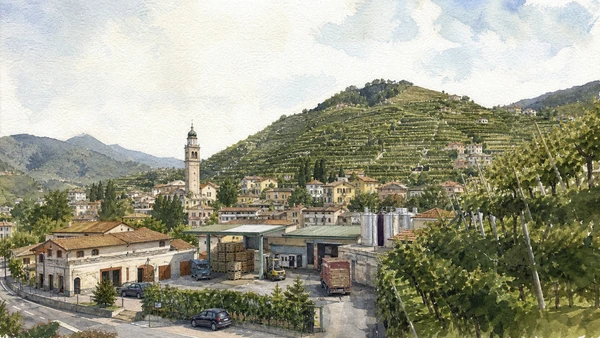
  7. 07Valdobbiadene: production capital, inhabited town
  8. 08Cartizze: 107 hectares, not a generic superlative
  9. 09Follina: abbey, wool and water
  10. 10Stewardship: visit a productive landscape lightly
01

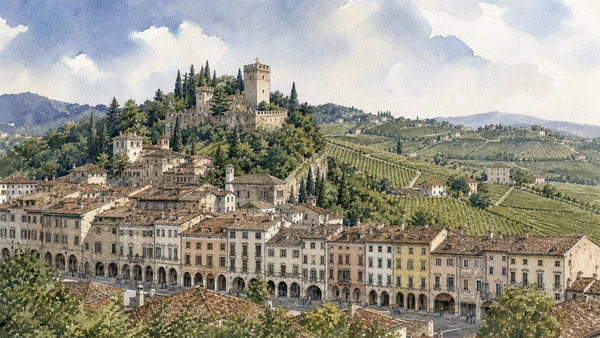
Castle hill, painted centre and wine institutions establish the cultural eastern gateway to the denomination

Conegliano: city before vineyard road

Conegliano is not simply a departure car park; its urban institutions explain how art, trade and wine education developed together.

Today

The centre and castle hill are walkable but steep. Museum and tower access vary; public transport can reduce traffic on a tasting route. Use authorised parking and begin before weekend congestion.

History

A fortified medieval centre developed beneath the castle. Venetian mainland history, confraternities and artists including Cima da Conegliano shaped the town. From the nineteenth century, formal wine education and research made Conegliano central to modern sparkling-wine knowledge.

How to read this place

Read the view from castle to plain and Prealps, then descend through the arcaded centre. The city connects laboratory, school, market and cultivated territory; do not start the story at the first tasting room.

What to notice

  • Castle hill orienting plain and Prealps
  • Arcaded urban fabric preceding modern wine tourism
  • School and research institutions connecting city to vineyards
Consorzio · Prosecco Wine Road
Original documentary watercolour of Conegliano castle hill, arcaded centre and wine-school landscape
Conegliano: city before vineyard roadOriginal Merlintravel documentary watercolour · 2026
02

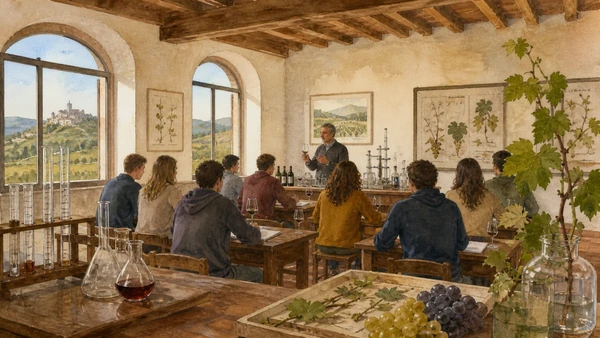
Scientific teaching and producer experimentation turn local practice into an internationally influential oenological system

The Wine School: knowledge behind the bubbles

The school and research tradition matter because sparkling wine is not produced by landscape image alone.

Today

The school is an active educational institution; visitor access is limited to announced museums, events or authorised routes. Do not enter teaching or production spaces uninvited. Use consortium educational material when interiors are closed.

History

Conegliano’s wine school was founded in 1876, and figures including Antonio Carpenè helped develop research and teaching around viticulture and sparkling methods. Later stations, laboratories and trained professionals connected local production to wider Italian oenology.

How to read this place

Look beyond historic equipment to the institutional chain: vineyard observation, chemistry, fermentation, sensory evaluation and regulation. Avoid attributing every technique to one inventor or reducing the method to a marketing name.

What to notice

  • Historic teaching rooms linking theory and production
  • Laboratory knowledge behind vineyard decisions
  • Education network spreading beyond one producer
Consorzio · Conegliano Valdobbiadene Academy
Original documentary watercolour of Conegliano wine education with historic classroom, laboratory glassware and vineyard samples
The Wine School: knowledge behind the bubblesOriginal Merlintravel documentary watercolour · 2026
03

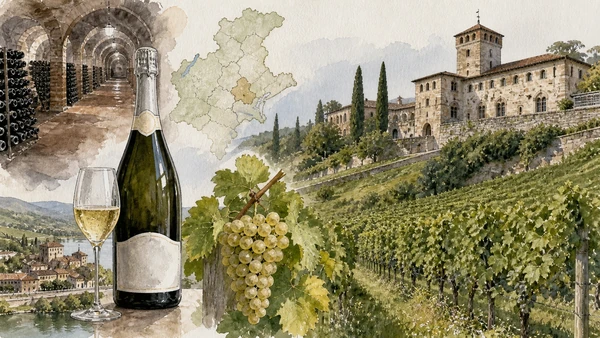
A defined territory, grape rules, tests and government seal distinguish Conegliano Valdobbiadene DOCG from broader Prosecco categories

Read the label: denomination before brand

Not every bottle labelled Prosecco comes from these hills, and not every hillside wine has the same official category.

Today

Use current consortium and ministry guidance; regulations can be amended. At tastings, ask for exact denomination, producer, vintage where applicable and sugar style. The official seal and place-name carry more information than informal prestige language.

History

The historic zone received DOC recognition in 1969 and DOCG status in 2009 during a wider reorganisation of Prosecco denominations. The defined area covers fifteen communes. Rive identify specified steep local origins under additional rules, while Superiore di Cartizze comes from a small subzone.

How to read this place

Turn a bottle in your hand and read origin, DOCG wording, seal and producer before tasting. Separate legal category from personal preference. Regulation does not eliminate variation in soil, exposure, farming or cellar choices.

What to notice

  • Government seal making traceability visible
  • Fifteen-commune origin defining the historic DOCG
  • Rive and Cartizze adding specific regulated origins
Consorzio · The DOCG wine
Original documentary watercolour still life of a correctly generic DOCG bottle label, government seal, map and vineyard origin with no readable brand text
Read the label: denomination before brandOriginal Merlintravel documentary watercolour · 2026
04

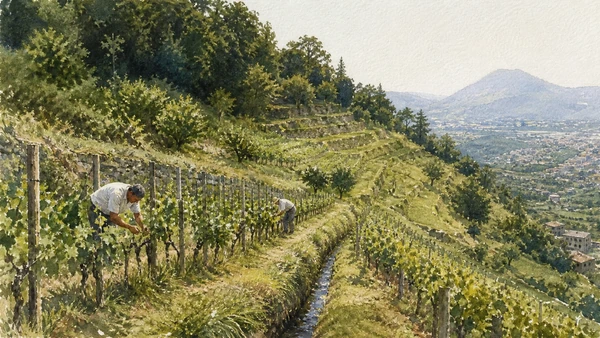
Narrow grassed terraces and small plots make hand labour, erosion control and biodiversity visible on steep hogback hills

Ciglioni: the architecture of cultivated slope

The UNESCO landscape is produced through repeated work, not through untouched nature or decorative rows.

Today

Vineyards are private and machinery, treatments and harvest work create hazards. Stay on marked public paths, close gates and never pick grapes. Heat and gradients make short distances demanding.

History

Growers adapted steep ridges through grassed earth terraces known as ciglioni, plot mosaics, hedges and woodland. Manual labour remains central on the steepest slopes. The pattern evolved across centuries and continues to change with regulation, mechanisation, market demand and conservation.

How to read this place

Stand at the boundary rather than inside a row and compare vine, grass bank, woodland and farm road. Look for drainage and retaining work. Terraces are one of several ways these slopes are managed, and the landscape remains a working environment.

What to notice

  • Grassed banks retaining steep cultivated ground
  • Small plots creating a mosaic with woods and villages
  • Hand work remaining visible in access paths and row spacing
UNESCO · Prosecco Hills
Original documentary watercolour of steep ciglioni vineyards, hand workers, drainage and woodland mosaic
Ciglioni: the architecture of cultivated slopeOriginal Merlintravel documentary watercolour · 2026
05

A parish church above the eastern hills connects Romanesque fabric and fresco to long rural settlement

San Pietro di Feletto: parish over the vineyards

The pieve provides a sacred and communal landmark that predates the modern wine-road identity.

Today

Church opening and worship vary; approach roads are narrow and parking limited. Dress respectfully and do not enter during private ceremonies. The panorama is best read from public ground.

History

The parish church developed through medieval phases and preserves Romanesque form and fresco decoration from different periods. Its elevated position served scattered rural communities. Continued worship and restoration sustain a building embedded in cultivated land.

How to read this place

Read porch, campanile and fresco fragments before turning to the view. The church shows how hill routes, parishes and settlement organised territory long before appellation maps.

What to notice

  • Pieve placed above dispersed rural communities
  • Fresco campaigns recording repeated local patronage
  • Vineyard view framed by an active church threshold
Consorzio · Wine Road itinerary
Original documentary watercolour of San Pietro di Feletto parish church, fresco porch and vineyard hills
San Pietro di Feletto: parish over the vineyardsOriginal Merlintravel documentary watercolour · 2026
06

A small mill beside a rock face demonstrates how water, grain and settlement supported the cultivated hills

Molinetto della Croda: water before wine tourism

The mill is a working-memory site whose channel, wheel, building and surrounding woods explain a rural economy beyond vineyards.

Today

Access, interior demonstrations and water levels vary. The site is compact and can be crowded; stay within paths and do not climb wet rock or infrastructure. Parking on narrow local roads must follow signs.

History

A mill operated at the waterfall for centuries, using channelled water to process grain for nearby communities. Restoration preserved machinery and building fabric while adapting the site for visits and events. Its popularity adds visitor pressure to a small hydrological setting.

How to read this place

Follow the water from intake to wheel and outflow before photographing the façade. Connect grain processing to farms and villages. The waterfall is managed infrastructure as well as natural flow.

What to notice

  • Water channel converting flow into mechanical work
  • Mill building fitted tightly against rock
  • Restoration turning rural infrastructure into a visitor site
Consorzio · Molinetto on the Wine Road
Original documentary watercolour of Molinetto della Croda showing channel, wheel, mill, rock and restrained visitors
Molinetto della Croda: water before wine tourismOriginal Merlintravel documentary watercolour · 2026
07

The western production centre joins civic life, growers, sparkling houses and the steepest hills of the denomination

Valdobbiadene: production capital, inhabited town

Valdobbiadene should be read as a working service and community centre, not as a gateway sign to Cartizze.

Today

Markets, schools, wineries and traffic share the town. Tastings require booking and a sober driver; cellar production areas are controlled workplaces. Use public spaces without blocking residents.

History

The town and surrounding villages developed through agriculture, trade and changing political borders. Modern sparkling-wine firms, cooperatives and consortium activity consolidated its role in the denomination. War damage and reconstruction also shaped the present fabric.

How to read this place

Begin in the civic centre, then move outward to the vineyard amphitheatre. Compare large producer facilities with small holdings and ask how grapes, workers and bottles move through the town.

What to notice

  • Civic centre serving an extensive rural population
  • Cellars and cooperatives linking hill plots to markets
  • Mountain edge compressing town and vineyards
Consorzio · Area of origin
Original documentary watercolour of Valdobbiadene town, working cellars and steep western vineyards
Valdobbiadene: production capital, inhabited townOriginal Merlintravel documentary watercolour · 2026
08

A small regulated subzone becomes a test of how to read prestige, microclimate, ownership and public access precisely

Cartizze: 107 hectares, not a generic superlative

Cartizze names a specific DOCG subzone around San Pietro di Barbozza, Santo Stefano and Saccol.

Today

Roads are narrow, farms private and busy during harvest. Use marked walks and official viewpoints; do not drive after tasting. Avoid entering rows or flying drones without permission.

History

The subzone received specific regulation in 1969 and covers about 107 hectares of steep, favourably exposed vineyards. Fragmented ownership, ancient soils and intensive hand work contribute to its identity. Prestige and land values grew with the global Prosecco market.

How to read this place

Use the official ring to compare exposure, slope, settlement and plot size. Read Cartizze on the label only when legally present. A famous name does not make the landscape public or guarantee one preferred taste.

What to notice

  • Small subzone distributed among multiple villages and owners
  • South-facing steep slopes requiring manual work
  • Regulated name linking bottle to exact terrain
Consorzio · Cartizze and wine types
Original documentary watercolour of Cartizze's steep 107-hectare hill mosaic, villages and hand-tended vines
Cartizze: 107 hectares, not a generic superlativeOriginal Merlintravel documentary watercolour · 2026
09

A Cistercian abbey and former wool-water economy reveal another productive history on the northern edge of the hills

Follina: abbey, wool and water

Follina prevents the guide from turning every historic structure into wine scenery.

Today

The abbey is active religious heritage; worship and community use come first. Village water routes are public only where marked. Check local museum or event openings.

History

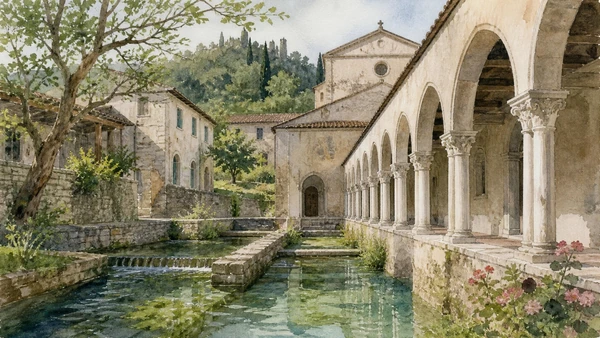
A monastic complex developed at Follina through medieval phases and received a refined cloister. Water supported settlement and a long wool and textile tradition whose traces survive in buildings and routes. Tourism now links the village to the UNESCO hills while its history remains broader.

How to read this place

Read cloister, church and water systems as institutions of labour, devotion and land management. Compare mill channels and former workshops with vineyard infrastructure without collapsing them into one economy.

What to notice

  • Cloister organising monastic community space
  • Water supporting wool and village production
  • Northern hill setting joining abbey to cultivated territory
Consorzio · History and culture in the hills
Original documentary watercolour of Follina Abbey cloister, water channels and former wool-working village
Follina: abbey, wool and waterOriginal Merlintravel documentary watercolour · 2026
10

Global demand, road traffic, treatments, land prices and climate turn landscape care into a present political and agricultural task

Stewardship: visit a productive landscape lightly

UNESCO inscription does not resolve conflicts around intensive production, biodiversity, mobility or resident life.

Today

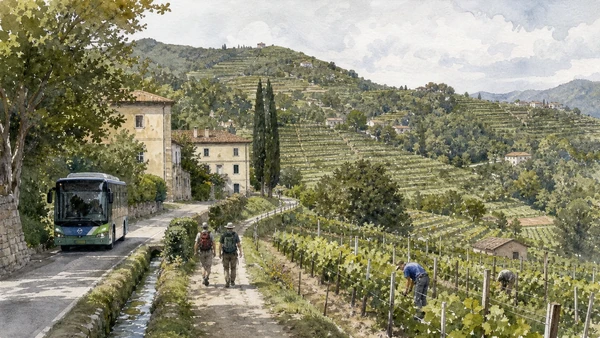
Book rather than dropping in, limit car movements, use designated trails and appoint a sober driver. Follow treatment warnings and harvest restrictions. Buy and taste without pressuring staff or entering production zones.

History

The denomination and UNESCO management system support research, sustainability and landscape protection while growers and communities face erosion, warming, pests, market cycles and visitor congestion. Different stakeholders do not always define sustainability identically.

How to read this place

Look for hedges, woods, drainage, grassed rows, traffic and settlement as carefully as vine pattern. Ask producers specific questions about soil and farming rather than expecting a universal green claim.

What to notice

  • Road pressure revealing the cost of dispersed car tourism
  • Woods and hedges contributing to landscape resilience
  • Management choices visible in soil, grass and drainage
Consorzio · Official stewardship role
Original documentary watercolour of low-impact visitation, bus and walkers among vineyard mosaic, woods, drainage and working growers
Stewardship: visit a productive landscape lightlyOriginal Merlintravel documentary watercolour · 2026

The hills through time

A short chronology

From long cultivation and the first named Prosecco records to wine science, regulation, UNESCO inscription and contemporary landscape stewardship.

  1. Communities cultivate the foothills and organise parishes, woods, water and small farms.

  2. San Pietro di Feletto and monastic sites record established rural settlement.

  3. A written reference associates Prosecco with the Conegliano area.

  4. Conegliano’s School of Viticulture and Oenology is founded.

  5. Antonio Carpenè and other researchers advance modern sparkling-wine knowledge.

  6. The First World War damages towns, farms and infrastructure across the Treviso hills.

  7. Eleven producers found the protection consortium.

  8. Italy’s first wine road is established between Conegliano and Valdobbiadene.

  9. The historic zone receives DOC recognition and Cartizze specific regulation.

  10. The renewed Prosecco and Colli Conegliano Valdobbiadene Wine Road is constituted.

  11. Conegliano Valdobbiadene becomes DOCG during wider denomination reorganisation.

  12. The Prosecco Hills are inscribed on the UNESCO World Heritage List.

  13. Landscape management responds to erosion, biodiversity, climate and visitor pressure.

  14. Manual work remains central on the steepest Rive and Cartizze plots.

  15. Residents, growers and institutions negotiate production, conservation and global demand.

Before your visit

Practical information

01

Assign a sober driver

Tasting and driving do not belong together; use a driver, tour or very limited non-alcoholic route.

02

Do not enter rows

Vineyards are private workplaces with machinery, treatments and harvest activity.

03

Read the legal label

DOCG, Rive and Cartizze have specific meanings; Prosecco alone is broader.

04

Walk one marked route

A slow authorised path reveals ciglioni and settlement better than repeated roadside stops.

05

Include non-wine history

Pieve, mill, abbey and wool-water systems keep the hills culturally legible.

06

Avoid harvest pressure

Book ahead, respect closures and never obstruct narrow roads or agricultural access.

Method and sources

Sources and image credits

This guide uses current official material from the UNESCO World Heritage Centre, Conegliano Valdobbiadene Prosecco Superiore DOCG Consortium and its official routes, checked on 28 August 2026. It distinguishes DOCG from broader Prosecco categories; Cartizze from a generic prestige word; cultivated landscape from untouched nature; public trail from private row; tasting from transport; and landscape stewardship from brand imagery.

All ten images are original Merlintravel editorial watercolours based on documented present-day conditions. They are illustrations, not substitutes for archaeological plans. Opening hours, tickets, accessible routes, temporary exhibitions and conservation work can change; consult the linked official pages shortly before visiting.