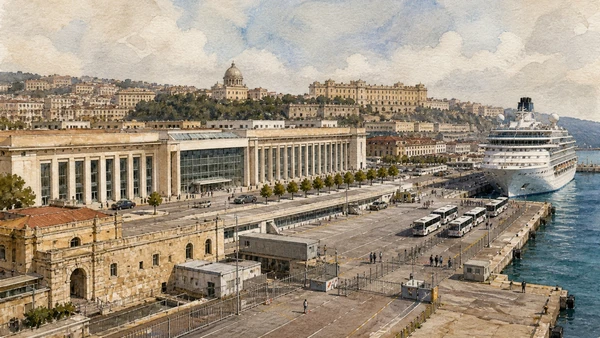
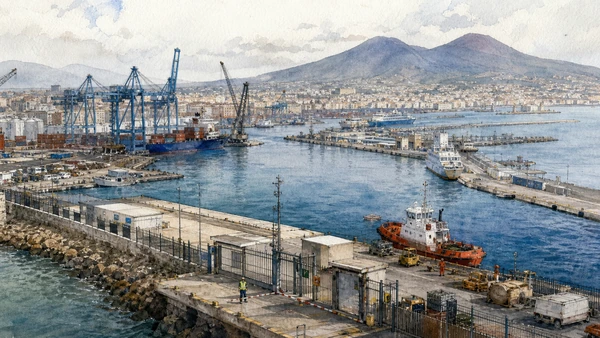
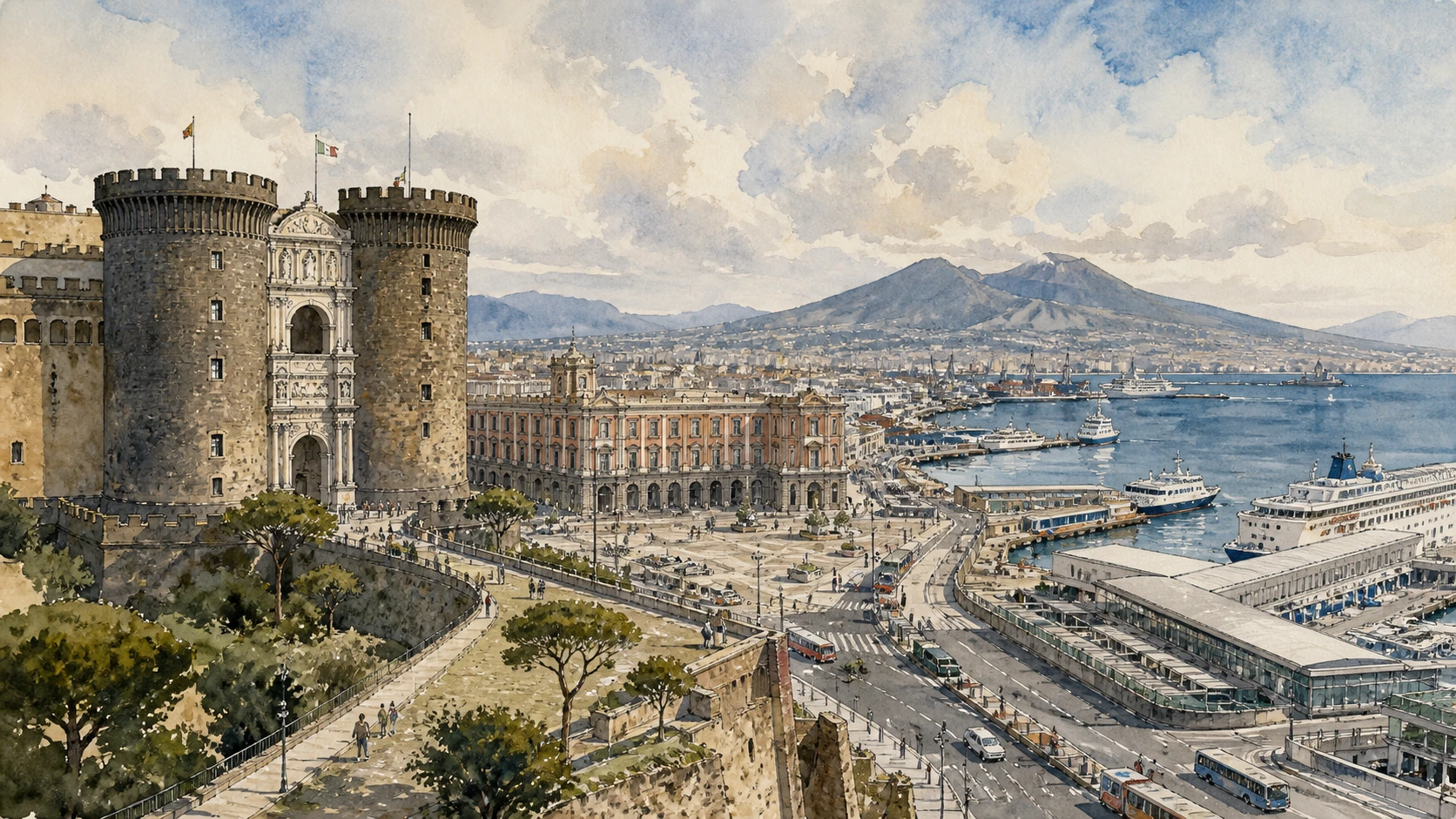
Original documentary watercolour panorama for Naples Castel Nuovo, Port and Maritime Government: Complete Guide, with accurate Naples architecture and lived urban context

Naples Guide 08 · Angevin castle, Aragonese triumph, civic museum, harbour infrastructure and working waterfront

Castel Nuovo, Port
& Maritime Government

A route through Naples’s political and maritime threshold, joining Castel Nuovo, the Aragonese triumphal arch, civic collections, Municipio, Molo Beverello, Stazione Marittima and the working systems of a Mediterranean port.

Plan the route
Naples · Campania10 chapters · one full day

Why this Naples district must be read in layers

Castel Nuovo was built to place royal government beside the harbour; the modern port still makes movement, security, labour and infrastructure inseparable from the monument.

The Angevin foundation, Aragonese rebuilding and Renaissance arch record successive claims to Naples as a capital. Chapels, halls and later civic museum use transformed the fortress without erasing its military mass.

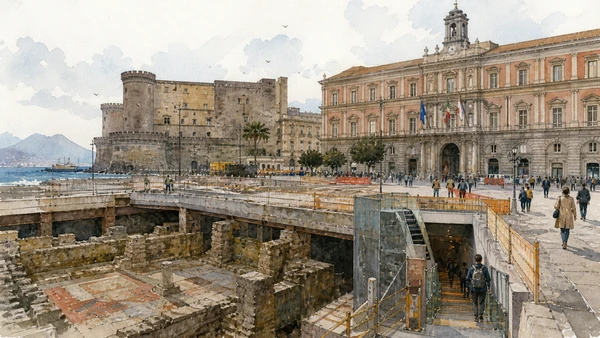
Piazza Municipio is an archaeological and transport field as well as a public square. Metro construction, excavated harbour evidence and new pedestrian connections reveal how the ancient and modern waterfront moved.

Molo Beverello and Stazione Marittima remain departure and operational zones. Ferries, cruise passengers, freight, police and port workers have priority; access rules and schedules are live infrastructure, not incidental inconvenience.

Begin with the castle’s exterior and controlled interiors, cross Municipio through open routes, then observe the port from public edges without entering restricted operational areas.

The route

Plan your visit

Read Castel Nuovo in chronological layers, then use Municipio and the metro archaeology to follow the retreating shoreline toward modern ferry and cruise infrastructure.

Early morning

Castel Nuovo · Aragonese triumphal arch · Palatine Chapel

Move in the documented order: Castel Nuovo: fortress beside the harbour; then Aragonese triumphal arch: conquest carved into the gate; then Palatine Chapel: surviving Angevin worship inside Aragonese rebuilding. Check live access before entering ticketed or liturgical spaces.

Late morning

Hall of the Barons · Civic Museum · Piazza Municipio

Move in the documented order: Hall of the Barons: royal ceremony and political conflict; then Civic Museum: art, fragments and the city’s ownership; then Piazza Municipio: archaeology, metro and civic government. Check live access before entering ticketed or liturgical spaces.

Afternoon

Municipio Metro station · Molo Beverello · Stazione Marittima

Move in the documented order: Municipio Metro station: transport through an archaeological harbour; then Molo Beverello: departure infrastructure for the islands; then Stazione Marittima: modern architecture at the cruise quay. Check live access before entering ticketed or liturgical spaces.

Late afternoon

The working port

Move in the documented order: The working port: labour, freight and security beyond the visitor frame. Check live access before entering ticketed or liturgical spaces.

Ten chapters

Explore the places

The order follows terrain, institutions and present-day movement. Use the index to return to a chapter without reducing the district to isolated monuments.

  1. 01Castel Nuovo: fortress beside the harbour
  2. 02Aragonese triumphal arch: conquest carved into the gate
  3. 03Palatine Chapel: surviving Angevin worship inside Aragonese rebuilding
  4. 04Hall of the Barons: royal ceremony and political conflict
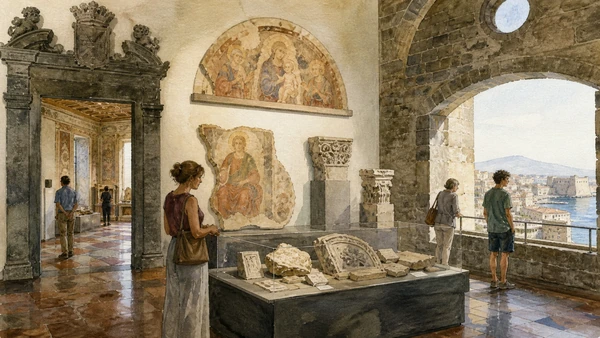
  5. 05Civic Museum: art, fragments and the city’s ownership
  6. 06Piazza Municipio: archaeology, metro and civic government
  7. 07Municipio Metro station: transport through an archaeological harbour
  8. 08Molo Beverello: departure infrastructure for the islands
  9. 09Stazione Marittima: modern architecture at the cruise quay
  10. 10The working port: labour, freight and security beyond the visitor frame
01

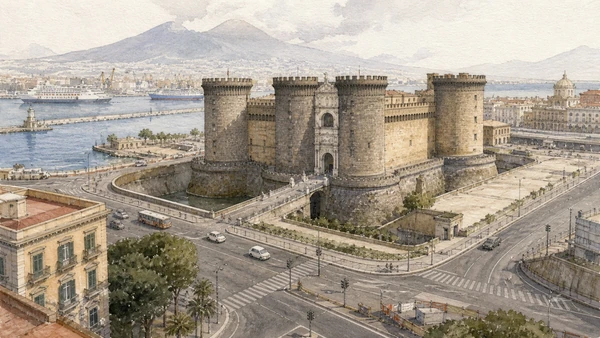
Five towers and a deep entrance front still announce royal control at the edge of the medieval port

Castel Nuovo: fortress beside the harbour

The castle’s isolation is partly the result of later clearance and road building.

Today

Exterior areas can be affected by events and works. Use marked crossings around Municipio and never enter fenced archaeological or service zones.

History

Charles I of Anjou founded the new castle in the late thirteenth century after moving the capital to Naples. Alfonso of Aragon ordered extensive fifteenth-century rebuilding.

How to read this place

Circle the public perimeter and compare tower shape, moat, curtain walls and later urban gaps. Recover the former proximity of water through maps.

What to notice

  • Round towers defining an Aragonese fortress
  • Moat and gate controlling royal access
  • Modern roads separating castle from port
Comune di Napoli · Castel Nuovo
Original documentary watercolour of Castel Nuovo: fortress beside the harbour in Naples, showing architecture, people and present-day urban context
Castel Nuovo: fortress beside the harbourOriginal Merlintravel documentary watercolour · 2026
02

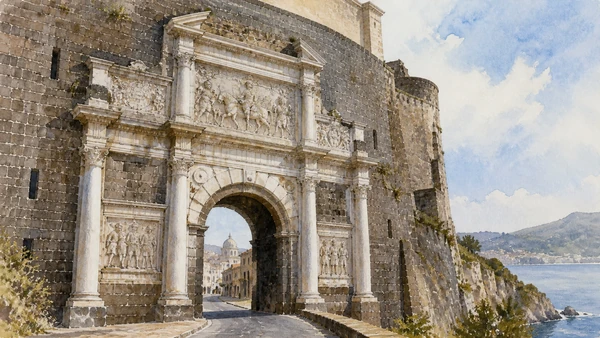
A white marble Renaissance monument was inserted between dark defensive towers

Aragonese triumphal arch: conquest carved into the gate

Its classical language turns military entry into a dynastic statement.

Today

The arch is viewed on the museum approach and may be partly constrained by conservation scaffolding. Keep the gate passage open.

History

The arch celebrated Alfonso’s entry into Naples and was built through several sculptural campaigns. Reliefs, inscriptions and royal imagery connect Italian Renaissance art to Aragonese power.

How to read this place

Read from lower reliefs upward and compare the fragile marble surface with the massive piperno fortification around it.

What to notice

  • White marble inserted into dark fortress stone
  • Royal entry procession carved in relief
  • Classical orders reframing a military gate
Comune di Napoli · Museo Civico Castel Nuovo
Original documentary watercolour of Aragonese triumphal arch: conquest carved into the gate in Naples, showing architecture, people and present-day urban context
Aragonese triumphal arch: conquest carved into the gateOriginal Merlintravel documentary watercolour · 2026
03

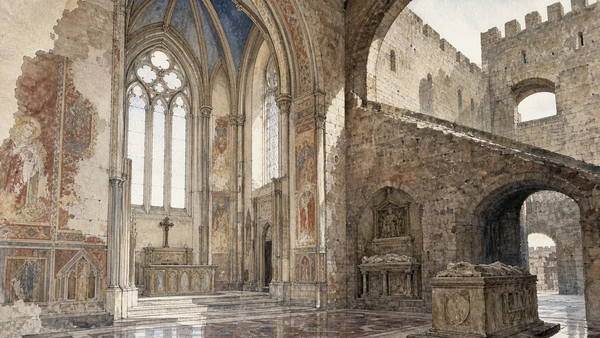
A Gothic sacred space preserves fragments and tombs within the later fortress

Palatine Chapel: surviving Angevin worship inside Aragonese rebuilding

It reveals institutional continuity across dynastic reconstruction.

Today

Interior access depends on the civic museum route and events. Some chapels or artworks can be unavailable.

History

The chapel belonged to the Angevin castle and retained important architectural and artistic evidence when the surrounding fortress was transformed under Aragonese rule.

How to read this place

Compare Gothic height and window form with the heavier castle structure. Fragmentary decoration should be read as survival, not as an incomplete attraction.

What to notice

  • Gothic chapel embedded within fortified mass
  • Fragments preserving Angevin artistic campaigns
  • Later dynastic tombs extending sacred use
Comune di Napoli · Museo Civico Castel Nuovo
Original documentary watercolour of Palatine Chapel: surviving Angevin worship inside Aragonese rebuilding in Naples, showing architecture, people and present-day urban context
Palatine Chapel: surviving Angevin worship inside Aragonese rebuildingOriginal Merlintravel documentary watercolour · 2026
04

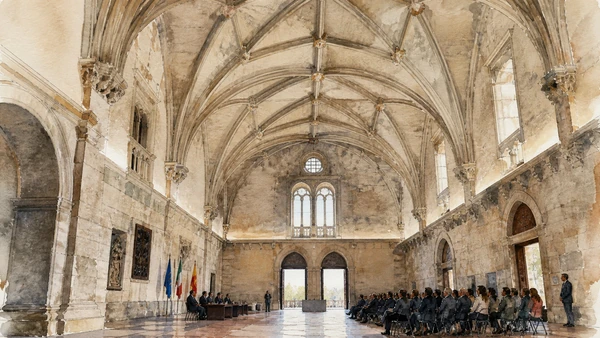
A vast ribbed vault created a single monumental room for court and government

Hall of the Barons: royal ceremony and political conflict

Its name recalls political confrontation while its architecture demonstrates Aragonese ambition.

Today

The hall is frequently used for civic events and may close to museum visitors. Check current access and never enter during setup without permission.

History

The great hall was rebuilt for Alfonso’s court and later associated with the arrest of rebellious barons under Ferrante. Subsequent fires, damage and restoration changed the space.

How to read this place

Look upward at the vault geometry and outward to circulation points. Separate documented events from later dramatic retellings.

What to notice

  • Large ribbed vault spanning a court hall
  • Royal scale suited to assembly and ceremony
  • Modern civic use continuing political function
Comune di Napoli · Castel Nuovo
Original documentary watercolour of Hall of the Barons: royal ceremony and political conflict in Naples, showing architecture, people and present-day urban context
Hall of the Barons: royal ceremony and political conflictOriginal Merlintravel documentary watercolour · 2026
05

Municipal collections inside the castle make Naples both subject and steward

Civic Museum: art, fragments and the city’s ownership

Display connects displaced artworks to churches, monuments and civic history.

Today

Galleries rotate and municipal events affect the route. Use current ticket and opening information.

History

The city established museum functions in the castle, assembling paintings, sculpture and objects from varied contexts while restoration recovered usable interiors.

How to read this place

Read provenance before style. A fragment from a demolished or altered church can document urban change as strongly as a complete painting.

What to notice

  • Municipal collection housed in a royal fortress
  • Fragments preserving lost city contexts
  • Museum use enabling public access to restored rooms
Comune di Napoli · Museo Civico Castel Nuovo
Original documentary watercolour of Civic Museum: art, fragments and the city's ownership in Naples, showing architecture, people and present-day urban context
Civic Museum: art, fragments and the city’s ownershipOriginal Merlintravel documentary watercolour · 2026
06

A broad space between town hall, castle and port has been repeatedly excavated and redesigned

Piazza Municipio: archaeology, metro and civic government

Its unfinished-looking layers expose the difficulty of building modern infrastructure over an ancient harbour.

Today

Construction phases and barriers change pedestrian routes. Follow current signs and do not cross fenced archaeological areas.

History

Shorelines and harbour facilities occupied parts of this zone in antiquity. Later fortifications, clearance, roads and municipal building changed the relationship between castle and water.

How to read this place

Use surface levels, excavation displays and metro entrances to reconstruct movement of the coast. Temporary works are part of the site’s current history.

What to notice

  • Castle, town hall and port facing one civic field
  • Excavated harbour evidence below modern grade
  • Metro construction producing new public routes
Comune di Napoli · Piazza Municipio
Original documentary watercolour of Piazza Municipio: archaeology, metro and civic government in Naples, showing architecture, people and present-day urban context
Piazza Municipio: archaeology, metro and civic governmentOriginal Merlintravel documentary watercolour · 2026
07

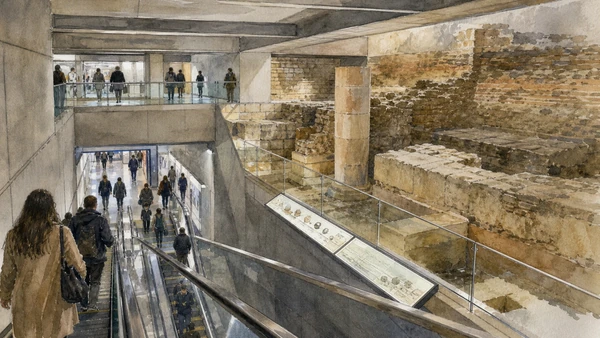
A major interchange incorporates finds and interpretations from a long excavation campaign

Municipio Metro station: transport through an archaeological harbour

The station links heritage display to the daily pressure of passenger movement.

Today

A valid ticket and live ANM service rules apply. Do not stop on escalators or platform circulation lines to view displays.

History

Metro works revealed phases of the ancient and later waterfront, prompting archaeological investigation and project redesign. Selected evidence was integrated into the station.

How to read this place

Follow the descent and note where interpretation corresponds to actual preserved fabric or displayed objects. Infrastructure and archaeology required negotiation.

What to notice

  • Transit levels descending through former shoreline
  • Archaeological evidence integrated with wayfinding
  • Commuter circulation remaining primary
ANM · Municipio station
Original documentary watercolour of Municipio Metro station: transport through an archaeological harbour in Naples, showing architecture, people and present-day urban context
Municipio Metro station: transport through an archaeological harbourOriginal Merlintravel documentary watercolour · 2026
08

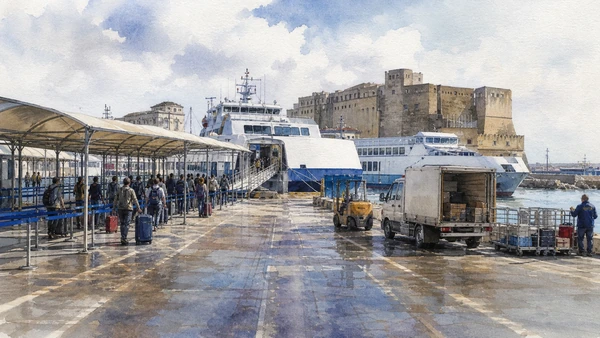
Ticketing, security, luggage and vessel turnaround make the pier a working transport terminal

Molo Beverello: departure infrastructure for the islands

The view is secondary to safe and efficient passenger movement.

Today

Sailings depend on weather and operator decisions. Verify the same day, arrive within the operator’s required time and keep emergency and boarding lanes clear.

History

Harbour edges beside Castel Nuovo served changing military, commercial and passenger functions. Modern piers and terminals were rebuilt to handle faster vessels and mass movement.

How to read this place

Observe vessel types, gangways and service zones only from public space. A ferry departure reveals the port as a timed logistics system.

What to notice

  • Fast ferries using controlled boarding lanes
  • Castle remaining visible behind modern piers
  • Luggage and service traffic defining terminal use
Autorità di Sistema Portuale del Mar Tirreno Centrale
Original documentary watercolour of Molo Beverello: departure infrastructure for the islands in Naples, showing architecture, people and present-day urban context
Molo Beverello: departure infrastructure for the islandsOriginal Merlintravel documentary watercolour · 2026
09

A large twentieth-century terminal faces the city along a controlled port edge

Stazione Marittima: modern architecture at the cruise quay

Its scale records the growth of passenger shipping and state infrastructure.

Today

Access depends on cruise and event operations; parts of the building or quay may be restricted. Observe port security without photographing controlled procedures.

History

The terminal was built during the interwar period as Naples modernised its maritime gateway. Post-war repair and contemporary cruise use altered interior functions.

How to read this place

Compare the symmetrical city-facing front with the operational quay side. The building mediates between civic monumentality and ship logistics.

What to notice

  • Long terminal façade addressing the city
  • Restricted quay handling ships and passengers
  • Modernist architecture beside older royal monuments
Autorità di Sistema Portuale del Mar Tirreno Centrale
Original documentary watercolour of Stazione Marittima: modern architecture at the cruise quay in Naples, showing architecture, people and present-day urban context
Stazione Marittima: modern architecture at the cruise quayOriginal Merlintravel documentary watercolour · 2026
10

Naples’s harbour serves ferries, cruises, cargo, ship services and public authorities

The working port: labour, freight and security beyond the visitor frame

A complete guide must acknowledge operations that cannot be entered or aestheticised.

Today

Remain in public areas, obey port and police instructions and never enter cargo or maintenance zones. Current operations can close expected viewpoints.

History

The port developed through repeated extensions, land reclamation and technical change while remaining central to the city’s economy and military history.

How to read this place

Read cranes, breakwaters, service craft and access controls as evidence. Do not crop labour and infrastructure out of the maritime city.

What to notice

  • Multiple harbour basins serving distinct functions
  • Security boundaries protecting active operations
  • Service craft and freight revealing port labour
Autorità di Sistema Portuale del Mar Tirreno Centrale
Original documentary watercolour of The working port: labour, freight and security beyond the visitor frame in Naples, showing architecture, people and present-day urban context
The working port: labour, freight and security beyond the visitor frameOriginal Merlintravel documentary watercolour · 2026

Naples through time

A short chronology

From Greek Neapolis and Roman infrastructure to dynastic capitals, wartime rupture, UNESCO care and a living metropolitan centre.

  1. Greek settlements and Neapolis establish the coastal and gridded urban foundations later absorbed by Roman Naples.

  2. Walls, streets, sanctuaries and civic spaces consolidate the ancient city on the tuff plateau.

  3. Roman Naples expands its theatres, baths, water systems, port functions and elite residences.

  4. Christian worship, burial and episcopal institutions reshape the ancient city and its edges.

  5. The Duchy of Naples maintains a distinct Mediterranean political and cultural identity.

  6. Norman and Swabian rule integrate Naples into larger southern kingdoms while reusing existing institutions.

  7. Angevin rule makes Naples a royal capital and begins major castle, church and urban commissions.

  8. Aragonese rule adds court culture, fortification and monumental Renaissance patronage.

  9. Spanish viceregal government extends Via Toledo, military quarters, religious houses and administrative power.

  10. Bourbon rule restores Naples as a dynastic capital and expands royal, cultural and infrastructural projects.

  11. The brief Parthenopean Republic and its repression expose deep political and social conflict.

  12. French-period government reforms streets, institutions and public administration.

  13. Naples enters the unified Kingdom of Italy and its capital functions are reorganised.

  14. Bombing, occupation, the Four Days and post-war rebuilding transform the city and port.

  15. UNESCO inscription, restoration, tourism pressure and resident-led cultural work renew debate over a living historic centre.

Before your visit

Practical information

01

Reserve constrained interiors

Timed museums, underground routes and major chapels can sell out; use only their current official booking channels.

02

Respect worship

Church access can pause for liturgy, funerals or community events; a visitor ticket never overrides religious use.

03

Walk the terrain

Tuff ridges, steep stairs, uneven paving and dense traffic are part of the city; keep a shorter accessible alternative.

04

Do not turn residents into scenery

Keep doorways, workshops, market lanes and courtyards clear; photograph people only with consent.

05

Check live transport

Metro, funicular, port and bus service can change; verify the same-day operator notice before relying on a connection.

06

Read layers, not clichés

Religious devotion, poverty, theatricality and danger are not interchangeable labels for Naples; use documented sites and institutions.

Method and sources

Sources and image credits

This guide uses official museum, ministry, church, transport and UNESCO documentation checked on 29 August 2026. It separates durable historical interpretation from access details that can change; distinguishes surviving fabric from reconstruction, restoration and legend; and treats worship, work, residence and public movement as part of the evidence rather than visual interference. Every chapter links its principal institutional source, while current tickets, closures and transport must always be verified again on the day of the visit.

All ten images are original Merlintravel editorial watercolours based on documented present-day conditions. They are illustrations, not substitutes for archaeological plans. Opening hours, tickets, accessible routes, temporary exhibitions and conservation work can change; consult the linked official pages shortly before visiting.