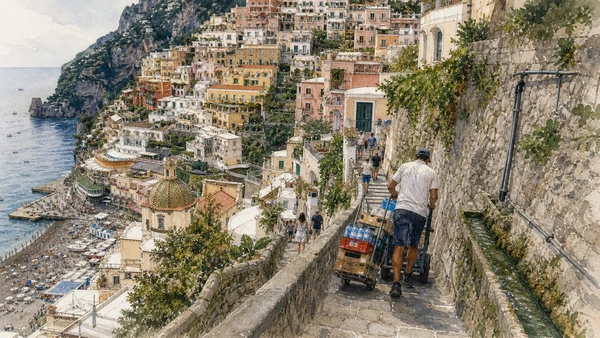
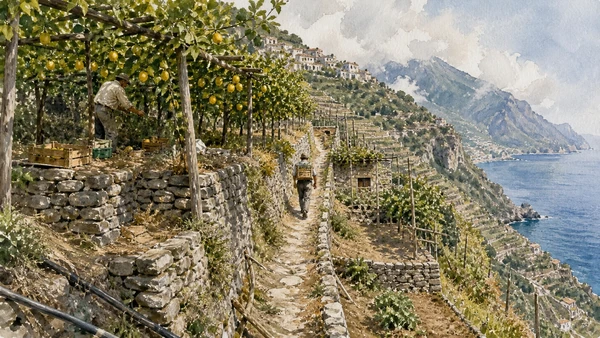
Original documentary watercolour panorama for Amalfi Coast: Maritime Towns, Terraces and Responsible Mobility — Complete Guide, showing landscape, heritage and present-day use

Campania Guide 04 · Maritime republic, cathedral, hill towns, villas, paths, lemons and constrained transport

Amalfi Coast:
Towns, Terraces & Mobility

A multi-day guide from Amalfi and Atrani to Ravello, Minori, Positano and the high paths, treating the UNESCO coast as an inhabited cultural landscape built through maritime exchange, terraced agriculture and difficult movement.

Plan the route
Campania · Italy10 chapters · one to three days

Why this Campania landscape must be read in layers

The Amalfi Coast is not a chain of independent postcard villages: roads, stairs, watercourses, terraces, ports, monasteries and agricultural labour bind steep settlements into one vulnerable cultural landscape.

Amalfi’s medieval maritime power survives through urban form, cathedral institutions, the Arsenal and documentary memory rather than through a romantic claim that every surviving house belongs to the republic’s peak.

Ravello’s gardens and villas occupy high terrain shaped by elite patronage and long views, while Atrani, Minori and other towns reveal dense housing, religious sites, mills and ancient remains closer to watercourses and shore.

Mobility is the core present issue. Narrow roads, seasonal ferries, buses, stairs, heat and congestion make itinerary stacking irresponsible. Official transport and weather checks are required each day, and one base is often more coherent than constant transfer.

Choose one coastal base, group nearby chapters and leave space for delay: the landscape becomes more legible when walking, ferry and bus are treated as systems rather than obstacles.

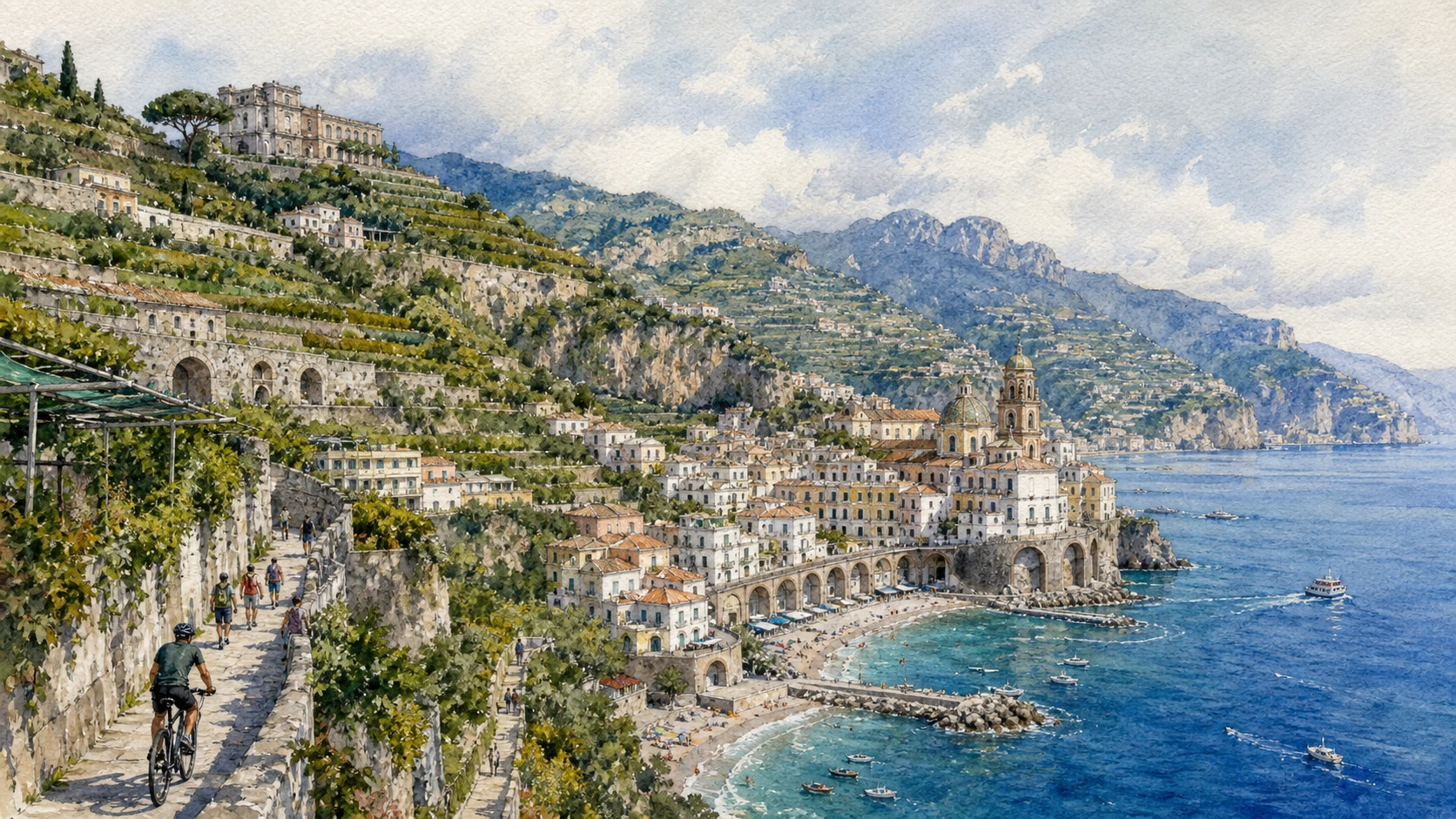
The route

Plan your visit

Begin with Amalfi’s civic and sacred core, connect Atrani and Ravello by realistic transport, then use separate days for Minori, Positano, a suitable open path and the agricultural landscape.

Early morning

Amalfi · Amalfi Cathedral · The Arsenal

Follow the documented sequence: Amalfi: a compact maritime city in a steep valley; then Amalfi Cathedral: basilica, cloister and diocesan memory; then The Arsenal: ships, documents and maritime institutions. Recheck current access, transport and weather before departure.

Late morning

Valley of the Mills and paper · Atrani · Ravello and Villa Rufolo

Follow the documented sequence: Valley of the Mills and paper: water as industry; then Atrani: inhabited coastal fabric beside Amalfi; then Ravello and Villa Rufolo: patronage above the coast. Recheck current access, transport and weather before departure.

Afternoon

Villa Cimbrone · Minori and the Roman maritime villa · Positano

Follow the documented sequence: Villa Cimbrone: a historic garden assembled through revival; then Minori and the Roman maritime villa; then Positano: vertical settlement and visitor pressure. Recheck current access, transport and weather before departure.

Late afternoon

Terraces, lemons and high paths

Follow the documented sequence: Terraces, lemons and high paths: agriculture before panorama. Recheck current access, transport and weather before departure.

Ten chapters

Explore the places

The order follows terrain, chronology and current movement. Use the index without detaching monuments from the living landscape and infrastructure that sustain them.

  1. 01Amalfi: a compact maritime city in a steep valley
  2. 02Amalfi Cathedral: basilica, cloister and diocesan memory
  3. 03The Arsenal: ships, documents and maritime institutions
  4. 04Valley of the Mills and paper: water as industry
  5. 05Atrani: inhabited coastal fabric beside Amalfi
  6. 06Ravello and Villa Rufolo: patronage above the coast
  7. 07Villa Cimbrone: a historic garden assembled through revival
  8. 08Minori and the Roman maritime villa
  9. 09Positano: vertical settlement and visitor pressure
  10. 10Terraces, lemons and high paths: agriculture before panorama
01

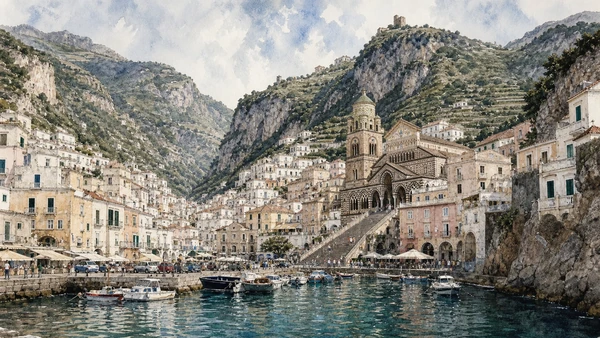
Port, cathedral, alleys and watercourse occupy scarce level ground between mountain and sea

Amalfi: a compact maritime city in a steep valley

Urban density records both maritime reach and environmental constraint.

Today

The centre is heavily visited and flood or weather conditions can affect access. Keep lanes, shop deliveries and emergency routes clear.

History

Amalfi became a major Mediterranean trading power in the early Middle Ages and developed institutions, law and religious patronage. Later political and coastal change reduced its reach without erasing the town.

How to read this place

Move from harbour inland and watch how streets narrow and climb beside the valley line. The cathedral stair marks scarce monumental space.

What to notice

  • Harbour opening into one narrow valley
  • Dense lanes climbing immediately from the shore
  • Cathedral terrace commanding limited civic ground
UNESCO · Costiera Amalfitana
Original documentary watercolour of Amalfi: a compact maritime city in a steep valley in Campania, showing accurate heritage, terrain and present-day use
Amalfi: a compact maritime city in a steep valleyOriginal Merlintravel documentary watercolour · 2026
02

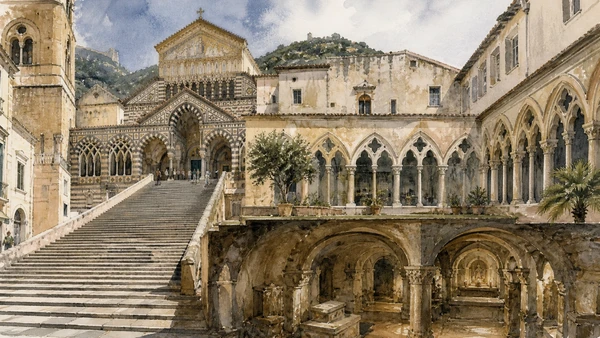
A monumental stair leads to a complex of church, crypt, older basilica and Paradise Cloister

Amalfi Cathedral: basilica, cloister and diocesan memory

Its striped and mosaic-rich façade is one phase in a long institution.

Today

Worship and ticketed museum areas have separate rules. Dress respectfully and check liturgical closures.

History

The cathedral developed around devotion to Saint Andrew and the power of the medieval city. Rebuilding, Baroque transformation and later restoration produced the present ensemble.

How to read this place

Read atrium, bronze doors, cloister and crypt in sequence. Separate surviving medieval fabric from nineteenth-century façade work.

What to notice

  • High stair creating a civic-sacred threshold
  • Cloister linking burial and Mediterranean forms
  • Crypt sustaining patronal devotion
Diocesi di Amalfi-Cava de’ Tirreni · Cathedral
Original documentary watercolour of Amalfi Cathedral: basilica, cloister and diocesan memory in Campania, showing accurate heritage, terrain and present-day use
Amalfi Cathedral: basilica, cloister and diocesan memoryOriginal Merlintravel documentary watercolour · 2026
03

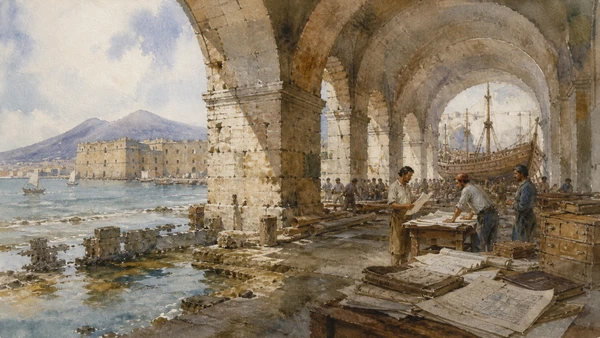
Vaulted waterfront spaces preserve the material scale of Amalfi’s naval history

The Arsenal: ships, documents and maritime institutions

The museum connects maritime law and exchange to construction and port geography.

Today

Opening and exhibition arrangements vary. Use current municipal information and respect event closures.

History

The medieval arsenal supported ships and maritime activity, while surviving bays represent only part of a changed waterfront. Civic collections interpret the republic and the Tavole Amalfitane tradition.

How to read this place

Compare vault dimensions with harbour access and imagine timber, rope and labour rather than empty monumental space.

What to notice

  • Stone vaults sized for maritime work
  • Changed shoreline altering original access
  • Documents connecting local port to wider trade
Comune di Amalfi · Arsenale della Repubblica
Original documentary watercolour of The Arsenal: ships, documents and maritime institutions in Campania, showing accurate heritage, terrain and present-day use
The Arsenal: ships, documents and maritime institutionsOriginal Merlintravel documentary watercolour · 2026
04

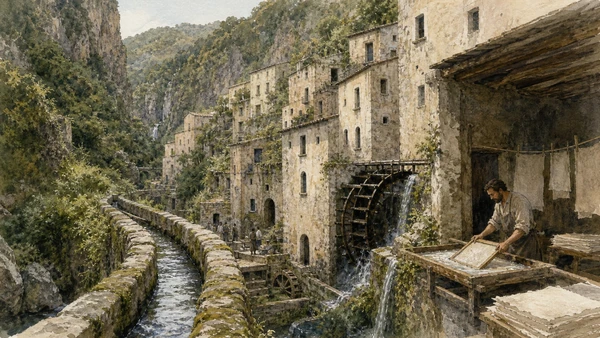
Streams above Amalfi powered mills and paper production within a narrow industrial valley

Valley of the Mills and paper: water as industry

The coast’s economy extended inland beyond seafaring.

Today

Trails can close after rain or maintenance and museum hours vary. Do not enter ruins or water channels outside authorised paths.

History

Paper production developed through water power, imported knowledge and local commerce. Workshops and mills changed as industrial conditions shifted, while some traditions survived through museums and specialist production.

How to read this place

Follow channels, building levels and humidity. Treat vegetation-covered ruins as industrial archaeology requiring safety and conservation.

What to notice

  • Water channels driving mill infrastructure
  • Multi-level buildings fitted into the valley
  • Paper craft linking imported technique to local power
Museo della Carta di Amalfi · Official museum
Original documentary watercolour of Valley of the Mills and paper: water as industry in Campania, showing accurate heritage, terrain and present-day use
Valley of the Mills and paper: water as industryOriginal Merlintravel documentary watercolour · 2026
05

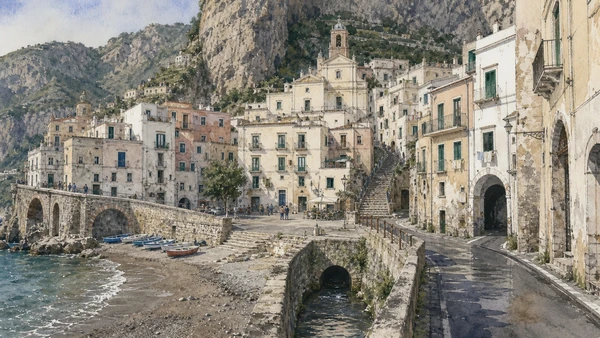
A small town compresses square, church, arches, houses and road infrastructure into a narrow valley mouth

Atrani: inhabited coastal fabric beside Amalfi

Its everyday scale corrects the idea that coastal beauty requires monumental villas.

Today

Respect residential quiet, keep the central square and stairways open and avoid entering private arches or courtyards.

History

Atrani developed in close relation to Amalfi while retaining its own civic and religious institutions. Floods, roads and coastal works repeatedly altered the valley mouth.

How to read this place

Look from beach to square and uphill church routes. The road viaduct and drainage are as important as façades.

What to notice

  • Square enclosed by dense inhabited buildings
  • Stairs rising directly from the valley floor
  • Road and drainage infrastructure crossing historic fabric
UNESCO · Costiera Amalfitana
Original documentary watercolour of Atrani: inhabited coastal fabric beside Amalfi in Campania, showing accurate heritage, terrain and present-day use
Atrani: inhabited coastal fabric beside AmalfiOriginal Merlintravel documentary watercolour · 2026
06

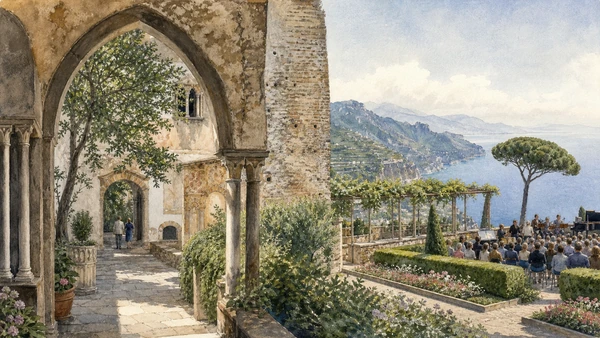
Medieval and later architecture frames gardens and controlled views from a high plateau

Ravello and Villa Rufolo: patronage above the coast

The celebrated panorama was produced through terracing, ownership and repeated garden design.

Today

Villa access is ticketed and events can restrict parts of the route. Stay on paths and respect planting and performance setup.

History

The Rufolo family created a major medieval residence later altered by new owners and revivalist restoration. Music and cultural programming added a modern identity.

How to read this place

Move through courtyards before the terrace so the view does not erase architecture. Distinguish medieval fabric from later garden composition.

What to notice

  • Courtyards mediating between town and terrace
  • Garden design framing selected coastal views
  • Modern performance use layered onto a historic residence
Villa Rufolo · Official foundation
Original documentary watercolour of Ravello and Villa Rufolo: patronage above the coast in Campania, showing accurate heritage, terrain and present-day use
Ravello and Villa Rufolo: patronage above the coastOriginal Merlintravel documentary watercolour · 2026
07

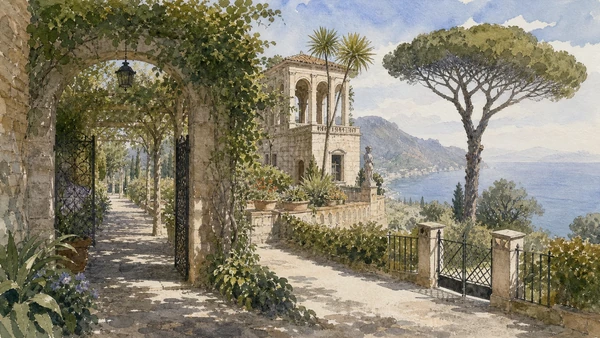
Terraces, sculpture and planting create a deliberate sequence toward the famous belvedere

Villa Cimbrone: a historic garden assembled through revival

Its apparent timelessness is largely the result of modern patronage and design.

Today

The garden is privately managed and ticketed; hotel areas remain restricted. Follow current visitor routes.

History

Older structures were transformed in the late nineteenth and early twentieth centuries through Ernest William Beckett’s patronage and a network of designers and craftspeople.

How to read this place

Read the garden as staged movement through gates, shade and openings. Label revival elements accurately rather than calling every feature medieval.

What to notice

  • Long designed sequence delaying the sea view
  • Revival architecture mixing historic references
  • Private hospitality and public garden access separated
Villa Cimbrone · Official site
Original documentary watercolour of Villa Cimbrone: a historic garden assembled through revival in Campania, showing accurate heritage, terrain and present-day use
Villa Cimbrone: a historic garden assembled through revivalOriginal Merlintravel documentary watercolour · 2026
08

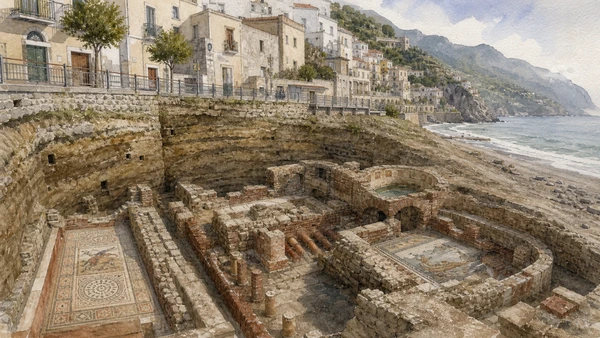
A Roman elite residence survives below modern town level near a watercourse and coast

Minori and the Roman maritime villa

Mosaics, baths and dining space reveal an ancient shoreline different from today’s.

Today

The state site follows current MiC hours and can close during weather or maintenance. Street level and archaeological level differ sharply.

History

The villa developed in the early imperial period and was altered over centuries. Alluvial deposits and later settlement buried it before modern discovery.

How to read this place

Use floor levels, mosaic rooms and water systems to reconstruct the coastal estate. Compare the excavation edge with the town above.

What to notice

  • Roman rooms below present urban grade
  • Mosaic and bath systems preserving elite use
  • Alluvial burial changing the coastline
Direzione regionale Musei nazionali Campania · Villa romana di Minori
Original documentary watercolour of Minori and the Roman maritime villa in Campania, showing accurate heritage, terrain and present-day use
Minori and the Roman maritime villaOriginal Merlintravel documentary watercolour · 2026
09

Houses, stairs, church and beach occupy a steep amphitheatre with limited road and public space

Positano: vertical settlement and visitor pressure

The iconic view depends on resident movement, drainage and service labour.

Today

Arrivals by road and sea are capacity- and weather-sensitive. Keep stairs and luggage routes clear and avoid private terraces.

History

The settlement developed through maritime, agricultural and religious life and was later reshaped by emigration, tourism and new construction. The church area preserves archaeological evidence beneath the modern centre.

How to read this place

Climb one public stair route and track how supplies move. Compare the famous façade layers with retaining walls and water management.

What to notice

  • Dense buildings stepping down a steep basin
  • Public stairs functioning as principal streets
  • Beach landing constrained by sea and crowd conditions
Italia.it · Positano and the Amalfi Coast
Original documentary watercolour of Positano: vertical settlement and visitor pressure in Campania, showing accurate heritage, terrain and present-day use
Positano: vertical settlement and visitor pressureOriginal Merlintravel documentary watercolour · 2026
10

Dry-stone walls, pergolas and foot routes hold a productive landscape on severe slopes

Terraces, lemons and high paths: agriculture before panorama

The famous paths cross working and fragile territory rather than free scenic space.

Today

Check official trail status, heat, landslide and transport conditions. Stay off private terraces, close gates and do not pick produce.

History

Generations constructed terraces to retain soil, manage water and cultivate vines, citrus and other crops. Footpaths linked scattered settlements before modern roads.

How to read this place

Look at wall maintenance, irrigation, access stairs and abandoned plots. A view should include the labour and risk that sustain it.

What to notice

  • Dry-stone walls retaining thin soils
  • Lemon pergolas creating productive shade
  • Footpaths linking farms and high settlements
UNESCO · Costiera Amalfitana
Original documentary watercolour of Terraces, lemons and high paths: agriculture before panorama in Campania, showing accurate heritage, terrain and present-day use
Terraces, lemons and high paths: agriculture before panoramaOriginal Merlintravel documentary watercolour · 2026

The landscape through time

A short chronology

A documented sequence from ancient settlement and environmental formation to modern conservation, mobility and resident life.

  1. Maritime villas and roads occupy selected coastal terraces and valley mouths.

  2. Amalfi is documented within the early medieval political landscape of southern Italy.

  3. The independent duchy expands maritime power and Mediterranean exchange.

  4. Amalfi’s commercial networks and legal traditions reach their greatest influence.

  5. Norman conquest changes political control while local maritime activity continues.

  6. Pisan attack and wider political change weaken Amalfi’s autonomous power.

  7. A destructive sea event damages the coastline and enters later historical memory.

  8. Terraces, monasteries, mills and compact towns intensify use of steep land.

  9. Elite travel and landscape description increase external attention to the coast.

  10. Road building changes access while paper, agriculture and maritime livelihoods adapt.

  11. Foreign patrons reshape villas and gardens at Ravello.

  12. Tourism, new housing and road traffic transform coastal economies.

  13. The Costiera Amalfitana is inscribed on the UNESCO World Heritage List.

  14. Seasonal congestion and trail pressure intensify debate over mobility and resident life.

  15. Conservation, slope stability, water, transport capacity and agricultural continuity remain connected challenges.

Before your visit

Practical information

01

Use only official tickets

Avoid resellers and verify timed-entry, named-ticket or same-day rules on the managing institution’s current site.

02

Keep a weather alternative

Heat, wind, sea state, volcanic conditions and heavy rain can change exposed archaeological, coastal and mountain routes.

03

Respect protected land

Stay on open paths, do not remove stone, plants or archaeological material and follow marine or park zoning.

04

Plan realistic transport

Rail, bus, ferry and road congestion vary sharply by season; do not combine distant chapters without a live connection check.

05

Protect resident access

Homes, farms, markets and working harbours are not sets; keep gates, lanes and deliveries clear and photograph people only with consent.

06

Separate fact from tradition

Legends and local narratives are identified as cultural evidence and are not substituted for archaeological, geological or archival proof.

Method and sources

Sources and image credits

This guide uses current documentation from the managing archaeological park, museum, ministry, UNESCO property, civil-protection authority, protected-area body or transport institution, checked on 29 August 2026. Claims are cross-checked against at least one second primary or institutional source where available. The guide separates current access from durable history and distinguishes surviving fabric from reconstruction, restoration, legend and promotional simplification.

All ten images are original Merlintravel editorial watercolours based on documented present-day conditions. They are illustrations, not substitutes for archaeological plans. Opening hours, tickets, accessible routes, temporary exhibitions and conservation work can change; consult the linked official pages shortly before visiting.