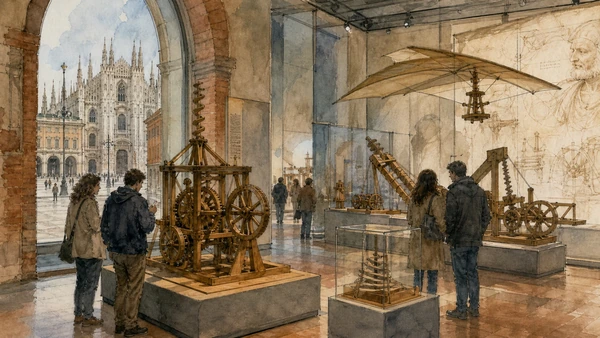
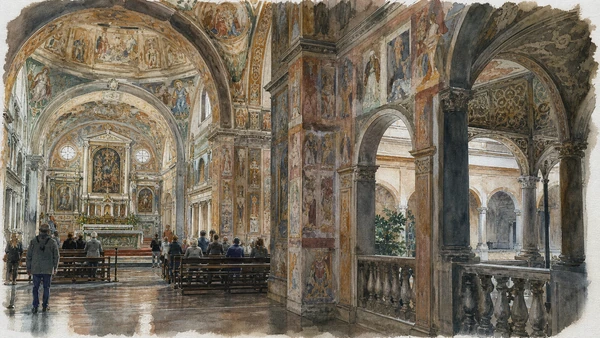
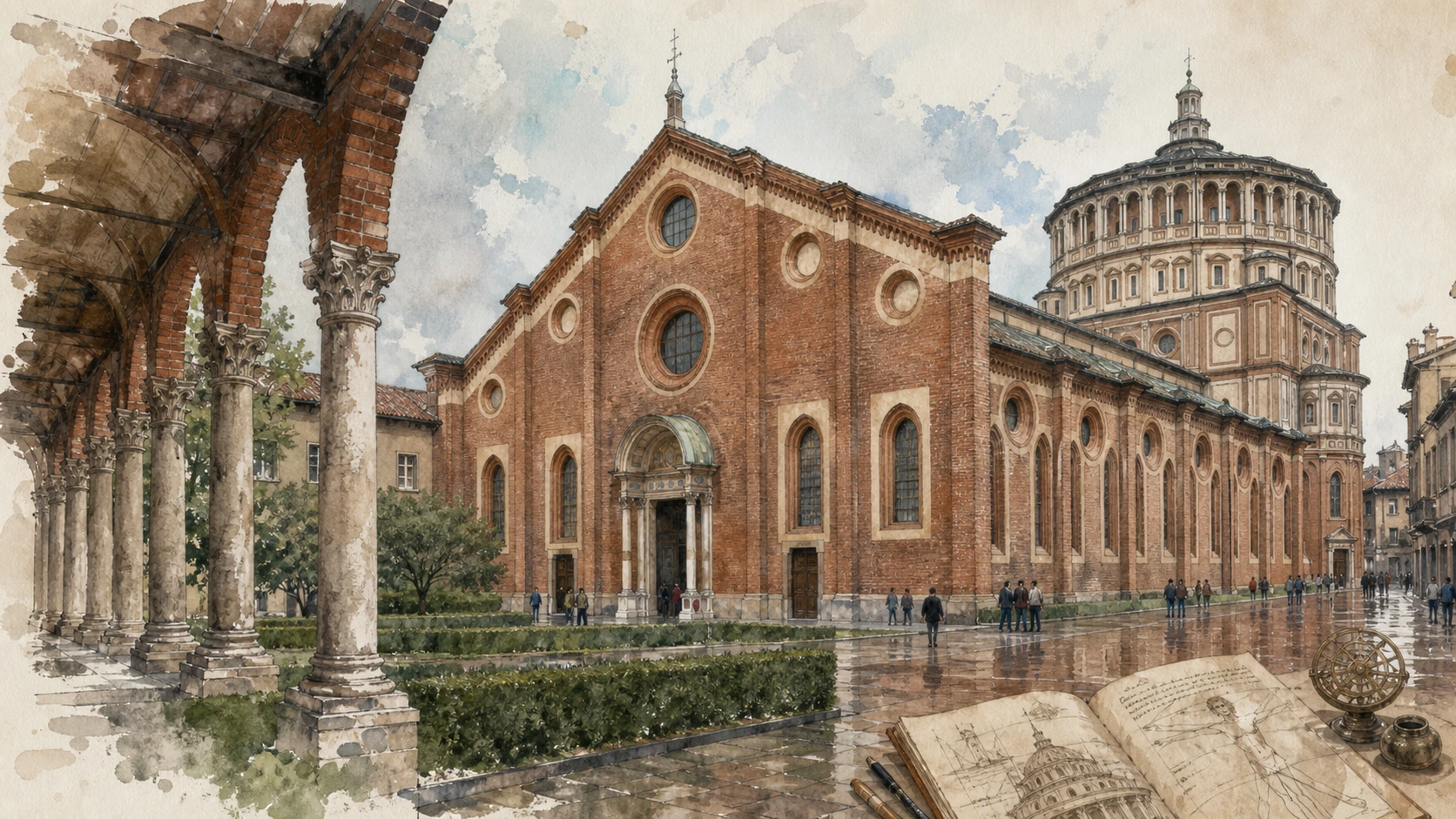
Original documentary watercolour panorama for Milan Santa Maria delle Grazie, the Last Supper and Leonardo: Complete Guide, with accurate Lombardy architecture, landscape and lived context

Milan Guide 04 · Dominican complex, controlled conservation, court networks, manuscripts, science and documented reception

Santa Maria delle Grazie,
the Last Supper & Leonardo

A complete evidence-led route from the Dominican church and refectory to Leonardo’s Milanese networks, Ambrosiana manuscripts and the national science museum, separating surviving works from copies, models and popular myth.

Plan the route
Milan · Lombardy10 chapters · one complete route

Why this route must be read in layers

Leonardo’s Milan survives through a small number of fragile works, dispersed manuscripts, documented court projects and later reconstructions; abundance in popular culture must not be confused with original material.

Santa Maria delle Grazie combines Solari’s Lombard church with the great tribune traditionally associated with Bramante and a Dominican complex still used for worship. The refectory preserves the Last Supper under tightly controlled museum access.

The painting’s experimental technique produced early deterioration. Damage, environmental exposure and repeated restorations mean that the visible surface is the outcome of survival and conservation, not a pristine Renaissance object.

The Ambrosiana and science museum provide different forms of evidence: original sheets and paintings on one side, later physical models and interpretive galleries on the other. Both are valuable when labelled accurately.

Reserve the constrained refectory visit first, then build the rest of the day around churches, manuscripts and museums without turning every mechanical model into an original Leonardo object.

The route

Plan your visit

Begin with the church and controlled Cenacolo route, then follow documented court, manuscript and technological evidence across the western historic centre.

Early morning

Santa Maria delle Grazie · The Last Supper · Cenacolo conservation

Move in the documented order: Santa Maria delle Grazie: Dominican church and living worship; then The Last Supper: a fragile wall painting under controlled access; then Cenacolo conservation: what the visitor actually sees. Recheck live access and transport before entering a controlled site.

Late morning

The tribune and cloisters · Leonardo at the Sforza court · Pinacoteca Ambrosiana

Move in the documented order: The tribune and cloisters: architecture of Sforza ambition; then Leonardo at the Sforza court: work across disciplines; then Pinacoteca Ambrosiana: portrait, copy and collection history. Recheck live access and transport before entering a controlled site.

Afternoon

Codex Atlanticus · National Science Museum · Leonardo models

Move in the documented order: Codex Atlanticus: dispersed thought gathered into one corpus; then National Science Museum: interpretation inside a former monastery; then Leonardo models: twentieth-century interpretation, not Renaissance objects. Recheck live access and transport before entering a controlled site.

Late afternoon

San Maurizio al Monastero Maggiore

Move in the documented order: San Maurizio al Monastero Maggiore: painting in Leonardo’s Milan. Recheck live access and transport before entering a controlled site.

Ten chapters

Explore the places

The order follows terrain, institutions and present-day movement. Use the index to return to a chapter without reducing the route to isolated monuments.

  1. 01Santa Maria delle Grazie: Dominican church and living worship
  2. 02The Last Supper: a fragile wall painting under controlled access
  3. 03Cenacolo conservation: what the visitor actually sees
  4. 04The tribune and cloisters: architecture of Sforza ambition
  5. 05Leonardo at the Sforza court: work across disciplines
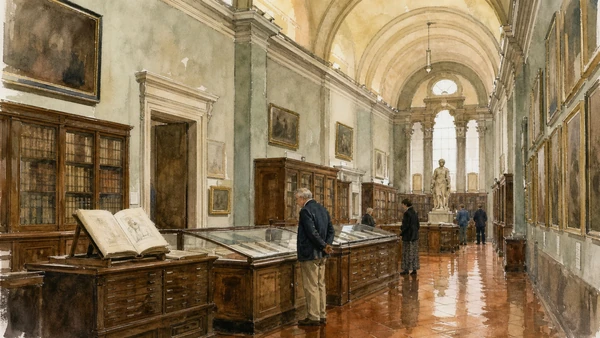
  6. 06Pinacoteca Ambrosiana: portrait, copy and collection history
  7. 07Codex Atlanticus: dispersed thought gathered into one corpus
  8. 08National Science Museum: interpretation inside a former monastery
  9. 09Leonardo models: twentieth-century interpretation, not Renaissance objects
  10. 10San Maurizio al Monastero Maggiore: painting in Leonardo’s Milan
01

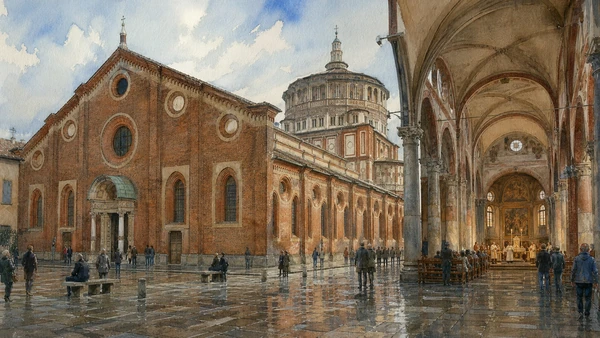
Nave, chapels, cloisters and tribune combine distinct building campaigns within an active religious institution.

Santa Maria delle Grazie: Dominican church and living worship

Nave, chapels, cloisters and tribune combine distinct building campaigns within an active religious institution. The site becomes clearer when its surviving fabric, later alterations and present use are read together.

Today

This is an active religious place as well as a historic building. Services, ceremonies and conservation can interrupt tourist access; dress appropriately, remain quiet and never treat a booked visit as priority over worship.

History

The Dominican complex developed in the later fifteenth century under ducal patronage. Solari’s church was followed by an ambitious eastern transformation associated with the Sforza court.

How to read this place

Begin with the brick nave and side chapels. Then compare the changed scale of the tribune with cloister and convent boundaries; the differences are evidence, not visual noise.

What to notice

  • the brick nave and side chapels
  • the changed scale of the tribune
  • cloister and convent boundaries
Santa Maria delle Grazie · Official Dominican community
Original documentary watercolour of Santa Maria delle Grazie: Dominican church and living worship in Milan · Lombardy, showing accurate architecture, landscape, people and present-day use
Santa Maria delle Grazie: Dominican church and living worshipOriginal Merlintravel documentary watercolour · 2026
02

Leonardo’s composition occupies the refectory wall opposite the Crucifixion and must be seen within the room’s monastic function.

The Last Supper: a fragile wall painting under controlled access

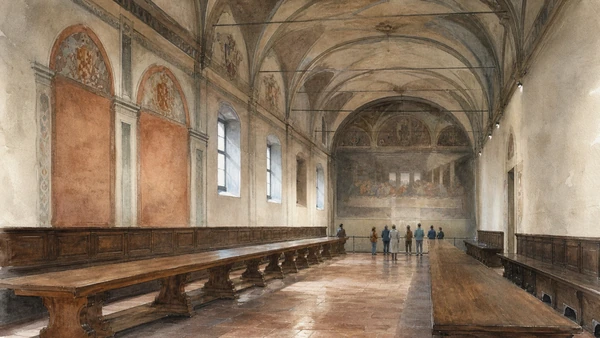
Leonardo’s composition occupies the refectory wall opposite the Crucifixion and must be seen within the room’s monastic function. The site becomes clearer when its surviving fabric, later alterations and present use are read together.

Today

Opening, ticketing, room access and temporary displays can change. Check the institution’s official notice shortly before visiting, use the designated entrance and allow for security or conservation controls.

History

Painted in the 1490s with an experimental technique, the work deteriorated early and survived alteration, wartime damage and multiple restoration campaigns.

How to read this place

Begin with the painting’s architectural perspective. Then compare the relationship to the refectory with areas of surviving paint and loss; the differences are evidence, not visual noise.

What to notice

  • the painting’s architectural perspective
  • the relationship to the refectory
  • areas of surviving paint and loss
Ministero della Cultura · Museo del Cenacolo Vinciano
Original documentary watercolour of The Last Supper: a fragile wall painting under controlled access in Milan · Lombardy, showing accurate architecture, landscape, people and present-day use
The Last Supper: a fragile wall painting under controlled accessOriginal Merlintravel documentary watercolour · 2026
03

Environmental control, limited dwell time and extensive conservation are part of the work’s survival rather than obstacles to a normal visit.

Cenacolo conservation: what the visitor actually sees

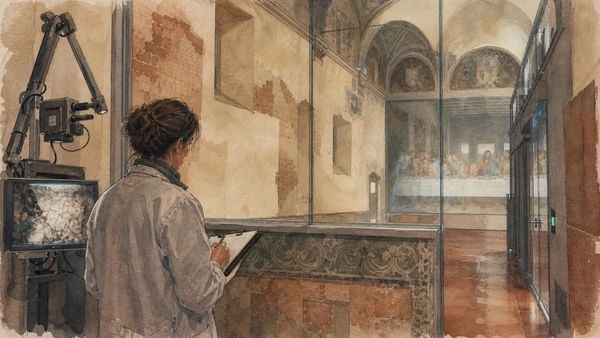
Environmental control, limited dwell time and extensive conservation are part of the work’s survival rather than obstacles to a normal visit. The site becomes clearer when its surviving fabric, later alterations and present use are read together.

Today

Opening, ticketing, room access and temporary displays can change. Check the institution’s official notice shortly before visiting, use the designated entrance and allow for security or conservation controls.

History

Scientific study and the long restoration completed around the turn of the twenty-first century removed unstable additions and clarified the limited original surface.

How to read this place

Begin with controlled doors and room climate. Then compare variations in the painted surface with the documentary explanation of restoration; the differences are evidence, not visual noise.

What to notice

  • controlled doors and room climate
  • variations in the painted surface
  • the documentary explanation of restoration
Ministero della Cultura · Museo del Cenacolo Vinciano
Original documentary watercolour of Cenacolo conservation: what the visitor actually sees in Milan · Lombardy, showing accurate architecture, landscape, people and present-day use
Cenacolo conservation: what the visitor actually seesOriginal Merlintravel documentary watercolour · 2026
04

A monumental eastern volume and related cloister spaces recast the earlier church as a dynastic and courtly project.

The tribune and cloisters: architecture of Sforza ambition

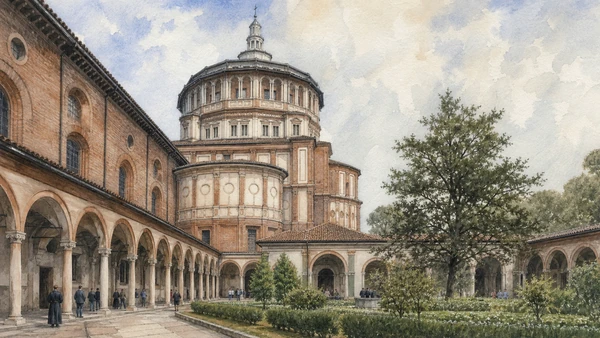
A monumental eastern volume and related cloister spaces recast the earlier church as a dynastic and courtly project. The site becomes clearer when its surviving fabric, later alterations and present use are read together.

Today

This is an active religious place as well as a historic building. Services, ceremonies and conservation can interrupt tourist access; dress appropriately, remain quiet and never treat a booked visit as priority over worship.

History

Ludovico Sforza’s patronage supported expansion commonly connected to Bramante. Attribution, workshop and later restoration should be read through institutional scholarship rather than simple labels.

How to read this place

Begin with the exterior drum and terracotta detail. Then compare interior spatial hierarchy with the relationship between church and convent; the differences are evidence, not visual noise.

What to notice

  • the exterior drum and terracotta detail
  • interior spatial hierarchy
  • the relationship between church and convent
Santa Maria delle Grazie · Official Dominican community
Original documentary watercolour of The tribune and cloisters: architecture of Sforza ambition in Milan · Lombardy, showing accurate architecture, landscape, people and present-day use
The tribune and cloisters: architecture of Sforza ambitionOriginal Merlintravel documentary watercolour · 2026
05

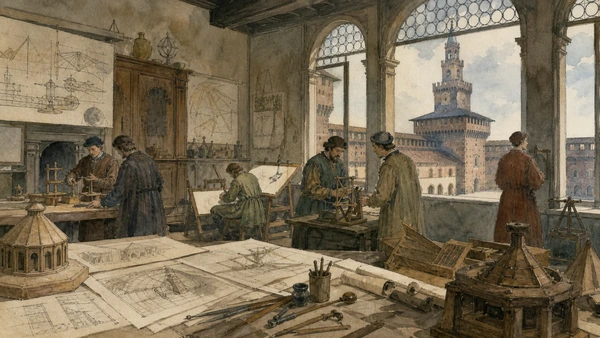
Painting, festivities, engineering, military design and water studies belonged to a court service network rather than a modern single-profession career.

Leonardo at the Sforza court: work across disciplines

Painting, festivities, engineering, military design and water studies belonged to a court service network rather than a modern single-profession career. The site becomes clearer when its surviving fabric, later alterations and present use are read together.

Today

Opening, ticketing, room access and temporary displays can change. Check the institution’s official notice shortly before visiting, use the designated entrance and allow for security or conservation controls.

History

Leonardo worked in Milan across long periods from the 1480s, serving ducal patrons and collaborating with administrators, artisans, architects and performers.

How to read this place

Begin with documented commissions and patrons. Then compare projects preserved only on paper with later stories unsupported by surviving evidence; the differences are evidence, not visual noise.

What to notice

  • documented commissions and patrons
  • projects preserved only on paper
  • later stories unsupported by surviving evidence
Veneranda Biblioteca Ambrosiana · Official site
Original documentary watercolour of Leonardo at the Sforza court: work across disciplines in Milan · Lombardy, showing accurate architecture, landscape, people and present-day use
Leonardo at the Sforza court: work across disciplinesOriginal Merlintravel documentary watercolour · 2026
07

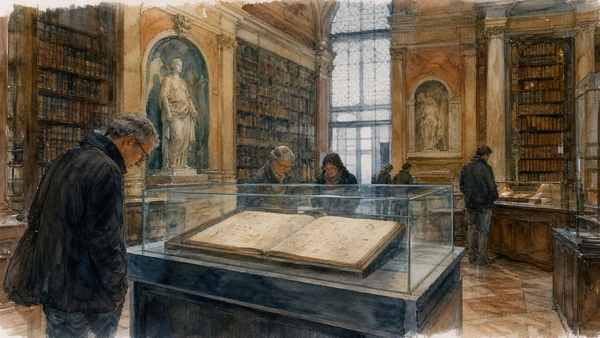
Drawings and notes document machines, geometry, architecture and observation without forming a finished technical manual.

Codex Atlanticus: dispersed thought gathered into one corpus

Drawings and notes document machines, geometry, architecture and observation without forming a finished technical manual. The site becomes clearer when its surviving fabric, later alterations and present use are read together.

Today

Opening, ticketing, room access and temporary displays can change. Check the institution’s official notice shortly before visiting, use the designated entrance and allow for security or conservation controls.

History

The sheets were assembled by Pompeo Leoni after Leonardo’s death and later entered the Ambrosiana. Conservation and rotation limit which originals are displayed.

How to read this place

Begin with the scale and direction of individual sheets. Then compare notations beside drawings with display conditions and facsimile labels; the differences are evidence, not visual noise.

What to notice

  • the scale and direction of individual sheets
  • notations beside drawings
  • display conditions and facsimile labels
Veneranda Biblioteca Ambrosiana · Official site
Original documentary watercolour of Codex Atlanticus: dispersed thought gathered into one corpus in Milan · Lombardy, showing accurate architecture, landscape, people and present-day use
Codex Atlanticus: dispersed thought gathered into one corpusOriginal Merlintravel documentary watercolour · 2026
08

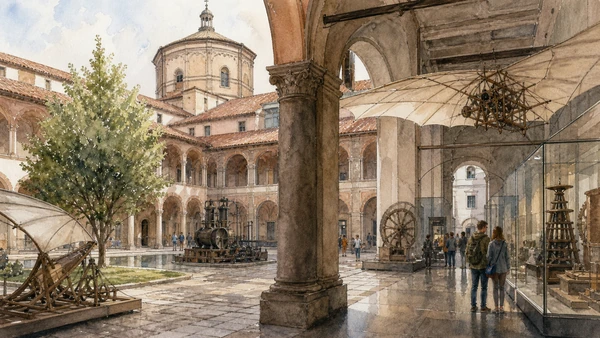
Historic transport, energy and communication collections provide the institutional setting for galleries devoted to Leonardo.

National Science Museum: interpretation inside a former monastery

Historic transport, energy and communication collections provide the institutional setting for galleries devoted to Leonardo. The site becomes clearer when its surviving fabric, later alterations and present use are read together.

Today

Opening, ticketing, room access and temporary displays can change. Check the institution’s official notice shortly before visiting, use the designated entrance and allow for security or conservation controls.

History

The museum opened in the 1950s in the restored monastery of San Vittore, linking post-war scientific education to industrial and technological collections.

How to read this place

Begin with the adapted monastic architecture. Then compare original historic machines in the wider collections with the separate leonardo interpretation galleries; the differences are evidence, not visual noise.

What to notice

  • the adapted monastic architecture
  • original historic machines in the wider collections
  • the separate Leonardo interpretation galleries
Museo Nazionale Scienza e Tecnologia Leonardo da Vinci
Original documentary watercolour of National Science Museum: interpretation inside a former monastery in Milan · Lombardy, showing accurate architecture, landscape, people and present-day use
National Science Museum: interpretation inside a former monasteryOriginal Merlintravel documentary watercolour · 2026
09

Physical reconstructions translate drawings into three dimensions but necessarily add materials, scale and engineering choices.

Leonardo models: twentieth-century interpretation, not Renaissance objects

Physical reconstructions translate drawings into three dimensions but necessarily add materials, scale and engineering choices. The site becomes clearer when its surviving fabric, later alterations and present use are read together.

Today

Opening, ticketing, room access and temporary displays can change. Check the institution’s official notice shortly before visiting, use the designated entrance and allow for security or conservation controls.

History

Many models were developed for exhibitions and museums from the twentieth century onward, especially around commemorative displays of Leonardo’s technical studies.

How to read this place

Begin with the drawing cited for each model. Then compare modern construction materials with choices required where the sheet is ambiguous; the differences are evidence, not visual noise.

What to notice

  • the drawing cited for each model
  • modern construction materials
  • choices required where the sheet is ambiguous
Museo Nazionale Scienza e Tecnologia Leonardo da Vinci
Original documentary watercolour of Leonardo models: twentieth-century interpretation, not Renaissance objects in Milan · Lombardy, showing accurate architecture, landscape, people and present-day use
Leonardo models: twentieth-century interpretation, not Renaissance objectsOriginal Merlintravel documentary watercolour · 2026
10

A richly painted convent church preserves work by Lombard artists shaped by courtly and Leonardesque visual culture.

San Maurizio al Monastero Maggiore: painting in Leonardo’s Milan

A richly painted convent church preserves work by Lombard artists shaped by courtly and Leonardesque visual culture. The site becomes clearer when its surviving fabric, later alterations and present use are read together.

Today

This is an active religious place as well as a historic building. Services, ceremonies and conservation can interrupt tourist access; dress appropriately, remain quiet and never treat a booked visit as priority over worship.

History

The Benedictine complex developed over ancient and medieval layers; sixteenth-century campaigns transformed the church with extensive fresco cycles and a divided monastic space.

How to read this place

Begin with the partition between public and monastic zones. Then compare painted architectural illusion with documented artists rather than generic leonardo attribution; the differences are evidence, not visual noise.

What to notice

  • the partition between public and monastic zones
  • painted architectural illusion
  • documented artists rather than generic Leonardo attribution
Comune di Milano · Civic museums and exhibition spaces
Original documentary watercolour of San Maurizio al Monastero Maggiore: painting in Leonardo's Milan in Milan · Lombardy, showing accurate architecture, landscape, people and present-day use
San Maurizio al Monastero Maggiore: painting in Leonardo’s MilanOriginal Merlintravel documentary watercolour · 2026

Milan through time

A short chronology

From Insubrian settlement and imperial Mediolanum to the ducal court, industrial metropolis, wartime rupture and contemporary redevelopment.

  1. An Insubrian settlement develops on the plain at the crossing of routes later absorbed by Roman Mediolanum.

  2. Roman forces take Mediolanum, which grows into a major Cisalpine administrative and commercial centre.

  3. Milan becomes an imperial residence in the western Roman Empire and gains palace, circus, baths and monumental infrastructure.

  4. The agreement associated with Constantine and Licinius establishes religious toleration and becomes inseparable from Milan’s Christian memory.

  5. Ambrose serves as bishop; basilicas, burial places and episcopal authority reshape the late-antique city.

  6. Frederick Barbarossa’s forces destroy much of Milan; reconstruction and communal institutions subsequently re-form the city.

  7. Visconti power becomes dominant, beginning a long phase of ducal patronage, fortification and territorial government.

  8. Construction of the Duomo begins, creating a building site and civic-religious institution that continue across centuries.

  9. Sforza rule renews the castle and court while artists, engineers and scholars, including Leonardo, work within ducal networks.

  10. Spanish Habsburg administration reshapes government, defence, religion and the social geography of the city.

  11. French and Napoleonic rule reorganises institutions, collections, ceremonial space and Milan’s role in northern Italy.

  12. Austrian rule ends and Milan enters the Kingdom of Italy, accelerating railway, industrial and civic expansion.

  13. The present Milano Centrale opens as a monumental transport complex within a rapidly expanding metropolis.

  14. Bombing, occupation, resistance and liberation damage monuments, housing and industry and leave a difficult memorial landscape.

  15. Post-war migration, design and manufacturing, deindustrialisation, Expo 2015 and metropolitan redevelopment repeatedly transform the city.

Before your visit

Practical information

01

Check the live page

Opening hours, reservation systems, restoration, exhibitions and transport can change. Recheck the linked official institution shortly before departure.

02

Separate worship and tourism

Churches and sanctuaries remain religious spaces. Services, funerals and community use take priority over visitor itineraries.

03

Plan real distances

Milan · Lombardy combines dense urban routes with lakes, valleys and dispersed towns. Do not compress distant chapters into an unsafe or superficial day.

04

Keep thresholds open

Arcades, station halls, markets, courtyards, workshops and residential streets must continue to function while you observe or photograph them.

05

Use current mobility data

Check the responsible rail, navigation, bus, road or park operator on the day; replacement services and weather can change an otherwise sound route.

06

Read change honestly

Restoration, reconstruction, adaptive reuse and new development have all shaped the landscape visible today.

Method and sources

Sources and image credits

This guide uses official museum, ministry, municipal, transport, park and UNESCO documentation checked on 29 August 2026. It separates durable historical interpretation from access details that can change, distinguishes surviving fabric from restoration or reconstruction, and treats worship, work, residence and public movement as part of the evidence. Every chapter links its principal institutional source; tickets, closures, weather and transport must always be verified again on the day of the visit.

All ten images are original Merlintravel editorial watercolours based on documented present-day conditions. They are illustrations, not substitutes for archaeological plans. Opening hours, tickets, accessible routes, temporary exhibitions and conservation work can change; consult the linked official pages shortly before visiting.