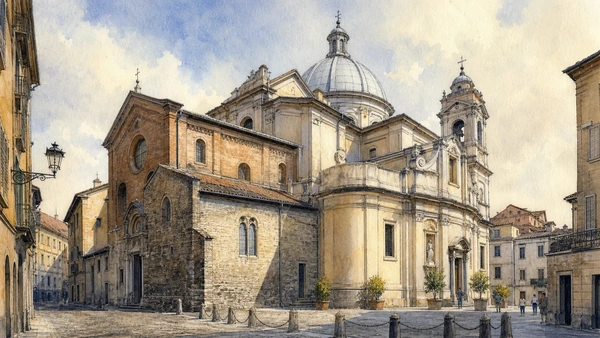
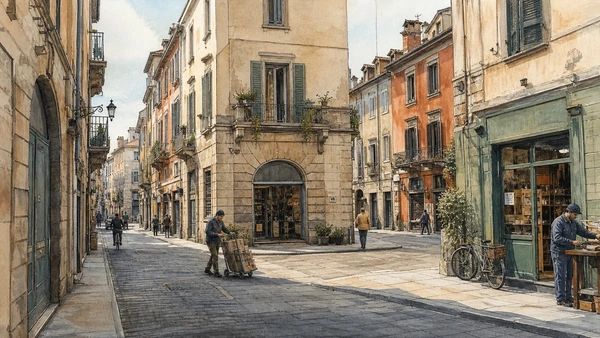
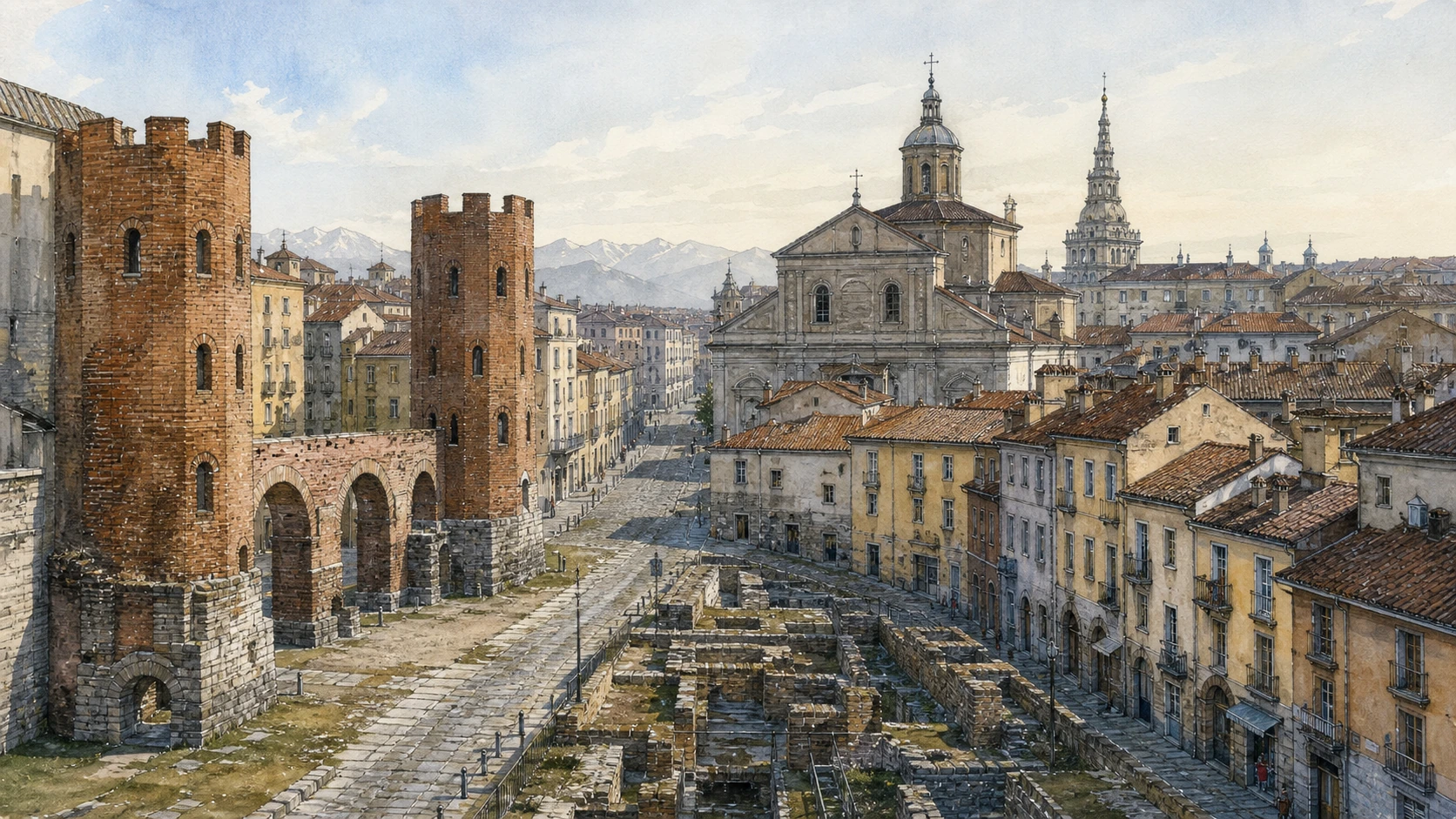
Original documentary watercolour panorama for Roman Turin, the Cathedral and the Quadrilatero: Complete Guide, with accurate Piedmont architecture, landscape and lived context

Turin Guide 01 · Roman gate and theatre, cathedral, Shroud Chapel, episcopal centre and the inhabited medieval grid

Roman Turin, the Cathedral
& the Quadrilatero

A complete walk through the north-western core of Turin, beginning with Augusta Taurinorum’s gate and street geometry before reading the cathedral, archaeological remains, Guarini’s Shroud Chapel and the dense inhabited fabric of the Quadrilatero.

Plan the route
Turin · Piedmont10 chapters · one complete route

Why this route must be read in layers

Turin’s oldest centre is not a preserved Roman set: ancient walls, medieval churches, Savoy rebuilding, markets, migration and nightlife occupy the same compact blocks.

Porta Palatina and the theatre make the Roman colony visible, but both survive through excavation, reconstruction and later urban clearance. The regular grid remains more extensive than the isolated monuments.

The cathedral and Shroud Chapel join worship, dynastic representation, fire damage and conservation. The Shroud’s identity belongs to religious tradition; consult the institution’s current information about its display.

The Quadrilatero contains homes, shops, worship and evening activity. A responsible route reads thresholds and reused fabric while leaving courtyards, services and resident movement unobstructed.

Begin at the Roman gate in quiet morning light, continue through the protected archaeological and cathedral areas, then cross the Quadrilatero without treating an inhabited district as a museum enclosure.

The route

Plan your visit

Start outside Porta Palatina, follow the Roman and episcopal edge, enter controlled religious spaces only when open, then read medieval and modern street life west of Via Milano.

Early morning

Porta Palatina · The Roman grid · Roman theatre

Move in the documented order: Porta Palatina: the Roman city gate; then The Roman grid: streets as the largest surviving artefact; then Roman theatre: performance behind the royal quarter. Recheck live access and transport before entering a controlled site.

Late morning

Archaeological Museum · Cathedral of Saint John the Baptist · Chapel of the Holy Shroud

Move in the documented order: Archaeological Museum: objects returned to context; then Cathedral of Saint John the Baptist: Renaissance church and active worship; then Chapel of the Holy Shroud: Guarini, fire and restoration. Recheck live access and transport before entering a controlled site.

Afternoon

The episcopal area · San Domenico · Consolata

Move in the documented order: The episcopal area: several churches beneath one centre; then San Domenico: medieval fabric inside the planned capital; then Consolata: sanctuary, city devotion and architectural layering. Recheck live access and transport before entering a controlled site.

Late afternoon

Quadrilatero Romano

Move in the documented order: Quadrilatero Romano: an inhabited historic grid. Recheck live access and transport before entering a controlled site.

Ten chapters

Explore the places

The order follows terrain, institutions and present-day movement. Use the index to return to a chapter without reducing the route to isolated monuments.

  1. 01Porta Palatina: the Roman city gate
  2. 02The Roman grid: streets as the largest surviving artefact
  3. 03Roman theatre: performance behind the royal quarter
  4. 04Archaeological Museum: objects returned to context
  5. 05Cathedral of Saint John the Baptist: Renaissance church and active worship
  6. 06Chapel of the Holy Shroud: Guarini, fire and restoration
  7. 07The episcopal area: several churches beneath one centre
  8. 08San Domenico: medieval fabric inside the planned capital
  9. 09Consolata: sanctuary, city devotion and architectural layering
  10. 10Quadrilatero Romano: an inhabited historic grid
01

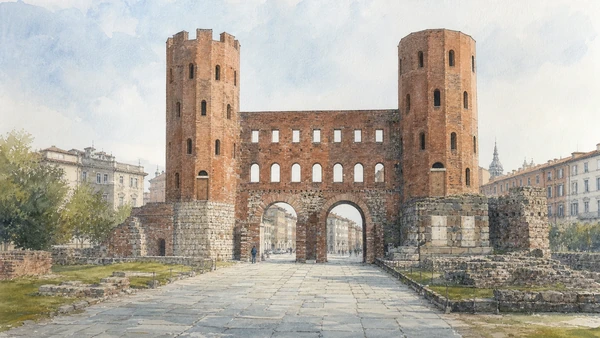
Twin towers and central arches mark the northern entrance to Augusta Taurinorum and anchor the surviving street grid.

Porta Palatina: the Roman city gate

Twin towers and central arches mark the northern entrance to Augusta Taurinorum and anchor the surviving street grid. The site becomes clearer when its surviving fabric, later alterations and present use are read together.

Today

Archaeological access may be limited to protected viewpoints, scheduled openings or guided routes. Stay outside barriers, distinguish original material from supports and reconstruction, and verify the official opening notice.

History

The gate was built in the Roman imperial period and passed through medieval reuse, later additions and modern restoration before the surrounding archaeological park opened it to public view.

How to read this place

Begin with the gate’s separate construction phases. Then compare the road axis continuing into the city with modern open space created around the monument; the differences are evidence, not visual noise.

What to notice

  • the gate’s separate construction phases
  • the road axis continuing into the city
  • modern open space created around the monument
Musei Reali Torino · Ministry of Culture
Original documentary watercolour of Porta Palatina: the Roman city gate in Turin · Piedmont, showing accurate architecture, landscape, people and present-day use
Porta Palatina: the Roman city gateOriginal Merlintravel documentary watercolour · 2026
02

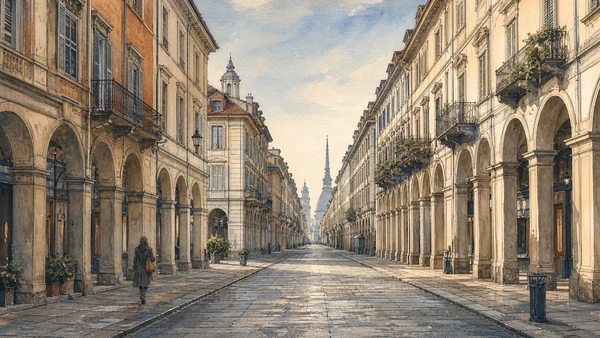
Via Garibaldi and the surrounding blocks retain orientations inherited from the colony even where buildings are much later.

The Roman grid: streets as the largest surviving artefact

Via Garibaldi and the surrounding blocks retain orientations inherited from the colony even where buildings are much later. The site becomes clearer when its surviving fabric, later alterations and present use are read together.

Today

The area is inhabited and worked, not staged for visitors. Keep doorways, pavements, cycle lanes and deliveries clear, ask before photographing people and use current municipal mobility information.

History

Augusta Taurinorum was laid out with intersecting principal streets and regular blocks; medieval property and Baroque rebuilding altered parcels without completely erasing the framework.

How to read this place

Begin with the long east-west axis. Then compare narrow cross streets and block depth with later arcades and façades laid over ancient orientation; the differences are evidence, not visual noise.

What to notice

  • the long east-west axis
  • narrow cross streets and block depth
  • later arcades and façades laid over ancient orientation
Città di Torino · Official portal
Original documentary watercolour of The Roman grid: streets as the largest surviving artefact in Turin · Piedmont, showing accurate architecture, landscape, people and present-day use
The Roman grid: streets as the largest surviving artefactOriginal Merlintravel documentary watercolour · 2026
03

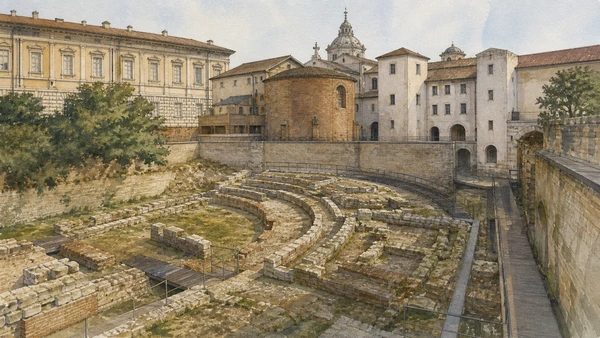
Protected remains reveal a major public building now enclosed by museums, cathedral structures and later service routes.

Roman theatre: performance behind the royal quarter

Protected remains reveal a major public building now enclosed by museums, cathedral structures and later service routes. The site becomes clearer when its surviving fabric, later alterations and present use are read together.

Today

Archaeological access may be limited to protected viewpoints, scheduled openings or guided routes. Stay outside barriers, distinguish original material from supports and reconstruction, and verify the official opening notice.

History

The theatre developed during the Roman city and was gradually buried and reused; archaeological campaigns exposed portions while later royal and museum buildings remained in place.

How to read this place

Begin with curved seating and structural walls. Then compare the relationship to the roman gate with modern supports and museum boundaries; the differences are evidence, not visual noise.

What to notice

  • curved seating and structural walls
  • the relationship to the Roman gate
  • modern supports and museum boundaries
Musei Reali Torino · Ministry of Culture
Original documentary watercolour of Roman theatre: performance behind the royal quarter in Turin · Piedmont, showing accurate architecture, landscape, people and present-day use
Roman theatre: performance behind the royal quarterOriginal Merlintravel documentary watercolour · 2026
04

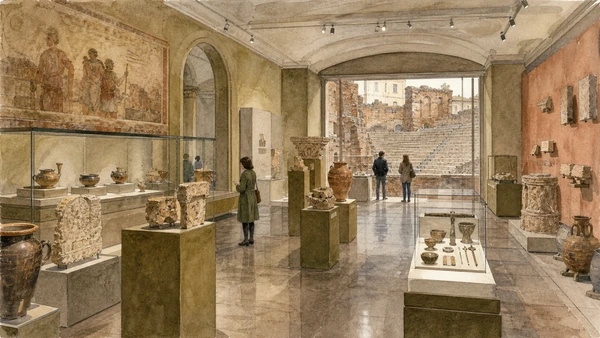
Regional collections connect Turin’s visible ruins to settlements, burials, roads and material culture across Piedmont.

Archaeological Museum: objects returned to context

Regional collections connect Turin’s visible ruins to settlements, burials, roads and material culture across Piedmont. The site becomes clearer when its surviving fabric, later alterations and present use are read together.

Today

Opening, ticketing, room access and temporary displays can change. Check the institution’s official notice shortly before visiting, use the designated entrance and allow for security or conservation controls.

History

Savoy collections and later archaeological research were reorganised within the Royal Museums, where cataloguing and display have changed with scholarship and conservation standards.

How to read this place

Begin with provenance and excavation labels. Then compare original material versus display reconstruction with the route between galleries and outdoor remains; the differences are evidence, not visual noise.

What to notice

  • provenance and excavation labels
  • original material versus display reconstruction
  • the route between galleries and outdoor remains
Musei Reali Torino · Ministry of Culture
Original documentary watercolour of Archaeological Museum: objects returned to context in Turin · Piedmont, showing accurate architecture, landscape, people and present-day use
Archaeological Museum: objects returned to contextOriginal Merlintravel documentary watercolour · 2026
05

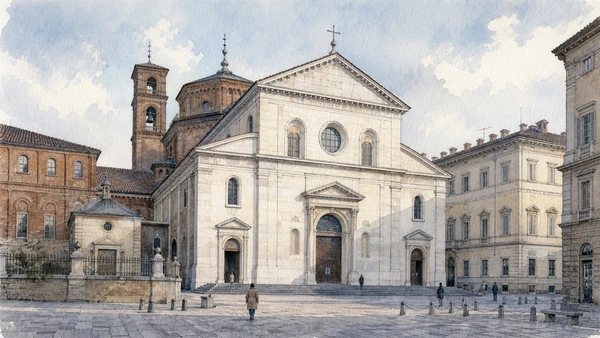
A restrained brick-and-stone exterior leads to a cathedral shaped by liturgy, dynastic patronage and later restoration.

Cathedral of Saint John the Baptist: Renaissance church and active worship

A restrained brick-and-stone exterior leads to a cathedral shaped by liturgy, dynastic patronage and later restoration. The site becomes clearer when its surviving fabric, later alterations and present use are read together.

Today

This is an active religious place as well as a historic building. Services, ceremonies and conservation can interrupt tourist access; dress appropriately, remain quiet and never treat a booked visit as priority over worship.

History

The present cathedral was built at the end of the fifteenth century on an older episcopal site and was subsequently connected to the royal palace and the Chapel of the Holy Shroud.

How to read this place

Begin with the renaissance façade and forecourt. Then compare chapels and later furnishings with liturgical circulation distinct from visitor movement; the differences are evidence, not visual noise.

What to notice

  • the Renaissance façade and forecourt
  • chapels and later furnishings
  • liturgical circulation distinct from visitor movement
Turismo Torino e Provincia · Official destination site
Original documentary watercolour of Cathedral of Saint John the Baptist: Renaissance church and active worship in Turin · Piedmont, showing accurate architecture, landscape, people and present-day use
Cathedral of Saint John the Baptist: Renaissance church and active worshipOriginal Merlintravel documentary watercolour · 2026
06

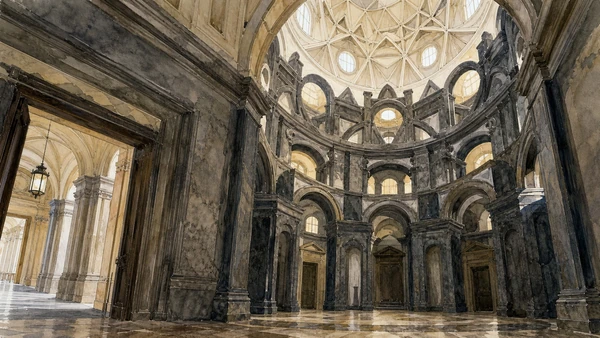
A rising geometry of dark marble and light links cathedral and palace while making conservation history visible.

Chapel of the Holy Shroud: Guarini, fire and restoration

A rising geometry of dark marble and light links cathedral and palace while making conservation history visible. The site becomes clearer when its surviving fabric, later alterations and present use are read together.

Today

Opening, ticketing, room access and temporary displays can change. Check the institution’s official notice shortly before visiting, use the designated entrance and allow for security or conservation controls.

History

Guarino Guarini transformed the chapel in the seventeenth century; after the 1997 fire a long restoration preceded its reopening within the Royal Museums in 2018.

How to read this place

Begin with stacked arches beneath the dome. Then compare fire-affected and restored stone with the raised connection between palace and cathedral; the differences are evidence, not visual noise.

What to notice

  • stacked arches beneath the dome
  • fire-affected and restored stone
  • the raised connection between palace and cathedral
Musei Reali Torino · Ministry of Culture
Original documentary watercolour of Chapel of the Holy Shroud: Guarini, fire and restoration in Turin · Piedmont, showing accurate architecture, landscape, people and present-day use
Chapel of the Holy Shroud: Guarini, fire and restorationOriginal Merlintravel documentary watercolour · 2026
07

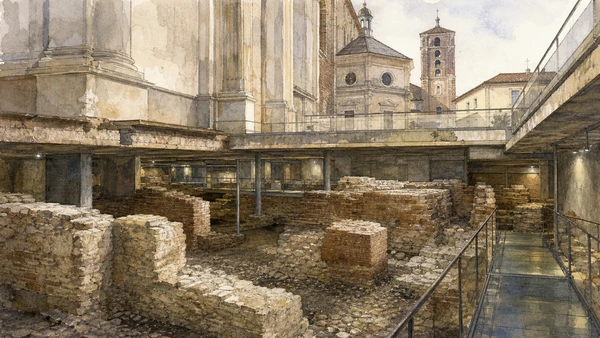
Archaeology and documentary evidence show that the cathedral precinct replaced and absorbed earlier Christian buildings.

The episcopal area: several churches beneath one centre

Archaeology and documentary evidence show that the cathedral precinct replaced and absorbed earlier Christian buildings. The site becomes clearer when its surviving fabric, later alterations and present use are read together.

Today

Archaeological access may be limited to protected viewpoints, scheduled openings or guided routes. Stay outside barriers, distinguish original material from supports and reconstruction, and verify the official opening notice.

History

Late-antique and medieval worship developed close to the Roman theatre and walls; later cathedral construction reorganised rather than simply erased this religious topography.

How to read this place

Begin with protected remains beneath current levels. Then compare changes in floor height with the boundary between excavated evidence and hypothesis; the differences are evidence, not visual noise.

What to notice

  • protected remains beneath current levels
  • changes in floor height
  • the boundary between excavated evidence and hypothesis
Musei Reali Torino · Ministry of Culture
Original documentary watercolour of The episcopal area: several churches beneath one centre in Turin · Piedmont, showing accurate architecture, landscape, people and present-day use
The episcopal area: several churches beneath one centreOriginal Merlintravel documentary watercolour · 2026
08

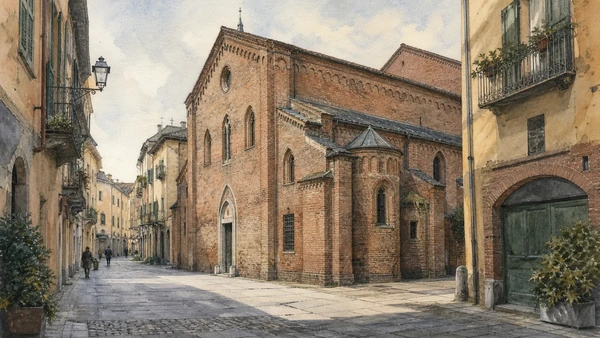
Brick architecture, chapels and convent memory preserve a medieval scale largely masked elsewhere by Baroque façades.

San Domenico: medieval fabric inside the planned capital

Brick architecture, chapels and convent memory preserve a medieval scale largely masked elsewhere by Baroque façades. The site becomes clearer when its surviving fabric, later alterations and present use are read together.

Today

This is an active religious place as well as a historic building. Services, ceremonies and conservation can interrupt tourist access; dress appropriately, remain quiet and never treat a booked visit as priority over worship.

History

The Dominican complex developed from the thirteenth century and acquired later decoration, restoration and memorial meanings while the surrounding quarter repeatedly changed.

How to read this place

Begin with brick structure and pointed openings. Then compare later chapel decoration with the church’s fit within narrow inhabited streets; the differences are evidence, not visual noise.

What to notice

  • brick structure and pointed openings
  • later chapel decoration
  • the church’s fit within narrow inhabited streets
Turismo Torino e Provincia · Official destination site
Original documentary watercolour of San Domenico: medieval fabric inside the planned capital in Turin · Piedmont, showing accurate architecture, landscape, people and present-day use
San Domenico: medieval fabric inside the planned capitalOriginal Merlintravel documentary watercolour · 2026
09

A complex interior and irregular exterior record successive churches, Guarini’s intervention, Juvarra’s expansion and continuing worship.

Consolata: sanctuary, city devotion and architectural layering

A complex interior and irregular exterior record successive churches, Guarini’s intervention, Juvarra’s expansion and continuing worship. The site becomes clearer when its surviving fabric, later alterations and present use are read together.

Today

This is an active religious place as well as a historic building. Services, ceremonies and conservation can interrupt tourist access; dress appropriately, remain quiet and never treat a booked visit as priority over worship.

History

The sanctuary grew around an older religious site and became a major focus of Turin devotion; multiple architects and restorations produced the present spatial sequence.

How to read this place

Begin with the junction of different volumes. Then compare votive and liturgical use with the relationship to the nearby roman wall line; the differences are evidence, not visual noise.

What to notice

  • the junction of different volumes
  • votive and liturgical use
  • the relationship to the nearby Roman wall line
Turismo Torino e Provincia · Official destination site
Original documentary watercolour of Consolata: sanctuary, city devotion and architectural layering in Turin · Piedmont, showing accurate architecture, landscape, people and present-day use
Consolata: sanctuary, city devotion and architectural layeringOriginal Merlintravel documentary watercolour · 2026
10

Restaurants and evening activity occupy streets that also contain housing, workshops, migrant businesses and religious institutions.

Quadrilatero Romano: an inhabited historic grid

Restaurants and evening activity occupy streets that also contain housing, workshops, migrant businesses and religious institutions. The site becomes clearer when its surviving fabric, later alterations and present use are read together.

Today

The area is inhabited and worked, not staged for visitors. Keep doorways, pavements, cycle lanes and deliveries clear, ask before photographing people and use current municipal mobility information.

History

The district follows part of the Roman and medieval core but its present identity results from long cycles of rebuilding, decline, migration, investment and commercial change.

How to read this place

Begin with street alignments rather than decorative surfaces. Then compare residential entrances beside hospitality with different uses across morning and evening; the differences are evidence, not visual noise.

What to notice

  • street alignments rather than decorative surfaces
  • residential entrances beside hospitality
  • different uses across morning and evening
Città di Torino · Official portal
Original documentary watercolour of Quadrilatero Romano: an inhabited historic grid in Turin · Piedmont, showing accurate architecture, landscape, people and present-day use
Quadrilatero Romano: an inhabited historic gridOriginal Merlintravel documentary watercolour · 2026

Turin through time

A short chronology

From Augusta Taurinorum and the Savoy court to national capital, industrial metropolis and contemporary reuse.

  1. Augusta Taurinorum is founded on a regular Roman grid close to the Po and Dora corridors.

  2. Gates, theatre, walls and urban infrastructure develop within the Roman colony.

  3. Bishops, communes, churches and fortified routes reshape the medieval city and its territory.

  4. The House of Savoy establishes firmer control over Turin, beginning a long dynastic transformation.

  5. The University of Turin is founded and becomes a durable part of the city’s institutional landscape.

  6. Emanuele Filiberto transfers the Savoy capital to Turin, accelerating court planning and fortification.

  7. New squares, straight streets, palaces and churches expand the capital beyond the Roman core.

  8. Guarino Guarini works in Turin, transforming sacred and court architecture through geometry and light.

  9. The siege of Turin ends; the victory is later commemorated through Juvarra’s Basilica of Superga.

  10. Royal status and Juvarra’s projects reinforce Turin’s ceremonial axes and metropolitan residence system.

  11. The Statuto Albertino and the Subalpine Parliament make Turin central to constitutional politics.

  12. Turin serves as the first capital of the Kingdom of Italy before the government moves to Florence.

  13. FIAT, Lingotto and Mirafiori help turn Turin into a major industrial and migrant metropolis.

  14. Bombing, occupation, resistance and liberation damage the city and leave a complex memorial geography.

  15. Deindustrialisation, museum growth, adaptive reuse and metropolitan regeneration repeatedly change Turin.

Before your visit

Practical information

01

Check the live page

Opening hours, reservation systems, restoration, exhibitions and transport can change. Recheck the linked official institution shortly before departure.

02

Separate worship and tourism

Churches and sanctuaries remain religious spaces. Services, funerals and community use take priority over visitor itineraries.

03

Plan real distances

Turin · Piedmont combines dense urban routes with lakes, valleys and dispersed towns. Do not compress distant chapters into an unsafe or superficial day.

04

Keep thresholds open

Arcades, station halls, markets, courtyards, workshops and residential streets must continue to function while you observe or photograph them.

05

Use current mobility data

Check the responsible rail, navigation, bus, road or park operator on the day; replacement services and weather can change an otherwise sound route.

06

Read change honestly

Restoration, reconstruction, adaptive reuse and new development have all shaped the landscape visible today.

Method and sources

Sources and image credits

This guide uses official museum, ministry, municipal, transport, park and UNESCO documentation checked on 29 August 2026. It separates durable historical interpretation from access details that can change, distinguishes surviving fabric from restoration or reconstruction, and treats worship, work, residence and public movement as part of the evidence. Every chapter links its principal institutional source; tickets, closures, weather and transport must always be verified again on the day of the visit.

All ten images are original Merlintravel editorial watercolours based on documented present-day conditions. They are illustrations, not substitutes for archaeological plans. Opening hours, tickets, accessible routes, temporary exhibitions and conservation work can change; consult the linked official pages shortly before visiting.