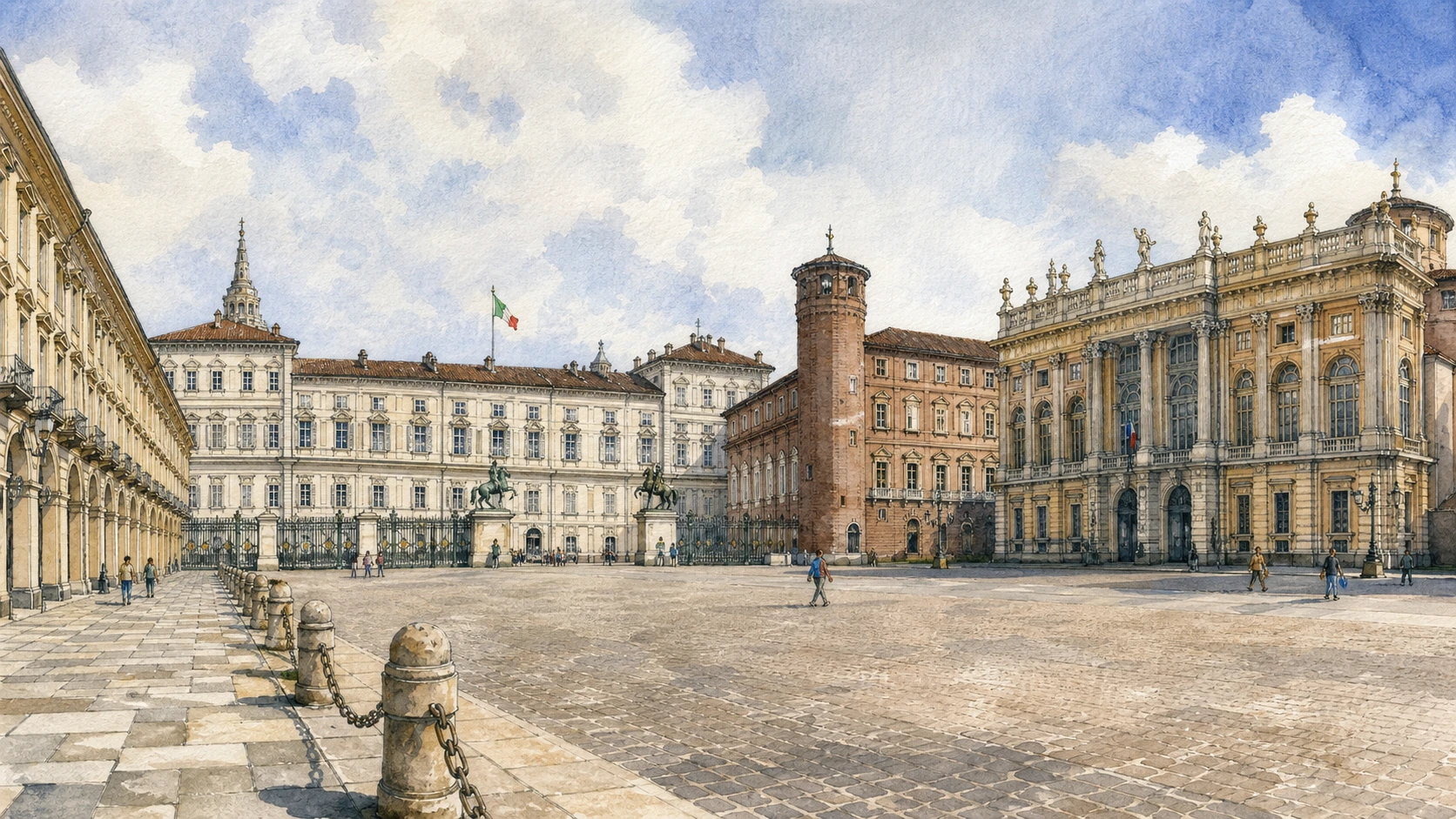
Original documentary watercolour panorama for Piazza Castello, the Royal Palace and Palazzo Madama: Complete Guide, with accurate Piedmont architecture, landscape and lived context

Turin Guide 02 · Palace, armoury, library, galleries, gardens, civic castle and the ceremonial state centre

Piazza Castello, the Royal Palace
& Palazzo Madama

A complete reading of Turin’s dynastic and civic centre, moving from the public square through the Royal Museums system and Palazzo Madama while separating court ceremony, state administration, collections and present museum access.

Plan the route
Turin · Piedmont10 chapters · one complete route

Why this route must be read in layers

Piazza Castello appears unified because centuries of planning made different institutions speak one ceremonial language; its buildings still preserve conflicting medieval, Baroque, national and civic histories.

The Royal Palace was a residence and a command centre, not simply a sequence of decorated rooms. Armoury, library, gallery and gardens belonged to a wider apparatus of knowledge and representation.

Palazzo Madama contains a Roman gate, medieval castle and Juvarra’s unfinished palace façade. Its asymmetry is the principal evidence, not a defect to be concealed by the square’s visual order.

Theatre, archives, worship, events and daily crossings keep the square active. Security perimeters and timed interiors can change, so a complete route must work even when one component is unavailable.

Read the open square and building exteriors first, then divide museum interiors across realistic sessions; the Royal Museums alone should never be compressed into a hurried passage.

The route

Plan your visit

Begin with Piazza Castello’s approaches, enter the Royal Palace complex through its official route, then give Palazzo Madama and the theatre edge separate attention.

Early morning

Piazza Castello · Royal Palace · Royal Armoury

Move in the documented order: Piazza Castello: a designed field of power and movement; then Royal Palace: residence and command centre; then Royal Armoury: weapons as collection and representation. Recheck live access and transport before entering a controlled site.

Late morning

Royal Library · Galleria Sabauda · Royal Gardens

Move in the documented order: Royal Library: drawings, books and controlled access; then Galleria Sabauda: a dynasty’s collection in a modern museum; then Royal Gardens: controlled nature behind the palace. Recheck live access and transport before entering a controlled site.

Afternoon

Palazzo Madama · Juvarra’s façade and staircase · Palazzo Madama’s civic collections

Move in the documented order: Palazzo Madama: Roman gate and medieval castle; then Juvarra’s façade and staircase: an unfinished palace project; then Palazzo Madama’s civic collections: Turin beyond the court. Recheck live access and transport before entering a controlled site.

Late afternoon

Teatro Regio

Move in the documented order: Teatro Regio: court theatre, fire and modern reconstruction. Recheck live access and transport before entering a controlled site.

Ten chapters

Explore the places

The order follows terrain, institutions and present-day movement. Use the index to return to a chapter without reducing the route to isolated monuments.

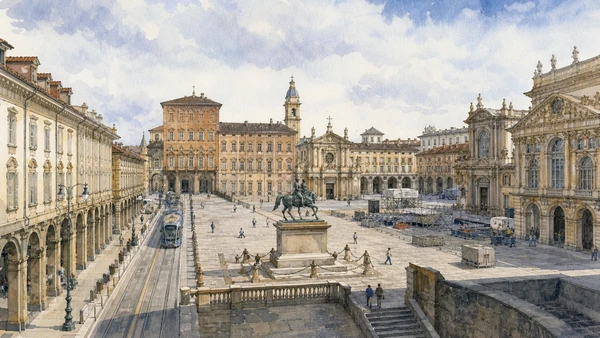
  1. 01Piazza Castello: a designed field of power and movement
  2. 02Royal Palace: residence and command centre
  3. 03Royal Armoury: weapons as collection and representation
  4. 04Royal Library: drawings, books and controlled access
  5. 05Galleria Sabauda: a dynasty’s collection in a modern museum
  6. 06Royal Gardens: controlled nature behind the palace
  7. 07Palazzo Madama: Roman gate and medieval castle
  8. 08Juvarra’s façade and staircase: an unfinished palace project
  9. 09Palazzo Madama’s civic collections: Turin beyond the court
  10. 10Teatro Regio: court theatre, fire and modern reconstruction
01

Arcaded streets, palace fronts, theatre, churches and transport meet in a square planned to organise both ceremony and circulation.

Piazza Castello: a designed field of power and movement

Arcaded streets, palace fronts, theatre, churches and transport meet in a square planned to organise both ceremony and circulation. The site becomes clearer when its surviving fabric, later alterations and present use are read together.

Today

The exterior can usually be read from public space, but events, works and crowd management may change circulation. Keep access routes open and verify any interior visit with the responsible institution.

History

The space grew from the medieval castle edge and was regularised through Savoy expansions, later national government and modern pedestrian and transport projects.

How to read this place

Begin with axes entering the square. Then compare different building alignments with temporary event and security infrastructure; the differences are evidence, not visual noise.

What to notice

  • axes entering the square
  • different building alignments
  • temporary event and security infrastructure
Città di Torino · Official portal
Original documentary watercolour of Piazza Castello: a designed field of power and movement in Turin · Piedmont, showing accurate architecture, landscape, people and present-day use
Piazza Castello: a designed field of power and movementOriginal Merlintravel documentary watercolour · 2026
02

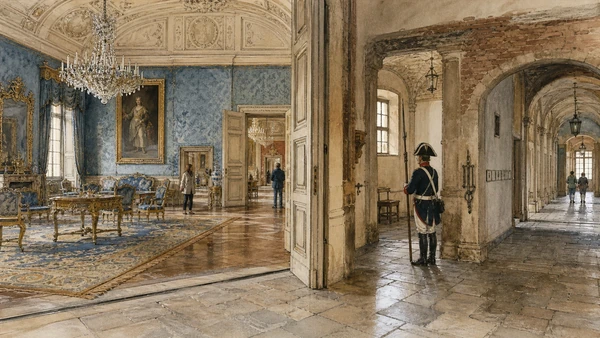
State rooms, service circulation and institutional thresholds reveal a working court beyond decorative spectacle.

Royal Palace: residence and command centre

State rooms, service circulation and institutional thresholds reveal a working court beyond decorative spectacle. The site becomes clearer when its surviving fabric, later alterations and present use are read together.

Today

Opening, ticketing, room access and temporary displays can change. Check the institution’s official notice shortly before visiting, use the designated entrance and allow for security or conservation controls.

History

The palace became the principal Turin residence of the Savoy dynasty after the capital moved in 1563 and changed through successive seventeenth- to nineteenth-century campaigns.

How to read this place

Begin with ceremonial sequence of rooms. Then compare service and guard thresholds with furnishings from different reigns; the differences are evidence, not visual noise.

What to notice

  • ceremonial sequence of rooms
  • service and guard thresholds
  • furnishings from different reigns
Musei Reali Torino · Ministry of Culture
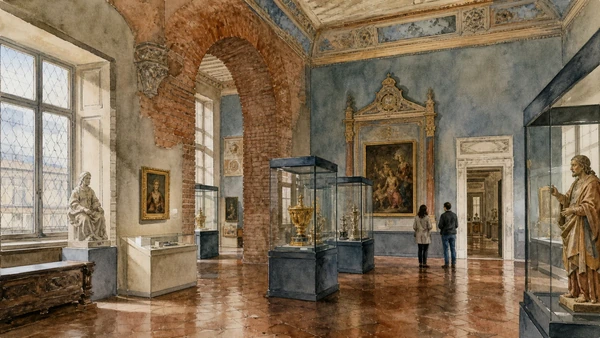
Original documentary watercolour of Royal Palace: residence and command centre in Turin · Piedmont, showing accurate architecture, landscape, people and present-day use
Royal Palace: residence and command centreOriginal Merlintravel documentary watercolour · 2026
03

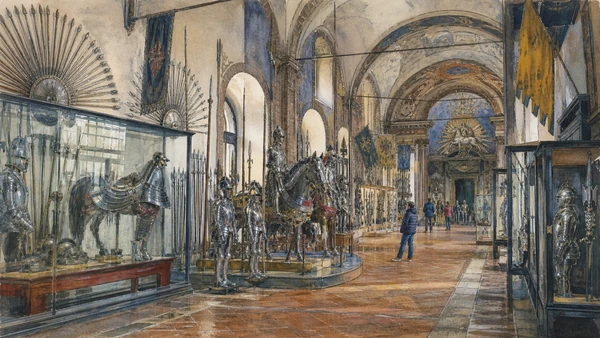
Arms, armour and spectacular display connect warfare, craftsmanship, diplomacy and dynastic identity.

Royal Armoury: weapons as collection and representation

Arms, armour and spectacular display connect warfare, craftsmanship, diplomacy and dynastic identity. The site becomes clearer when its surviving fabric, later alterations and present use are read together.

Today

Opening, ticketing, room access and temporary displays can change. Check the institution’s official notice shortly before visiting, use the designated entrance and allow for security or conservation controls.

History

The collection was organised as a public royal armoury in the nineteenth century using earlier Savoy holdings and subsequent acquisitions within a purpose-built gallery sequence.

How to read this place

Begin with object labels and provenance. Then compare functional construction of armour with the gallery’s theatrical arrangement; the differences are evidence, not visual noise.

What to notice

  • object labels and provenance
  • functional construction of armour
  • the gallery’s theatrical arrangement
Musei Reali Torino · Ministry of Culture
Original documentary watercolour of Royal Armoury: weapons as collection and representation in Turin · Piedmont, showing accurate architecture, landscape, people and present-day use
Royal Armoury: weapons as collection and representationOriginal Merlintravel documentary watercolour · 2026
04

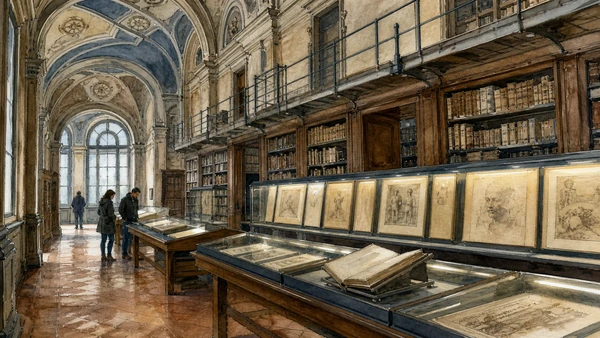
Manuscripts and graphic collections preserve knowledge networks whose fragile originals require strict conservation.

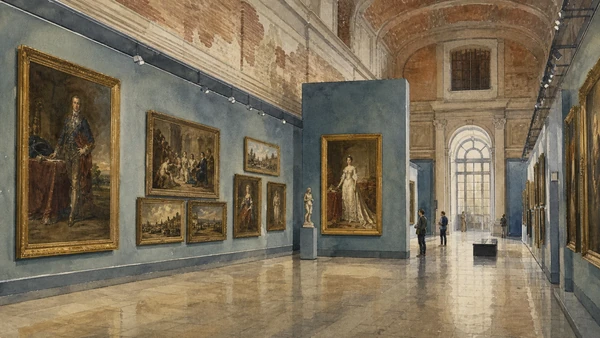
Royal Library: drawings, books and controlled access

Manuscripts and graphic collections preserve knowledge networks whose fragile originals require strict conservation. The site becomes clearer when its surviving fabric, later alterations and present use are read together.

Today

Opening, ticketing, room access and temporary displays can change. Check the institution’s official notice shortly before visiting, use the designated entrance and allow for security or conservation controls.

History

Carlo Alberto founded the library in the nineteenth century around Savoy holdings; its collections expanded to include major works, among them drawings associated with Leonardo da Vinci.

How to read this place

Begin with catalogue evidence before famous names. Then compare conservation lighting and display limits with the distinction between original and facsimile; the differences are evidence, not visual noise.

What to notice

  • catalogue evidence before famous names
  • conservation lighting and display limits
  • the distinction between original and facsimile
Musei Reali Torino · Ministry of Culture
Original documentary watercolour of Royal Library: drawings, books and controlled access in Turin · Piedmont, showing accurate architecture, landscape, people and present-day use
Royal Library: drawings, books and controlled accessOriginal Merlintravel documentary watercolour · 2026
06

Formal axes, walls and later public access connect court retreat to the city’s river and archaeological edge.

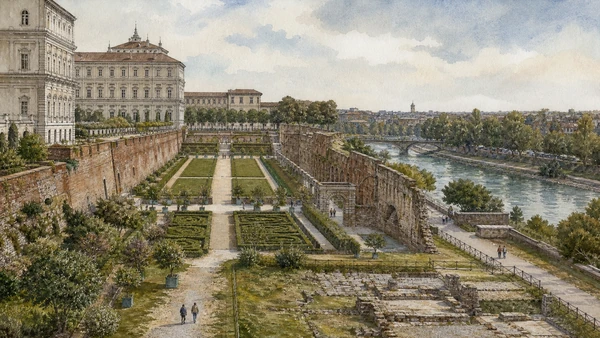
Royal Gardens: controlled nature behind the palace

Formal axes, walls and later public access connect court retreat to the city’s river and archaeological edge. The site becomes clearer when its surviving fabric, later alterations and present use are read together.

Today

Weather, water levels, trail conditions and seasonal services can alter the route. Use official transport and park information, remain on authorised paths and do not enter farms, vineyards or private gardens without permission.

History

Garden phases developed from the seventeenth century with designs associated with court architects and André Le Nôtre’s influence, followed by alteration, damage and restoration.

How to read this place

Begin with axes extending from palace façades. Then compare retained walls and level changes with restored planting distinguished from historic structure; the differences are evidence, not visual noise.

What to notice

  • axes extending from palace façades
  • retained walls and level changes
  • restored planting distinguished from historic structure
Musei Reali Torino · Ministry of Culture
Original documentary watercolour of Royal Gardens: controlled nature behind the palace in Turin · Piedmont, showing accurate architecture, landscape, people and present-day use
Royal Gardens: controlled nature behind the palaceOriginal Merlintravel documentary watercolour · 2026
07

Rear towers and archaeological levels expose a building far older and less symmetrical than its Baroque front.

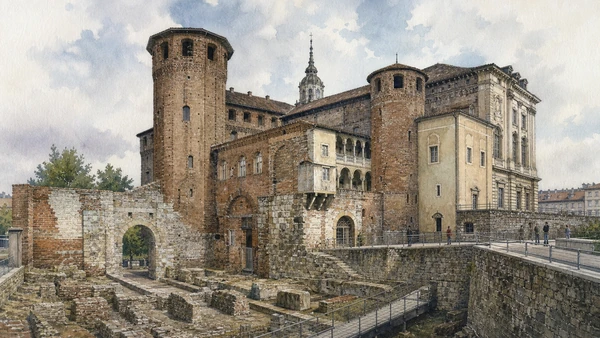
Palazzo Madama: Roman gate and medieval castle

Rear towers and archaeological levels expose a building far older and less symmetrical than its Baroque front. The site becomes clearer when its surviving fabric, later alterations and present use are read together.

Today

Opening, ticketing, room access and temporary displays can change. Check the institution’s official notice shortly before visiting, use the designated entrance and allow for security or conservation controls.

History

A Roman gate was fortified and enlarged into a medieval castle before becoming a residence for Savoy duchesses, leaving several construction systems within one mass.

How to read this place

Begin with roman foundations and gate line. Then compare medieval towers and courtyard with later palace rooms inserted into the fabric; the differences are evidence, not visual noise.

What to notice

  • Roman foundations and gate line
  • medieval towers and courtyard
  • later palace rooms inserted into the fabric
Palazzo Madama · Fondazione Torino Musei
Original documentary watercolour of Palazzo Madama: Roman gate and medieval castle in Turin · Piedmont, showing accurate architecture, landscape, people and present-day use
Palazzo Madama: Roman gate and medieval castleOriginal Merlintravel documentary watercolour · 2026
08

Monumental stone and a luminous stair conceal neither the medieval rear nor the fact that the planned transformation stopped.

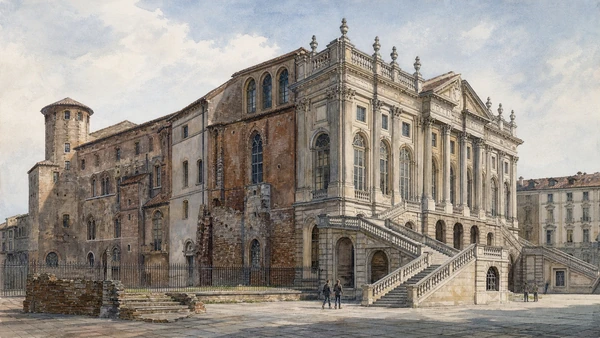
Juvarra’s façade and staircase: an unfinished palace project

Monumental stone and a luminous stair conceal neither the medieval rear nor the fact that the planned transformation stopped. The site becomes clearer when its surviving fabric, later alterations and present use are read together.

Today

Opening, ticketing, room access and temporary displays can change. Check the institution’s official notice shortly before visiting, use the designated entrance and allow for security or conservation controls.

History

Filippo Juvarra designed the new ceremonial front for Madama Reale in the early eighteenth century; only part of the intended palace rebuilding was realised.

How to read this place

Begin with the double-height stair. Then compare structural join with older masonry with front and rear viewed together; the differences are evidence, not visual noise.

What to notice

  • the double-height stair
  • structural join with older masonry
  • front and rear viewed together
Palazzo Madama · Fondazione Torino Musei
Original documentary watercolour of Juvarra's façade and staircase: an unfinished palace project in Turin · Piedmont, showing accurate architecture, landscape, people and present-day use
Juvarra’s façade and staircase: an unfinished palace projectOriginal Merlintravel documentary watercolour · 2026
09

Decorative arts, sculpture and painting create a civic account that crosses medieval, Baroque and modern collecting histories.

Palazzo Madama’s civic collections: Turin beyond the court

Decorative arts, sculpture and painting create a civic account that crosses medieval, Baroque and modern collecting histories. The site becomes clearer when its surviving fabric, later alterations and present use are read together.

Today

Opening, ticketing, room access and temporary displays can change. Check the institution’s official notice shortly before visiting, use the designated entrance and allow for security or conservation controls.

History

The municipal museum developed after Italian unification and occupied Palazzo Madama from the twentieth century, adapting a former residence to collection, study and public education.

How to read this place

Begin with object provenance and original function. Then compare museum cases within palace rooms with restoration choices visible in the route; the differences are evidence, not visual noise.

What to notice

  • object provenance and original function
  • museum cases within palace rooms
  • restoration choices visible in the route
Palazzo Madama · Fondazione Torino Musei
Original documentary watercolour of Palazzo Madama's civic collections: Turin beyond the court in Turin · Piedmont, showing accurate architecture, landscape, people and present-day use
Palazzo Madama’s civic collections: Turin beyond the courtOriginal Merlintravel documentary watercolour · 2026
10

A contemporary auditorium occupies the historic theatre site while retaining a ceremonial relationship to Piazza Castello.

Teatro Regio: court theatre, fire and modern reconstruction

A contemporary auditorium occupies the historic theatre site while retaining a ceremonial relationship to Piazza Castello. The site becomes clearer when its surviving fabric, later alterations and present use are read together.

Today

Opening, ticketing, room access and temporary displays can change. Check the institution’s official notice shortly before visiting, use the designated entrance and allow for security or conservation controls.

History

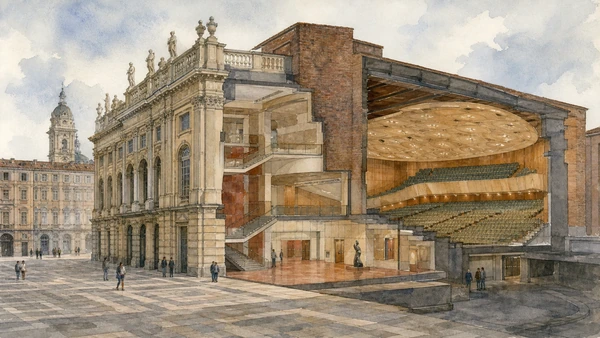
Juvarra’s eighteenth-century theatre was altered and then destroyed by fire in 1936; Carlo Mollino’s new building opened in 1973 behind the retained historic frontage.

How to read this place

Begin with historic façade versus modern interior. Then compare foyer and auditorium geometry with performance logistics around the square; the differences are evidence, not visual noise.

What to notice

  • historic façade versus modern interior
  • foyer and auditorium geometry
  • performance logistics around the square
Teatro Regio Torino · Official site
Original documentary watercolour of Teatro Regio: court theatre, fire and modern reconstruction in Turin · Piedmont, showing accurate architecture, landscape, people and present-day use
Teatro Regio: court theatre, fire and modern reconstructionOriginal Merlintravel documentary watercolour · 2026

Turin through time

A short chronology

From Augusta Taurinorum and the Savoy court to national capital, industrial metropolis and contemporary reuse.

  1. Augusta Taurinorum is founded on a regular Roman grid close to the Po and Dora corridors.

  2. Gates, theatre, walls and urban infrastructure develop within the Roman colony.

  3. Bishops, communes, churches and fortified routes reshape the medieval city and its territory.

  4. The House of Savoy establishes firmer control over Turin, beginning a long dynastic transformation.

  5. The University of Turin is founded and becomes a durable part of the city’s institutional landscape.

  6. Emanuele Filiberto transfers the Savoy capital to Turin, accelerating court planning and fortification.

  7. New squares, straight streets, palaces and churches expand the capital beyond the Roman core.

  8. Guarino Guarini works in Turin, transforming sacred and court architecture through geometry and light.

  9. The siege of Turin ends; the victory is later commemorated through Juvarra’s Basilica of Superga.

  10. Royal status and Juvarra’s projects reinforce Turin’s ceremonial axes and metropolitan residence system.

  11. The Statuto Albertino and the Subalpine Parliament make Turin central to constitutional politics.

  12. Turin serves as the first capital of the Kingdom of Italy before the government moves to Florence.

  13. FIAT, Lingotto and Mirafiori help turn Turin into a major industrial and migrant metropolis.

  14. Bombing, occupation, resistance and liberation damage the city and leave a complex memorial geography.

  15. Deindustrialisation, museum growth, adaptive reuse and metropolitan regeneration repeatedly change Turin.

Before your visit

Practical information

01

Check the live page

Opening hours, reservation systems, restoration, exhibitions and transport can change. Recheck the linked official institution shortly before departure.

02

Separate worship and tourism

Churches and sanctuaries remain religious spaces. Services, funerals and community use take priority over visitor itineraries.

03

Plan real distances

Turin · Piedmont combines dense urban routes with lakes, valleys and dispersed towns. Do not compress distant chapters into an unsafe or superficial day.

04

Keep thresholds open

Arcades, station halls, markets, courtyards, workshops and residential streets must continue to function while you observe or photograph them.

05

Use current mobility data

Check the responsible rail, navigation, bus, road or park operator on the day; replacement services and weather can change an otherwise sound route.

06

Read change honestly

Restoration, reconstruction, adaptive reuse and new development have all shaped the landscape visible today.

Method and sources

Sources and image credits

This guide uses official museum, ministry, municipal, transport, park and UNESCO documentation checked on 29 August 2026. It separates durable historical interpretation from access details that can change, distinguishes surviving fabric from restoration or reconstruction, and treats worship, work, residence and public movement as part of the evidence. Every chapter links its principal institutional source; tickets, closures, weather and transport must always be verified again on the day of the visit.

All ten images are original Merlintravel editorial watercolours based on documented present-day conditions. They are illustrations, not substitutes for archaeological plans. Opening hours, tickets, accessible routes, temporary exhibitions and conservation work can change; consult the linked official pages shortly before visiting.