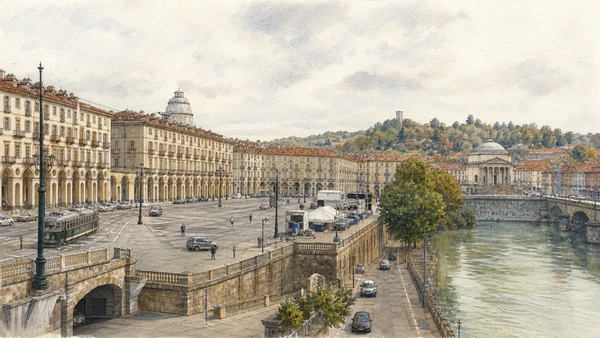
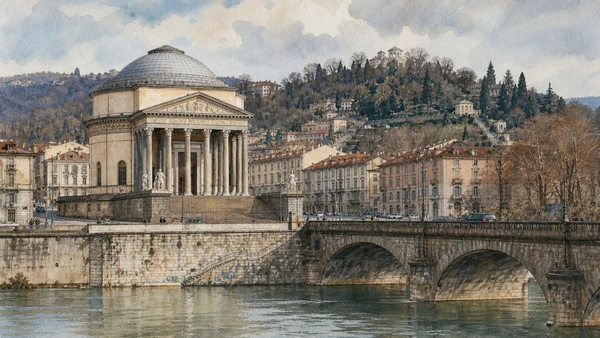
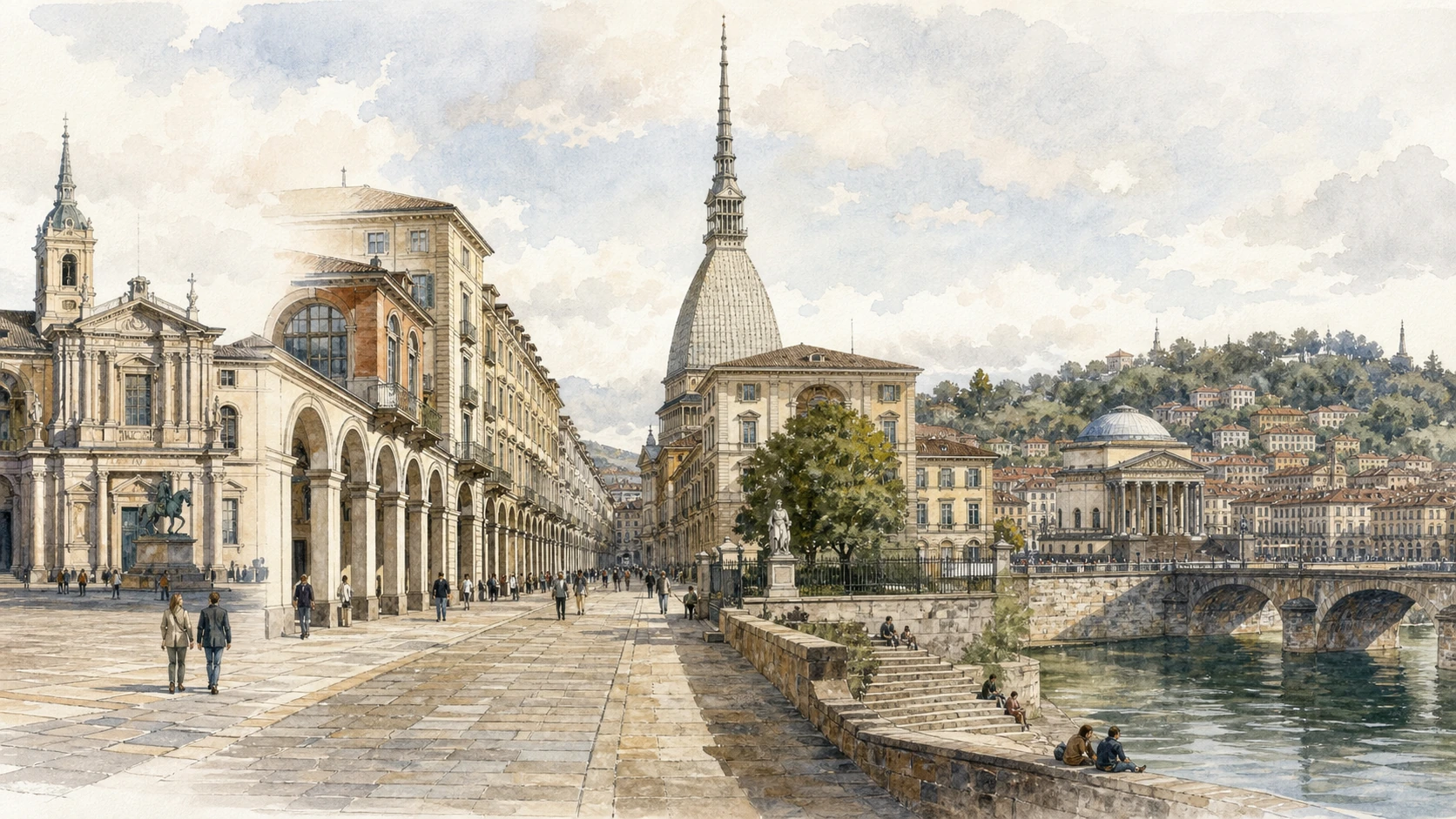
Original documentary watercolour panorama for Via Po, the Mole and the Cinema City: Complete Guide, with accurate Piedmont architecture, landscape and lived context

Turin Guide 04 · Arcades, university, books, Mole Antonelliana, moving-image collections and the river threshold

Via Po, the Mole
& the Cinema City

A complete route from Piazza Castello along the angled arcades of Via Po to the Mole Antonelliana, the university quarter, Piazza Vittorio Veneto, Gran Madre and the river, using cinema as an institutional and urban history rather than a single landmark view.

Plan the route
Turin · Piedmont10 chapters · one complete route

Why this route must be read in layers

Via Po connects court centre, university, publishing, worship, entertainment and river crossing. The Mole’s extraordinary silhouette belongs to that network and to a complicated change from planned synagogue to civic monument and museum.

The street’s arcades were designed to maintain a ceremonial and commercial route despite an inherited alignment toward the bridge. Their apparently continuous frontage contains different dates and uses.

The Mole began as a synagogue project before cost and design conflict led the Jewish community to transfer it to the city. Its later national symbolism and cinema museum use must not erase that origin.

Piazza Vittorio and Gran Madre stage a monumental river crossing, but the Po remains an ecological corridor and transport boundary whose banks are used daily by residents.

Walk outward from Piazza Castello, leave time for the museum as a separate interior visit, and finish at the river only after comparing both banks and current pedestrian conditions.

The route

Plan your visit

Follow Via Po’s north and south arcades, enter university and museum spaces through official access, then cross Piazza Vittorio toward the Po without blocking porticoes or bridge circulation.

Early morning

Via Po · University of Turin · Books, cafés and porticoes

Move in the documented order: Via Po: an angled Baroque axis; then University of Turin: study inside the court-city fabric; then Books, cafés and porticoes: a working intellectual street. Recheck live access and transport before entering a controlled site.

Late morning

Mole Antonelliana · Archaeology of cinema · The cinema machine

Move in the documented order: Mole Antonelliana: structure, ambition and changing ownership; then Archaeology of cinema: devices before film projection; then The cinema machine: production behind the finished film. Recheck live access and transport before entering a controlled site.

Afternoon

Posters, photography and archives · Panoramic lift · Piazza Vittorio Veneto

Move in the documented order: Posters, photography and archives: images that circulated cinema; then Panoramic lift: modern access inside a historic volume; then Piazza Vittorio Veneto: monumental space on a slope. Recheck live access and transport before entering a controlled site.

Late afternoon

Gran Madre and the Po threshold

Move in the documented order: Gran Madre and the Po threshold: city, hill and water. Recheck live access and transport before entering a controlled site.

Ten chapters

Explore the places

The order follows terrain, institutions and present-day movement. Use the index to return to a chapter without reducing the route to isolated monuments.

  1. 01Via Po: an angled Baroque axis
  2. 02University of Turin: study inside the court-city fabric
  3. 03Books, cafés and porticoes: a working intellectual street
  4. 04Mole Antonelliana: structure, ambition and changing ownership
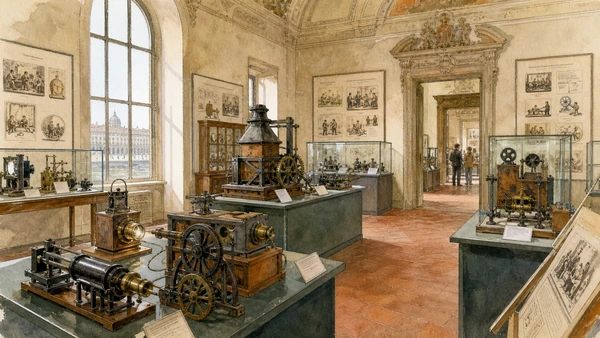
  5. 05Archaeology of cinema: devices before film projection
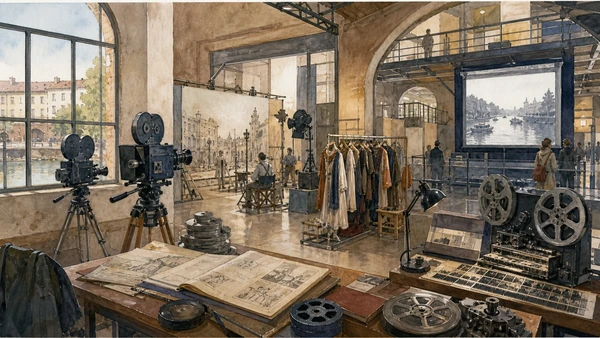
  6. 06The cinema machine: production behind the finished film
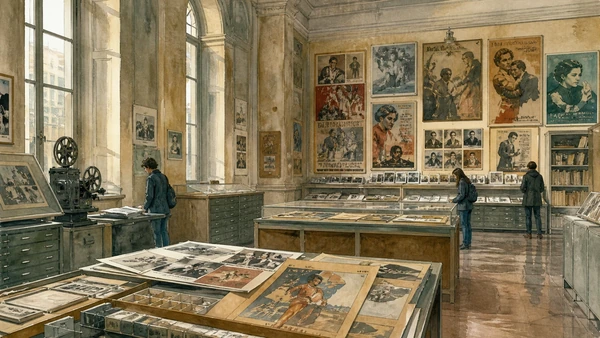
  7. 07Posters, photography and archives: images that circulated cinema
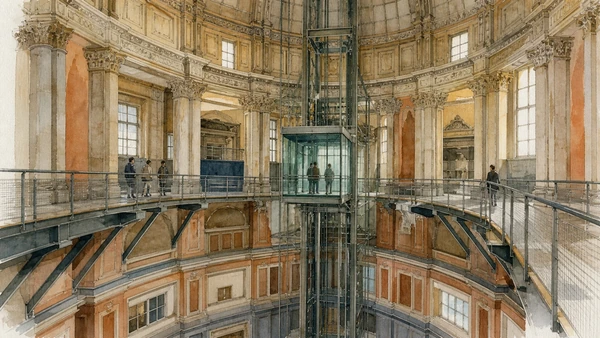
  8. 08Panoramic lift: modern access inside a historic volume
  9. 09Piazza Vittorio Veneto: monumental space on a slope
  10. 10Gran Madre and the Po threshold: city, hill and water
01

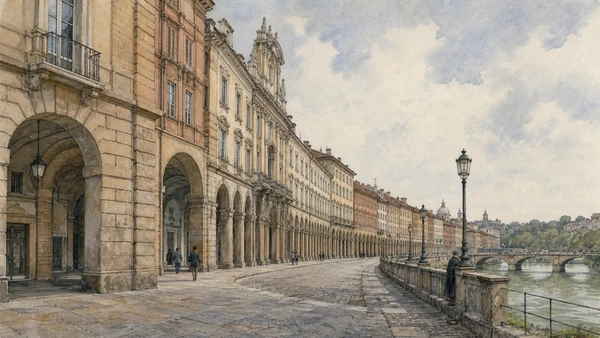
Long arcades connect Piazza Castello to the river while adapting a planned capital to the older road toward Chieri.

Via Po: an angled Baroque axis

Long arcades connect Piazza Castello to the river while adapting a planned capital to the older road toward Chieri. The site becomes clearer when its surviving fabric, later alterations and present use are read together.

Today

The area is inhabited and worked, not staged for visitors. Keep doorways, pavements, cycle lanes and deliveries clear, ask before photographing people and use current municipal mobility information.

History

The street was laid out in the seventeenth century as part of Turin’s eastward expansion, with continuous sheltered circulation later reinforced for court movement.

How to read this place

Begin with the diagonal perspective from piazza castello. Then compare changes between individual palace fronts with the continuous public passage beneath them; the differences are evidence, not visual noise.

What to notice

  • the diagonal perspective from Piazza Castello
  • changes between individual palace fronts
  • the continuous public passage beneath them
Turismo Torino e Provincia · Official destination site
Original documentary watercolour of Via Po: an angled Baroque axis in Turin · Piedmont, showing accurate architecture, landscape, people and present-day use
Via Po: an angled Baroque axisOriginal Merlintravel documentary watercolour · 2026
02

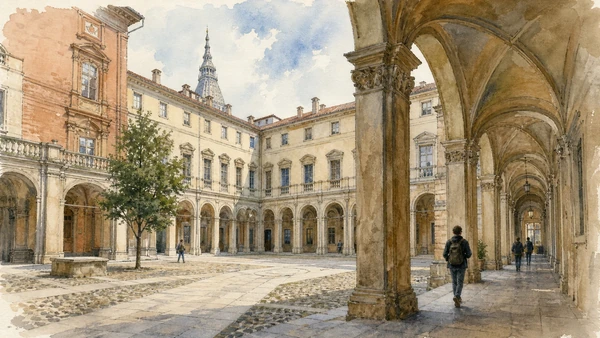
Courtyards and institutional buildings place teaching, archives and research directly on the ceremonial route.

University of Turin: study inside the court-city fabric

Courtyards and institutional buildings place teaching, archives and research directly on the ceremonial route. The site becomes clearer when its surviving fabric, later alterations and present use are read together.

Today

The area is inhabited and worked, not staged for visitors. Keep doorways, pavements, cycle lanes and deliveries clear, ask before photographing people and use current municipal mobility information.

History

Founded in 1404, the university occupied several sites before major institutions developed around Via Po, contributing to the street’s book, café and student culture.

How to read this place

Begin with institutional entrances within arcades. Then compare courtyard proportions with current study routes distinct from visitor circulation; the differences are evidence, not visual noise.

What to notice

  • institutional entrances within arcades
  • courtyard proportions
  • current study routes distinct from visitor circulation
University of Turin · Official site
Original documentary watercolour of University of Turin: study inside the court-city fabric in Turin · Piedmont, showing accurate architecture, landscape, people and present-day use
University of Turin: study inside the court-city fabricOriginal Merlintravel documentary watercolour · 2026
03

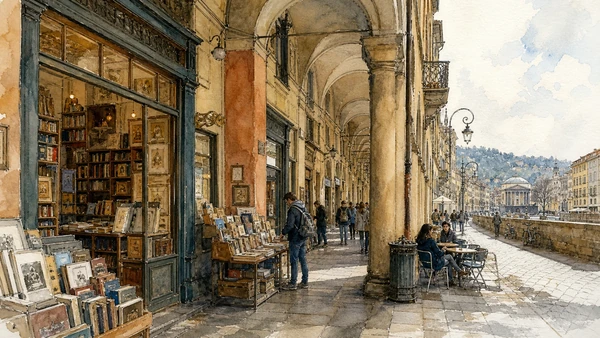
Bookshops, stalls, cafés and student services keep Via Po active beyond its architecture.

Books, cafés and porticoes: a working intellectual street

Bookshops, stalls, cafés and student services keep Via Po active beyond its architecture. The site becomes clearer when its surviving fabric, later alterations and present use are read together.

Today

The area is inhabited and worked, not staged for visitors. Keep doorways, pavements, cycle lanes and deliveries clear, ask before photographing people and use current municipal mobility information.

History

Printing, university life, political discussion and commerce accumulated along the route across the eighteenth to twentieth centuries, while businesses and tenancies continued to change.

How to read this place

Begin with shopfront depth beneath arcades. Then compare temporary book stalls and pedestrian flow with historic interiors distinguished from later branding; the differences are evidence, not visual noise.

What to notice

  • shopfront depth beneath arcades
  • temporary book stalls and pedestrian flow
  • historic interiors distinguished from later branding
Turismo Torino e Provincia · Official destination site
Original documentary watercolour of Books, cafés and porticoes: a working intellectual street in Turin · Piedmont, showing accurate architecture, landscape, people and present-day use
Books, cafés and porticoes: a working intellectual streetOriginal Merlintravel documentary watercolour · 2026
04

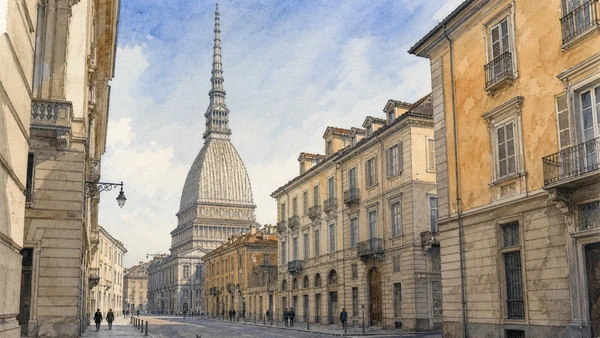
A tall masonry dome and spire grew from Alessandro Antonelli’s repeatedly enlarged design and a project that changed client and meaning.

Mole Antonelliana: structure, ambition and changing ownership

A tall masonry dome and spire grew from Alessandro Antonelli’s repeatedly enlarged design and a project that changed client and meaning. The site becomes clearer when its surviving fabric, later alterations and present use are read together.

Today

Opening, ticketing, room access and temporary displays can change. Check the institution’s official notice shortly before visiting, use the designated entrance and allow for security or conservation controls.

History

The building began in the 1860s as a synagogue commissioned by Turin’s Jewish community; escalating scope and cost led to municipal acquisition and completion as a civic monument.

How to read this place

Begin with the square base and rising dome. Then compare structural transitions beneath the spire with the former synagogue project acknowledged in interpretation; the differences are evidence, not visual noise.

What to notice

  • the square base and rising dome
  • structural transitions beneath the spire
  • the former synagogue project acknowledged in interpretation
Museo Nazionale del Cinema · Official site
Original documentary watercolour of Mole Antonelliana: structure, ambition and changing ownership in Turin · Piedmont, showing accurate architecture, landscape, people and present-day use
Mole Antonelliana: structure, ambition and changing ownershipOriginal Merlintravel documentary watercolour · 2026
05

Optical instruments, images and experiments show that moving-image culture emerged from several technical and popular traditions.

Archaeology of cinema: devices before film projection

Optical instruments, images and experiments show that moving-image culture emerged from several technical and popular traditions. The site becomes clearer when its surviving fabric, later alterations and present use are read together.

Today

Opening, ticketing, room access and temporary displays can change. Check the institution’s official notice shortly before visiting, use the designated entrance and allow for security or conservation controls.

History

The museum preserves pre-cinematic devices and documents collected through the work of Maria Adriana Prolo and later institutional research.

How to read this place

Begin with mechanisms rather than screen effect alone. Then compare labels distinguishing dates and inventors with original devices versus interactive replicas; the differences are evidence, not visual noise.

What to notice

  • mechanisms rather than screen effect alone
  • labels distinguishing dates and inventors
  • original devices versus interactive replicas
Museo Nazionale del Cinema · Official site
Original documentary watercolour of Archaeology of cinema: devices before film projection in Turin · Piedmont, showing accurate architecture, landscape, people and present-day use
Archaeology of cinema: devices before film projectionOriginal Merlintravel documentary watercolour · 2026
06

Cameras, scripts, sets, costume, editing and projection reveal collective industrial work.

The cinema machine: production behind the finished film

Cameras, scripts, sets, costume, editing and projection reveal collective industrial work. The site becomes clearer when its surviving fabric, later alterations and present use are read together.

Today

Opening, ticketing, room access and temporary displays can change. Check the institution’s official notice shortly before visiting, use the designated entrance and allow for security or conservation controls.

History

Film production developed through changing technologies and professional roles, which the museum organises through objects, archives and immersive display rather than one national chronology.

How to read this place

Begin with equipment tied to documented productions. Then compare workflow between departments with display scenography as a modern layer; the differences are evidence, not visual noise.

What to notice

  • equipment tied to documented productions
  • workflow between departments
  • display scenography as a modern layer
Museo Nazionale del Cinema · Official site
Original documentary watercolour of The cinema machine: production behind the finished film in Turin · Piedmont, showing accurate architecture, landscape, people and present-day use
The cinema machine: production behind the finished filmOriginal Merlintravel documentary watercolour · 2026
07

Graphic design and publicity shaped how films reached audiences, while archives preserve versions that theatres once treated as ephemeral.

Posters, photography and archives: images that circulated cinema

Graphic design and publicity shaped how films reached audiences, while archives preserve versions that theatres once treated as ephemeral. The site becomes clearer when its surviving fabric, later alterations and present use are read together.

Today

Opening, ticketing, room access and temporary displays can change. Check the institution’s official notice shortly before visiting, use the designated entrance and allow for security or conservation controls.

History

The museum’s holdings include posters, photographs and paper collections assembled and catalogued across decades of preservation work.

How to read this place

Begin with printing technique and typography. Then compare national variations in promotion with conservation limits affecting light and display; the differences are evidence, not visual noise.

What to notice

  • printing technique and typography
  • national variations in promotion
  • conservation limits affecting light and display
Museo Nazionale del Cinema · Official site
Original documentary watercolour of Posters, photography and archives: images that circulated cinema in Turin · Piedmont, showing accurate architecture, landscape, people and present-day use
Posters, photography and archives: images that circulated cinemaOriginal Merlintravel documentary watercolour · 2026
08

A glass lift crosses the central void to a viewing level, producing a contemporary experience distinct from the original building programme.

Panoramic lift: modern access inside a historic volume

A glass lift crosses the central void to a viewing level, producing a contemporary experience distinct from the original building programme. The site becomes clearer when its surviving fabric, later alterations and present use are read together.

Today

Timetables, engineering works, capacity and accessibility arrangements can change. Check the operator on the day, leave a realistic connection margin and never enter tracks, depots or restricted infrastructure.

History

The lift was installed as part of the Mole’s adaptation and has its own operational, weather and capacity controls independent of museum galleries.

How to read this place

Begin with lift structure within the dome. Then compare museum ramps around the central space with visibility and access restrictions treated as live facts; the differences are evidence, not visual noise.

What to notice

  • lift structure within the dome
  • museum ramps around the central space
  • visibility and access restrictions treated as live facts
Museo Nazionale del Cinema · Official site
Original documentary watercolour of Panoramic lift: modern access inside a historic volume in Turin · Piedmont, showing accurate architecture, landscape, people and present-day use
Panoramic lift: modern access inside a historic volumeOriginal Merlintravel documentary watercolour · 2026
09

Arcaded blocks appear level while the ground descends toward the Po, turning topography into architecture.

Piazza Vittorio Veneto: monumental space on a slope

Arcaded blocks appear level while the ground descends toward the Po, turning topography into architecture. The site becomes clearer when its surviving fabric, later alterations and present use are read together.

Today

The exterior can usually be read from public space, but events, works and crowd management may change circulation. Keep access routes open and verify any interior visit with the responsible institution.

History

The square developed in the nineteenth century at the end of Via Po and was shaped with the bridge and church across the river as a large urban composition.

How to read this place

Begin with fall of the ground toward the river. Then compare continuous façades masking individual buildings with event infrastructure and daily traffic; the differences are evidence, not visual noise.

What to notice

  • fall of the ground toward the river
  • continuous façades masking individual buildings
  • event infrastructure and daily traffic
Città di Torino · Official portal
Original documentary watercolour of Piazza Vittorio Veneto: monumental space on a slope in Turin · Piedmont, showing accurate architecture, landscape, people and present-day use
Piazza Vittorio Veneto: monumental space on a slopeOriginal Merlintravel documentary watercolour · 2026
10

Church, bridge, embankment and wooded hill create a frontal image that also carries traffic, worship and flood risk.

Gran Madre and the Po threshold: city, hill and water

Church, bridge, embankment and wooded hill create a frontal image that also carries traffic, worship and flood risk. The site becomes clearer when its surviving fabric, later alterations and present use are read together.

Today

This is an active religious place as well as a historic building. Services, ceremonies and conservation can interrupt tourist access; dress appropriately, remain quiet and never treat a booked visit as priority over worship.

History

The church was built after the Restoration to commemorate the return of Victor Emmanuel I, while the bridge and banks changed through engineering and modern mobility projects.

How to read this place

Begin with the church aligned to via po. Then compare river levels and engineered banks with routes continuing into inhabited hillside streets; the differences are evidence, not visual noise.

What to notice

  • the church aligned to Via Po
  • river levels and engineered banks
  • routes continuing into inhabited hillside streets
Turismo Torino e Provincia · Official destination site
Original documentary watercolour of Gran Madre and the Po threshold: city, hill and water in Turin · Piedmont, showing accurate architecture, landscape, people and present-day use
Gran Madre and the Po threshold: city, hill and waterOriginal Merlintravel documentary watercolour · 2026

Turin through time

A short chronology

From Augusta Taurinorum and the Savoy court to national capital, industrial metropolis and contemporary reuse.

  1. Augusta Taurinorum is founded on a regular Roman grid close to the Po and Dora corridors.

  2. Gates, theatre, walls and urban infrastructure develop within the Roman colony.

  3. Bishops, communes, churches and fortified routes reshape the medieval city and its territory.

  4. The House of Savoy establishes firmer control over Turin, beginning a long dynastic transformation.

  5. The University of Turin is founded and becomes a durable part of the city’s institutional landscape.

  6. Emanuele Filiberto transfers the Savoy capital to Turin, accelerating court planning and fortification.

  7. New squares, straight streets, palaces and churches expand the capital beyond the Roman core.

  8. Guarino Guarini works in Turin, transforming sacred and court architecture through geometry and light.

  9. The siege of Turin ends; the victory is later commemorated through Juvarra’s Basilica of Superga.

  10. Royal status and Juvarra’s projects reinforce Turin’s ceremonial axes and metropolitan residence system.

  11. The Statuto Albertino and the Subalpine Parliament make Turin central to constitutional politics.

  12. Turin serves as the first capital of the Kingdom of Italy before the government moves to Florence.

  13. FIAT, Lingotto and Mirafiori help turn Turin into a major industrial and migrant metropolis.

  14. Bombing, occupation, resistance and liberation damage the city and leave a complex memorial geography.

  15. Deindustrialisation, museum growth, adaptive reuse and metropolitan regeneration repeatedly change Turin.

Before your visit

Practical information

01

Check the live page

Opening hours, reservation systems, restoration, exhibitions and transport can change. Recheck the linked official institution shortly before departure.

02

Separate worship and tourism

Churches and sanctuaries remain religious spaces. Services, funerals and community use take priority over visitor itineraries.

03

Plan real distances

Turin · Piedmont combines dense urban routes with lakes, valleys and dispersed towns. Do not compress distant chapters into an unsafe or superficial day.

04

Keep thresholds open

Arcades, station halls, markets, courtyards, workshops and residential streets must continue to function while you observe or photograph them.

05

Use current mobility data

Check the responsible rail, navigation, bus, road or park operator on the day; replacement services and weather can change an otherwise sound route.

06

Read change honestly

Restoration, reconstruction, adaptive reuse and new development have all shaped the landscape visible today.

Method and sources

Sources and image credits

This guide uses official museum, ministry, municipal, transport, park and UNESCO documentation checked on 29 August 2026. It separates durable historical interpretation from access details that can change, distinguishes surviving fabric from restoration or reconstruction, and treats worship, work, residence and public movement as part of the evidence. Every chapter links its principal institutional source; tickets, closures, weather and transport must always be verified again on the day of the visit.

All ten images are original Merlintravel editorial watercolours based on documented present-day conditions. They are illustrations, not substitutes for archaeological plans. Opening hours, tickets, accessible routes, temporary exhibitions and conservation work can change; consult the linked official pages shortly before visiting.