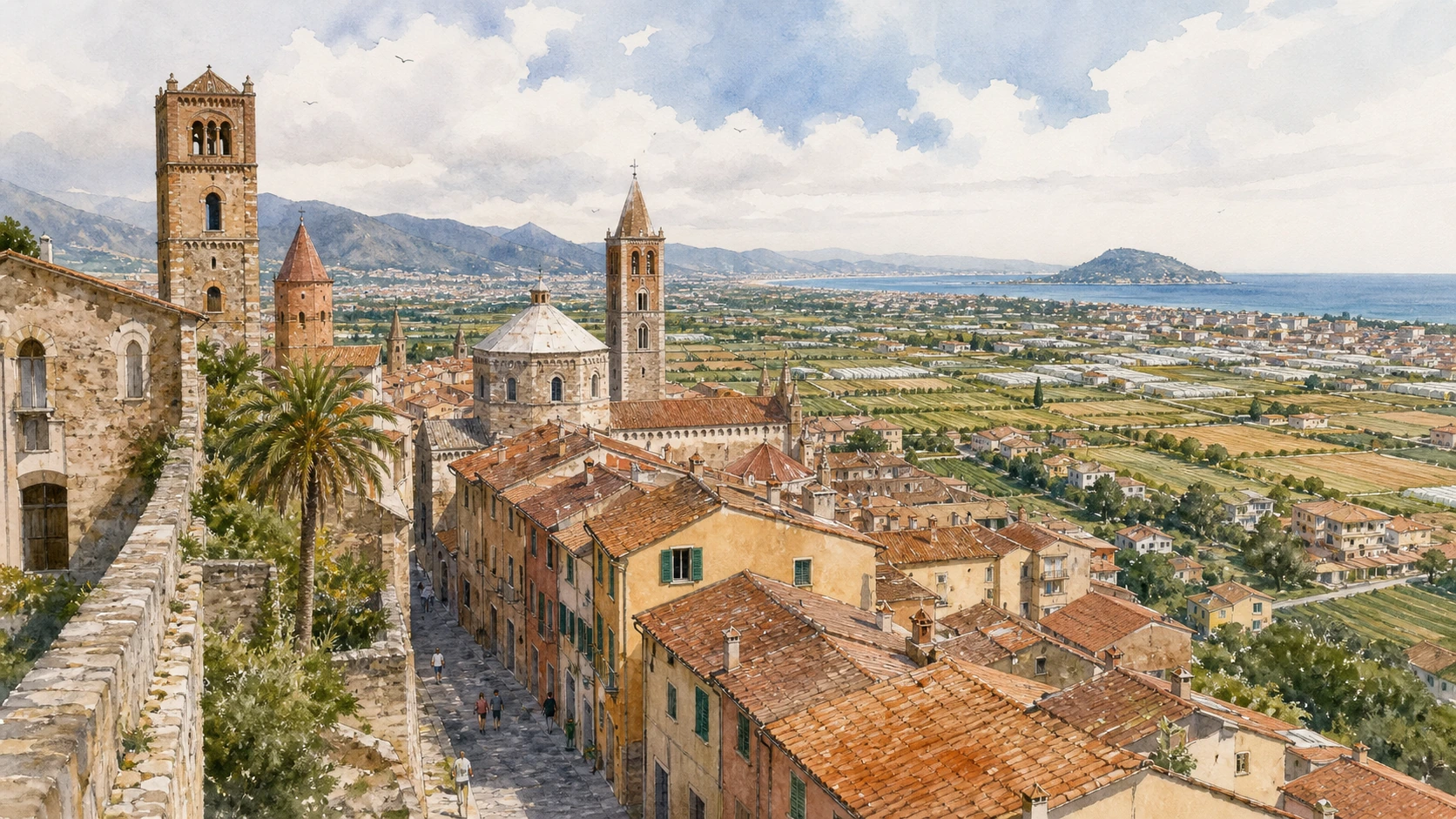
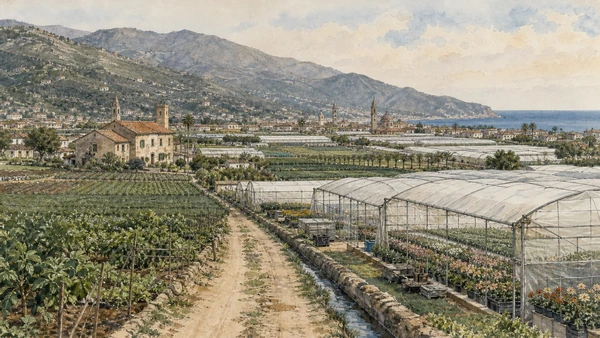
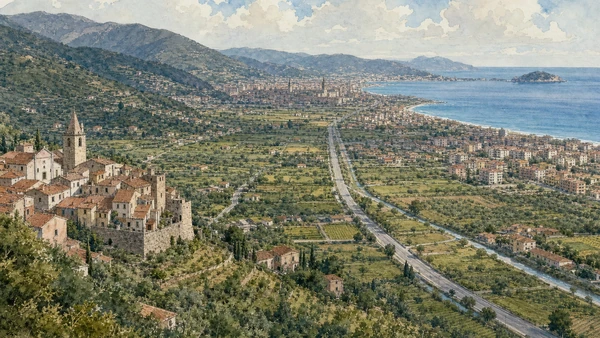
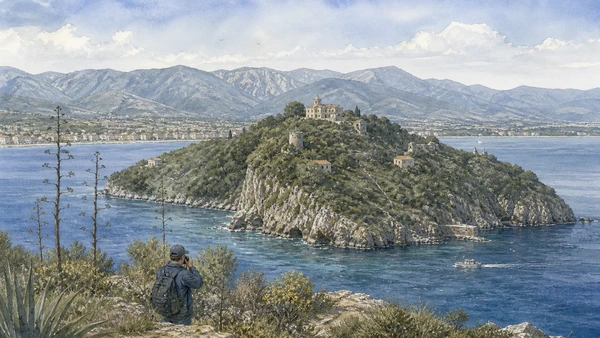
Original documentary watercolour panorama for Albenga and its Roman Plain: Complete Guide, with accurate Ligurian architecture, landscape and lived context

Liguria Guide 06 · Roman city, early Christian baptistery, medieval towers, museums, agricultural plain and Gallinara

Albenga
city and plain

A one- or two-day guide to the most legible historic centre of the western Riviera and the agricultural landscape that explains its long continuity.

Plan the route
Albenga and its plain · Liguria10 chapters · one complete route

Why this route must be read in layers

Albenga is both a layered city and a productive plain, not an isolated cluster of medieval towers.

Roman Albingaunum occupied a strategic coastal plain linked to the Via Iulia Augusta. The shoreline has shifted, but roads, archaeology and museum collections preserve the city’s Mediterranean connections.

The cathedral, baptistery and towers form a dense early Christian and medieval centre whose ground levels and reconstructions must be read carefully.

Horticulture, irrigation and river management keep the plain economically active. Villages, farms and greenhouse systems are part of the contemporary landscape, while Gallinara marks an ecological and monastic horizon offshore.

Give the centre a slow walking day and use a second half-day for the Roman road, plain and authorised coastal viewpoints toward Gallinara.

The route

Plan your visit

Begin below current street level at the baptistery and museums, climb the civic towers, then move outward to Roman routes, Centa river and active agriculture.

Early morning

Early Christian Baptistery · San Michele Cathedral · Medieval towers

Move in the documented order: Early Christian Baptistery: mosaic below modern street level; then San Michele Cathedral: medieval fabric beside the baptistery; then Medieval towers: family power in the city skyline. Recheck live access and transport before entering a controlled site.

Late morning

Palazzo Vecchio and civic museum · Roman Naval Museum · Via Iulia Augusta

Move in the documented order: Palazzo Vecchio and civic museum: government over archaeology; then Roman Naval Museum: the sea reconstructed through cargo; then Via Iulia Augusta: road and funerary landscape. Recheck live access and transport before entering a controlled site.

Afternoon

Centa river · Albenga plain · Villanova, Ceriale and the wider plain

Move in the documented order: Centa river: city edge, floodplain and archaeological exposure; then Albenga plain: horticulture as contemporary heritage; then Villanova, Ceriale and the wider plain: settlements beyond the walls. Recheck live access and transport before entering a controlled site.

Late afternoon

Gallinara Island

Move in the documented order: Gallinara Island: monastic memory and protected habitat. Recheck live access and transport before entering a controlled site.

Ten chapters

Explore the places

The order follows terrain, institutions and present-day movement. Use the index to return to a chapter without reducing the route to isolated monuments.

  1. 01Early Christian Baptistery: mosaic below modern street level
  2. 02San Michele Cathedral: medieval fabric beside the baptistery
  3. 03Medieval towers: family power in the city skyline
  4. 04Palazzo Vecchio and civic museum: government over archaeology
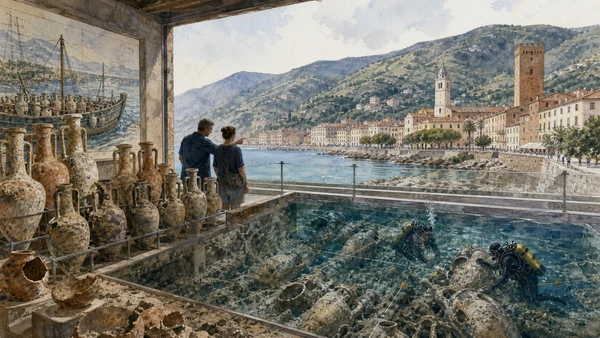
  5. 05Roman Naval Museum: the sea reconstructed through cargo
  6. 06Via Iulia Augusta: road and funerary landscape
  7. 07Centa river: city edge, floodplain and archaeological exposure
  8. 08Albenga plain: horticulture as contemporary heritage
  9. 09Villanova, Ceriale and the wider plain: settlements beyond the walls
  10. 10Gallinara Island: monastic memory and protected habitat
01

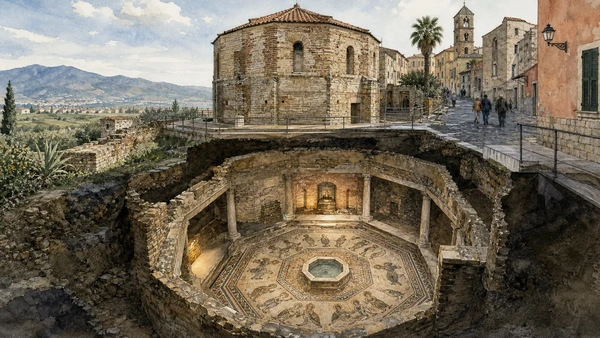
An octagonal interior, font and sixth-century mosaic preserve an exceptional early Christian monument.

Early Christian Baptistery: mosaic below modern street level

An octagonal interior, font and sixth-century mosaic preserve an exceptional early Christian monument. The site becomes clearer when its surviving fabric, later alterations and present use are read together.

Today

Archaeological access may be limited to protected viewpoints, scheduled openings or guided routes. Stay outside barriers, distinguish original material from supports and reconstruction, and verify the official opening notice.

History

Built in late antiquity and altered by later structures and an erroneous nineteenth-century intervention, the baptistery now requires guided access through the museum system.

How to read this place

Begin with external decagon and internal octagon. Then compare mosaic iconography with difference between ancient and current ground level; the differences are evidence, not visual noise.

What to notice

  • external decagon and internal octagon
  • mosaic iconography
  • difference between ancient and current ground level
Comune di Albenga · Baptistery
Original documentary watercolour of Early Christian Baptistery: mosaic below modern street level in Albenga and its plain · Liguria, showing accurate architecture, landscape, people and present-day use
Early Christian Baptistery: mosaic below modern street levelOriginal Merlintravel documentary watercolour · 2026
02

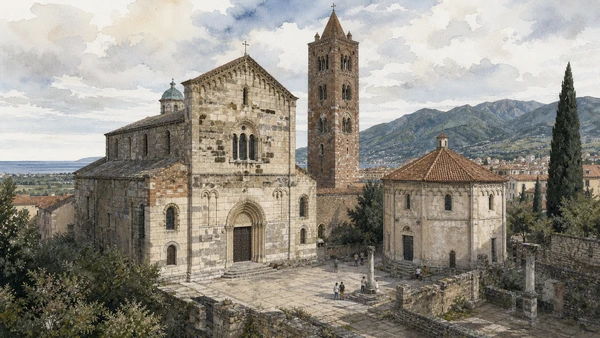
Church, bell tower and adjacent civic buildings form a compact religious centre above Roman levels.

San Michele Cathedral: medieval fabric beside the baptistery

Church, bell tower and adjacent civic buildings form a compact religious centre above Roman levels. The site becomes clearer when its surviving fabric, later alterations and present use are read together.

Today

This is an active religious place as well as a historic building. Services, ceremonies and conservation can interrupt tourist access; dress appropriately, remain quiet and never treat a booked visit as priority over worship.

History

A medieval cathedral developed through Romanesque and later phases, with restoration shaping how its earlier fabric is now perceived.

How to read this place

Begin with façade masonry phases. Then compare bell tower with relationship to baptistery and square; the differences are evidence, not visual noise.

What to notice

  • façade masonry phases
  • bell tower
  • relationship to baptistery and square
Comune di Albenga · Official site
Original documentary watercolour of San Michele Cathedral: medieval fabric beside the baptistery in Albenga and its plain · Liguria, showing accurate architecture, landscape, people and present-day use
San Michele Cathedral: medieval fabric beside the baptisteryOriginal Merlintravel documentary watercolour · 2026
03

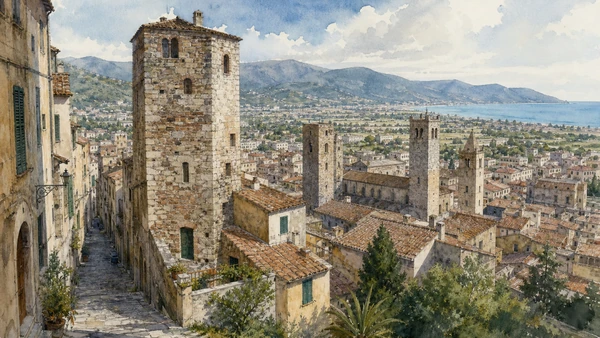
Brick and stone towers rise from a street grid where elite houses, lanes and squares remain closely interwoven.

Medieval towers: family power in the city skyline

Brick and stone towers rise from a street grid where elite houses, lanes and squares remain closely interwoven. The site becomes clearer when its surviving fabric, later alterations and present use are read together.

Today

The area is inhabited and worked, not staged for visitors. Keep doorways, pavements, cycle lanes and deliveries clear, ask before photographing people and use current municipal mobility information.

History

Communal competition and family status produced vertical residences and defensive structures later adapted into civic and domestic buildings.

How to read this place

Begin with tower bases within houses. Then compare masonry changes with sightlines along narrow streets; the differences are evidence, not visual noise.

What to notice

  • tower bases within houses
  • masonry changes
  • sightlines along narrow streets
Comune di Albenga · Official site
Original documentary watercolour of Medieval towers: family power in the city skyline in Albenga and its plain · Liguria, showing accurate architecture, landscape, people and present-day use
Medieval towers: family power in the city skylineOriginal Merlintravel documentary watercolour · 2026
04

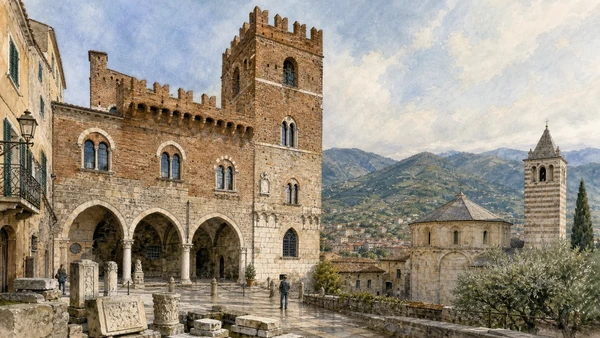
A medieval civic building preserves collections and provides access to earlier urban layers.

Palazzo Vecchio and civic museum: government over archaeology

A medieval civic building preserves collections and provides access to earlier urban layers. The site becomes clearer when its surviving fabric, later alterations and present use are read together.

Today

Opening, ticketing, room access and temporary displays can change. Check the institution’s official notice shortly before visiting, use the designated entrance and allow for security or conservation controls.

History

Communal administration occupied a centre already structured by cathedral and baptistery; museum use now links objects to the buildings around them.

How to read this place

Begin with loggia and tower connections. Then compare roman inscriptions and finds with museum route into the baptistery; the differences are evidence, not visual noise.

What to notice

  • loggia and tower connections
  • Roman inscriptions and finds
  • museum route into the baptistery
Comune di Albenga · Official site
Original documentary watercolour of Palazzo Vecchio and civic museum: government over archaeology in Albenga and its plain · Liguria, showing accurate architecture, landscape, people and present-day use
Palazzo Vecchio and civic museum: government over archaeologyOriginal Merlintravel documentary watercolour · 2026
06

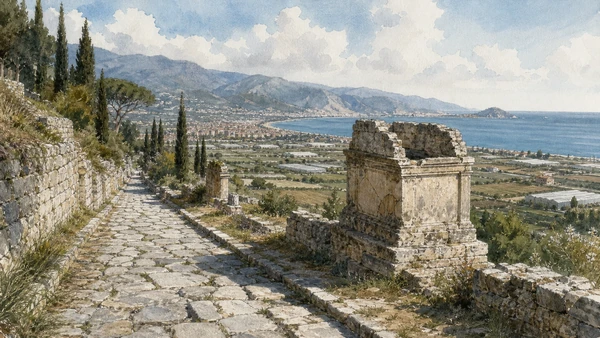
Surviving road segments and tombs above the coast preserve movement outside the Roman city.

Via Iulia Augusta: road and funerary landscape

Surviving road segments and tombs above the coast preserve movement outside the Roman city. The site becomes clearer when its surviving fabric, later alterations and present use are read together.

Today

Archaeological access may be limited to protected viewpoints, scheduled openings or guided routes. Stay outside barriers, distinguish original material from supports and reconstruction, and verify the official opening notice.

History

The route connected western Liguria to Gaul; funerary monuments occupied approaches where travellers encountered the civic territory.

How to read this place

Begin with road paving and retaining walls. Then compare tomb remains with views across the plain and changed shoreline; the differences are evidence, not visual noise.

What to notice

  • road paving and retaining walls
  • tomb remains
  • views across the plain and changed shoreline
Comune di Albenga · Official site
Original documentary watercolour of Via Iulia Augusta: road and funerary landscape in Albenga and its plain · Liguria, showing accurate architecture, landscape, people and present-day use
Via Iulia Augusta: road and funerary landscapeOriginal Merlintravel documentary watercolour · 2026
07

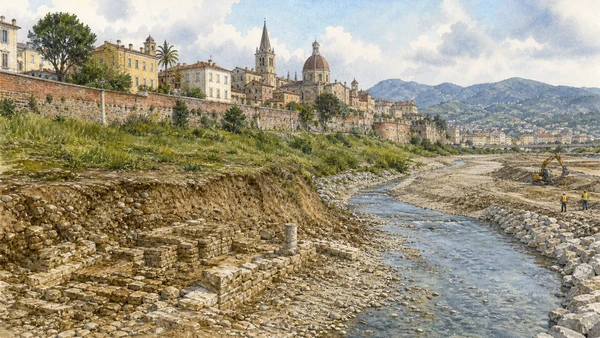
Embankments, bridges and changing channels reveal a river that repeatedly reshaped access and preservation.

Centa river: city edge, floodplain and archaeological exposure

Embankments, bridges and changing channels reveal a river that repeatedly reshaped access and preservation. The site becomes clearer when its surviving fabric, later alterations and present use are read together.

Today

Weather, water levels, trail conditions and seasonal services can alter the route. Use official transport and park information, remain on authorised paths and do not enter farms, vineyards or private gardens without permission.

History

Sediment and floods altered the coastal plain, occasionally exposing or threatening archaeological remains and requiring modern hydraulic control.

How to read this place

Begin with riverbed material. Then compare embankment engineering with historic centre position above the active channel; the differences are evidence, not visual noise.

What to notice

  • riverbed material
  • embankment engineering
  • historic centre position above the active channel
Comune di Albenga · Official site
Original documentary watercolour of Centa river: city edge, floodplain and archaeological exposure in Albenga and its plain · Liguria, showing accurate architecture, landscape, people and present-day use
Centa river: city edge, floodplain and archaeological exposureOriginal Merlintravel documentary watercolour · 2026
08

Fields, greenhouses, irrigation and markets form one of Liguria’s rare broad productive coastal landscapes.

Albenga plain: horticulture as contemporary heritage

Fields, greenhouses, irrigation and markets form one of Liguria’s rare broad productive coastal landscapes. The site becomes clearer when its surviving fabric, later alterations and present use are read together.

Today

Weather, water levels, trail conditions and seasonal services can alter the route. Use official transport and park information, remain on authorised paths and do not enter farms, vineyards or private gardens without permission.

History

Alluvial soils supported long agriculture; modern floriculture and intensive horticulture changed structures, water demand and market connections.

How to read this place

Begin with field geometry. Then compare greenhouse systems with farm access that must remain unobstructed; the differences are evidence, not visual noise.

What to notice

  • field geometry
  • greenhouse systems
  • farm access that must remain unobstructed
Comune di Albenga · Official site
Original documentary watercolour of Albenga plain: horticulture as contemporary heritage in Albenga and its plain · Liguria, showing accurate architecture, landscape, people and present-day use
Albenga plain: horticulture as contemporary heritageOriginal Merlintravel documentary watercolour · 2026
09

Smaller centres, roads and farmsteads show Albenga as a territorial system rather than one monument zone.

Villanova, Ceriale and the wider plain: settlements beyond the walls

Smaller centres, roads and farmsteads show Albenga as a territorial system rather than one monument zone. The site becomes clearer when its surviving fabric, later alterations and present use are read together.

Today

The area is inhabited and worked, not staged for visitors. Keep doorways, pavements, cycle lanes and deliveries clear, ask before photographing people and use current municipal mobility information.

History

Roman, medieval and modern routes organised dispersed settlement while tourism and road infrastructure expanded the coastal strip.

How to read this place

Begin with village centres. Then compare road and irrigation networks with transition between housing and cultivation; the differences are evidence, not visual noise.

What to notice

  • village centres
  • road and irrigation networks
  • transition between housing and cultivation
Comune di Albenga · Official site
Original documentary watercolour of Villanova, Ceriale and the wider plain: settlements beyond the walls in Albenga and its plain · Liguria, showing accurate architecture, landscape, people and present-day use
Villanova, Ceriale and the wider plain: settlements beyond the wallsOriginal Merlintravel documentary watercolour · 2026
10

The island’s profile, vegetation and restricted access preserve ecological value and traditions of early monastic occupation.

Gallinara Island: monastic memory and protected habitat

The island’s profile, vegetation and restricted access preserve ecological value and traditions of early monastic occupation. The site becomes clearer when its surviving fabric, later alterations and present use are read together.

Today

Weather, water levels, trail conditions and seasonal services can alter the route. Use official transport and park information, remain on authorised paths and do not enter farms, vineyards or private gardens without permission.

History

Religious associations and later private or defensive uses form a fragmentary history; protection limits landing and requires authorised observation.

How to read this place

Begin with island shape from public shore. Then compare nesting and vegetation zones with distance from the roman plain; the differences are evidence, not visual noise.

What to notice

  • island shape from public shore
  • nesting and vegetation zones
  • distance from the Roman plain
Regione Liguria · Gallinara protected area
Original documentary watercolour of Gallinara Island: monastic memory and protected habitat in Albenga and its plain · Liguria, showing accurate architecture, landscape, people and present-day use
Gallinara Island: monastic memory and protected habitatOriginal Merlintravel documentary watercolour · 2026

Liguria through time

A short chronology

From prehistoric caves and Roman roads to the maritime republic, railways, port industry, protected landscapes and climate-sensitive travel.

  1. Caves and open sites in western Liguria preserve exceptionally long evidence of human occupation and environmental change.

  2. Ligurian communities occupy coastal and inland territories connected to Etruscan, Greek and Celtic exchange networks.

  3. Roman conquest and road building integrate ports, plains and passes into wider Mediterranean and Po-basin systems.

  4. Albingaunum, Genua, Luna and smaller centres develop through harbours, agriculture, Christianity and regional roads.

  5. Byzantine, Lombard and Carolingian powers reorganise settlements, bishoprics, monasteries and coastal defence.

  6. Genoa grows as a maritime commune while castles, churches and village territories consolidate along both Rivieras.

  7. Commercial expansion, crusading routes, colonies and banking enrich Genoa while factional conflict reshapes its government.

  8. Doge government, foreign interventions and powerful families contest control of the republic and its maritime system.

  9. The aristocratic Republic of Genoa develops the Rolli palace system, finance, naval infrastructure and territorial fortifications.

  10. Coastal defence, olive and wine landscapes, ports and inland routes continue to connect specialised local economies.

  11. French and Napoleonic rule ends the old republic before Liguria is incorporated into the Kingdom of Sardinia.

  12. Roads, railways, port works and unification transform mobility; the Genoa–La Spezia railway changes the eastern coast.

  13. Industry, emigration, resort culture, naval bases, war and resistance create sharply different modern landscapes.

  14. Port expansion, reconstruction, mass tourism, motorway infrastructure and deindustrialisation alter coast and cities.

  15. UNESCO recognition, park management, climate risk and overtourism intensify the need to maintain terraces, paths and living communities.

Before your visit

Practical information

01

Check the live page

Opening hours, reservation systems, restoration, exhibitions and transport can change. Recheck the linked official institution shortly before departure.

02

Separate worship and tourism

Churches and sanctuaries remain religious spaces. Services, funerals and community use take priority over visitor itineraries.

03

Plan real distances

Albenga and its plain · Liguria combines dense urban routes with lakes, valleys and dispersed towns. Do not compress distant chapters into an unsafe or superficial day.

04

Keep thresholds open

Arcades, station halls, markets, courtyards, workshops and residential streets must continue to function while you observe or photograph them.

05

Use current mobility data

Check the responsible rail, navigation, bus, road or park operator on the day; replacement services and weather can change an otherwise sound route.

06

Read change honestly

Restoration, reconstruction, adaptive reuse and new development have all shaped the landscape visible today.

Method and sources

Sources and image credits

This guide uses official museum, ministry, municipal, transport, park and UNESCO documentation checked on 31 August 2026. It separates durable historical interpretation from access details that can change, distinguishes surviving fabric from restoration or reconstruction, and treats worship, port work, residence, farming, fishing and public movement as part of the evidence. Every chapter links its principal institutional source; tickets, closures, weather, sea conditions, trails and transport must always be verified again on the day of the visit.

All ten images are original Merlintravel editorial watercolours based on documented present-day conditions. They are illustrations, not substitutes for archaeological plans. Opening hours, tickets, accessible routes, temporary exhibitions and conservation work can change; consult the linked official pages shortly before visiting.