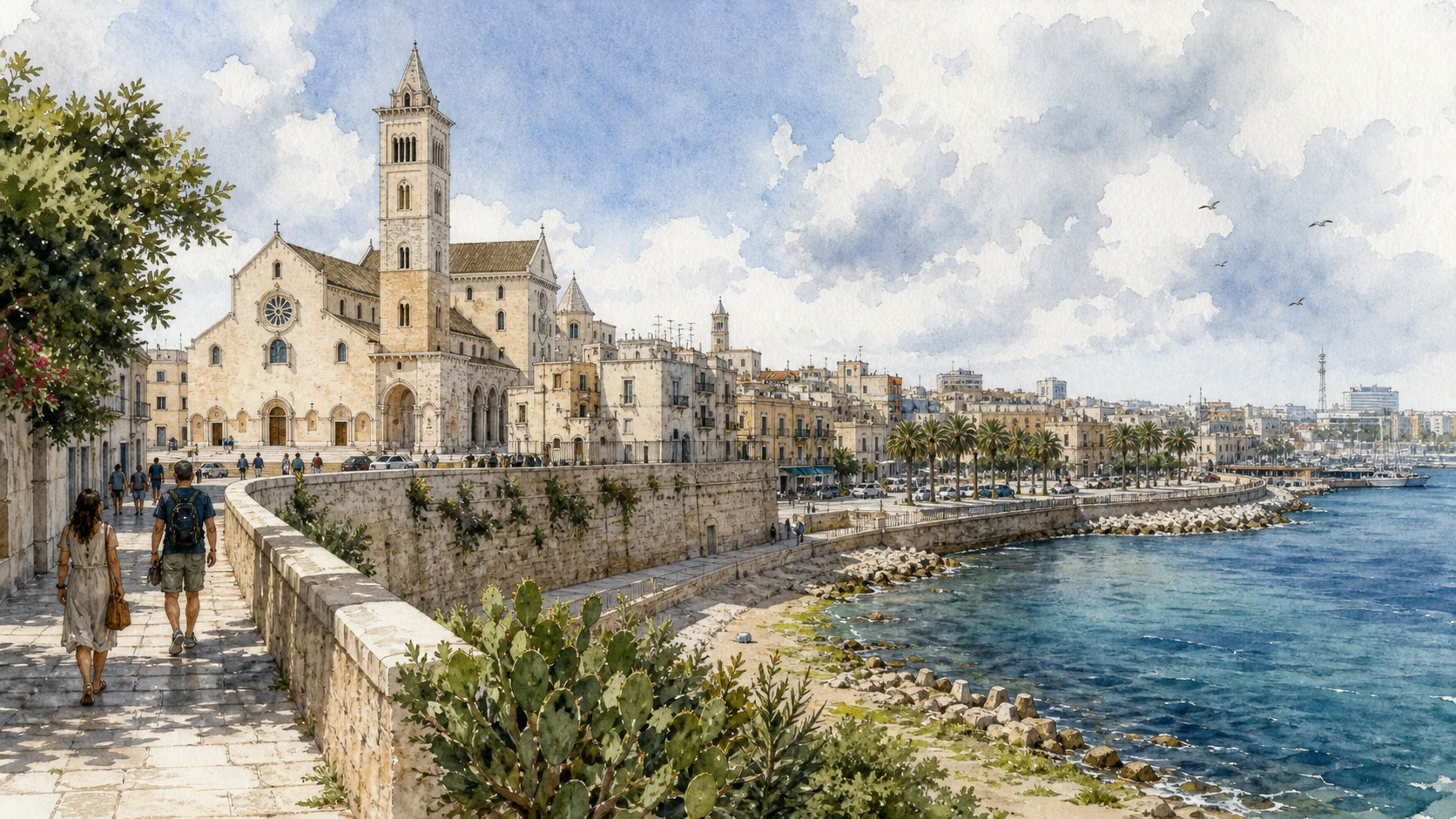
Original documentary watercolour panorama for Bari and the Adriatic Capital: Complete Guide, with accurate Puglian architecture, landscape and lived context

Puglia Guide 01 · Archaeology, architecture, working landscapes and contemporary access

Bari
faces east

A two-day route through pilgrimage, Romanesque architecture, a layered old city, Norman-Swabian power, twentieth-century expansion and a working Adriatic waterfront.

Plan the route
Bari · Puglia10 chapters · one complete route

Why this route must be read in layers

Bari is not only a gateway: pilgrimage, government, domestic streets and port infrastructure occupy the same compact urban edge.

The route begins with documented fabric and institutional collections rather than a list of photogenic surfaces. Each chapter separates what survives, what was rebuilt and what remains in use.

Puglia’s ports, pilgrimage sites, farms, forests, archaeological parks and inhabited centres operate under different access conditions. Current notices therefore belong to the route rather than an appendix.

Each chapter includes an illustration of the place described. The images are watercolours rather than photographs.

A two-day route through pilgrimage, Romanesque architecture, a layered old city, Norman-Swabian power, twentieth-century expansion and a working Adriatic waterfront.

The route

Plan your visit

A two-day route through pilgrimage, Romanesque architecture, a layered old city, Norman-Swabian power, twentieth-century expansion and a working Adriatic waterfront.

Early morning

Basilica of Saint Nicholas · Bari Cathedral · Swabian Castle

Move in the documented order: Basilica of Saint Nicholas: pilgrimage and Adriatic connection; then Bari Cathedral: San Sabino beneath later rebuilding; then Swabian Castle: fortress, court and museum. Recheck live access and transport before entering a controlled site.

Late morning

Santa Scolastica · Bari Vecchia · Fortino Sant’Antonio and the sea walls

Move in the documented order: Santa Scolastica: archaeology at the old city’s edge; then Bari Vecchia: inhabited lanes around courts and shrines; then Fortino Sant’Antonio and the sea walls. Recheck live access and transport before entering a controlled site.

Afternoon

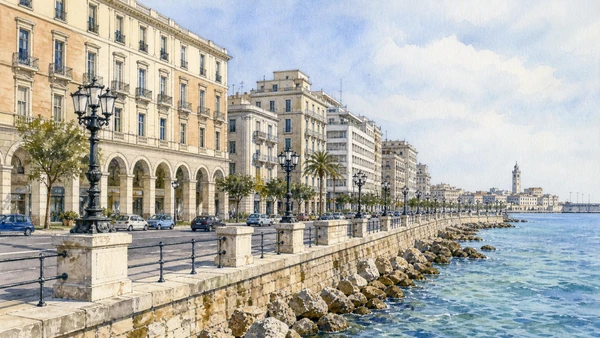
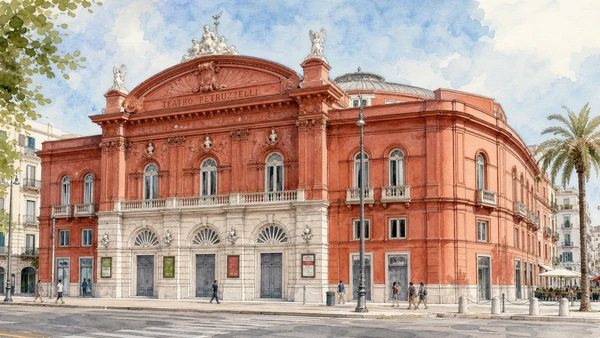
Old harbour and Teatro Margherita · The Lungomare · Teatro Petruzzelli

Move in the documented order: Old harbour and Teatro Margherita: water, fish and adaptive reuse; then The Lungomare: a twentieth-century civic facade; then Teatro Petruzzelli: performance, fire and reconstruction. Recheck live access and transport before entering a controlled site.

Late afternoon

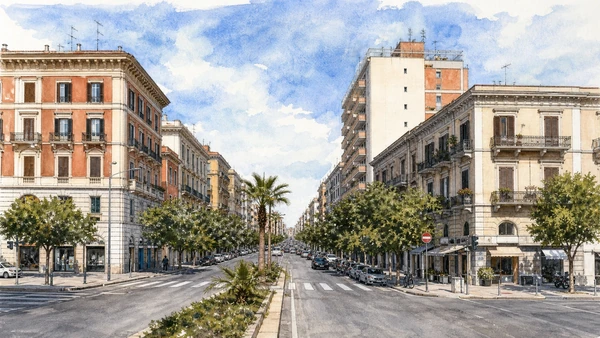
Murat district

Move in the documented order: Murat district: the grid beyond the old city. Recheck live access and transport before entering a controlled site.

Ten chapters

Explore the places

The order follows terrain, institutions and present-day movement. Use the index to return to a chapter without reducing the route to isolated monuments.

  1. 01Basilica of Saint Nicholas: pilgrimage and Adriatic connection
  2. 02Bari Cathedral: San Sabino beneath later rebuilding
  3. 03Swabian Castle: fortress, court and museum
  4. 04Santa Scolastica: archaeology at the old city’s edge
  5. 05Bari Vecchia: inhabited lanes around courts and shrines
  6. 06Fortino Sant’Antonio and the sea walls
  7. 07Old harbour and Teatro Margherita: water, fish and adaptive reuse
  8. 08The Lungomare: a twentieth-century civic facade
  9. 09Teatro Petruzzelli: performance, fire and reconstruction
  10. 10Murat district: the grid beyond the old city
01

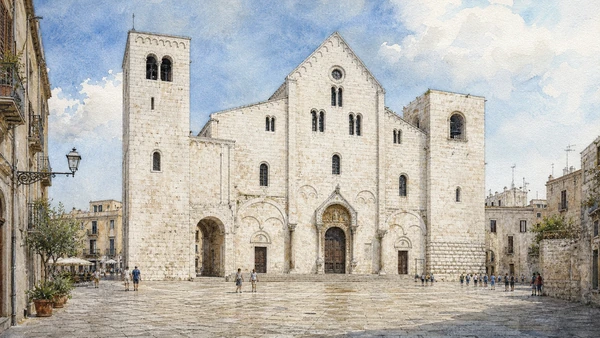
The basilica joins Romanesque stone, the cult of Saint Nicholas and continuing Catholic and Orthodox pilgrimage.

Basilica of Saint Nicholas: pilgrimage and Adriatic connection

The basilica joins Romanesque stone, the cult of Saint Nicholas and continuing Catholic and Orthodox pilgrimage. The place becomes clearer when surviving fabric, later change and present use are read together.

Today

This is an active religious place. Services, ceremonies and conservation can interrupt tourist access; dress appropriately, remain quiet and verify the official notice.

History

Construction followed the transfer of the saint’s relics from Myra in 1087; later additions and restorations accumulated around the medieval church.

How to read this place

Compare the upper basilica and crypt, then observe how different communities share one active sacred building without erasing its architectural phases.

What to notice

  • the relationship between worship and visitor circulation
  • older fabric and later rebuilding
  • objects still used in liturgy
Basilica San Nicola · official site
Original documentary watercolour of Basilica of Saint Nicholas: pilgrimage and Adriatic connection in Bari · Puglia, showing accurate architecture, landscape and present-day use
Basilica of Saint Nicholas: pilgrimage and Adriatic connectionOriginal Merlintravel documentary watercolour · 2026
02

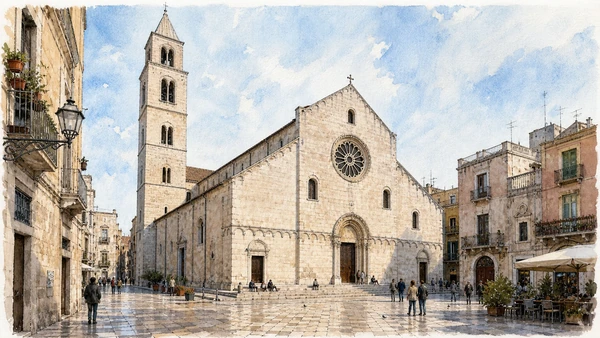
A Romanesque cathedral incorporates earlier occupation, a crypt and centuries of liturgical and architectural change.

Bari Cathedral: San Sabino beneath later rebuilding

A Romanesque cathedral incorporates earlier occupation, a crypt and centuries of liturgical and architectural change. The place becomes clearer when surviving fabric, later change and present use are read together.

Today

This is an active religious place. Services, ceremonies and conservation can interrupt tourist access; dress appropriately, remain quiet and verify the official notice.

History

The present building rose largely in the twelfth and thirteenth centuries after destruction of an earlier cathedral; archaeological evidence extends further back.

How to read this place

Read the restrained exterior before the crypt and archaeological area; separate medieval fabric from Baroque removals and modern presentation.

What to notice

  • the relationship between worship and visitor circulation
  • older fabric and later rebuilding
  • objects still used in liturgy
Arcidiocesi Bari-Bitonto
Original documentary watercolour of Bari Cathedral: San Sabino beneath later rebuilding in Bari · Puglia, showing accurate architecture, landscape and present-day use
Bari Cathedral: San Sabino beneath later rebuildingOriginal Merlintravel documentary watercolour · 2026
03

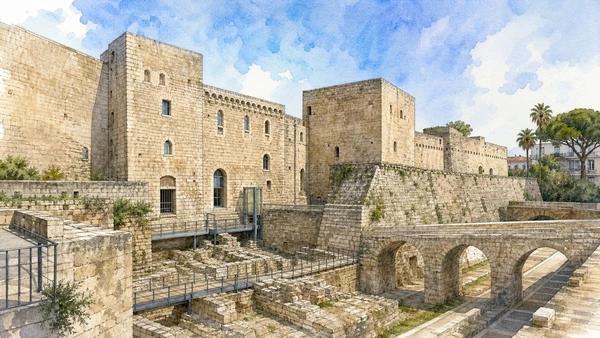
The castle records Norman foundation, Frederick II’s rebuilding, Aragonese defences and Renaissance court life.

Swabian Castle: fortress, court and museum

The castle records Norman foundation, Frederick II’s rebuilding, Aragonese defences and Renaissance court life. The place becomes clearer when surviving fabric, later change and present use are read together.

Today

Interior routes, exhibitions and controlled areas can change. Check the managing institution, respect barriers and distinguish surviving fabric from restoration.

History

Founded under Roger II in 1131, the complex was rebuilt under Frederick II and later adapted by Angevin, Aragonese and Sforza patrons.

How to read this place

Follow changes between the medieval core, sloping bastions and museum displays rather than treating the whole enclosure as one date.

What to notice

  • defensive geometry and controlled approaches
  • different masonry phases
  • present cultural or civic use
Direzione regionale Musei Puglia · Castello Svevo
Original documentary watercolour of Swabian Castle: fortress, court and museum in Bari · Puglia, showing accurate architecture, landscape and present-day use
Swabian Castle: fortress, court and museumOriginal Merlintravel documentary watercolour · 2026
04

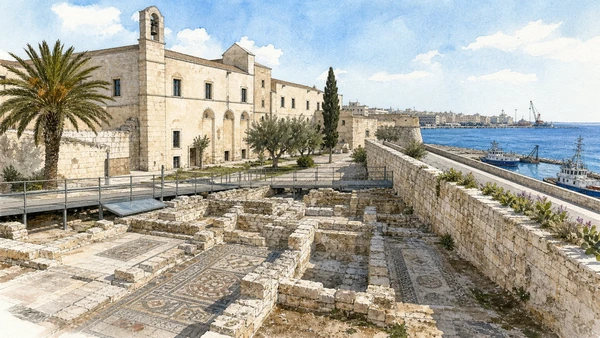
The museum and bastion connect Peucetian, Roman, medieval and maritime Bari through finds tied to the urban peninsula.

Santa Scolastica: archaeology at the old city’s edge

The museum and bastion connect Peucetian, Roman, medieval and maritime Bari through finds tied to the urban peninsula. The place becomes clearer when surviving fabric, later change and present use are read together.

Today

Opening, ticketing, room access and temporary displays can change. Check the museum’s official notice shortly before visiting and allow for security or conservation controls.

History

Collections developed from excavations across Bari and its territory; the former monastic complex now frames a long archaeological sequence.

How to read this place

Use the display chronology to connect objects to excavated places, then look back toward the sea wall and working port.

What to notice

  • the chronological order of the displays
  • finds tied to documented excavation contexts
  • modern conservation and interpretation
Museo Archeologico di Santa Scolastica
Original documentary watercolour of Santa Scolastica: archaeology at the old city's edge in Bari · Puglia, showing accurate architecture, landscape and present-day use
Santa Scolastica: archaeology at the old city’s edgeOriginal Merlintravel documentary watercolour · 2026
05

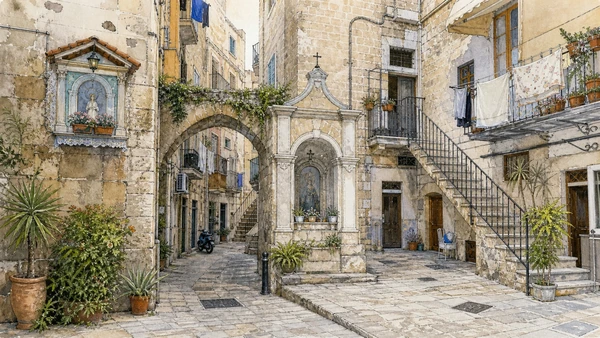
Domestic passages, ovens, street shrines and workshops survive inside a centre that is also intensely visited.

Bari Vecchia: inhabited lanes around courts and shrines

Domestic passages, ovens, street shrines and workshops survive inside a centre that is also intensely visited. The place becomes clearer when surviving fabric, later change and present use are read together.

Today

This is an inhabited place, not a visitor set. Keep doorways, pavements and deliveries clear, and use current municipal mobility information.

History

The peninsula preserves a medieval street structure repeatedly modified by religious institutions, houses, sanitation, restoration and tourism.

How to read this place

Notice thresholds, shared courts and daily work; do not reduce residents or pasta-making streets to performance for photographs.

What to notice

  • street width and building materials
  • residential use behind historic facades
  • later infrastructure and adaptation
Italia.it · Bari
Original documentary watercolour of Bari Vecchia: inhabited lanes around courts and shrines in Bari · Puglia, showing accurate architecture, landscape and present-day use
Bari Vecchia: inhabited lanes around courts and shrinesOriginal Merlintravel documentary watercolour · 2026
06

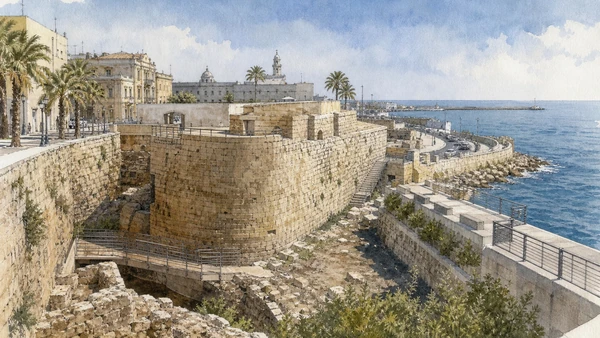
A surviving bastion and elevated walk reveal how the old city met harbour defence, trade and the Adriatic horizon.

Fortino Sant’Antonio and the sea walls

A surviving bastion and elevated walk reveal how the old city met harbour defence, trade and the Adriatic horizon. The place becomes clearer when surviving fabric, later change and present use are read together.

Today

Interior routes, exhibitions and controlled areas can change. Check the managing institution, respect barriers and distinguish surviving fabric from restoration.

History

Fortification changed repeatedly under Byzantine, Norman, Angevin and later rule; modern promenades now reuse parts of the defensive edge.

How to read this place

Compare wall thickness and changing ground levels with roads, harbour structures and public terraces added outside the old enclosure.

What to notice

  • defensive geometry and controlled approaches
  • different masonry phases
  • present cultural or civic use
Comune di Bari
Original documentary watercolour of Fortino Sant'Antonio and the sea walls in Bari · Puglia, showing accurate architecture, landscape and present-day use
Fortino Sant’Antonio and the sea wallsOriginal Merlintravel documentary watercolour · 2026
07

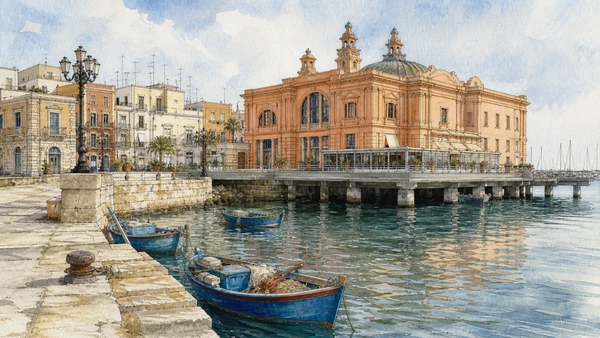
Fishing boats, market activity and a former theatre built over the water meet at the transition between old and modern Bari.

Old harbour and Teatro Margherita: water, fish and adaptive reuse

Fishing boats, market activity and a former theatre built over the water meet at the transition between old and modern Bari. The place becomes clearer when surviving fabric, later change and present use are read together.

Today

Public use, traffic, events and works can change circulation. Keep access routes open and verify any controlled interior with the responsible institution.

History

The twentieth-century Teatro Margherita used a concrete structure over the sea and later became a cultural venue as harbour functions changed.

How to read this place

Read the harbour as working infrastructure; compare the theatre’s modern fabric with older waterfront streets and contemporary cultural use.

What to notice

  • the relation between public space and movement
  • historic fabric beside later additions
  • present-day work and residence
Comune di Bari
Original documentary watercolour of Old harbour and Teatro Margherita: water, fish and adaptive reuse in Bari · Puglia, showing accurate architecture, landscape and present-day use
Old harbour and Teatro Margherita: water, fish and adaptive reuseOriginal Merlintravel documentary watercolour · 2026
08

Seafront roads and public buildings extend Bari beyond the old peninsula while keeping the Adriatic visible as infrastructure and climate.

The Lungomare: a twentieth-century civic facade

Seafront roads and public buildings extend Bari beyond the old peninsula while keeping the Adriatic visible as infrastructure and climate. The place becomes clearer when surviving fabric, later change and present use are read together.

Today

Public use, traffic, events and works can change circulation. Keep access routes open and verify any controlled interior with the responsible institution.

History

Much of the monumental waterfront took form during twentieth-century expansion, alongside port, fair and administrative projects.

How to read this place

Observe building setbacks, arcades, traffic and sea defences; the waterfront is planned modern city, not an ancient promenade.

What to notice

  • the relation between public space and movement
  • historic fabric beside later additions
  • present-day work and residence
Italia.it · Bari
Original documentary watercolour of The Lungomare: a twentieth-century civic facade in Bari · Puglia, showing accurate architecture, landscape and present-day use
The Lungomare: a twentieth-century civic facadeOriginal Merlintravel documentary watercolour · 2026
09

The opera house embodies late nineteenth-century civic ambition and the contested work of reconstruction after the 1991 fire.

Teatro Petruzzelli: performance, fire and reconstruction

The opera house embodies late nineteenth-century civic ambition and the contested work of reconstruction after the 1991 fire. The place becomes clearer when surviving fabric, later change and present use are read together.

Today

Public use, traffic, events and works can change circulation. Keep access routes open and verify any controlled interior with the responsible institution.

History

Opened in 1903, the theatre was severely damaged by fire in 1991 and reopened in 2009 after reconstruction and institutional dispute.

How to read this place

Compare the historicist exterior with the rebuilt auditorium and current production systems; continuity here includes major modern intervention.

What to notice

  • the relation between public space and movement
  • historic fabric beside later additions
  • present-day work and residence
Fondazione Teatro Petruzzelli
Original documentary watercolour of Teatro Petruzzelli: performance, fire and reconstruction in Bari · Puglia, showing accurate architecture, landscape and present-day use
Teatro Petruzzelli: performance, fire and reconstructionOriginal Merlintravel documentary watercolour · 2026
10

Regular blocks, commerce and nineteenth- and twentieth-century facades show Bari’s expansion under new administrative and economic conditions.

Murat district: the grid beyond the old city

Regular blocks, commerce and nineteenth- and twentieth-century facades show Bari’s expansion under new administrative and economic conditions. The place becomes clearer when surviving fabric, later change and present use are read together.

Today

This is an inhabited place, not a visitor set. Keep doorways, pavements and deliveries clear, and use current municipal mobility information.

History

The planned district developed from the early nineteenth century and continued to change with railway, port and metropolitan growth.

How to read this place

Use the contrast with Bari Vecchia to read block size, street hierarchy and changing shopfronts rather than searching for a single monument.

What to notice

  • street width and building materials
  • residential use behind historic facades
  • later infrastructure and adaptation
Comune di Bari
Original documentary watercolour of Murat district: the grid beyond the old city in Bari · Puglia, showing accurate architecture, landscape and present-day use
Murat district: the grid beyond the old cityOriginal Merlintravel documentary watercolour · 2026

Puglia through time

A short chronology

From Daunian, Peucetian and Messapian landscapes to Greek Taras, Roman roads, medieval ports, modern cities, protected parks and contemporary cultural recovery.

  1. Coastal landings, cave occupation and Bronze Age communities connect Adriatic, Ionian and inland routes.

  2. Daunian, Peucetian and Messapian societies develop distinct settlements, funerary customs and material cultures.

  3. Greek Taras expands on the Ionian coast while Indigenous centres negotiate trade and conflict across the region.

  4. Fortified towns, sanctuaries and rural systems change under pressure from Taranto, neighbouring peoples and Roman expansion.

  5. Roman colonies, estates, ports and the Via Appia and Via Traiana reorganise Apulia’s movement and production.

  6. Byzantine, Lombard and local powers contest a frontier shaped by ports, cave settlements, bishoprics and monastic networks.

  7. Norman rule, pilgrimage and maritime commerce support cathedrals, castles and new Latin institutions.

  8. Frederick II and his administration reshape castles, towns and royal landscapes across the region.

  9. Angevin and Aragonese power changes fortified towns, estates and relations with the Adriatic and Balkan coasts.

  10. The Ottoman capture of Otranto and its aftermath become a lasting element of Salento’s civic and religious memory.

  11. Coastal towers, masserie, olive estates and urban rebuilding respond to insecurity, trade and landholding systems.

  12. Feudal abolition, Bourbon reforms and Italian unification alter institutions without resolving rural inequality.

  13. Ports, railways, industry, war and migration transform cities while archaeology and heritage protection acquire new public roles.

  14. Land reform, industrial development, tourism and mass mobility reshape plains, coastlines and historic centres.

  15. UNESCO sites, national parks and museum networks expand while overtourism, industrial transition, olive disease and climate risk demand new care.

Before your visit

Practical information

01

Check the live page

Opening hours, reservations, restoration, worship and seasonal services can change. Recheck the linked institution shortly before departure.

02

Plan the long geography

Puglia is a long region. Do not compress distant cities, headlands and archaeological parks into an unsafe or superficial day.

03

Separate worship and tourism

Basilicas, cathedrals, sanctuaries and chapels remain religious places. Services and community use take priority.

04

Protect inhabited centres

Old towns, trulli districts, fishing quarters and working ports are not stage sets. Keep access, homes and deliveries clear.

05

Use current environmental notices

Heat, fire risk, sea state, coastal erosion, forest restrictions and protected habitats can alter a route at short notice.

06

Read reconstruction honestly

Restoration, adaptive reuse, modern infrastructure and contemporary art are part of the documented landscape, not defects to hide.

Method and sources

Sources and image credits

This guide uses official museum, ministry, municipal, park, UNESCO and regional-tourism documentation checked on 1 September 2026. It distinguishes Daunian, Peucetian, Messapian, Greek, Roman, Byzantine, Lombard, Norman, Swabian and later phases rather than treating Puglia as one timeless Mediterranean image. Every chapter links its principal institutional source; tickets, services, worship, closures, heat, fire risk, sea conditions and transport must always be verified again on the day of the visit.

All ten images are original Merlintravel editorial watercolours based on documented present-day conditions. They are illustrations, not substitutes for archaeological plans. Opening hours, tickets, accessible routes, temporary exhibitions and conservation work can change; consult the linked official pages shortly before visiting.