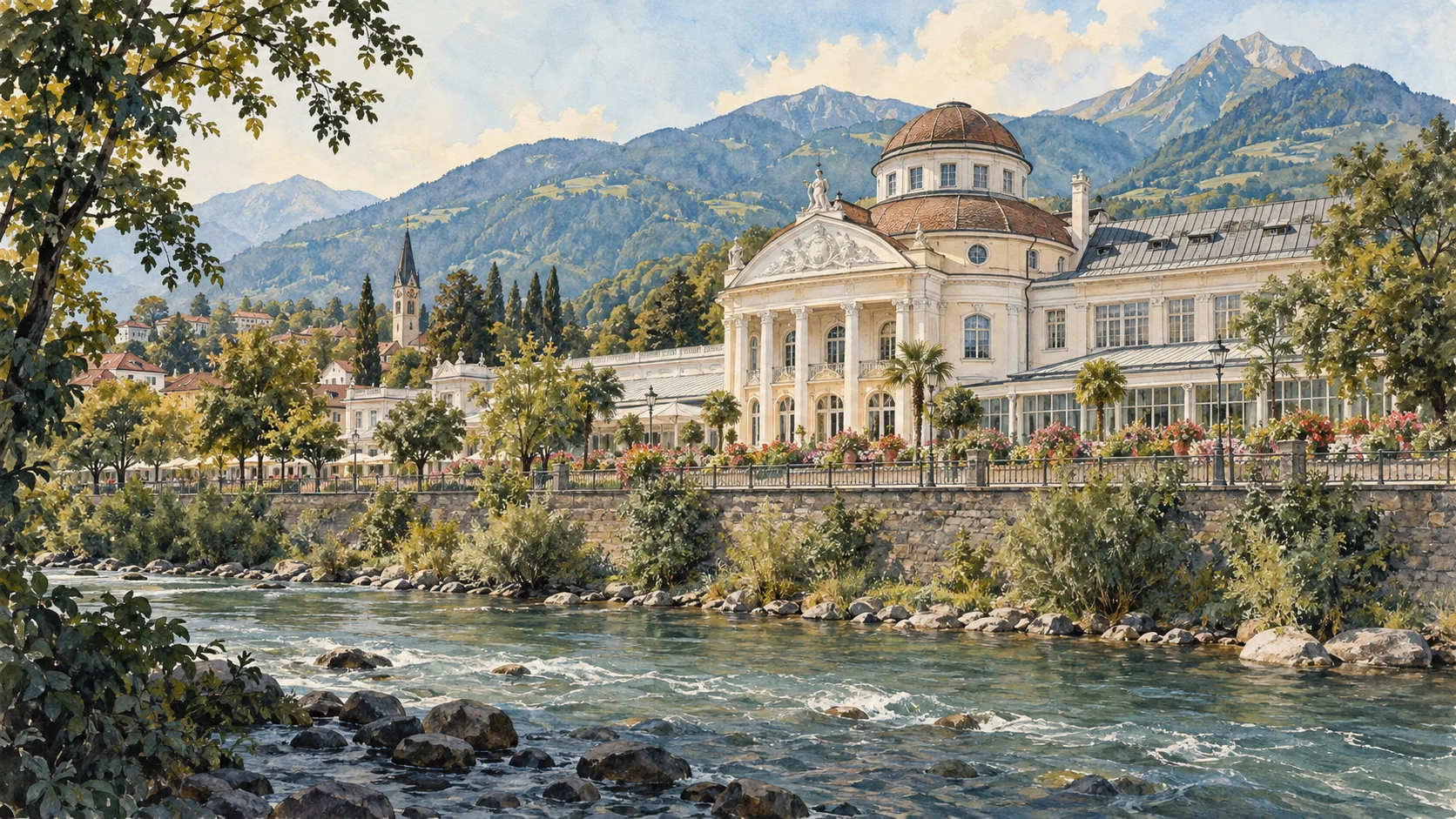
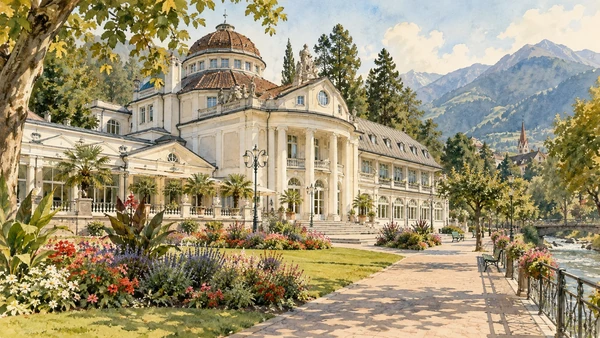
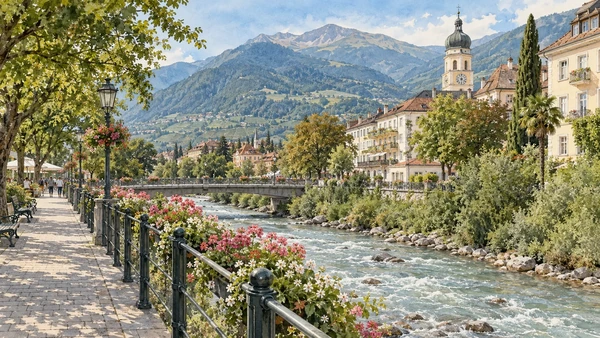
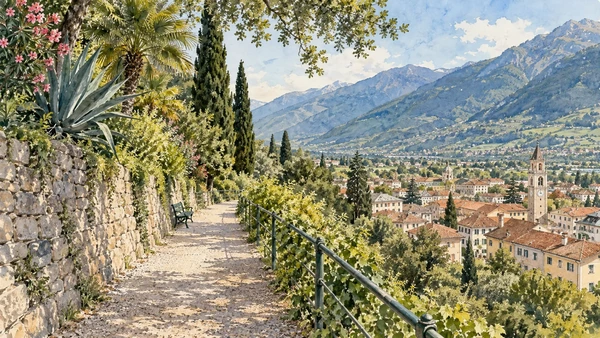
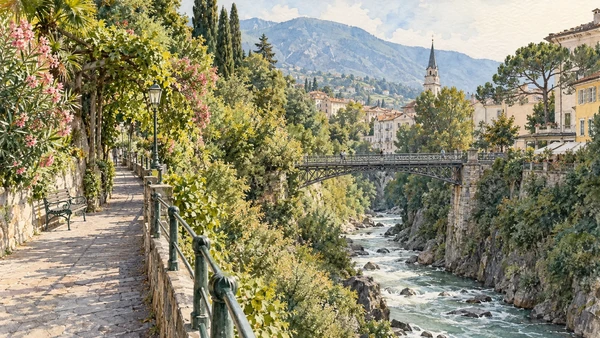
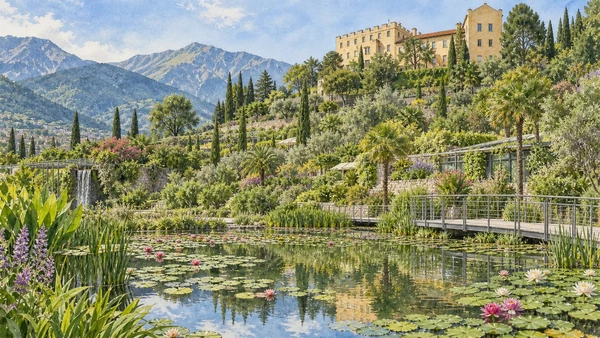
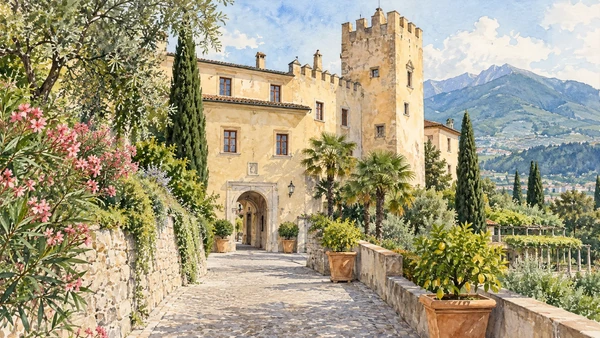
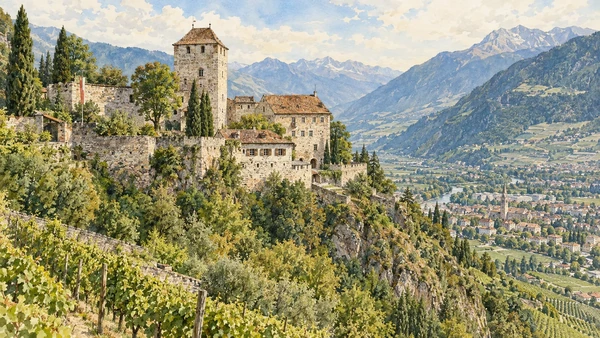
Editorial watercolour establishing view for Merano / Meran

Trentino-Alto Adige · Guide 05

Merano
Meran

A medieval trading centre became a spa town of promenades and gardens. Its museums reveal the changes behind that apparently effortless elegance.

Plan the route
Merano / Meran10 chapters · history, culture and landscape

Why this place matters

The landscape of a town that learned to welcome visitors.

The arcades and the river promenade belong to different chapters of Merano. A good visit gives room to both: the compact inherited town and the spaces made for walking, treatment and leisure. The surrounding gardens and Castel Tirolo are separate destinations, not buildings on one continuous city street.

The guide separates documented history from suggestions for reading the site. Named buildings and landscape relationships follow institutional sources; the illustrations are editorial interpretations, not measured surveys or records of current access.

A medieval trading centre became a spa town of promenades and gardens. Its museums reveal the changes behind that apparently effortless elegance.

The route

Plan your visit

Keep the old centre and river walks together. Allow a separate half-day or more for Trauttmansdorff and the Touriseum, and another outing for Castel Tirolo. The order is a framework, not a timed promise.

Day 1 · old town

Arcades, St Nicholas and Prince’s Castle

Keep the old centre and river walks together. Allow a separate half-day or more for Trauttmansdorff and the Touriseum, and another outing for Castel Tirolo. The order is a framework, not a timed promise.

Day 1 · river

Kurhaus and the Passer promenades

Day 2 · choose a hillside walk

Tappeiner and the town outlook

Separate half-days

Trauttmansdorff, Touriseum or Castel Tirolo

Ten chapters

Explore the places

The chapters connect history and terrain. Mountain areas and outlying towns are separate options, not a single continuous walking route.

  1. 01Portici / Lauben and the old centre
  2. 02St Nicholas / San Nicolò
  3. 03The Prince’s Castle / Landesfürstliche Burg
  4. 04Kurhaus and the spa-town frontage
  5. 05Passer / Passirio promenades
  6. 06Tappeiner promenade
  7. 07Gilf and the river’s upper approach
  8. 08Gardens of Trauttmansdorff Castle
  9. 09Touriseum: the history of tourism
  10. 10Castel Tirolo / Schloss Tirol
01

The inhabited landscape

Portici / Lauben and the old centre

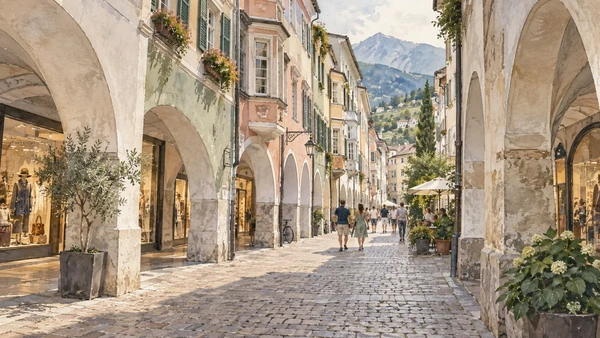
The arcades offer a sheltered route through the historic town, connecting shopping with the scale of older urban plots. Start with an unhurried walk rather than a shopping list.

Today

This remains an inhabited place. Use pedestrian routes, keep entrances clear and check municipal mobility notices for any restricted area.

History

The trading centre preceded the later spa town. Its compact streets provide a useful contrast with the broader leisure spaces near the river.

How to read this place

Notice how side passages and shopfronts organise movement. Contemporary commerce continues the street’s purpose even where products and interiors have changed.

What to notice

  • Notice how side passages and shopfronts organise movement.
  • The relationship between the site and its surrounding route.
  • The distinction between surviving evidence and modern interpretation.
Merano Tourist Office · cultural walking map
Watercolour: Merano’s arcaded street and pastel facades.
Portici / Lauben and the old centreOriginal Merlintravel documentary watercolour · 2026
02

Worship and memory

St Nicholas / San Nicolò

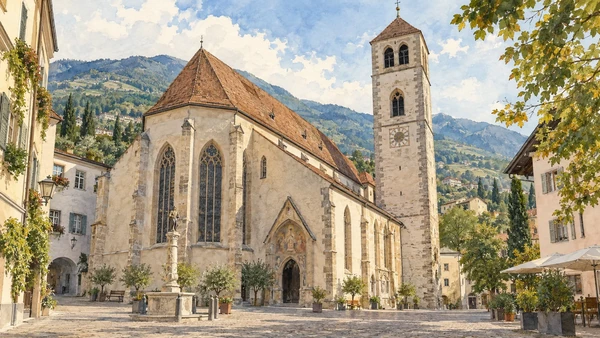
The church anchors the upper end of the old-town walk. Its exterior gives a strong point of orientation among the streets and roofs.

Today

Worship and local religious life continue here. Visitor access may pause for services; consult the church or managing institution before planning an interior visit.

History

Religious space and the trading settlement grew together; the visible church preserves a different urban history from the later spa buildings.

How to read this place

Compare the scale of the tower with the surrounding houses. Enter quietly and check whether worship limits the visitor route.

What to notice

  • Compare the scale of the tower with the surrounding houses.
  • The relationship between the site and its surrounding route.
  • The distinction between surviving evidence and modern interpretation.
Merano Tourist Office · cultural walking map
Watercolour: St Nicholas church and its tall bell tower.
St Nicholas / San NicolòOriginal Merlintravel documentary watercolour · 2026
03

Evidence and interpretation

The Prince’s Castle / Landesfürstliche Burg

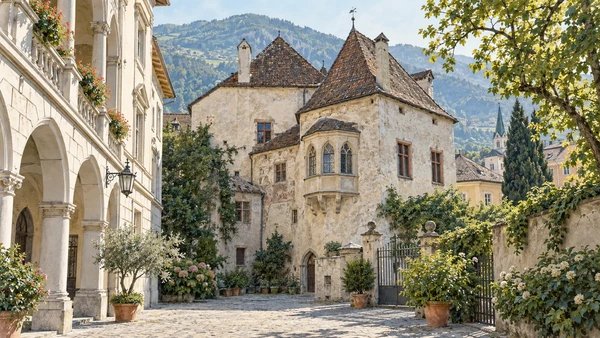
The small urban residence is reached within the old centre. It is a courtly building to explore at room scale, not a vast hilltop fortress.

Today

Check the institution’s current opening, booking arrangements and accessible route. Individual rooms, exhibitions and approaches may have separate conditions.

History

Built around 1470 for Duke Sigismund of Austria, the castle represents late-Gothic princely residence in the town.

How to read this place

Look for the relationship between domestic rooms and public status. Avoid adding defensive expectations to a building whose role was primarily residential.

What to notice

  • Look for the relationship between domestic rooms and public status.
  • The relationship between the site and its surrounding route.
  • The distinction between surviving evidence and modern interpretation.
Merano Tourist Office · Prince’s Castle
Watercolour: The small Prince’s Castle with steep roofs and projecting windows.
The Prince’s Castle / Landesfürstliche BurgOriginal Merlintravel documentary watercolour · 2026
04

The inhabited landscape

Kurhaus and the spa-town frontage

The Kurhaus faces the promenade as a public expression of Merano’s visitor culture. Its exterior is part of the town walk; access inside depends on events and arrangements.

Today

This remains an inhabited place. Use pedestrian routes, keep entrances clear and check municipal mobility notices for any restricted area.

History

The building belongs to the development of the spa town and its social spaces. It should not be read as a medieval civic palace.

How to read this place

Notice how the façade addresses the promenade. The architecture assumes people looking, strolling and gathering along the river.

What to notice

  • Notice how the façade addresses the promenade.
  • The relationship between the site and its surrounding route.
  • The distinction between surviving evidence and modern interpretation.
Merano Tourist Office · city guide
Watercolour: The white Kurhaus beside the promenade.
Kurhaus and the spa-town frontageOriginal Merlintravel documentary watercolour · 2026
05

The inhabited landscape

Passer / Passirio promenades

The river walk opens the dense town into a sequence of planted public spaces. It is also a practical way to understand how the valley enters the city.

Today

This remains an inhabited place. Use pedestrian routes, keep entrances clear and check municipal mobility notices for any restricted area.

History

Promenades formed part of the culture of the health resort, turning walking and scenery into organised urban experiences.

How to read this place

Compare river engineering with ornamental planting. Keep the route’s different surfaces and crossings in mind if step-free access is important.

What to notice

  • Compare river engineering with ornamental planting.
  • The relationship between the site and its surrounding route.
  • The distinction between surviving evidence and modern interpretation.
Merano Tourist Office · city guide
Watercolour: The Passer river and planted promenade in Merano.
Passer / Passirio promenadesOriginal Merlintravel documentary watercolour · 2026
06

The inhabited landscape

Tappeiner promenade

The hillside walk changes the view from individual streets to the wider Merano basin. Access points involve a climb even where sections of the promenade are gentler.

Today

This remains an inhabited place. Use pedestrian routes, keep entrances clear and check municipal mobility notices for any restricted area.

History

Created in phases beginning in 1893, the promenade owes much to the donations of physician Franz Tappeiner.

How to read this place

Read the planted vegetation as a designed landscape. Choose your access and return route before assuming the whole outing is level.

What to notice

  • Read the planted vegetation as a designed landscape.
  • The relationship between the site and its surrounding route.
  • The distinction between surviving evidence and modern interpretation.
Merano Tourist Office · Tappeiner promenade
Watercolour: The Tappeiner hillside path above the town’s red roofs.
Tappeiner promenadeOriginal Merlintravel documentary watercolour · 2026
07

The inhabited landscape

Gilf and the river’s upper approach

This continuation of the river walk brings the route closer to the narrower landscape upstream. It can complement the town centre without requiring a mountain excursion.

Today

This remains an inhabited place. Use pedestrian routes, keep entrances clear and check municipal mobility notices for any restricted area.

History

The promenade system connected different kinds of scenery within the spa town’s walking culture.

How to read this place

Let the change in river setting guide the pace. Check local diversions and avoid treating a garden path as a route beyond its managed limits.

What to notice

  • Let the change in river setting guide the pace.
  • The relationship between the site and its surrounding route.
  • The distinction between surviving evidence and modern interpretation.
Merano Tourist Office · cultural walking map
Watercolour: The narrow Passer gorge and walkway at the Gilf promenade.
Gilf and the river’s upper approachOriginal Merlintravel documentary watercolour · 2026
08

Terrain and access

Gardens of Trauttmansdorff Castle

The gardens occupy a substantial hillside area outside the central walking circuit. Several garden environments are arranged around the castle and connected by paths.

Today

Conditions depend on the exact route and the day. Check the responsible operator, weather and local access notices; a viewpoint is not the same undertaking as a mountain traverse.

History

This is a deliberately composed botanical landscape, with plants from different parts of the world. It is not a untouched sample of local Alpine vegetation.

How to read this place

Read the planting labels and the terrain together. Seasonal appearance and the effort needed to move between levels can differ from a flat urban park.

What to notice

  • Read the planting labels and the terrain together.
  • The relationship between the site and its surrounding route.
  • The distinction between surviving evidence and modern interpretation.
Gardens of Trauttmansdorff Castle
Watercolour: Botanical terraces and a pond below Trauttmansdorff Castle.
Gardens of Trauttmansdorff CastleOriginal Merlintravel documentary watercolour · 2026
09

Evidence and interpretation

Touriseum: the history of tourism

Inside Trauttmansdorff Castle, the tourism museum adds a social history to the garden visit. Visitors themselves become part of the subject.

Today

Check the institution’s current opening, booking arrangements and accessible route. Individual rooms, exhibitions and approaches may have separate conditions.

History

The permanent interpretation follows the development of tourism through changing transport, accommodation, expectations and political circumstances.

How to read this place

Ask who worked behind the scenes of the resort economy. Models and staged displays explain history; they are not original inhabited rooms from every period.

What to notice

  • Ask who worked behind the scenes of the resort economy.
  • The relationship between the site and its surrounding route.
  • The distinction between surviving evidence and modern interpretation.
Touriseum · history of tourism
Watercolour: The exterior of Trauttmansdorff Castle, home to Touriseum.
Touriseum: the history of tourismOriginal Merlintravel documentary watercolour · 2026
10

Evidence and interpretation

Castel Tirolo / Schloss Tirol

The castle above the Merano basin is a separate destination approached through the surrounding settlement and landscape. Its museum gives regional history a wider frame.

Today

Check the institution’s current opening, booking arrangements and accessible route. Individual rooms, exhibitions and approaches may have separate conditions.

History

The castle became the home of the South Tyrolean cultural and historical museum in 2003, following a much longer history and later restoration.

How to read this place

Separate medieval fabric, restoration and modern interpretation. The walk to the castle and the museum’s interior access both need planning.

What to notice

  • Separate medieval fabric, restoration and modern interpretation.
  • The relationship between the site and its surrounding route.
  • The distinction between surviving evidence and modern interpretation.
Castel Tirolo · provincial history museum
Watercolour: Castel Tirolo on a rocky ridge above the valley.
Castel Tirolo / Schloss TirolOriginal Merlintravel documentary watercolour · 2026

The territory through time

A short chronology

A concise chronology linking the documented sites to the wider story.

  1. The arcaded trading centre precedes the later resort landscape.

  2. The Prince’s Castle is built for Duke Sigismund of Austria.

  3. Promenades and public buildings give walking and leisure a new urban setting.

  4. The first phase of the Tappeiner promenade opens.

  5. Further phases extend the promenade.

  6. Changes in transport and accommodation reshape the visitor economy.

  7. Castel Tirolo becomes the home of the provincial cultural and historical museum.

  8. Gardens and the Touriseum combine landscape with reflection on the history of travel.

Before your visit

Practical information

01

Plan separate days

Choose a manageable set of visits and allow for transport, booked entries and the return journey.

02

Use the exact place name

Italian, German and Ladin names may differ. Match the actual destination and province when reading signs, booking a visit or checking transport.

03

Check the institution

Opening hours, tickets, exhibitions and religious access change. Use the linked managing institution shortly before visiting.

04

Check the actual terrain

A town walk, gorge walkway, lift arrival and mountain path have different demands. Use current route information, weather and closures for the option you choose.

05

Arrange accessible visits

Historic interiors and mountain approaches can include steps, gradients or uneven surfaces. Ask about the specific route instead of assuming an entire destination is step-free.

06

Respect work and residence

Farms, workshops, churches and historic streets remain in use. Follow signs, keep entrances clear and ask permission before entering private spaces.

Method and sources

Sources and image credits

Prepared on 8 September 2026 from the institutional sources linked below. Historical claims are separated from editorial observations and itinerary suggestions. Older institutional brochures are used for stable cultural context, never as current timetables. Prices, lift schedules, trail status and admission are deliberately left to the responsible operators. Illustrations are not photographs, measured reconstructions or evidence of current conditions.

The eleven images are original Merlintravel editorial watercolours. They interpret named places and are not photographs or substitutes for measured plans. Opening hours, tickets, accessible routes, temporary exhibitions and conservation work can change; consult the linked official pages shortly before visiting.