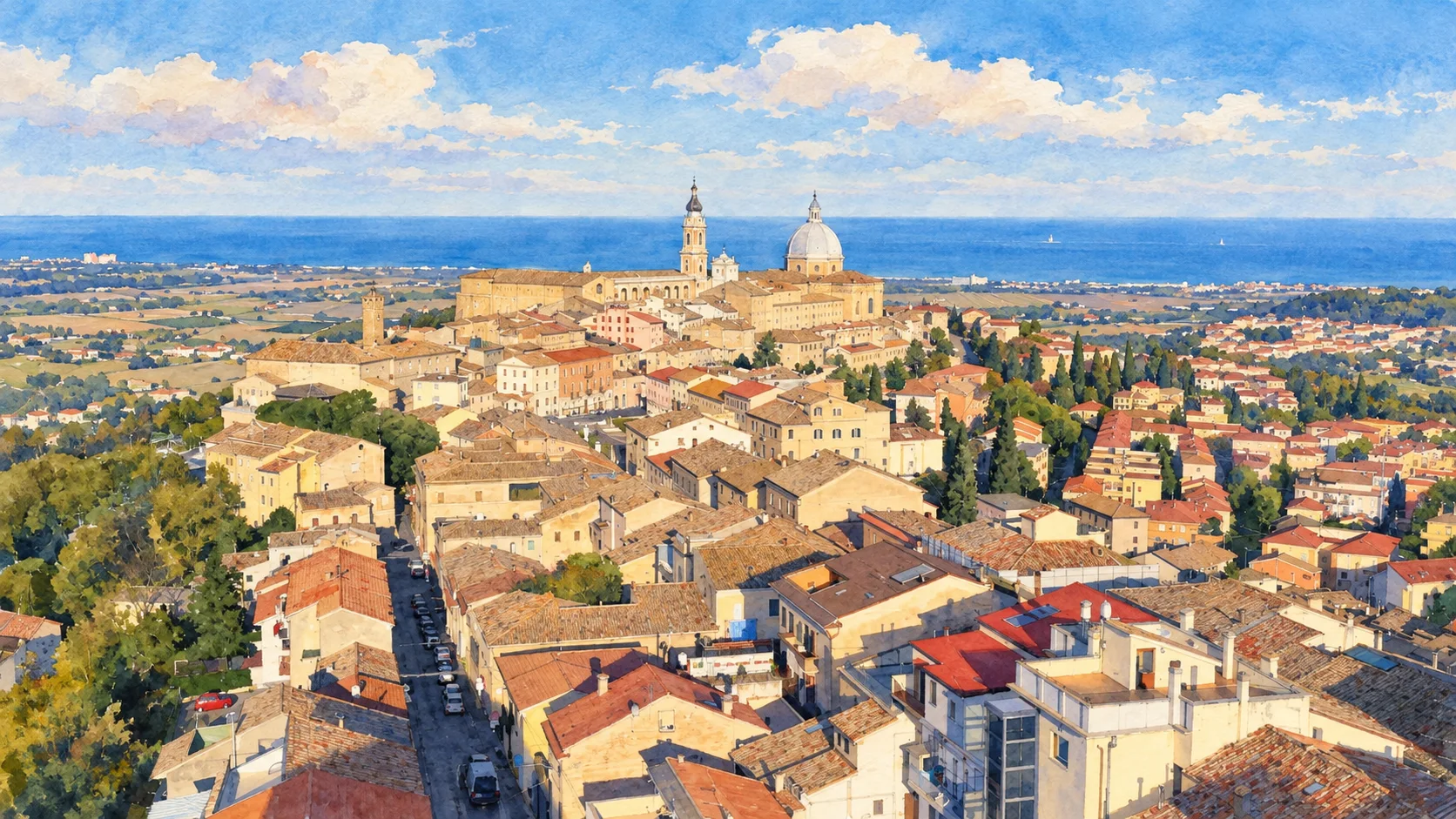
Watercolour: Loreto establishing view

Marche · Guide 04

Loreto

A pilgrimage sanctuary brings devotion, Renaissance sculpture, defensive architecture and a remarkable museum into one hilltop ensemble.

Plan the route
Loreto10 chapters · history, culture and landscape

Why this place matters

Read the sanctuary at three different scales.

The basilica surrounds the Santa Casa; the square and Apostolic Palace surround the basilica; pilgrimage routes connect the hill to a much larger world. These scales explain why Loreto is both an intimate devotional destination and an ambitious architectural complex. The tradition of the Holy House belongs to religious belief, alongside the documented history of the buildings that protect it.

The guide separates documented history from suggestions for reading the site. Named buildings and landscape relationships follow institutional sources; the illustrations are editorial interpretations, not measured surveys or records of current access.

A pilgrimage sanctuary brings devotion, Renaissance sculpture, defensive architecture and a remarkable museum into one hilltop ensemble.
The route

Plan your visit

Allow a dedicated sanctuary day. Worship, museum entry and defensive-walkway visits have separate arrangements. The Via Lauretana is a wider pilgrimage network, not a short extension to complete after the museum.

Outside

Piazza della Madonna and the palace

Allow a dedicated sanctuary day. Worship, museum entry and defensive-walkway visits have separate arrangements. The Via Lauretana is a wider pilgrimage network, not a short extension to complete after the museum.

Basilica visit

Santa Casa and its marble enclosure

Booked option

Defensive walkways

Museum choice

Painting, ceramics and textiles

Ten chapters

Explore the places

The chapters connect history and terrain. Mountain areas and outlying towns are separate options, not a single continuous walking route.

  1. 01Piazza della Madonna
  2. 02The basilica: a building around a shrine
  3. 03The Santa Casa and devotional tradition
  4. 04The marble enclosure
  5. 05The dome and the fortified exterior
  6. 06The defensive walkways
  7. 07The Apostolic Palace
  8. 08Lorenzo Lotto in the Pontifical Museum
  9. 09The pharmacy ceramics
  10. 10Tapestries and a wider artistic network
01

The inhabited landscape

Piazza della Madonna

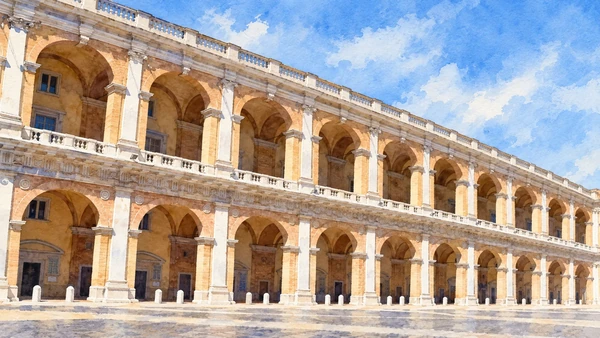
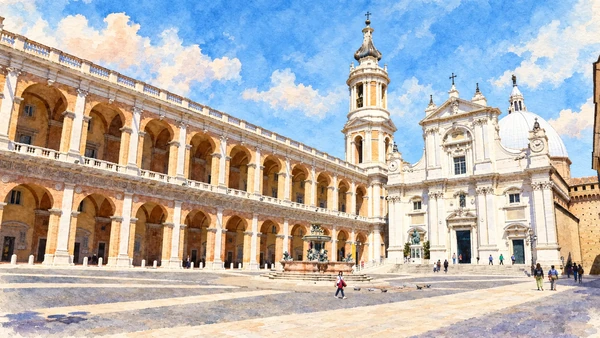
The square reveals how the sanctuary is framed by palace architecture. It is a place to orient yourself before entering a complex with several different visitor routes.

Today

This remains an inhabited place. Use pedestrian routes, keep entrances clear and check municipal mobility notices for any restricted area.

History

The basilica and Apostolic Palace developed through successive campaigns involving important Renaissance and later architects. Their apparent unity does not mean they were built at once.

How to read this place

Read the relationship between the basilica frontage, arcaded palace and open space. Leave ceremonial and religious movement unobstructed.

What to notice

  • Read the relationship between the basilica frontage, arcaded palace and open space.
  • The relationship between the site and its surrounding route.
  • The distinction between surviving evidence and modern interpretation.
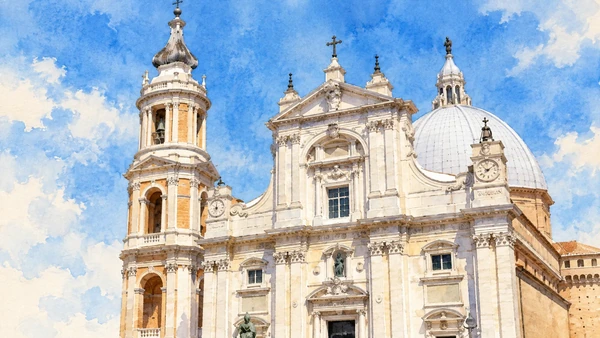
Sanctuary of Loreto · basilica and Apostolic Palace
Watercolour: Piazza della Madonna
Piazza della MadonnaEditorial watercolour · AI-generated · 2026
02

Worship and memory

The basilica: a building around a shrine

The large church is organised around a much smaller sacred focus. Its spatial scale reflects the demands of pilgrimage as well as the ambitions of its patrons.

Today

Worship and local religious life continue here. Visitor access may pause for services; consult the church or managing institution before planning an interior visit.

History

Construction began in 1469. Successive architects shaped the main body, dome and façade, which was completed in the later sixteenth century.

How to read this place

Distinguish the church’s envelope from the structure it contains. Use the sanctuary’s own guide to locate chapels without treating an active service as a sightseeing obstacle.

What to notice

  • Distinguish the church’s envelope from the structure it contains.
  • The relationship between the site and its surrounding route.
  • The distinction between surviving evidence and modern interpretation.
Sanctuary of Loreto · the basilica
Watercolour: The basilica: a building around a shrine
The basilica: a building around a shrineEditorial watercolour · AI-generated · 2026
03

Worship and memory

The Santa Casa and devotional tradition

The small shrine is the centre of Loreto’s religious life. Its significance for pilgrims cannot be understood solely through the size or splendour of the surrounding basilica.

Today

Worship and local religious life continue here. Visitor access may pause for services; consult the church or managing institution before planning an interior visit.

History

Catholic tradition identifies the Holy House with Mary’s home at Nazareth and recounts its transfer to Loreto. That tradition is distinct from independently established building chronology.

How to read this place

Allow devotional visitors their space. Read the sanctuary’s account as an account of belief, and avoid turning its miraculous narrative into an unqualified archaeological conclusion.

What to notice

  • Allow devotional visitors their space.
  • The relationship between the site and its surrounding route.
  • The distinction between surviving evidence and modern interpretation.
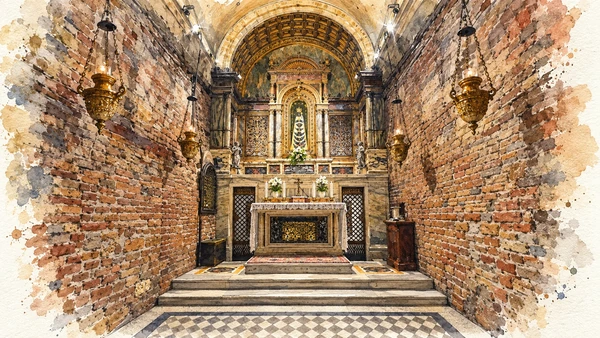
Sanctuary of Loreto · the basilica
Watercolour: The Santa Casa and devotional tradition
The Santa Casa and devotional traditionEditorial watercolour · AI-generated · 2026
04

Worship and memory

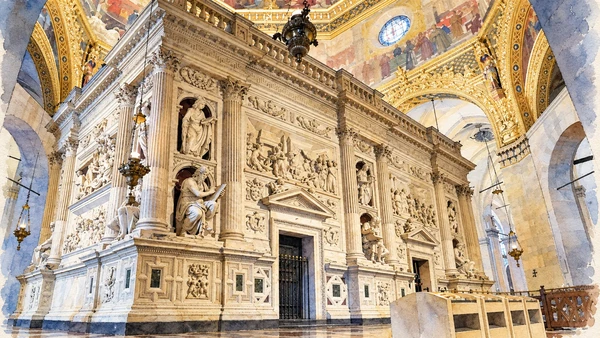
The marble enclosure

The richly sculpted exterior gives the small shrine a monumental presence inside the basilica. Its architectural frame and reliefs deserve attention as an ensemble.

Today

Worship and local religious life continue here. Visitor access may pause for services; consult the church or managing institution before planning an interior visit.

History

The Renaissance marble revetment belongs to the artistic transformation of the sanctuary. It is a later enclosure, not the original surface of the walls it protects.

How to read this place

Compare the relief panels with the framing columns and niches. Keep the history of the sculptural casing separate from the devotional tradition attached to the house within.

What to notice

  • Compare the relief panels with the framing columns and niches.
  • The relationship between the site and its surrounding route.
  • The distinction between surviving evidence and modern interpretation.
Sanctuary of Loreto · basilica and Apostolic Palace
Watercolour: The marble enclosure
The marble enclosureEditorial watercolour · AI-generated · 2026
05

Worship and memory

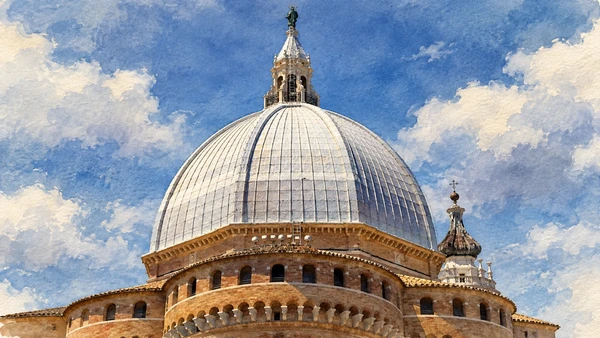
The dome and the fortified exterior

From the outside, the building’s mass can look as defensive as devotional. The dome and the articulated apses are best read as parts of a large working complex.

Today

Worship and local religious life continue here. Visitor access may pause for services; consult the church or managing institution before planning an interior visit.

History

Giuliano da Sangallo is associated with the dome’s construction. Defensive works formed another important strand of the sanctuary’s late fifteenth-century development.

How to read this place

Walk only along available public approaches. A high parapet seen from below is not evidence of a freely accessible terrace.

What to notice

  • Walk only along available public approaches.
  • The relationship between the site and its surrounding route.
  • The distinction between surviving evidence and modern interpretation.
Sanctuary of Loreto · the basilica
Watercolour: The dome and the fortified exterior
The dome and the fortified exteriorEditorial watercolour · AI-generated · 2026
06

Evidence and interpretation

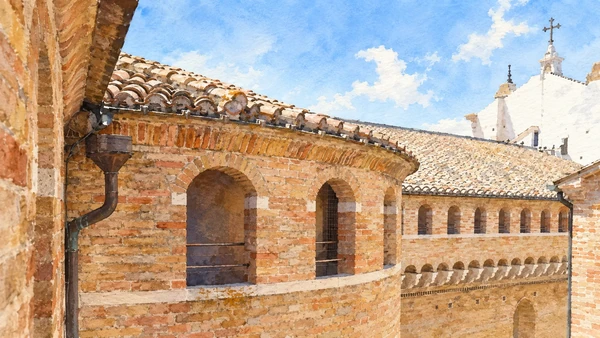
The defensive walkways

The elevated circuit can explain how a pilgrimage sanctuary was also protected. It is a specialist visit with its own access arrangements.

Today

Check the institution’s current opening, booking arrangements and accessible route. Individual rooms, exhibitions and approaches may have separate conditions.

History

The defensive system was commissioned in the late fifteenth century. It belongs to a historical setting in which religious institutions also had practical security concerns.

How to read this place

Book through the managing museum where visits are offered. Ask about steps and restricted passages before choosing this option.

What to notice

  • Book through the managing museum where visits are offered.
  • The relationship between the site and its surrounding route.
  • The distinction between surviving evidence and modern interpretation.
Pontifical Museum · defensive walkways
Watercolour: Brick rampart arcade at the Loreto sanctuary
The defensive walkwaysEditorial watercolour · AI-generated · 2026
07

Evidence and interpretation

The Apostolic Palace

Arcades and upper loggias create a measured edge to the square. The palace also provides the setting for collections whose subjects extend beyond the church interior.

Today

Check the institution’s current opening, booking arrangements and accessible route. Individual rooms, exhibitions and approaches may have separate conditions.

History

Bramante, Sansovino, Antonio da Sangallo the Younger and later architects contributed to the palace’s long development. The result reflects changing projects rather than a single completed original plan.

How to read this place

Follow the repeated bays and their relationship to the square. Museum access leads to selected spaces; other parts retain institutional uses.

What to notice

  • Follow the repeated bays and their relationship to the square.
  • The relationship between the site and its surrounding route.
  • The distinction between surviving evidence and modern interpretation.
Sanctuary of Loreto · basilica and Apostolic Palace
Watercolour: The Apostolic Palace
The Apostolic PalaceEditorial watercolour · AI-generated · 2026
08

Evidence and interpretation

Lorenzo Lotto in the Pontifical Museum

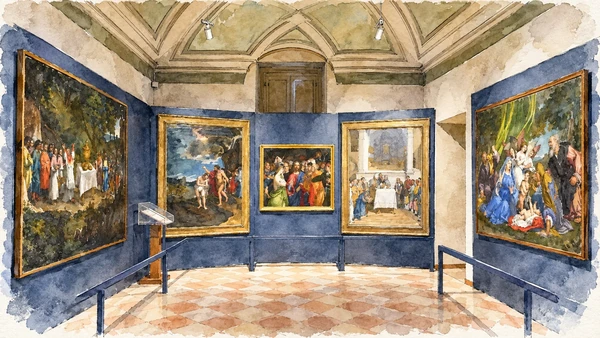
Painting offers another route into Loreto’s history. Give the museum time for looking, rather than using it only as a passage towards a viewpoint.

Today

Check the institution’s current opening, booking arrangements and accessible route. Individual rooms, exhibitions and approaches may have separate conditions.

History

The museum holds works by Lorenzo Lotto, who spent his final years at Loreto. Its collection also reflects the sanctuary’s later conservation and collecting history.

How to read this place

Read individual labels for date, subject and provenance. A modern museum arrangement is not necessarily the original location intended for a work.

What to notice

  • Read individual labels for date, subject and provenance.
  • The relationship between the site and its surrounding route.
  • The distinction between surviving evidence and modern interpretation.
Sanctuary of Loreto · Pontifical Museum
Watercolour: Lorenzo Lotto in the Pontifical Museum
Lorenzo Lotto in the Pontifical MuseumEditorial watercolour · AI-generated · 2026
09

Evidence and interpretation

The pharmacy ceramics

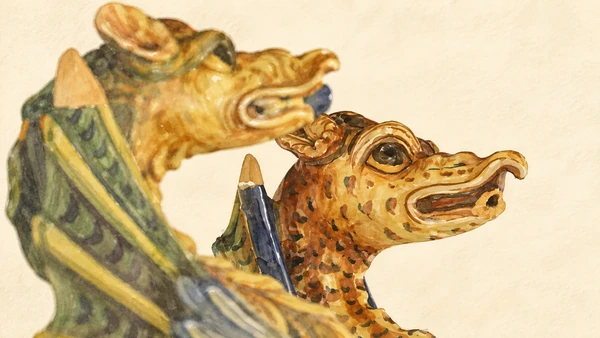
Rows of ceramic vessels connect the sanctuary with care, storage and the practical organisation of a large institution. Their shapes mattered as much as their decoration.

Today

Check the institution’s current opening, booking arrangements and accessible route. Individual rooms, exhibitions and approaches may have separate conditions.

History

The Pontifical Museum preserves an important pharmacy-ceramic collection. Such objects belong to the material history of the sanctuary as well as the history of applied art.

How to read this place

Compare vessel forms and decorative systems. Avoid interpreting a historic label as a present-day remedy or assuming that every vessel held the same substance.

What to notice

  • Compare vessel forms and decorative systems.
  • The relationship between the site and its surrounding route.
  • The distinction between surviving evidence and modern interpretation.
Sanctuary of Loreto · Pontifical Museum
Watercolour: Ceramic animal-head handles on pharmacy jars in the Loreto collection
The pharmacy ceramicsEditorial watercolour · AI-generated · 2026
10

Evidence and interpretation

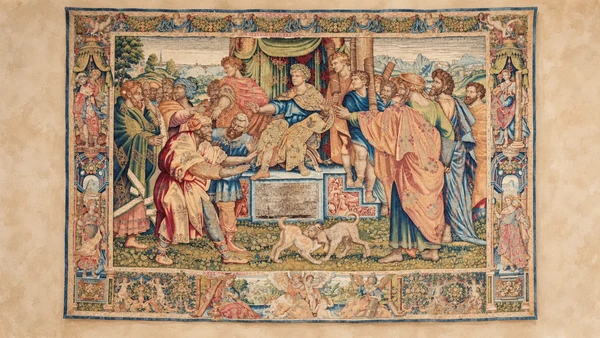
Tapestries and a wider artistic network

Large textiles change the scale and texture of a museum visit. Their woven surfaces require a different kind of looking from painted panels or carved marble.

Today

Check the institution’s current opening, booking arrangements and accessible route. Individual rooms, exhibitions and approaches may have separate conditions.

History

The museum’s tapestries include works derived from Raphael’s designs. Design, workshop production and later collecting are separate parts of their history.

How to read this place

Do not describe Raphael as personally weaving the textiles. Read the collection labels for workshop, date and the relationship between a design and its woven interpretation.

What to notice

  • Do not describe Raphael as personally weaving the textiles.
  • The relationship between the site and its surrounding route.
  • The distinction between surviving evidence and modern interpretation.
Sanctuary of Loreto · Pontifical Museum
Watercolour: Watercolour interpretation of a historical tapestry in the Loreto museum
Tapestries and a wider artistic networkEditorial watercolour · AI-generated · 2026

The territory through time

A short chronology

A concise chronology linking the documented sites to the wider story.

  1. The Holy House narrative connects Loreto with Nazareth; it is presented as religious tradition.

  2. Construction of the present basilica begins.

  3. Dome building and defensive works reshape the sanctuary.

  4. The marble enclosure gives the Santa Casa a monumental sculptural setting.

  5. The Apostolic Palace develops through successive architectural campaigns.

  6. The basilica façade reaches completion.

  7. Paintings, ceramics and textiles acquire a museum setting.

  8. Worship and separately managed cultural visits continue side by side.

Before your visit

Practical information

01

Plan separate days

Choose a manageable set of visits and allow for transport, booked entries and the return journey.

02

Use the exact place name

The Marche contain separate valleys, towns and coastal approaches. Confirm the precise locality and route rather than treating nearby names as one destination.

03

Check the institution

Opening hours, tickets, exhibitions and religious access change. Use the linked managing institution shortly before visiting.

04

Check the actual terrain

A town walk, gorge walkway, lift arrival and mountain path have different demands. Use current route information, weather and closures for the option you choose.

05

Arrange accessible visits

Historic interiors and mountain approaches can include steps, gradients or uneven surfaces. Ask about the specific route instead of assuming an entire destination is step-free.

06

Respect work and residence

Farms, workshops, churches and historic streets remain in use. Follow signs, keep entrances clear and ask permission before entering private spaces.

Method and sources

Sources and image credits

Prepared on 9 September 2026 from the institutional sources linked below. Historical claims are separated from editorial observations and itinerary suggestions. Older institutional brochures are used for stable cultural context, never as current timetables. Prices, transport schedules, trail status and admission are deliberately left to the responsible operators. Illustrations are not photographs, measured reconstructions or evidence of current conditions.

The eleven images are AI-generated editorial watercolours guided by photographic references. They interpret named places and are not photographs or substitutes for measured plans. Opening hours, tickets, accessible routes, temporary exhibitions and conservation work can change; consult the linked official pages shortly before visiting.

Illustration references and credits