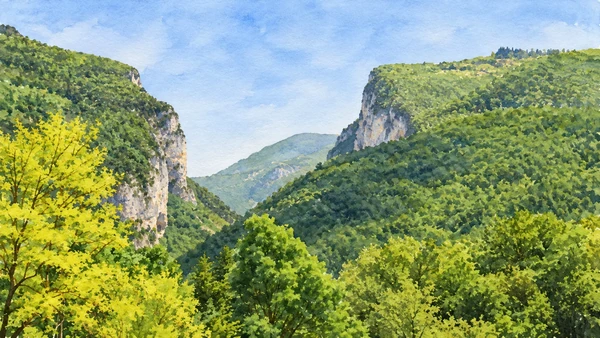
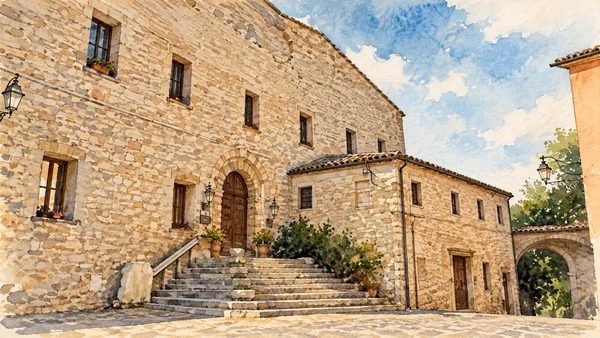
Watercolour: Frasassi and Genga establishing view

Marche · Guide 05

Frasassi
& Genga

Caves, a limestone gorge, monastic buildings and a hill village connect geological time with the inhabited Sentino valley.

Plan the route
Frasassi and Genga10 chapters · history, culture and landscape

Why this place matters

The underground visit is only one layer.

Frasassi is famous for immense subterranean spaces, but the surface landscape deserves equal attention. The Sentino gorge, San Vittore and Genga explain how people have lived beside, crossed and interpreted this limestone terrain. Keep a guided cave visit separate from caving activities and outdoor trails. The access path to the sanctuary known as Tempio del Valadier is temporarily closed according to the municipal and park notices checked on 8 September 2026.

The guide separates documented history from suggestions for reading the site. Named buildings and landscape relationships follow institutional sources; the illustrations are editorial interpretations, not measured surveys or records of current access.

Caves, a limestone gorge, monastic buildings and a hill village connect geological time with the inhabited Sentino valley.
The route

Plan your visit

Build the day around the booked cave tour and nearby museum or abbey. Give Genga village its own stop. The Valadier and Infra Saxa chapters explain closed-access heritage and are not proposed walking stops while the closure remains in force.

Booked visit

The tourist cave route

Build the day around the booked cave tour and nearby museum or abbey.

Nearby cultural visits

San Vittore and the museum

Separate village stop

Genga and local collections

Read before travelling

Gorge paths and sanctuary closure

Ten chapters

Explore the places

The chapters connect history and terrain. Mountain areas and outlying towns are separate options, not a single continuous walking route.

  1. 01The Frasassi cave system
  2. 02Reading stalactites and stalagmites
  3. 03The managed visitor route
  4. 04Abbey of San Vittore delle Chiuse
  5. 05The ichthyosaur at the museum
  6. 06The Sentino gorge
  7. 07The sanctuary known as Tempio del Valadier
  8. 08Santa Maria Infra Saxa
  9. 09Genga village
  10. 10Museo Arte, Storia, Territorio
01

Terrain and access

The Frasassi cave system

The tourist route introduces spaces formed on a scale that can be hard to judge underground. The guide’s explanations are essential to understanding what the lighting makes visible.

Today

Conditions depend on the exact route and the day. Check the responsible operator, weather and local access notices; a viewpoint is not the same undertaking as a mountain traverse.

History

Exploration brought the system to wide public attention in the twentieth century. The opening of a managed visitor route is a different event from the much longer formation of the caves.

How to read this place

Follow the operator’s instructions and remain on the authorised route. An illuminated chamber does not imply that adjoining passages are part of the same visit.

What to notice

  • Follow the operator’s instructions and remain on the authorised route.
  • The relationship between the site and its surrounding route.
  • The distinction between surviving evidence and modern interpretation.
Frasassi Caves · managing operator
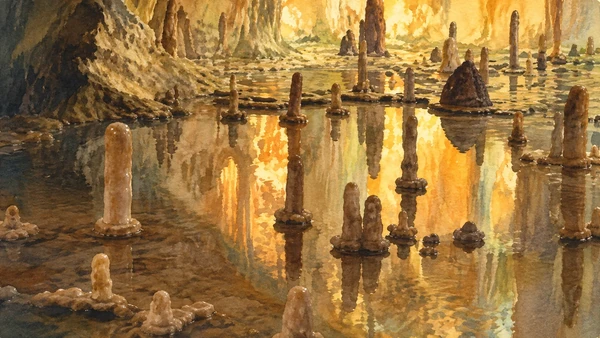
Watercolour: The Frasassi cave system
The Frasassi cave systemEditorial watercolour · AI-generated · 2026
02

Terrain and access

Reading stalactites and stalagmites

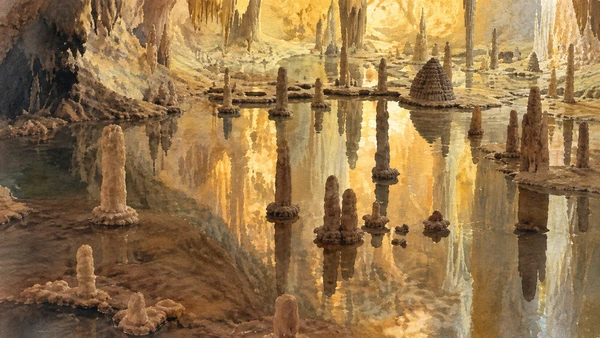
A close view reveals how water and mineral deposition can create intricate forms. The same chamber contains structures with very different shapes and relationships to gravity.

Today

Conditions depend on the exact route and the day. Check the responsible operator, weather and local access notices; a viewpoint is not the same undertaking as a mountain traverse.

History

The formations record geological processes, not a human-built decoration scheme. Their familiar nicknames are interpretive aids rather than scientific classifications.

How to read this place

Notice whether a formation descends from the roof or grows from the floor. Do not touch: a close-up illustration is an invitation to observe, not to leave the walkway.

What to notice

  • Notice whether a formation descends from the roof or grows from the floor.
  • The relationship between the site and its surrounding route.
  • The distinction between surviving evidence and modern interpretation.
Frasassi Caves · managing operator
Watercolour: Reading stalactites and stalagmites
Reading stalactites and stalagmitesEditorial watercolour · AI-generated · 2026
03

Terrain and access

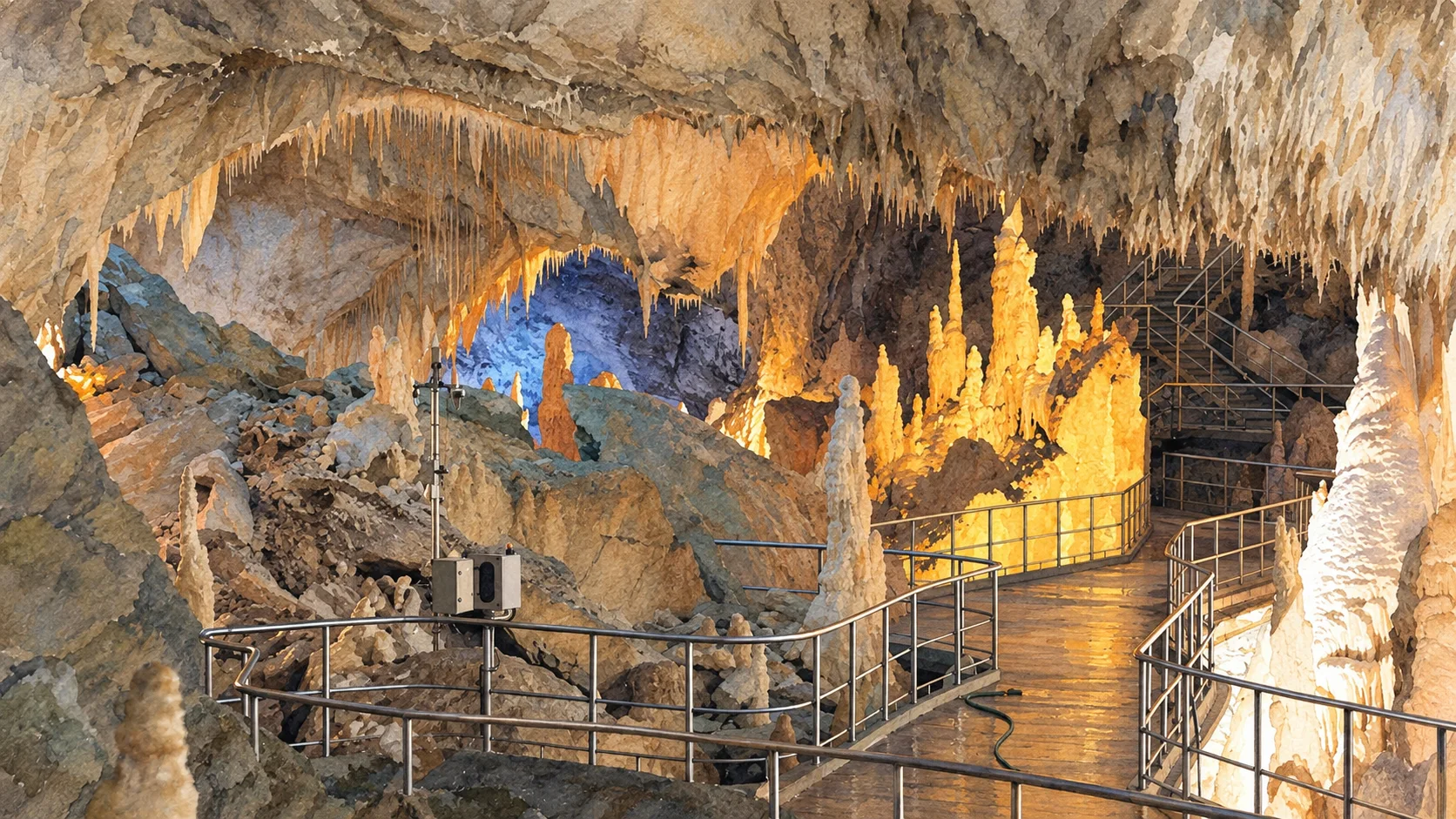
The managed visitor route

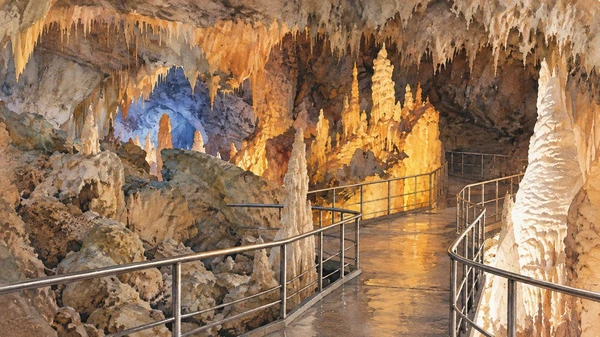
Walkways, lighting and a guide make a selected part of the underground system visitable. These modern provisions are part of the experience and should remain visible in its interpretation.

Today

Conditions depend on the exact route and the day. Check the responsible operator, weather and local access notices; a viewpoint is not the same undertaking as a mountain traverse.

History

Tourism transformed access to the caves without making the whole underground network an ordinary pedestrian space. Specialist activities have different requirements from the standard tour.

How to read this place

Confirm the meeting point, clothing advice and accessible arrangements with the operator. Do not substitute a generic mountain walk description for the cave tour’s actual conditions.

What to notice

  • Confirm the meeting point, clothing advice and accessible arrangements with the operator.
  • The relationship between the site and its surrounding route.
  • The distinction between surviving evidence and modern interpretation.
Frasassi Caves · visits and associated museums
Watercolour: The managed visitor route
The managed visitor routeEditorial watercolour · AI-generated · 2026
04

Worship and memory

Abbey of San Vittore delle Chiuse

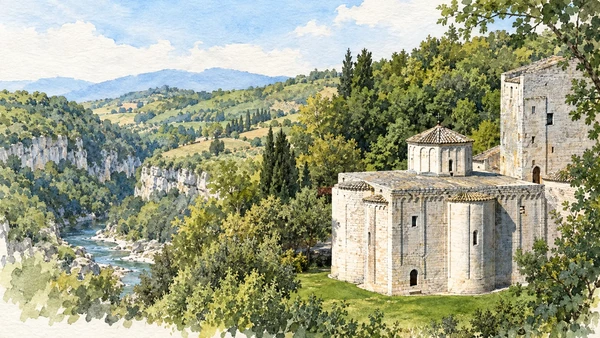
The abbey introduces a compact architectural counterpoint to the huge cave chambers. Its position in the valley connects religious life with a travelled landscape.

Today

Worship and local religious life continue here. Visitor access may pause for services; consult the church or managing institution before planning an interior visit.

History

The medieval monastic complex later provided space for the speleological and archaeological museum. Religious architecture and scientific interpretation now occupy neighbouring parts of the same setting.

How to read this place

Read the solid massing and the relationship between church and former monastic rooms. Check church access independently from museum admission.

What to notice

  • Read the solid massing and the relationship between church and former monastic rooms.
  • The relationship between the site and its surrounding route.
  • The distinction between surviving evidence and modern interpretation.
ISPRA · Genga speleological and archaeological museum
Watercolour: Abbey of San Vittore delle Chiuse
Abbey of San Vittore delle ChiuseEditorial watercolour · AI-generated · 2026
05

Evidence and interpretation

The ichthyosaur at the museum

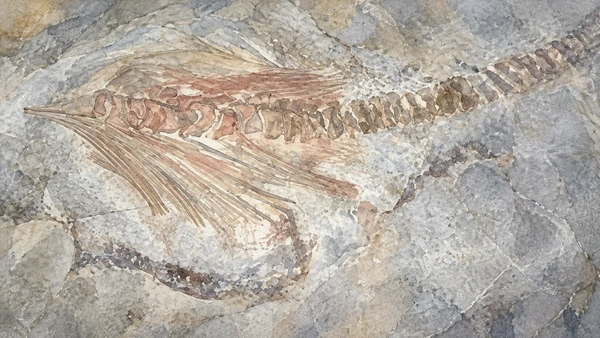
A fossil gives the valley an unexpected marine dimension. It makes geological change tangible without requiring the visitor to read every rock face in the gorge.

Today

Check the institution’s current opening, booking arrangements and accessible route. Individual rooms, exhibitions and approaches may have separate conditions.

History

The ichthyosaur was found near Camponocecchio during tunnel works in 1976. It was a marine reptile, not a dinosaur living in the present cave system.

How to read this place

Distinguish the fossil from any diagram or reconstruction displayed alongside it. Its discovery location matters as much as its striking shape.

What to notice

  • Distinguish the fossil from any diagram or reconstruction displayed alongside it.
  • The relationship between the site and its surrounding route.
  • The distinction between surviving evidence and modern interpretation.
ISPRA · Genga speleological and archaeological museum
Watercolour: Detail of the ichthyosaur fossil preserved on a stone slab at Genga
The ichthyosaur at the museumEditorial watercolour · AI-generated · 2026
06

Terrain and access

The Sentino gorge

The narrow river corridor explains why rock walls, roads and historic buildings sit so close together. A view from an authorised stopping place can be a complete landscape visit.

Today

Conditions depend on the exact route and the day. Check the responsible operator, weather and local access notices; a viewpoint is not the same undertaking as a mountain traverse.

History

Water and limestone structure shaped the gorge over geological time. Human routes later took advantage of the same passage through the hills.

How to read this place

Separate riverbank scenery from an approved walking route. Never stop on an unsafe road edge or enter water passages on the strength of an illustrative view.

What to notice

  • Separate riverbank scenery from an approved walking route.
  • The relationship between the site and its surrounding route.
  • The distinction between surviving evidence and modern interpretation.
Gola della Rossa e di Frasassi Regional Park
Watercolour: Wooded limestone walls in the Frasassi gorge landscape
The Sentino gorgeEditorial watercolour · AI-generated · 2026
07

Worship and memory

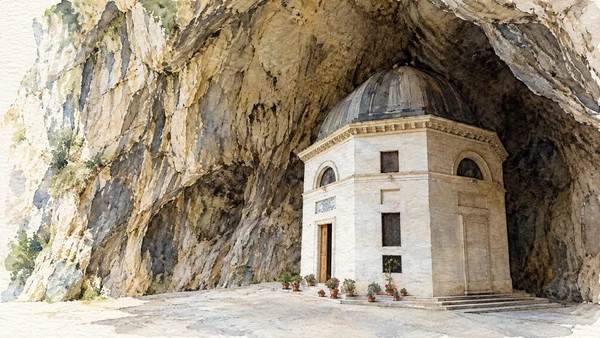
The sanctuary known as Tempio del Valadier

A small centrally planned temple stands within an immense rock cavity. The contrast is architectural and devotional, but it does not make the approach a current visitor option.

Today

Access is temporarily closed. The Comune di Genga notice of 23 June 2026 and the park closure notice remained the relevant published guidance checked on 8 September 2026; do not use the path without an official reopening.

History

The nineteenth-century sanctuary is conventionally known by Valadier’s name. The municipality and park have issued notices closing its access path for works and safety measures.

How to read this place

Treat this as a heritage chapter, not an open itinerary stop. Check for an explicit reopening notice from the responsible authorities before planning access.

What to notice

  • Treat this as a heritage chapter, not an open itinerary stop.
  • The relationship between the site and its surrounding route.
  • The distinction between surviving evidence and modern interpretation.
Comune di Genga · access closure, 23 June 2026
Watercolour: The sanctuary known as Tempio del Valadier
The sanctuary known as Tempio del ValadierEditorial watercolour · AI-generated · 2026
08

Worship and memory

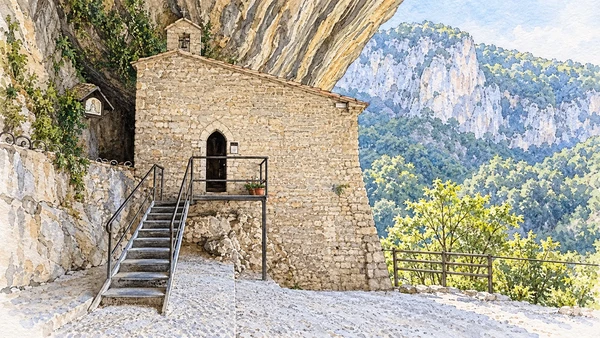
Santa Maria Infra Saxa

The small rock sanctuary offers a different scale from the nearby freestanding temple. Its walls and the natural cavity are closely interwoven.

Today

The approach shares the closed sanctuary access path. Consult the park and municipality for an official reopening; this chapter does not propose a currently available walk.

History

The devotional site belongs to the religious history of the Frasassi gorge. It shares the access setting affected by the published Valadier-path closure.

How to read this place

This is not an alternative route around the closure. Its historical importance can be understood before a future visit becomes possible.

What to notice

  • This is not an alternative route around the closure.
  • The relationship between the site and its surrounding route.
  • The distinction between surviving evidence and modern interpretation.
Regional Park · Valadier path closure
Watercolour: Santa Maria Infra Saxa
Santa Maria Infra SaxaEditorial watercolour · AI-generated · 2026
09

The inhabited landscape

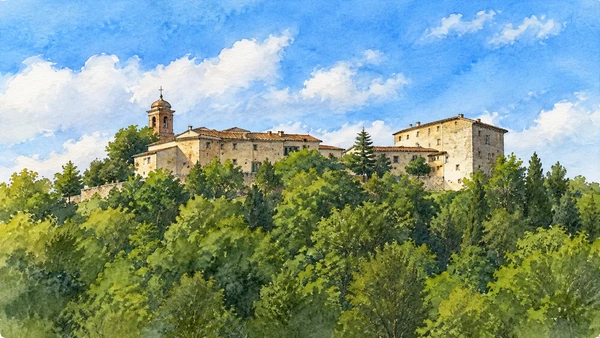
Genga village

The village provides streets, doors and civic life above the better-known gorge attractions. Give it time as a settlement rather than treating it as a label attached to the caves.

Today

This remains an inhabited place. Use pedestrian routes, keep entrances clear and check municipal mobility notices for any restricted area.

History

Genga’s built heritage belongs to the inhabited history of the limestone hills. Its local museum interprets a territory whose story is not confined to cave exploration.

How to read this place

Follow public lanes and respect private thresholds. Village visits and cave tickets have different practical arrangements even when a combined offer is advertised.

What to notice

  • Follow public lanes and respect private thresholds.
  • The relationship between the site and its surrounding route.
  • The distinction between surviving evidence and modern interpretation.
Frasassi Caves · visits and associated museums
Watercolour: Genga village
Genga villageEditorial watercolour · AI-generated · 2026
10

Evidence and interpretation

Museo Arte, Storia, Territorio

The local museum offers a cultural counterpart to the natural-history collection at San Vittore. It helps connect the village with the surrounding territory.

Today

Check the institution’s current opening, booking arrangements and accessible route. Individual rooms, exhibitions and approaches may have separate conditions.

History

The operator lists the Genga museum among the cultural visits associated with the cave destination. Its subject differs from the fossil and speleological displays by the abbey.

How to read this place

Confirm the address and current opening of the intended museum. Similar combined-ticket descriptions should not make two distinct institutions appear to be one building.

What to notice

  • Confirm the address and current opening of the intended museum.
  • The relationship between the site and its surrounding route.
  • The distinction between surviving evidence and modern interpretation.
Frasassi Caves · visits and associated museums
Watercolour: Exterior entrance of Museo di Genga Arte Storia Territorio
Museo Arte, Storia, TerritorioEditorial watercolour · AI-generated · 2026

The territory through time

A short chronology

A concise chronology linking the documented sites to the wider story.

  1. Water and limestone processes form caves and the gorge landscape.

  2. The ichthyosaur fossil records an environment very different from the present hills.

  3. San Vittore and rock sanctuaries give religious life a place in the valley.

  4. The temple conventionally called Valadier is built in its rock cavity.

  5. Cave exploration brings the underground system to wider attention.

  6. The ichthyosaur is discovered during tunnel works near Camponocecchio.

  7. Guided routes and museums interpret the area’s natural and cultural heritage.

  8. The sanctuary path is temporarily closed; an official reopening must precede a visit.

Before your visit

Practical information

01

Plan separate days

Choose a manageable set of visits and allow for transport, booked entries and the return journey.

02

Use the exact place name

The Marche contain separate valleys, towns and coastal approaches. Confirm the precise locality and route rather than treating nearby names as one destination.

03

Check the institution

Opening hours, tickets, exhibitions and religious access change. Use the linked managing institution shortly before visiting.

04

Check the actual terrain

A town walk, gorge walkway, lift arrival and mountain path have different demands. Use current route information, weather and closures for the option you choose.

05

Arrange accessible visits

Historic interiors and mountain approaches can include steps, gradients or uneven surfaces. Ask about the specific route instead of assuming an entire destination is step-free.

06

Respect work and residence

Farms, workshops, churches and historic streets remain in use. Follow signs, keep entrances clear and ask permission before entering private spaces.

Method and sources

Sources and image credits

Prepared on 9 September 2026 from the institutional sources linked below. Historical claims are separated from editorial observations and itinerary suggestions. Older institutional brochures are used for stable cultural context, never as current timetables. Prices, transport schedules, trail status and admission are deliberately left to the responsible operators. Illustrations are not photographs, measured reconstructions or evidence of current conditions.

The eleven images are AI-generated editorial watercolours guided by photographic references. They interpret named places and are not photographs or substitutes for measured plans. Opening hours, tickets, accessible routes, temporary exhibitions and conservation work can change; consult the linked official pages shortly before visiting.

Illustration references and credits
  • The Frasassi cave system — reference: backoffice.turismo.marche.it. Transformed into an AI-generated watercolour.
  • Reading stalactites and stalagmites — reference: backoffice.turismo.marche.it. Transformed into an AI-generated watercolour.
  • The sanctuary known as Tempio del Valadier — reference: www.frasassi.com. Transformed into an AI-generated watercolour.
  • Abbey of San Vittore delle Chiuse — reference: www.frasassi.com. Transformed into an AI-generated watercolour.
  • Genga village — reference: www.frasassi.com. Transformed into an AI-generated watercolour.
  • Santa Maria Infra Saxa — reference: Accurimbono · CC BY-SA 4.0; this watercolour adaptation is offered under the same licence. Transformed into an AI-generated watercolour.
  • Museo Arte, Storia, Territorio — reference: Maddy16869 · CC BY-SA 4.0; this watercolour adaptation is offered under the same licence. Transformed into an AI-generated watercolour.
  • Opening image — reference: www.frasassi.com. Transformed into an AI-generated watercolour.
  • The managed visitor route — reference: www.frasassi.com. Transformed into an AI-generated watercolour.
  • The ichthyosaur at the museum — reference: www.isprambiente.gov.it. Transformed into an AI-generated watercolour.
  • The Sentino gorge — reference: www.parcogolarossa.it. Transformed into an AI-generated watercolour.