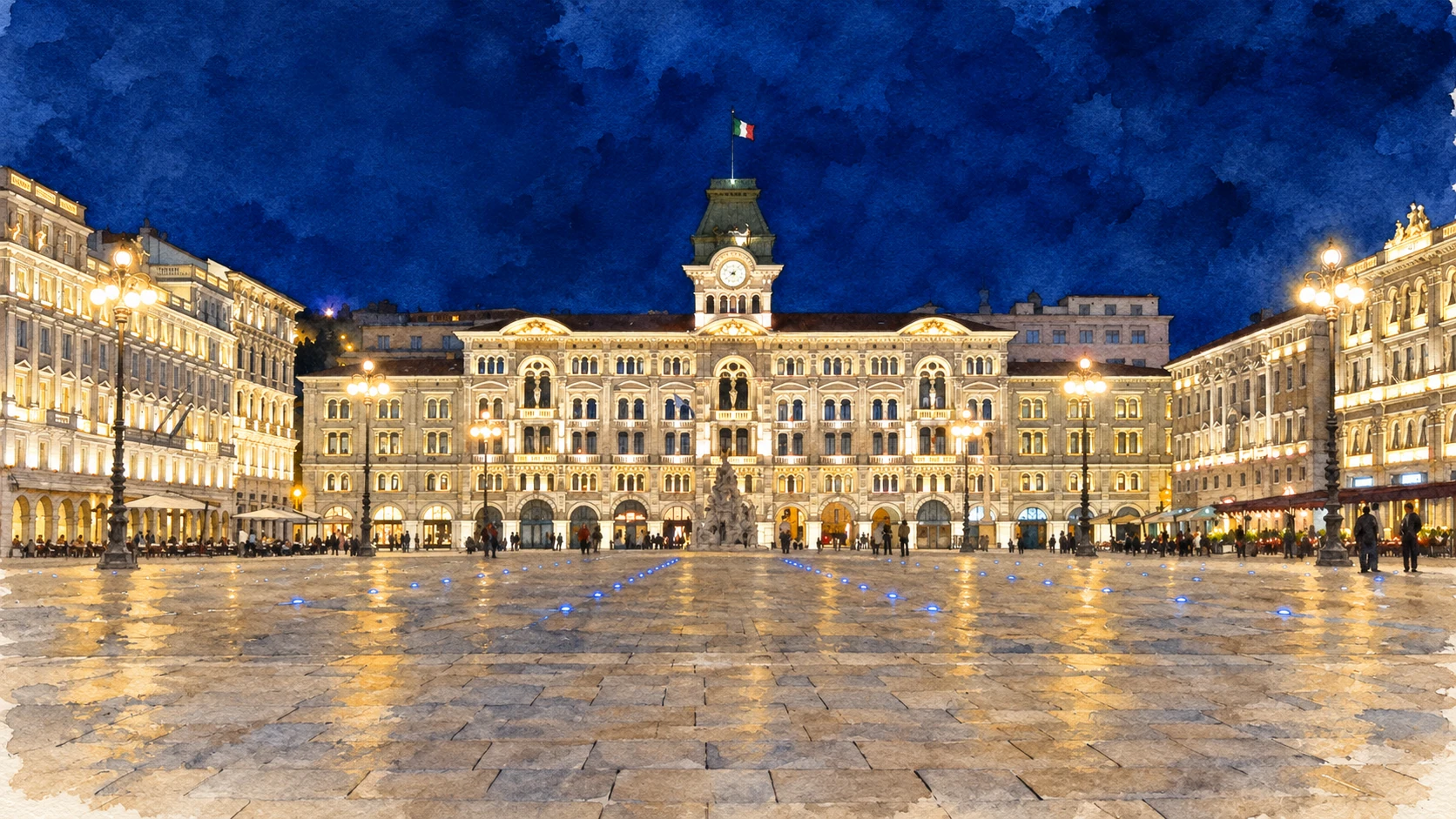
Watercolour: Trieste establishing view

Friuli Venezia Giulia · Guide 01

Trieste

A port city of civic squares, religious communities, collecting and contested memory, where the Adriatic meets the histories of Central Europe.

Plan the route
Trieste10 chapters · history, culture and landscape

Why this place matters

Read the city from the waterfront towards the hill.

Trieste offers several histories at once. The monumental seafront belongs to the expansion of a commercial port; the hill of San Giusto preserves older civic and religious layers; museums reveal the ambitions of nineteenth-century collectors and the work of performers. The Risiera di San Sabba requires a separate, attentive visit to a site of Nazi persecution. Avoid turning these different experiences into a single picturesque narrative. Move between them with time to understand why each place exists.

The guide separates documented history from suggestions for reading the site. Named buildings and landscape relationships follow institutional sources; the illustrations are editorial interpretations, not measured surveys or records of current access.

A port city of civic squares, religious communities, collecting and contested memory, where the Adriatic meets the histories of Central Europe.
The route

Plan your visit

Begin with the central waterfront and Canal Grande. Choose the hill museums or the lower-city collections for another part of the day. Miramare lies outside the centre; San Sabba is a separate memorial visit. Neither is an extra stop to squeeze into a continuous town walk.

Waterfront

Piazza Unità and Canal Grande

Begin with the central waterfront and Canal Grande.

San Giusto hill

Cathedral and castle

Collections

Revoltella and the theatre museum

Separate visits

Miramare and the Risiera

Ten chapters

Explore the places

The chapters connect history and terrain. Use the route notes to choose visits and plan transfers between separate sites.

  1. 01Piazza Unità d’Italia
  2. 02Canal Grande and Borgo Teresiano
  3. 03Cathedral of San Giusto
  4. 04Castello di San Giusto
  5. 05San Spiridione
  6. 06Museo Revoltella
  7. 07Museo Teatrale Carlo Schmidl
  8. 08Miramare: rooms of a Habsburg residence
  9. 09Miramare: gardens and the sea
  10. 10Risiera di San Sabba
01

The inhabited landscape

Piazza Unità d’Italia

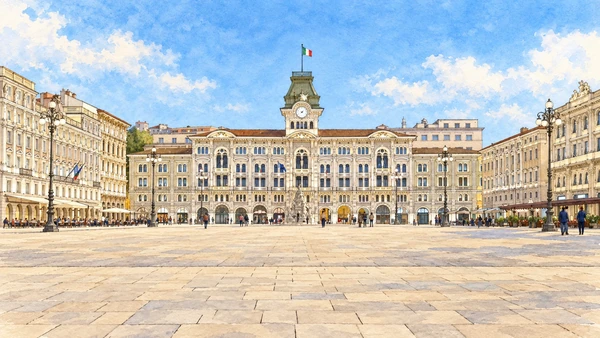
The square opens directly towards the sea. Stand near its waterfront edge and read the civic buildings as one ensemble before approaching individual façades. The empty centre is part of its public character, not unused space.

Today

This remains an inhabited place. Use pedestrian routes, keep entrances clear and check municipal mobility notices for any restricted area.

History

The monumental waterfront expresses Trieste’s growth as a commercial city under Habsburg rule. The square and its later Italian name belong to different historical layers; its present appearance should not be projected unchanged into every earlier period.

How to read this place

Compare the city hall at the closed end with the open horizon opposite. Look at the scale of the square in relation to the streets behind it. The adjacent Molo Audace is a distinct public projection into the harbour, subject to weather and local restrictions.

What to notice

  • Compare the city hall at the closed end with the open horizon opposite.
  • Look at the scale of the square in relation to the streets behind it.
  • The adjacent Molo Audace is a distinct public projection into the harbour, subject to weather and local restrictions.
Trieste · PromoTurismoFVG
Watercolour: Piazza Unità d’Italia in Trieste, actual city hall and flanking monumental façades, broad paved square
Piazza Unità d’ItaliaEditorial watercolour · AI-generated · 2026
02

The inhabited landscape

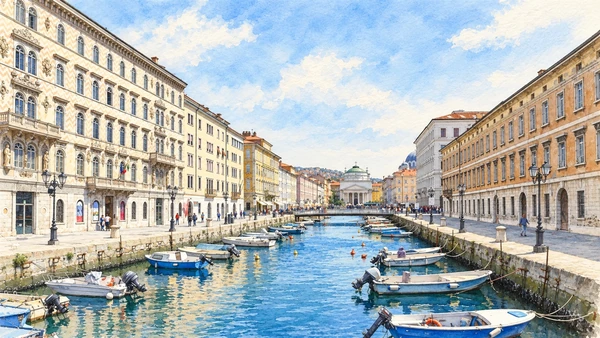
Canal Grande and Borgo Teresiano

The canal provides a clear line through the lower city. Its water, bridges and parallel building fronts make the planned quarter easier to understand than a disconnected list of monuments.

Today

This remains an inhabited place. Use pedestrian routes, keep entrances clear and check municipal mobility notices for any restricted area.

History

The Borgo Teresiano belongs to the expansion associated with Maria Theresa and the commercial port. Religious buildings around this area record communities linked to maritime exchange, migration and the institutions of the city.

How to read this place

Follow the visual axis without assuming the canal is still a working route for the ships that shaped the port. Distinguish the boats seen today from the historical commercial function. Cross a bridge to compare the different relationships between façades, water and street.

What to notice

  • Follow the visual axis without assuming the canal is still a working route for the ships that shaped the port.
  • Distinguish the boats seen today from the historical commercial function.
  • Cross a bridge to compare the different relationships between façades, water and street.
Trieste · PromoTurismoFVG
Watercolour: Trieste Canal Grande viewed along the real canal towards Sant’Antonio Nuovo, boats, bridges and straight palazzo fronts
Canal Grande and Borgo TeresianoEditorial watercolour · AI-generated · 2026
03

Worship and memory

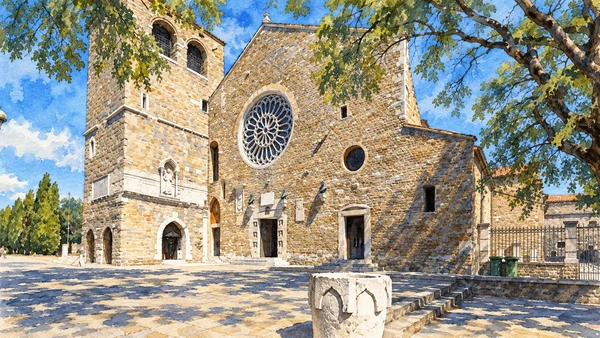
Cathedral of San Giusto

The cathedral occupies the hill above the port. Its broad stone front, rose window and square bell tower create a markedly different scale from the lower city’s nineteenth-century façades.

Today

Worship and local religious life continue here. Visitor access may pause for services; consult the church or managing institution before planning an interior visit.

History

The present building resulted from joining two earlier churches in the early fourteenth century. The surviving fabric contains reused material and evidence from several phases. Its five-aisled interior reflects a history of combination rather than a single uniform campaign.

How to read this place

Read the large rose window, the doorway and the adjoining tower separately. Inside, distinguish surviving early material, medieval work and later interventions using the cathedral’s interpretation. A church visit must remain compatible with worship.

What to notice

  • Read the large rose window, the doorway and the adjoining tower separately.
  • Inside, distinguish surviving early material, medieval work and later interventions using the cathedral’s interpretation.
  • A church visit must remain compatible with worship.
Cattedrale di San Giusto · PromoTurismoFVG
Watercolour: Trieste San Giusto cathedral real gabled stone facade with rose window and adjacent squat square bell tower
Cathedral of San GiustoEditorial watercolour · AI-generated · 2026
04

Evidence and interpretation

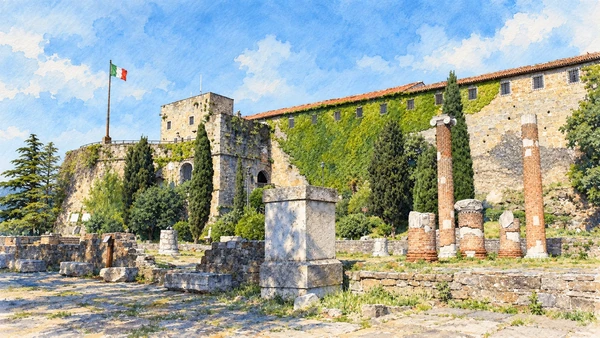
Castello di San Giusto

The fortress beside the cathedral turns the hill into a place for reading both the city and its defences. Its walls and bastions make the relationship between elevated ground and the port tangible.

Today

Check the institution’s current opening, booking arrangements and accessible route. Individual rooms, exhibitions and approaches may have separate conditions.

History

The standing castle developed over successive phases under changing Venetian and Habsburg control. It later became a municipal museum. The Lapidario Tergestino gives Roman stone finds a protected interpretive setting within this much later defensive building.

How to read this place

Separate the age of an exhibited object from that of the room containing it. Compare walls and bastions from the authorised route; the panoramic view should be read together with the structure that made observation and defence possible.

What to notice

  • Separate the age of an exhibited object from that of the room containing it.
  • Compare walls and bastions from the authorised route; the panoramic view should be read together with the structure that made observation and defence possible.
Castello di San Giusto · PromoTurismoFVG
Watercolour: Trieste Castello di San Giusto actual stone ramparts above Roman remains, no invented towers
Castello di San GiustoEditorial watercolour · AI-generated · 2026
05

Worship and memory

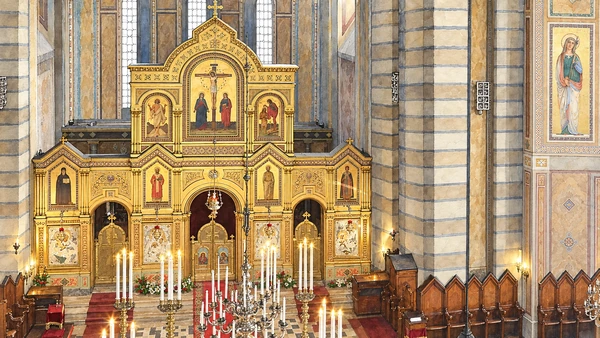
San Spiridione

The Serbian Orthodox church gives the canal district a distinctive sacred interior. Its domes, painted surfaces and iconostasis reflect a living community, not simply an ornamental addition to a commercial quarter.

Today

Worship and local religious life continue here. Visitor access may pause for services; consult the church or managing institution before planning an interior visit.

History

The present church was built in the 1860s to a design by Carlo Maciachini, replacing an earlier place of worship. The Serbian Orthodox community’s institutional history is connected to the expansion of the free port and the eighteenth-century recognition of religious communities.

How to read this place

Notice how the iconostasis divides and connects spaces of worship. Read images through the church’s own tradition and interpretation. Access, photography and movement inside should follow the community’s arrangements, especially during services.

What to notice

  • Notice how the iconostasis divides and connects spaces of worship.
  • Read images through the church’s own tradition and interpretation.
  • Access, photography and movement inside should follow the community’s arrangements, especially during services.
Chiesa Serbo Ortodossa di San Spiridione · PromoTurismoFVG
Watercolour: San Spiridione Trieste actual golden iconostasis beneath painted blue and gold vaults
San SpiridioneEditorial watercolour · AI-generated · 2026
06

Evidence and interpretation

Museo Revoltella

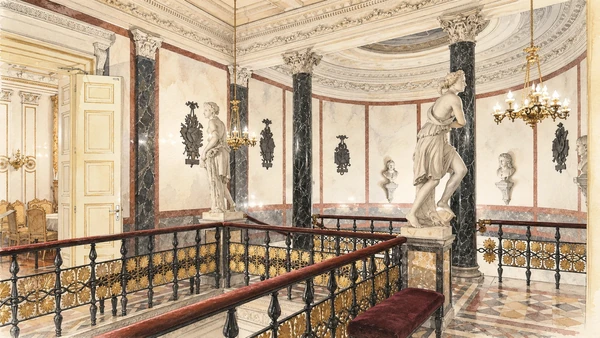
A private residence became a public institution. The decorated rooms and imposing circulation spaces reveal the social ambitions of the founder before the visitor encounters the wider modern-art collection.

Today

Check the institution’s current opening, booking arrangements and accessible route. Individual rooms, exhibitions and approaches may have separate conditions.

History

Pasquale Revoltella commissioned the residence in the 1850s and left it to the city as a museum on his death in 1869. The institution subsequently expanded into the adjoining Palazzo Brunner, bringing a domestic collection into a much larger public history of art.

How to read this place

Compare a furnished room with a gallery space. They invite different kinds of attention: one preserves a setting of ownership and display, while the other arranges works for public interpretation. Consult the museum for the rooms and exhibitions available on the day.

What to notice

  • Compare a furnished room with a gallery space.
  • They invite different kinds of attention: one preserves a setting of ownership and display, while the other arranges works for public interpretation.
  • Consult the museum for the rooms and exhibitions available on the day.
Museo Revoltella · PromoTurismoFVG
Watercolour: Museo Revoltella Trieste actual ornate interior stair landing with black railings marble columns and sculpture
Museo RevoltellaEditorial watercolour · AI-generated · 2026
07

Evidence and interpretation

Museo Teatrale Carlo Schmidl

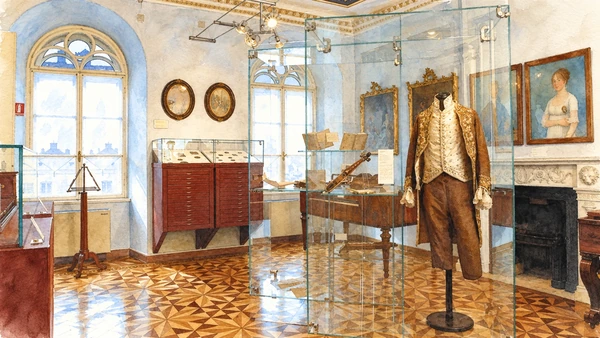
Instruments, costumes, programmes and archives offer another way into the port city. Theatre depends on performers, makers, audiences and buildings; the museum puts that collective work beside the names of celebrated individuals.

Today

Check the institution’s current opening, booking arrangements and accessible route. Individual rooms, exhibitions and approaches may have separate conditions.

History

The collection documents theatrical and musical life in Trieste from the eighteenth century onwards. Its holdings include material relating to Giorgio Strehler and collections of musical instruments, together with records used for research and consultation.

How to read this place

Choose one instrument or programme and ask what it records about performance, production or audiences. A displayed object is evidence from a working practice. Archival consultation and an ordinary museum visit have different arrangements; organise them separately.

What to notice

  • Choose one instrument or programme and ask what it records about performance, production or audiences.
  • A displayed object is evidence from a working practice.
  • Archival consultation and an ordinary museum visit have different arrangements; organise them separately.
Museo Teatrale Carlo Schmidl · PromoTurismoFVG
Watercolour: Museo Teatrale Carlo Schmidl Trieste actual historic museum room with musical instruments parquet and tall windows
Museo Teatrale Carlo SchmidlEditorial watercolour · AI-generated · 2026
08

Evidence and interpretation

Miramare: rooms of a Habsburg residence

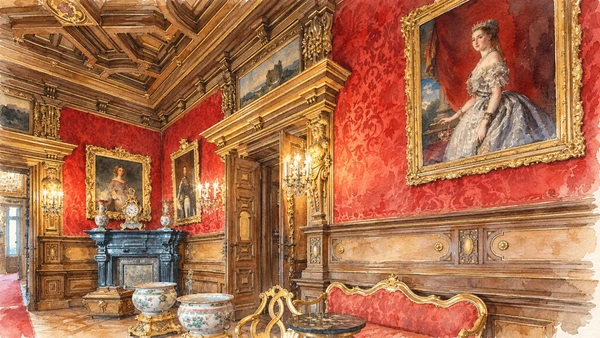
The surviving interiors place imperial ambition within a carefully designed domestic world. Timber, textiles, portraits and furnishings create a setting whose decorative richness should be read alongside the biographies of its owners.

Today

Check the institution’s current opening, booking arrangements and accessible route. Individual rooms, exhibitions and approaches may have separate conditions.

History

The castle was built between 1856 and 1860 for Archduke Ferdinand Maximilian and Charlotte of Belgium. Maximilian later became emperor of Mexico. The residence preserves furnished apartments and reception rooms rather than functioning as a reconstructed medieval fortress.

How to read this place

Read a room as a relationship between materials, furniture and ceremonial purpose. Follow the museum’s designated route and distinguish original furnishings from later presentation choices.

What to notice

  • Read a room as a relationship between materials, furniture and ceremonial purpose.
  • Follow the museum’s designated route and distinguish original furnishings from later presentation choices.
Castello di Miramare · PromoTurismoFVG
Watercolour: Miramare Castle actual red reception room, timber ceiling, portraits, fireplace and gilded furniture
Miramare: rooms of a Habsburg residenceEditorial watercolour · AI-generated · 2026
09

Terrain and access

Miramare: gardens and the sea

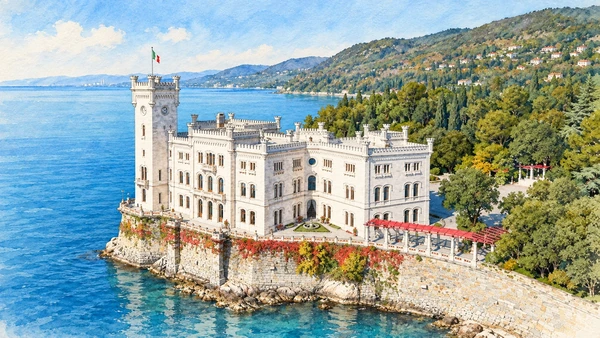
The pale castle stands directly above the water, while planted ground rises behind it. Approaching through the park explains why the residence belongs to a designed coastal landscape rather than to an isolated architectural object.

Today

Check park opening and any path closures with the Miramare museum. Garden access, castle admission and the marine reserve have separate arrangements.

History

Maximilian took an active interest in the grounds. The park combines different garden arrangements, collections of plants and terraces descending towards the sea. Its relationship with the residence is central to the history of the estate.

How to read this place

Compare formal approaches with more wooded sections. Garden paths, museum entrances and the adjacent protected marine area follow separate access arrangements. A view of the water does not imply permission to swim, land a boat or enter a restricted coastal zone.

What to notice

  • Compare formal approaches with more wooded sections.
  • Garden paths, museum entrances and the adjacent protected marine area follow separate access arrangements.
  • A view of the water does not imply permission to swim, land a boat or enter a restricted coastal zone.
Castello di Miramare · PromoTurismoFVG
Watercolour: Miramare Castle white crenellated residence directly on the Adriatic shore with planted coastal park behind
Miramare: gardens and the seaEditorial watercolour · AI-generated · 2026
10

Evidence and interpretation

Risiera di San Sabba

This is a memorial and historical museum at a former industrial site used by Nazi occupiers. Give it time apart from recreational sightseeing. The surviving spaces and modern memorial architecture require careful distinction and a restrained response.

Today

Check the institution’s current opening, booking arrangements and accessible route. Individual rooms, exhibitions and approaches may have separate conditions.

History

Built as a rice-processing facility in 1898, the complex became a Nazi police detention camp in autumn 1943. It was used for detention, killings and the transfer of deportees. A crematorium operated from 1944. The site became a national monument in 1965 and a civic museum in 1975.

How to read this place

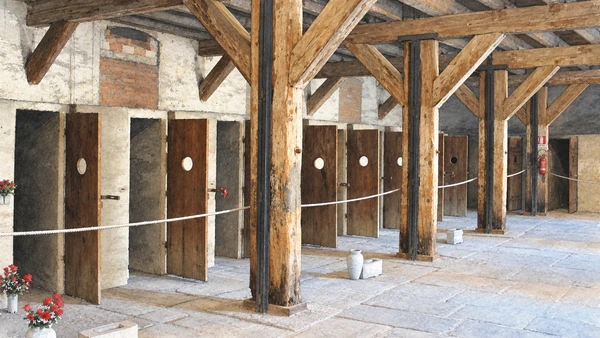
Use the museum’s documentation to identify what survives and what was added in the memorial intervention by Romano Boico. The illustration shows the preserved detention-cell setting without reconstructing violence or presenting missing structures as extant. Follow the memorial’s visitor guidance.

What to notice

  • Use the museum’s documentation to identify what survives and what was added in the memorial intervention by Romano Boico.
  • The illustration shows the preserved detention-cell setting without reconstructing violence or presenting missing structures as extant.
  • Follow the memorial’s visitor guidance.
Risiera di S. Sabba – Monumento Nazionale · PromoTurismoFVG
Watercolour: Risiera di San Sabba actual preserved row of detention cells with timber columns, sober documentary rendering without people or dramatic effects
Risiera di San SabbaEditorial watercolour · AI-generated · 2026

The territory through time

A short chronology

A concise chronology linking the documented sites to the wider story.

  1. San Giusto hill preserves evidence predating the monumental lower waterfront.

  2. Two earlier churches are joined to form the cathedral.

  3. Free-port status helps transform the scale and connections of the city.

  4. The Borgo Teresiano and recognised religious communities develop with the port.

  5. Miramare and Revoltella’s residence express different forms of elite patronage.

  6. Nazi occupation turns the Risiera into a place of detention, killing and deportation.

  7. The Risiera becomes a national monument and then a civic museum.

  8. Worship, port work, collecting and historical interpretation continue in distinct institutions.

Before your visit

Practical information

01

Plan separate days

Choose a manageable set of visits and allow for transport, booked entries and the return journey.

02

Use the exact place name

Friuli Venezia Giulia contains separate valleys, towns and coastal approaches; some guides also include nearby places in Slovenia. Confirm the precise locality and route rather than treating nearby names as one destination.

03

Check the institution

Opening hours, tickets, exhibitions and religious access change. Use the linked managing institution shortly before visiting.

04

Check the actual terrain

Steps, gradients and uneven ground vary between the individual sites. Use current route information, weather and closures for the option you choose.

05

Arrange accessible visits

Historic interiors and outdoor approaches can include steps, gradients or uneven surfaces. Ask about the specific route instead of assuming an entire destination is step-free.

06

Respect work and residence

Farms, workshops, churches and historic streets remain in use. Follow signs, keep entrances clear and ask permission before entering private spaces.

Method and sources

Sources and image credits

Prepared on 9 September 2026 from the institutional sources linked below. Historical claims are separated from editorial observations and itinerary suggestions. Older institutional brochures are used for stable cultural context, never as current timetables. Prices, transport schedules, trail status and admission are deliberately left to the responsible operators. Illustrations are not photographs, measured reconstructions or evidence of current conditions.

The eleven images are AI-generated editorial watercolours guided by photographic references. They interpret named places and are not photographs or substitutes for measured plans. Opening hours, tickets, accessible routes, temporary exhibitions and conservation work can change; consult the linked official pages shortly before visiting.

Illustration references and credits