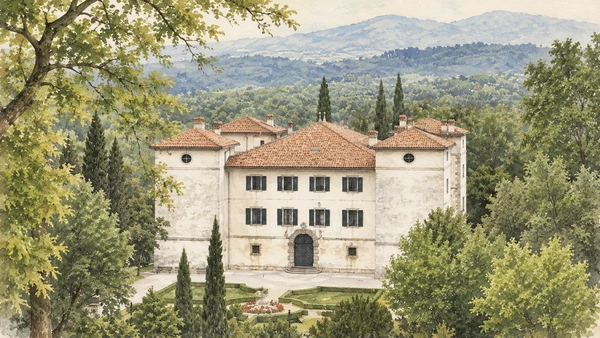
Watercolour: Gorizia & Nova Gorica establishing view

Friuli Venezia Giulia · Guide 05

Gorizia &
Nova Gorica

Two neighbouring cities, a changing border and a shared cultural landscape: castles, religious communities, modern planning and the Soča valley.

Plan the route
Gorizia & Nova Gorica10 chapters · history, culture and landscape

Why this place matters

Read the border through places and people.

Gorizia and Nova Gorica make sense together, but their buildings do not tell the same story. The older town gathers around a castle hill and civic streets; the planned postwar city developed after the new international boundary of 1947. Museums, a former synagogue and a Franciscan monastery add histories that cross these political periods. The shared European Capital of Culture year was 2025. Its renewed spaces now belong to the continuing everyday life of both cities.

The guide separates documented history from suggestions for reading the site. Named buildings and landscape relationships follow institutional sources; the illustrations are editorial interpretations, not measured surveys or records of current access.

Two neighbouring cities, a changing border and a shared cultural landscape: castles, religious communities, modern planning and the Soča valley.
The route

Plan your visit

Begin with the castle hill and Piazza della Vittoria, then plan the museums and the journey to Transalpina separately. Nova Gorica’s civic centre, Kostanjevica, Solkan and Kromberk are distinct destinations. Choose transport for the actual distances and check the arrangements of each institution.

Gorizia centre

Castle, square and Sant’Ignazio

Begin with the castle hill and Piazza della Vittoria, then plan the museums and the journey to Transalpina separately.

Collections and memory

Synagogue and Palazzo Attems

Across the border

Transalpina and Nova Gorica

Separate extensions

Kostanjevica, Solkan and Kromberk

Ten chapters

Explore the places

The chapters connect history and terrain. Use the route notes to choose visits and plan transfers between separate sites.

  1. 01Castello di Gorizia
  2. 02Piazza della Vittoria
  3. 03Sant’Ignazio
  4. 04The former synagogue
  5. 05Palazzo Attems Petzenstein
  6. 06Transalpina · Trg Evrope
  7. 07Nova Gorica’s civic centre
  8. 08Kostanjevica monastery
  9. 09Solkan railway bridge
  10. 10Kromberk Castle
01

Evidence and interpretation

Castello di Gorizia

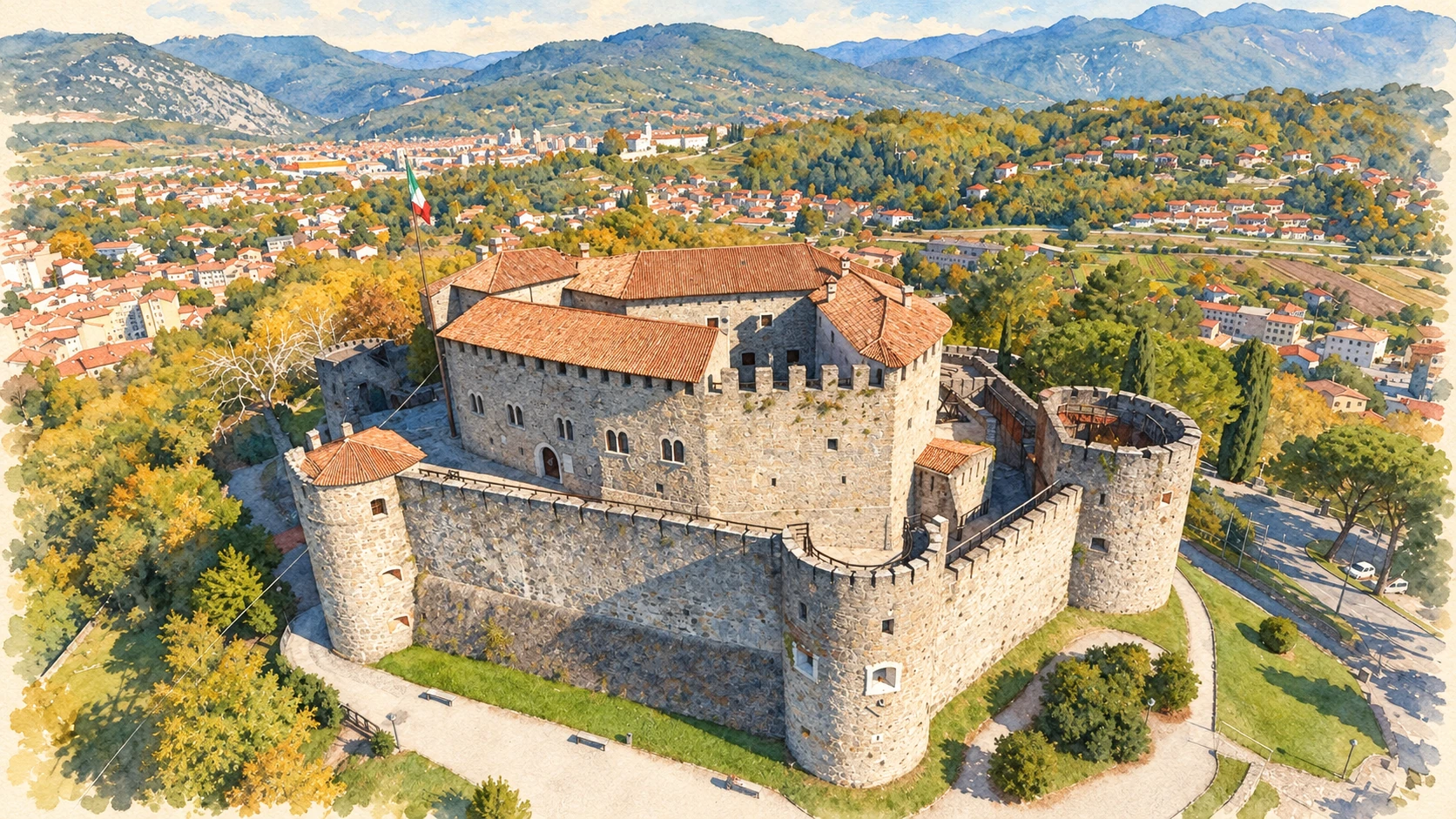
The castle hill establishes the old town’s topography. Its masonry enclosure and buildings form a compact elevated group, with the lower streets and surrounding hills visible beyond the walls.

Today

Check the institution’s current opening, booking arrangements and accessible route. Individual rooms, exhibitions and approaches may have separate conditions.

History

The castle has medieval origins and underwent many changes in function and form. First World War bombardment caused major damage; reconstruction in the 1930s strongly shaped its present medieval appearance.

How to read this place

Look at the relation between the enclosure and the hill before studying individual architectural details. Interpret the standing structure alongside its reconstruction history; a medieval-looking surface is not automatically an untouched medieval survival.

What to notice

  • Look at the relation between the enclosure and the hill before studying individual architectural details.
  • Interpret the standing structure alongside its reconstruction history; a medieval-looking surface is not automatically an untouched medieval survival.
Castello di Gorizia · PromoTurismoFVG
Watercolour: Gorizia castle actual stone enclosure and tiled central buildings above the town
Castello di GoriziaEditorial watercolour · AI-generated · 2026
02

The inhabited landscape

Piazza della Vittoria

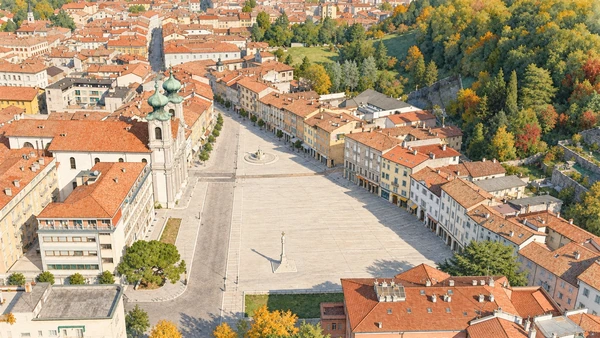
The elongated square gathers the lower town around church towers and continuous building fronts. Its shape is an effective starting point for understanding the relationship between the castle slope and the civic streets.

Today

This remains an inhabited place. Use pedestrian routes, keep entrances clear and check municipal mobility notices for any restricted area.

History

Gorizia developed through changing political and cultural settings, including Habsburg rule and twentieth-century boundary changes. The square belongs to the accumulated urban fabric, with buildings and names from different periods.

How to read this place

Follow the public edges to compare the scale of the church with the houses opposite. Street names are historical evidence too, but they should be dated rather than treated as timeless descriptions of the population.

What to notice

  • Follow the public edges to compare the scale of the church with the houses opposite.
  • Street names are historical evidence too, but they should be dated rather than treated as timeless descriptions of the population.
Gorizia · PromoTurismoFVG
Watercolour: Piazza della Vittoria Gorizia elongated square beneath wooded castle hill
Piazza della VittoriaEditorial watercolour · AI-generated · 2026
03

Worship and memory

Sant’Ignazio

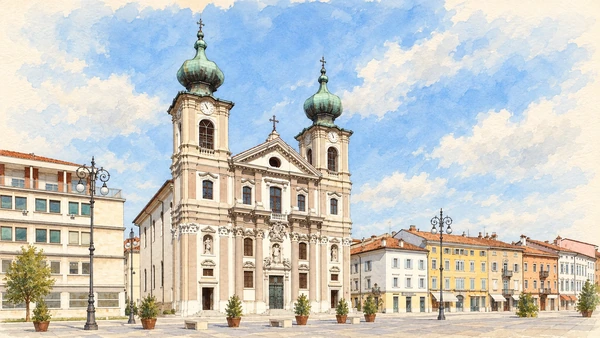
Twin onion domes give the church a clear presence on Piazza della Vittoria. Its façade and deep interior express the ambitions of an early modern religious institution within the town.

Today

Worship and local religious life continue here. Visitor access may pause for services; consult the church or managing institution before planning an interior visit.

History

The Jesuit church was built between 1654 and 1747. The façade is associated with Christoph Tausch; the interior has a single nave with three chapels on each side.

How to read this place

Compare the paired towers with the central entrance and the rhythm of the chapels inside. Read the decoration as part of a Jesuit sacred setting, while respecting the church’s present religious use.

What to notice

  • Compare the paired towers with the central entrance and the rhythm of the chapels inside.
  • Read the decoration as part of a Jesuit sacred setting, while respecting the church’s present religious use.
Chiesa di Sant’Ignazio di Gorizia · PromoTurismoFVG
Watercolour: Sant Ignazio Gorizia actual pale facade and two green onion domes
Sant’IgnazioEditorial watercolour · AI-generated · 2026
04

Evidence and interpretation

The former synagogue

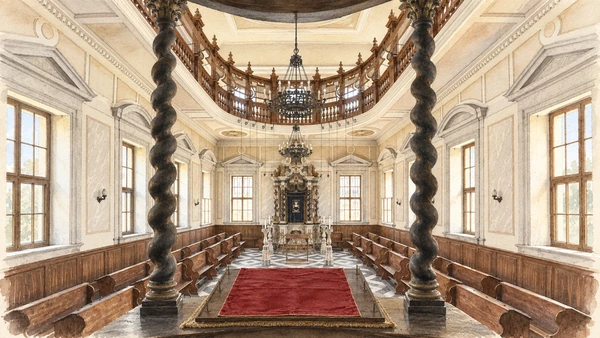
The preserved interior records a Jewish community whose history cannot be reduced to a decorative stop. Its architectural setting should be read alongside the documentation of community life and persecution.

Today

This former synagogue functions as a cultural and historical space. Check its current visitor arrangements with the local managing institution; it is not an active synagogue offering ordinary worship access.

History

The synagogue dates to 1756. Fascist racial laws and Nazi deportations devastated the community; a deportation took place on 23 November 1943. The restored building reopened in 1984 as a cultural space and is no longer used for worship.

How to read this place

Give the historical interpretation as much attention as the furnishings. Distinguish the former liturgical arrangement from the building’s present cultural role, and consult the managing institution for access.

What to notice

  • Give the historical interpretation as much attention as the furnishings.
  • Distinguish the former liturgical arrangement from the building’s present cultural role, and consult the managing institution for access.
Sinagoga di Gorizia · PromoTurismoFVG
Watercolour: Gorizia synagogue actual interior twisted columns central reading platform and gallery
The former synagogueEditorial watercolour · AI-generated · 2026
05

Evidence and interpretation

Palazzo Attems Petzenstein

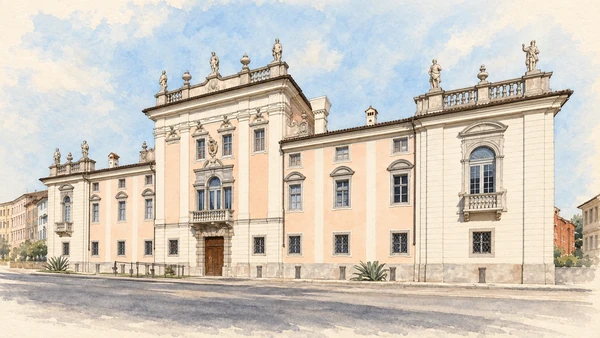
The palace connects aristocratic residence with public collecting. Its façade, roof statues and decorated interiors provide a setting for art from different periods of the region.

Today

Check the institution’s current opening, booking arrangements and accessible route. Individual rooms, exhibitions and approaches may have separate conditions.

History

The eighteenth-century palace acquired a neoclassical façade in the nineteenth century. Antonio Paroli’s ceiling decoration dates to 1745. The museum collection extends beyond the original household and includes works by Giuseppe Tominz and later regional artists.

How to read this place

Separate the architecture of patronage from the later museum arrangement. Compare a decorated room with the works displayed within it; the paintings need not have been commissioned for their current location.

What to notice

  • Separate the architecture of patronage from the later museum arrangement.
  • Compare a decorated room with the works displayed within it; the paintings need not have been commissioned for their current location.
Palazzo Attems Petzenstein di Gorizia · PromoTurismoFVG
Watercolour: Palazzo Attems Petzenstein actual symmetrical pale facade with roof statues
Palazzo Attems PetzensteinEditorial watercolour · AI-generated · 2026
06

The inhabited landscape

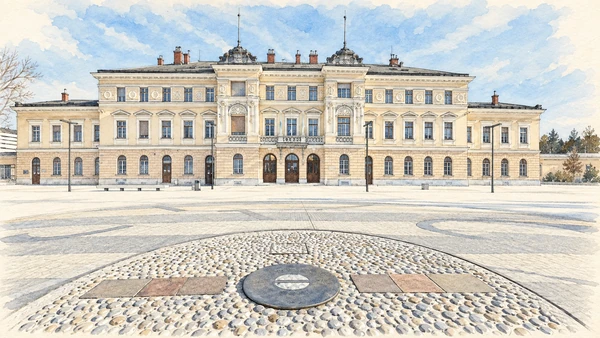
Transalpina · Trg Evrope

The square before Nova Gorica railway station crosses the international boundary. Its open surface makes a once-divided space legible, while the station recalls an older transport network.

Today

This remains an inhabited place. Use pedestrian routes, keep entrances clear and check municipal mobility notices for any restricted area.

History

The postwar boundary divided the square in 1947. Slovenia’s entry into the European Union in 2004 marked another phase in its public symbolism. A further renewal was completed in early 2025 for the shared European Capital of Culture programme.

How to read this place

Read the railway building, boundary interpretation and renewed paving as different layers. The 2025 cultural year is now past; consult current listings for events rather than expecting its original programme to continue unchanged.

What to notice

  • Read the railway building, boundary interpretation and renewed paving as different layers.
  • The 2025 cultural year is now past; consult current listings for events rather than expecting its original programme to continue unchanged.
EGTC GO · Transalpina, history and significance
Watercolour: Renewed Transalpina Europe Square and Nova Gorica railway station in 2025
Transalpina · Trg EvropeEditorial watercolour · AI-generated · 2026
07

The inhabited landscape

Nova Gorica’s civic centre

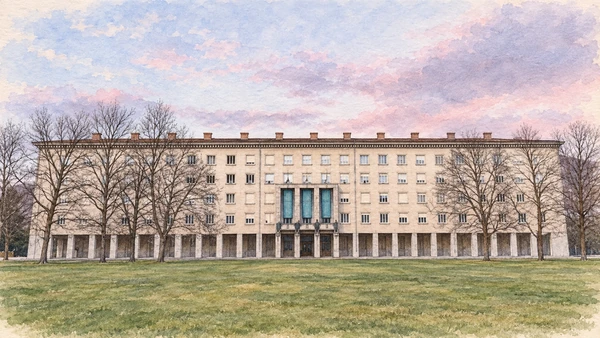
Broad streets, greenery and public buildings create a different urban scale from Gorizia’s historic centre. The municipal building gives this planned landscape a clearly defined civic front.

Today

Use the public square and pedestrian approaches. The building remains a working municipal institution; visits to rooms such as the painted council hall require specific arrangements.

History

Nova Gorica developed after the boundary settlement of 1947. Vinko Glanz designed the municipal building, constructed in 1949–1953, while Edvard Ravnikar’s wider urban plan shaped the new town’s modernist framework.

How to read this place

Compare the stone arcade with the open space in front. The municipal building and the city plan are different commissions by different architects. Interior artworks have their own access arrangements within a working public institution.

What to notice

  • Compare the stone arcade with the open space in front.
  • The municipal building and the city plan are different commissions by different architects.
  • Interior artworks have their own access arrangements within a working public institution.
Nova Gorica Digital Archive · Municipal building
Watercolour: Nova Gorica municipal building actual stone facade and colonnade
Nova Gorica’s civic centreEditorial watercolour · AI-generated · 2026
08

Worship and memory

Kostanjevica monastery

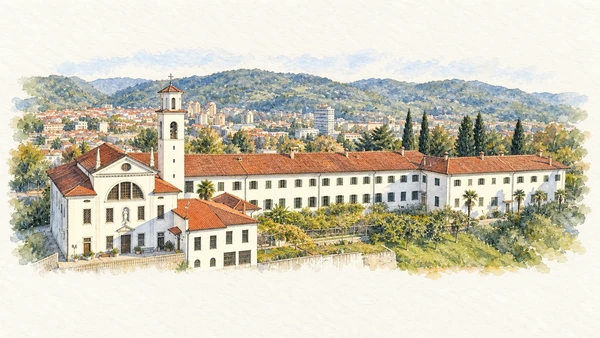
The monastery combines a living religious community with a library and the Bourbon tombs. It offers a quieter setting for considering how spiritual, cultural and dynastic histories meet.

Today

Consult the monastery for access to the church, Bourbon tombs and library. These are separate experiences within an active religious complex, and their visiting arrangements may differ.

History

Franciscan custodianship has maintained the church, library and tombs across successive political changes. The whole complex was declared a cultural and historical landmark in Slovenia in 2024.

How to read this place

Treat the church, library and tombs as related but distinct spaces. Ask which parts are available during your visit. The hilltop setting adds geographical context without replacing the institution’s own explanation of its collections.

What to notice

  • Treat the church, library and tombs as related but distinct spaces.
  • Ask which parts are available during your visit.
  • The hilltop setting adds geographical context without replacing the institution’s own explanation of its collections.
Franciscan Monastery Kostanjevica · About the monastery
Watercolour: Kostanjevica Franciscan monastery actual hilltop church and monastery in Nova Gorica
Kostanjevica monasteryEditorial watercolour · AI-generated · 2026
09

Terrain and access

Solkan railway bridge

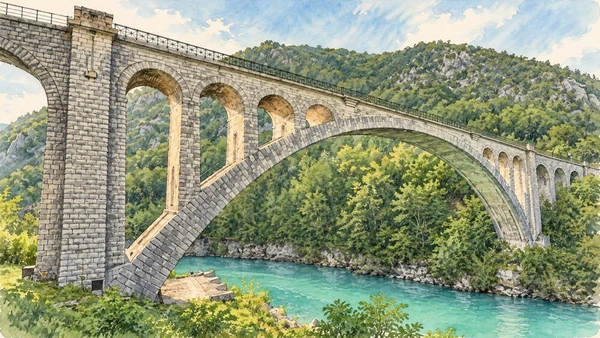
The stone railway arch spans the Soča between wooded slopes. A nearby modern road bridge makes the contrast between two generations of infrastructure visible from appropriate public viewpoints.

Today

Use designated public viewpoints and current local route information. The railway is operational infrastructure. Do not assume a heritage-train service or river activity is available merely because it appears in an older tourism description.

History

The railway bridge was completed in 1905 and served the route opened in 1906. Destroyed during the First World War, it was rebuilt. Its principal stone arch spans 85 metres. The adjacent road bridge is a later structure.

How to read this place

Identify the stone railway bridge before reading the engineering form. Stay on authorised public approaches and never enter the railway. River access and recreational activities require their own conditions and arrangements.

What to notice

  • Identify the stone railway bridge before reading the engineering form.
  • Stay on authorised public approaches and never enter the railway.
  • River access and recreational activities require their own conditions and arrangements.
Nova Gorica and Vipava Valley Tourism · Solkan Bridge
Watercolour: Solkan stone railway arch across the turquoise Soca between wooded slopes
Solkan railway bridgeEditorial watercolour · AI-generated · 2026
10

Evidence and interpretation

Kromberk Castle

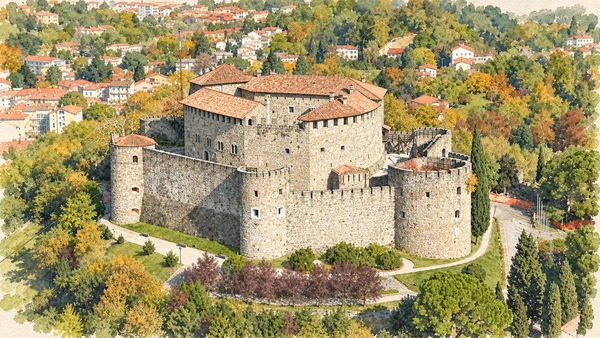
Four corner towers give the residence a castle-like outline, but its museum interpretation places aristocratic domestic life beside the changing cultural history of the region.

Today

Check the institution’s current opening, booking arrangements and accessible route. Individual rooms, exhibitions and approaches may have separate conditions.

History

The Coronini residence developed in the seventeenth century on an older estate. Fires and destruction in both world wars led to major rebuilding. Goriški muzej has occupied it since 1954, and the northern towers were reconstructed in later decades.

How to read this place

Read the building as a residence and museum rather than assuming every wall had a defensive purpose. Compare the collections with the reconstructed architecture and surrounding park. Plan Kromberk as a separate visit outside the central city route.

What to notice

  • Read the building as a residence and museum rather than assuming every wall had a defensive purpose.
  • Compare the collections with the reconstructed architecture and surrounding park.
  • Plan Kromberk as a separate visit outside the central city route.
Goriški muzej · Kromberk Castle
Watercolour: Kromberk Castle actual pale residence with four corner towers and garden
Kromberk CastleEditorial watercolour · AI-generated · 2026

The territory through time

A short chronology

A concise chronology linking the documented sites to the wider story.

  1. The castle hill forms an important centre of power.

  2. The Jesuit church of Sant’Ignazio takes shape.

  3. The synagogue becomes a setting for Jewish community life.

  4. The Solkan bridge and new railway connections enter service.

  5. War damages the region and its monuments.

  6. Nazi deportation devastates Gorizia’s Jewish community.

  7. A new boundary and the construction of Nova Gorica reshape the urban area.

  8. EU membership and the shared cultural-capital year mark further stages of cross-border cooperation.

Before your visit

Practical information

01

Plan separate days

Choose a manageable set of visits and allow for transport, booked entries and the return journey.

02

Use the exact place name

Friuli Venezia Giulia contains separate valleys, towns and coastal approaches; some guides also include nearby places in Slovenia. Confirm the precise locality and route rather than treating nearby names as one destination.

03

Check the institution

Opening hours, tickets, exhibitions and religious access change. Use the linked managing institution shortly before visiting.

04

Check the actual terrain

Steps, gradients and uneven ground vary between the individual sites. Use current route information, weather and closures for the option you choose.

05

Arrange accessible visits

Historic interiors and outdoor approaches can include steps, gradients or uneven surfaces. Ask about the specific route instead of assuming an entire destination is step-free.

06

Respect work and residence

Farms, workshops, churches and historic streets remain in use. Follow signs, keep entrances clear and ask permission before entering private spaces.

Method and sources

Sources and image credits

Prepared on 9 September 2026 from the institutional sources linked below. Historical claims are separated from editorial observations and itinerary suggestions. Older institutional brochures are used for stable cultural context, never as current timetables. Prices, transport schedules, trail status and admission are deliberately left to the responsible operators. Illustrations are not photographs, measured reconstructions or evidence of current conditions.

The eleven images are AI-generated editorial watercolours guided by photographic references. They interpret named places and are not photographs or substitutes for measured plans. Opening hours, tickets, accessible routes, temporary exhibitions and conservation work can change; consult the linked official pages shortly before visiting.

Illustration references and credits