Watercolour: Collio & Brda establishing view

Friuli Venezia Giulia · Guide 08

Collio & Brda

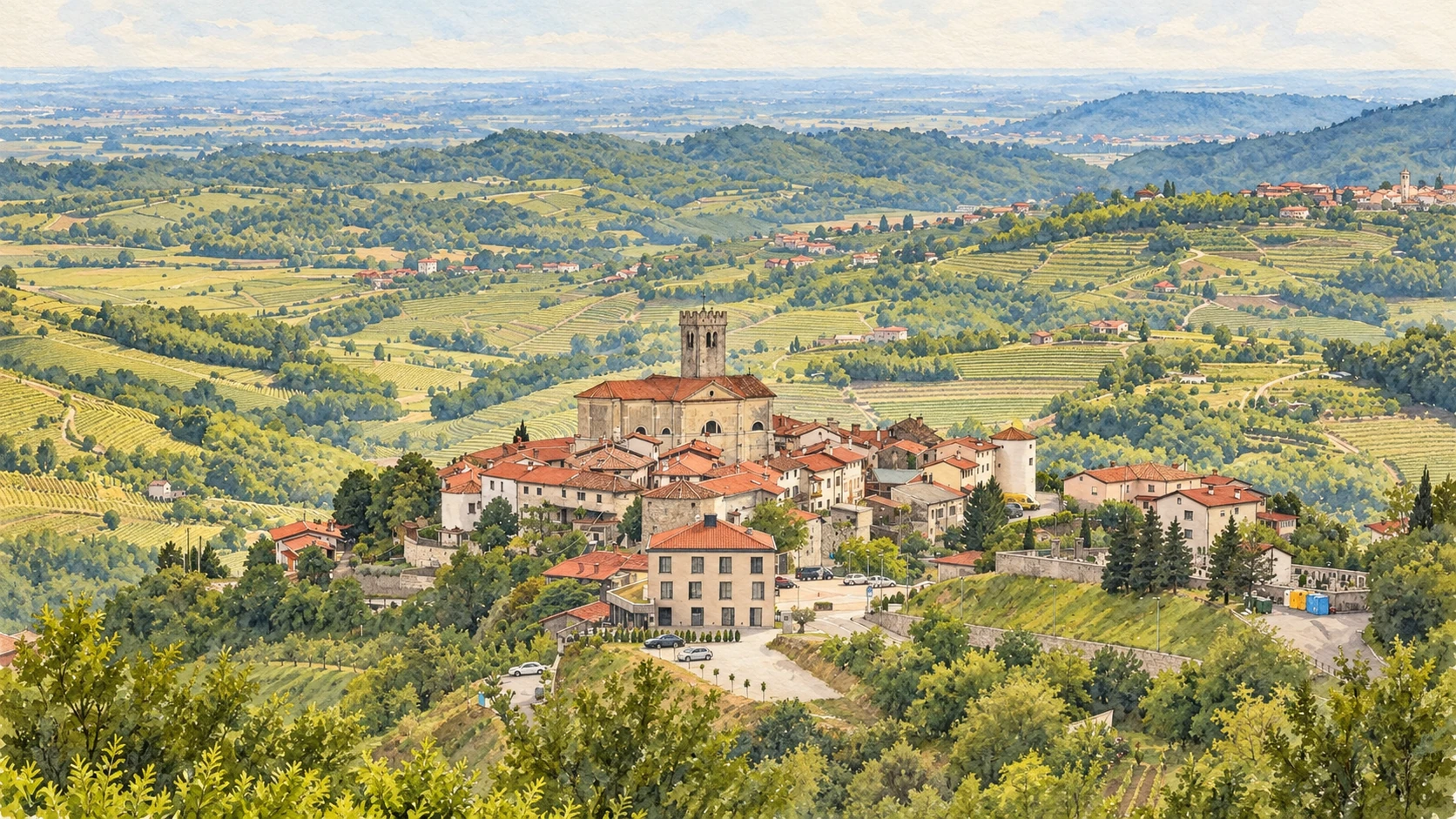
Hill villages, cultivated slopes, noble residences and a limestone stream valley connect two neighbouring territories across the Italian–Slovenian border.

Plan the route
Collio & Brda10 chapters · history, culture and landscape

Why this place matters

Follow the hills without erasing the border.

Collio in Italy and Brda in Slovenia share a continuous hill landscape, but their names, institutions and wine designations are not interchangeable. Cormòns provides an Italian starting point, with a church, civic palace and nearby castle. Across the border, Šmartno, Dobrovo and Vipolže reveal different forms of settlement and patronage. Gonjače offers a modern viewpoint and place of remembrance, while Krčnik changes the scale from cultivated hills to a stream-cut gorge.

The guide separates documented history from suggestions for reading the site. Named buildings and landscape relationships follow institutional sources; the illustrations are editorial interpretations, not measured surveys or records of current access.

Hill villages, cultivated slopes, noble residences and a limestone stream valley connect two neighbouring territories across the Italian–Slovenian border.
The route

Plan your visit

Use Cormòns for the first group of visits. Plan the Slovenian villages and Krčnik with their own transfers and opening information. These stops are a collection of possibilities across several days, not one continuous footpath or a timed driving schedule.

Italian starting point

Cormòns, Sant’Adalberto and Palazzo Locatelli

Use Cormòns for the first group of visits.

Collio landscape

San Floriano and cultivated hills

Brda buildings

Šmartno, Dobrovo and Vipolže

Views and water

Gonjače and Krčnik

Ten chapters

Explore the places

The chapters connect history and terrain. Use the route notes to choose visits and plan transfers between separate sites.

  1. 01Cormòns
  2. 02Sant’Adalberto
  3. 03Palazzo Locatelli
  4. 04San Floriano del Collio castle
  5. 05Reading the cultivated hills
  6. 06Šmartno
  7. 07Dobrovo Castle
  8. 08Gonjače: viewpoint and remembrance
  9. 09Vila Vipolže
  10. 10Krčnik and the Kožbanjšček brook
01

The inhabited landscape

Cormòns

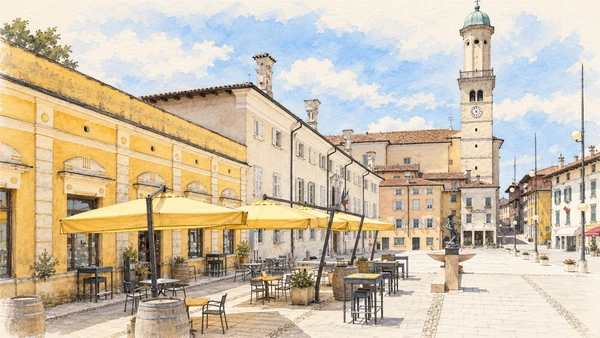
The town offers a civic centre within a largely rural itinerary. Squares, cafés and building fronts provide a place to understand the hills through everyday activity rather than only through viewpoints and wine estates.

Today

This remains an inhabited place. Use pedestrian routes, keep entrances clear and check municipal mobility notices for any restricted area.

History

Cormòns developed within the historical connections of the Gorizia territory and retains a strong Habsburg-era character. Nearby settlements also preserve Slovenian linguistic and cultural traditions within Italy.

How to read this place

Begin with the public squares and compare the scale of civic, commercial and religious buildings. Local food traditions can add another layer to the visit, but a menu alone does not represent every community or every period of the borderland.

What to notice

  • Begin with the public squares and compare the scale of civic, commercial and religious buildings.
  • Local food traditions can add another layer to the visit, but a menu alone does not represent every community or every period of the borderland.
PromoTurismoFVG · Cormòns
Watercolour: Cormòns actual central square with yellow and pale building fronts and bell tower
CormònsEditorial watercolour · AI-generated · 2026
02

Worship and memory

Sant’Adalberto

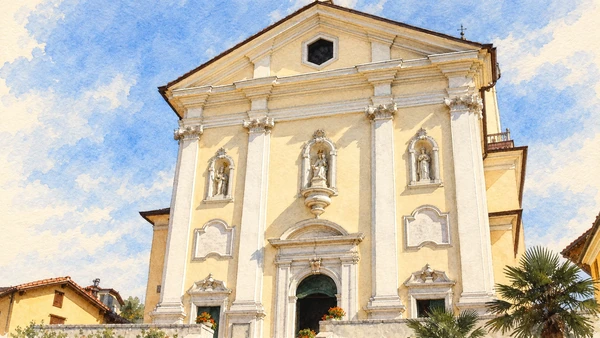
The church’s elevated approach and broad façade give worship a prominent place above the town streets. A closer view reveals statues, pilasters and the relationship between the doorway and the upper pediment.

Today

Worship and local religious life continue here. Visitor access may pause for services; consult the church or managing institution before planning an interior visit.

History

Built between 1736 and 1760, the present church incorporates an earlier thirteenth-century building. Its single nave and later Baroque furnishings sit within a site still marked by remnants of the old fortified enclosure.

How to read this place

Compare the façade’s vertical divisions with the broad stair approach. Inside, distinguish the later setting from older works transferred or retained within it. Crypts and subsidiary spaces should not be assumed open merely because they are described in historical accounts.

What to notice

  • Compare the façade’s vertical divisions with the broad stair approach.
  • Inside, distinguish the later setting from older works transferred or retained within it.
  • Crypts and subsidiary spaces should not be assumed open merely because they are described in historical accounts.
Duomo di Sant’Adalberto di Cormons · PromoTurismoFVG
Watercolour: Sant’Adalberto Cormòns actual pale facade with four pilasters statues and pediment
Sant’AdalbertoEditorial watercolour · AI-generated · 2026
03

Evidence and interpretation

Palazzo Locatelli

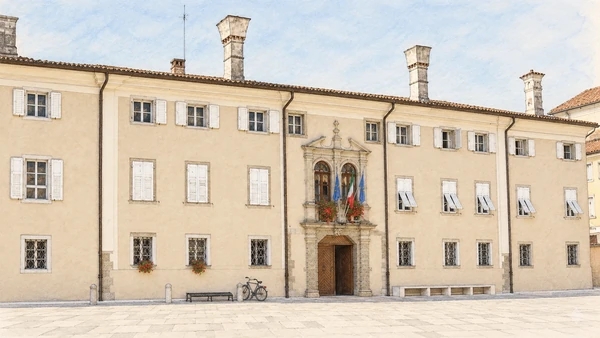
The palace forms an important civic frontage on Piazza XXIV Maggio. Its restrained exterior introduces a building that has moved from private residence to public use.

Today

Check the institution’s current opening, booking arrangements and accessible route. Individual rooms, exhibitions and approaches may have separate conditions.

History

The Locatelli family built the residence in the eighteenth century. Later decoration includes nineteenth-century frescoes by Antonio Picco. The complex houses civic functions, the town enoteca and the territorial museum.

How to read this place

Read the entrance and family coat of arms from the square before considering an interior visit. The garden, offices, museum and decorated rooms have different uses. Confirm which spaces are available rather than treating the entire palace as a single open attraction.

What to notice

  • Read the entrance and family coat of arms from the square before considering an interior visit.
  • The garden, offices, museum and decorated rooms have different uses.
  • Confirm which spaces are available rather than treating the entire palace as a single open attraction.
Palazzo Locatelli di Cormons · PromoTurismoFVG
Watercolour: Palazzo Locatelli Cormòns actual long pale facade on the square
Palazzo LocatelliEditorial watercolour · AI-generated · 2026
04

Evidence and interpretation

San Floriano del Collio castle

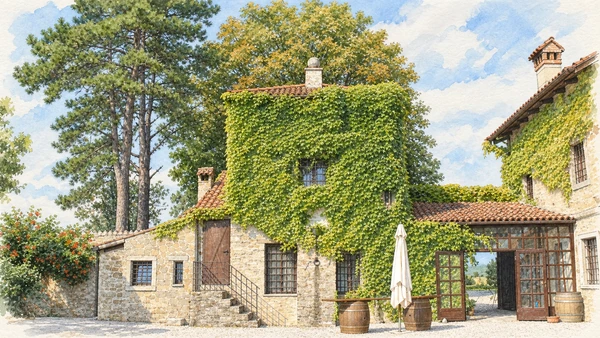
The surviving castle complex records both defence and residence. A close view of its masonry and altered buildings is more revealing than imagining an intact medieval fortress.

Today

This is a private property. Check whether a visit is offered and make the required arrangements; a published description of the castle is not evidence of unrestricted daily access.

History

The site had patriarchal connections by the eleventh century and passed to the Formentini family in 1520. Its military role declined, and a nineteenth-century transformation adapted it as a residence. Older walls, the northern access and cylindrical towers survive among later changes.

How to read this place

Identify the documented older elements and compare them with residential additions. The estate is privately owned. Arrange any visit through the owner or the historic-castles organisation, and stay within the spaces made available.

What to notice

  • Identify the documented older elements and compare them with residential additions.
  • The estate is privately owned.
  • Arrange any visit through the owner or the historic-castles organisation, and stay within the spaces made available.
Castello di San Floriano del Collio · PromoTurismoFVG
Watercolour: San Floriano del Collio actual ivy-covered castle building and courtyard
San Floriano del Collio castleEditorial watercolour · AI-generated · 2026
05

Terrain and access

Reading the cultivated hills

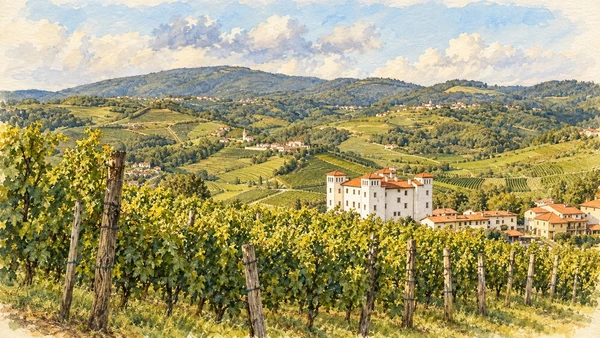
Rows of vines, terraces, orchards and wooded margins give the hills their visible pattern. Agriculture is active work here, and the paths between fields do not all belong to the public visitor network.

Today

For a winery visit, confirm the producer, appointment and transport beforehand. A scenic vineyard route does not imply open access to estates or an available tasting.

History

Generations of cultivation have shaped the landscape on both sides of the border. In the Italian Collio, layered marl and sandstone are commonly called ponca. Collio DOC and Slovenian Brda remain distinct designations despite their neighbouring terrain.

How to read this place

Compare row direction with the slope and look for the relationship between cultivated parcels and village ridges. The illustration shows vineyards near Dobrovo in Brda. Arrange a cellar visit with its producer, and use public viewpoints without entering working rows or farmyards.

What to notice

  • Compare row direction with the slope and look for the relationship between cultivated parcels and village ridges.
  • The illustration shows vineyards near Dobrovo in Brda.
  • Arrange a cellar visit with its producer, and use public viewpoints without entering working rows or farmyards.
Brda tourism · Landscape and cultural places
Watercolour: Actual Brda vineyard rows with Dobrovo Castle beyond and cultivated hills
Reading the cultivated hillsEditorial watercolour · AI-generated · 2026
06

The inhabited landscape

Šmartno

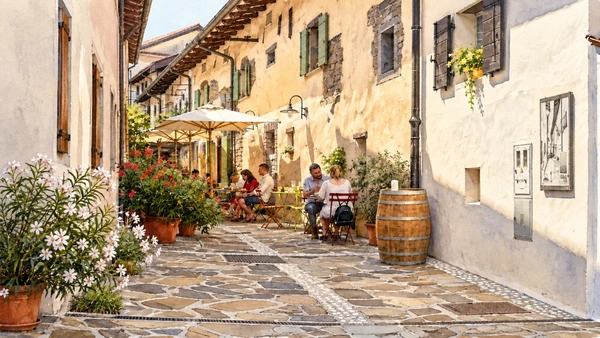
The walled village gathers lanes, houses and its church on a compact hilltop. Walking inside the enclosure changes the experience from a distant silhouette to closely observed thresholds and building materials.

Today

This remains an inhabited place. Use pedestrian routes, keep entrances clear and check municipal mobility notices for any restricted area.

History

Šmartno was a defensive settlement on the Venetian–Habsburg frontier. Five towers survive from a more extensive system. Its military role later receded, and organised restoration began in the late 1970s.

How to read this place

Compare the enclosing wall with the domestic lanes inside. The church tower has a defensive origin, but the village’s later life is equally visible. The Brda House and cultural exhibitions offer further interpretation when open; they are separate from simply walking the streets.

What to notice

  • Compare the enclosing wall with the domestic lanes inside.
  • The church tower has a defensive origin, but the village’s later life is equally visible.
  • The Brda House and cultural exhibitions offer further interpretation when open; they are separate from simply walking the streets.
Brda tourism · Šmartno
Watercolour: Šmartno actual narrow stone-paved lane with pale plaster houses and timber eaves
ŠmartnoEditorial watercolour · AI-generated · 2026
07

Evidence and interpretation

Dobrovo Castle

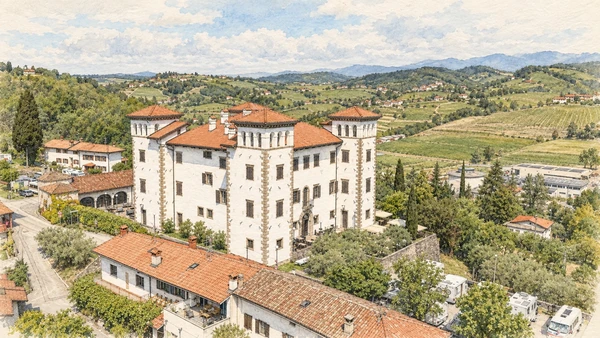
Four corner towers give the Renaissance residence a recognisable outline above its surroundings. Its regular plan differs from the more closely packed defensive settlement of Šmartno.

Today

The official Brda page currently carries a maintenance notice for the museum collections alongside general opening information. Confirm access directly before travelling for an interior visit; this guide does not assume the collections are open.

History

The present building dates principally from the early seventeenth century, replacing an older castle. Successive noble owners altered and decorated it; the Baguer family acquired the property through marriage in 1872.

How to read this place

Compare the corners, central block and relationship with the surrounding estate from authorised public areas. Interior collections and exhibitions have their own access conditions. Do not plan the day around a specific gallery without confirmation from the institution.

What to notice

  • Compare the corners, central block and relationship with the surrounding estate from authorised public areas.
  • Interior collections and exhibitions have their own access conditions.
  • Do not plan the day around a specific gallery without confirmation from the institution.
Brda tourism · Dobrovo Castle
Watercolour: Dobrovo Castle actual white residence with four square corner towers and red roofs
Dobrovo CastleEditorial watercolour · AI-generated · 2026
08

The inhabited landscape

Gonjače: viewpoint and remembrance

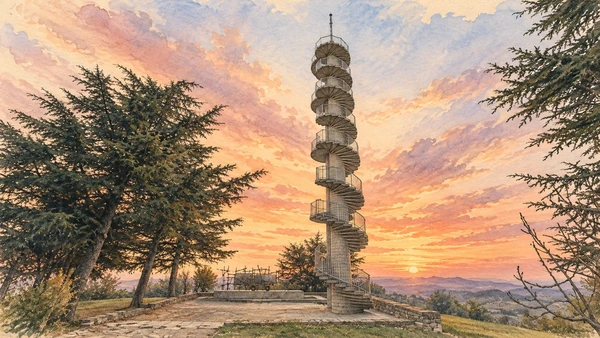
The modern tower turns the panorama into a deliberately constructed experience. Beside it, a memorial asks for attention to the human history of the surrounding territory.

Today

Check access and weather before climbing. The tower involves stairs and exposure to height; a broad view is dependent on visibility, not guaranteed by the route description.

History

Designed by Marko Šlajmer and built in 1961, the tower stands on the Mejnik hill. The nearby work by Janez Boljka commemorates victims of the Second World War from Brda and Slavia Friulana.

How to read this place

Read the tower’s spiral circulation and the memorial as distinct but neighbouring works. At the viewpoint, visibility determines how much of the distant terrain can be identified. Take time at the memorial rather than treating it as foreground decoration for a photograph.

What to notice

  • Read the tower’s spiral circulation and the memorial as distinct but neighbouring works.
  • At the viewpoint, visibility determines how much of the distant terrain can be identified.
  • Take time at the memorial rather than treating it as foreground decoration for a photograph.
Brda tourism · Gonjače and cultural heritage
Watercolour: Gonjače actual modern spiral concrete observation tower between trees
Gonjače: viewpoint and remembranceEditorial watercolour · AI-generated · 2026
09

Evidence and interpretation

Vila Vipolže

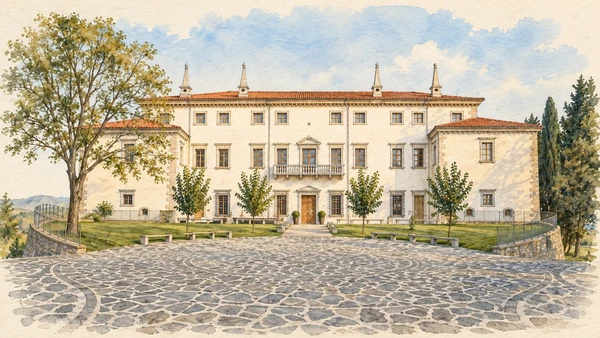
The broad villa façade and formal approach express a different relationship with the hills from a fortified village. The restored complex now supports exhibitions, gatherings and other cultural uses.

Today

Check the institution’s current opening, booking arrangements and accessible route. Individual rooms, exhibitions and approaches may have separate conditions.

History

The villa developed through successive building campaigns and changes of ownership. The Goriški Museum’s permanent historical presentation uses models to explain that development rather than treating the visible building as the product of one moment.

How to read this place

Compare the main façade with the surviving and restored fabric shown by the museum interpretation. A guided visit can clarify changes that are difficult to identify from outside. Events, exhibitions and ordinary visiting hours need separate checks.

What to notice

  • Compare the main façade with the surviving and restored fabric shown by the museum interpretation.
  • A guided visit can clarify changes that are difficult to identify from outside.
  • Events, exhibitions and ordinary visiting hours need separate checks.
Vila Vipolže · History and museum
Watercolour: Vila Vipolže actual long pale facade with central balcony and paved approach
Vila VipolžeEditorial watercolour · AI-generated · 2026
10

Terrain and access

Krčnik and the Kožbanjšček brook

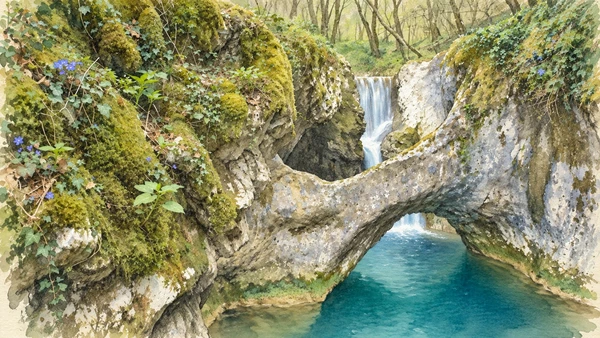
A natural stone bridge spans a confined stream-cut hollow. The scale is intimate: rock, water and vegetation replace the broad vineyard views of the ridges.

Today

Check the local approach and weather before visiting. Remain on the permitted route, avoid the edge of wet rock and do not infer swimming access or safe water conditions from a tourism photograph.

History

Flowing water carrying sediment has shaped the limestone gorge, rounded basins and natural bridge. Nearby pools known as Kotline belong to the same stream system but are distinct features, not another name for the bridge itself.

How to read this place

Observe the curve of the opening and the relationship between resistant rock and moving water from the authorised approach. Wet stone can be slippery and water levels change. A published photograph of clear pools does not establish safe conditions for entering them.

What to notice

  • Observe the curve of the opening and the relationship between resistant rock and moving water from the authorised approach.
  • Wet stone can be slippery and water levels change.
  • A published photograph of clear pools does not establish safe conditions for entering them.
Brda tourism · Krčnik and the Kožbanjšček valley
Watercolour: Krčnik actual natural limestone bridge above turquoise stream pool and small waterfall
Krčnik and the Kožbanjšček brookEditorial watercolour · AI-generated · 2026

The territory through time

A short chronology

A concise chronology linking the documented sites to the wider story.

  1. Castles and settlements develop within the Gorizia borderland.

  2. The Formentini family acquires San Floriano castle.

  3. Šmartno serves as a fortified frontier settlement.

  4. The present Renaissance castle is built at Dobrovo.

  5. The present Sant’Adalberto church is constructed at Cormòns.

  6. Noble residences acquire new decoration and civic roles.

  7. The Gonjače observation tower is built.

  8. Restoration helps shape the present appearance of Šmartno.

Before your visit

Practical information

01

Plan separate days

Choose a manageable set of visits and allow for transport, booked entries and the return journey.

02

Use the exact place name

Friuli Venezia Giulia contains separate valleys, towns and coastal approaches; some guides also include nearby places in Slovenia. Confirm the precise locality and route rather than treating nearby names as one destination.

03

Check the institution

Opening hours, tickets, exhibitions and religious access change. Use the linked managing institution shortly before visiting.

04

Check the actual terrain

Steps, gradients and uneven ground vary between the individual sites. Use current route information, weather and closures for the option you choose.

05

Arrange accessible visits

Historic interiors and outdoor approaches can include steps, gradients or uneven surfaces. Ask about the specific route instead of assuming an entire destination is step-free.

06

Respect work and residence

Farms, workshops, churches and historic streets remain in use. Follow signs, keep entrances clear and ask permission before entering private spaces.

Method and sources

Sources and image credits

Prepared on 9 September 2026 from the institutional sources linked below. Historical claims are separated from editorial observations and itinerary suggestions. Older institutional brochures are used for stable cultural context, never as current timetables. Prices, transport schedules, trail status and admission are deliberately left to the responsible operators. Illustrations are not photographs, measured reconstructions or evidence of current conditions.

The eleven images are AI-generated editorial watercolours guided by photographic references. They interpret named places and are not photographs or substitutes for measured plans. Opening hours, tickets, accessible routes, temporary exhibitions and conservation work can change; consult the linked official pages shortly before visiting.

Illustration references and credits