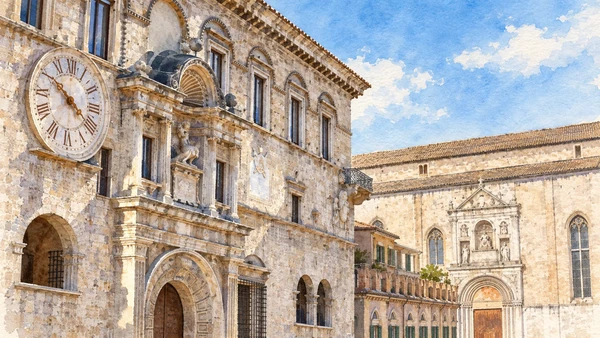
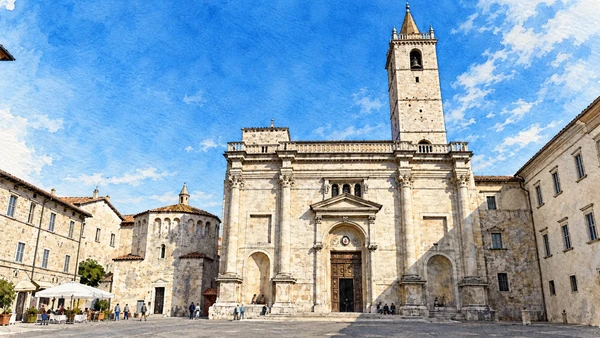
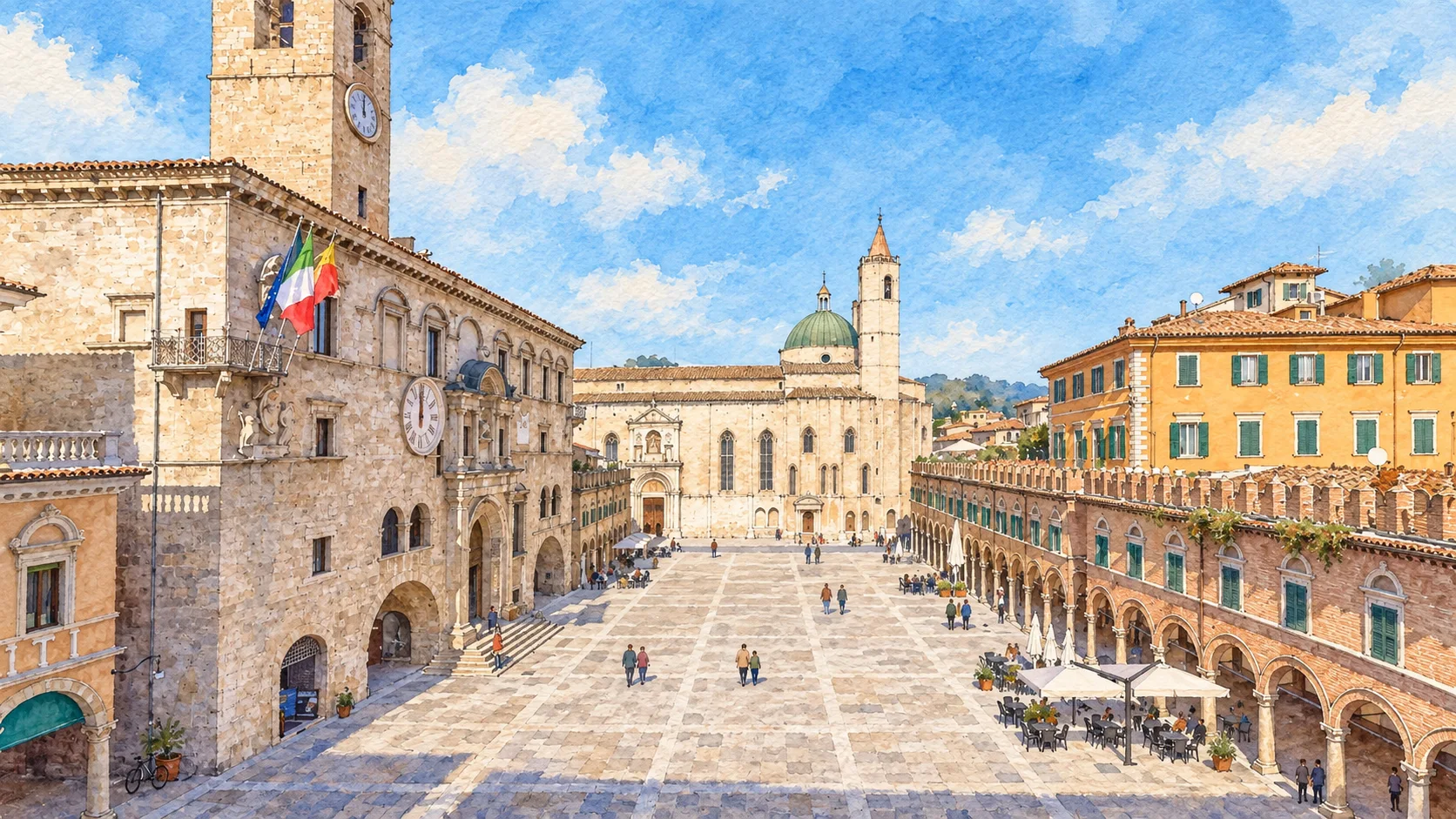
Watercolour: Ascoli Piceno establishing view

Marche · Guide 03

Ascoli Piceno

Travertine squares, civic authority, religious art and Roman traces give the inland Picene city a remarkably coherent material character.

Plan the route
Ascoli Piceno10 chapters · history, culture and landscape

Why this place matters

Two squares, several different histories.

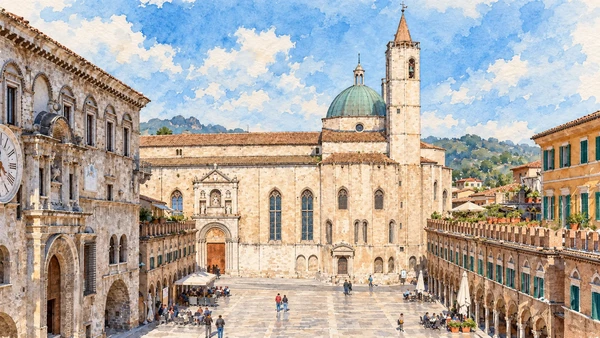
Piazza del Popolo and Piazza Arringo are close enough to connect on foot, but they tell different stories. The first brings civic ceremony, commerce and the side of San Francesco into one composed space; the second gathers the cathedral, baptistery and civic collections. Follow the pale stone across them, then look for changes in date, purpose and scale.

The guide separates documented history from suggestions for reading the site. Named buildings and landscape relationships follow institutional sources; the illustrations are editorial interpretations, not measured surveys or records of current access.

Travertine squares, civic authority, religious art and Roman traces give the inland Picene city a remarkably coherent material character.
The route

Plan your visit

Use the two principal squares as the core of one city day. Choose museum and cathedral interiors according to opening. The Roman theatre and other outer sites need their own approach rather than an assumed direct archaeological circuit.

First square

Piazza del Popolo and the Capitani

Use the two principal squares as the core of one city day.

Religious and social life

San Francesco and Caffè Meletti

Second square

Arringo, cathedral and baptistery

Museum choice

Civic collections and Roman evidence

Ten chapters

Explore the places

The chapters connect history and terrain. Mountain areas and outlying towns are separate options, not a single continuous walking route.

  1. 01Piazza del Popolo
  2. 02Palazzo dei Capitani del Popolo
  3. 03San Francesco
  4. 04Caffè Meletti and the modern square
  5. 05Piazza Arringo
  6. 06Cathedral of Sant’Emidio
  7. 07Baptistery of San Giovanni
  8. 08Pinacoteca Civica in the Palazzo dell’Arengo
  9. 09Forte Malatesta and the lapidarium
  10. 10The Roman theatre
01

The inhabited landscape

Piazza del Popolo

The square’s unity comes from the relationship between paving, arcades and tall civic and religious buildings. Its everyday use is part of the experience.

Today

This remains an inhabited place. Use pedestrian routes, keep entrances clear and check municipal mobility notices for any restricted area.

History

The Renaissance arrangement of the square brought greater visual order to an older urban centre. Medieval institutions remained present within the reorganised setting.

How to read this place

San Francesco presents its long side towards the square: this is not the cathedral façade. Locate each building before treating the view as one undifferentiated monument.

What to notice

  • San Francesco presents its long side towards the square: this is not the cathedral façade.
  • The relationship between the site and its surrounding route.
  • The distinction between surviving evidence and modern interpretation.
Regione Marche · Piceno cultural guide
Watercolour: Piazza del Popolo
Piazza del PopoloEditorial watercolour · AI-generated · 2026
02

The inhabited landscape

Palazzo dei Capitani del Popolo

The civic palace anchors one side of the square. Its tower and concentrated frontage contrast with the lower rhythm of the neighbouring porticoes.

Today

This remains an inhabited place. Use pedestrian routes, keep entrances clear and check municipal mobility notices for any restricted area.

History

The palace brings together phases of communal and later government. Reworking an existing building was one way successive authorities claimed a place in the city.

How to read this place

Look for changes in the arrangement of windows and stonework. Check which parts are open for exhibitions or visits instead of assuming the entire civic building is a museum.

What to notice

  • Look for changes in the arrangement of windows and stonework.
  • The relationship between the site and its surrounding route.
  • The distinction between surviving evidence and modern interpretation.
Regione Marche · Piceno cultural guide
Watercolour: Palazzo dei Capitani del Popolo
Palazzo dei Capitani del PopoloEditorial watercolour · AI-generated · 2026
03

Worship and memory

San Francesco

The church is best understood by walking its publicly accessible perimeter. Its portal, long wall and dome appear differently from the main square and the adjoining streets.

Today

Worship and local religious life continue here. Visitor access may pause for services; consult the church or managing institution before planning an interior visit.

History

Franciscan patronage helped shape the medieval city. The church’s construction and later completion span more than one stylistic moment.

How to read this place

Read the building as a sequence rather than a single dated façade. Interior access must accommodate worship and the managing community’s arrangements.

What to notice

  • Read the building as a sequence rather than a single dated façade.
  • The relationship between the site and its surrounding route.
  • The distinction between surviving evidence and modern interpretation.
Church of San Francesco · Ascoli Piceno
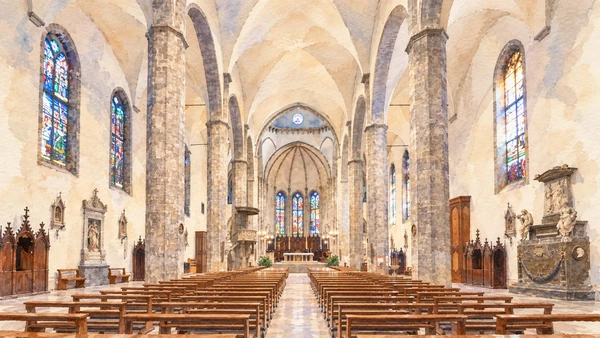
Watercolour: Interior of the church of San Francesco in Ascoli Piceno
San FrancescoEditorial watercolour · AI-generated · 2026
04

The inhabited landscape

Caffè Meletti and the modern square

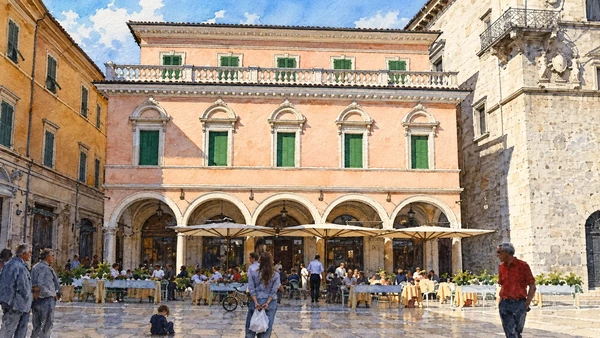
A historic café adds a more recent social layer to the monumental setting. Its frontage belongs to a place of commerce and conversation, not to an unchanged medieval tableau.

Today

This remains an inhabited place. Use pedestrian routes, keep entrances clear and check municipal mobility notices for any restricted area.

History

The café opened in the early twentieth century in a pre-existing building on Piazza del Popolo. Its decorative character differs from the civic and religious architecture around it.

How to read this place

Compare the café’s colour and detail with the square’s stone arcades. A view from the public square does not require entering or purchasing anything.

What to notice

  • Compare the café’s colour and detail with the square’s stone arcades.
  • The relationship between the site and its surrounding route.
  • The distinction between surviving evidence and modern interpretation.
Regione Marche · Piceno cultural guide
Watercolour: Caffè Meletti and the modern square
Caffè Meletti and the modern squareEditorial watercolour · AI-generated · 2026
05

The inhabited landscape

Piazza Arringo

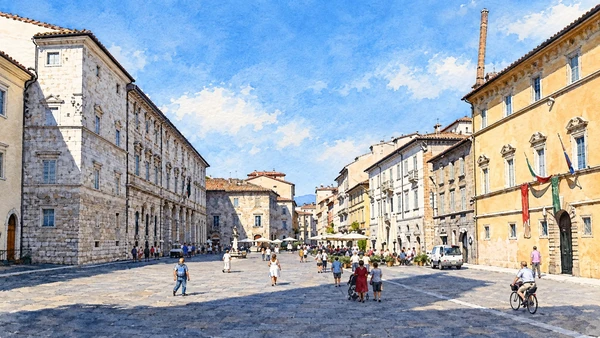
The older monumental square has a different rhythm from Piazza del Popolo. Cathedral, baptistery and palace fronts frame a broad space with nineteenth-century fountains.

Today

This remains an inhabited place. Use pedestrian routes, keep entrances clear and check municipal mobility notices for any restricted area.

History

Piazza Arringo has long served civic and religious assembly. Its buildings were formed and altered over many centuries.

How to read this place

Identify the separate entrances before choosing an interior visit. The two decorative fountains belong to a later layer of the square’s history.

What to notice

  • Identify the separate entrances before choosing an interior visit.
  • The relationship between the site and its surrounding route.
  • The distinction between surviving evidence and modern interpretation.
Regione Marche · Piazza Arringo
Watercolour: Piazza Arringo
Piazza ArringoEditorial watercolour · AI-generated · 2026
06

Worship and memory

Cathedral of Sant’Emidio

The cathedral introduces the city’s patronal devotion and an important artistic interior. Give it time beyond the first view from the square.

Today

Worship and local religious life continue here. Visitor access may pause for services; consult the church or managing institution before planning an interior visit.

History

Among its significant works is Carlo Crivelli’s fifteenth-century polyptych. The cathedral’s long history also includes alterations to its architecture and devotional spaces.

How to read this place

Read the altarpiece through its original religious purpose as well as its painted detail. Check current access to the crypt and chapels separately.

What to notice

  • Read the altarpiece through its original religious purpose as well as its painted detail.
  • The relationship between the site and its surrounding route.
  • The distinction between surviving evidence and modern interpretation.
Regione Marche · Piceno cultural guide
Watercolour: Cathedral of Sant’Emidio
Cathedral of Sant’EmidioEditorial watercolour · AI-generated · 2026
07

Worship and memory

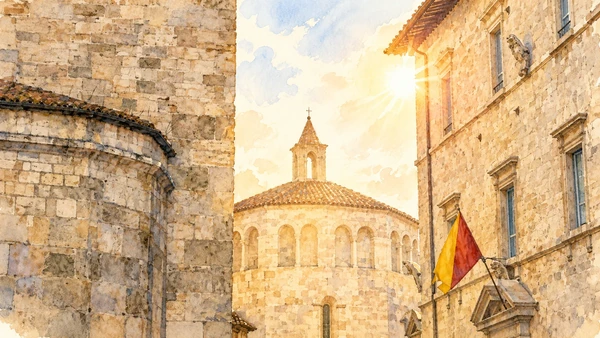
Baptistery of San Giovanni

The compact building beside the cathedral makes the distinction between a baptistery and a main church visible in stone. Its scale is an invitation to look carefully.

Today

Worship and local religious life continue here. Visitor access may pause for services; consult the church or managing institution before planning an interior visit.

History

The medieval baptistery forms part of the long-established religious group around Piazza Arringo. Its independent volume contrasts with the cathedral’s larger mass.

How to read this place

Follow the transition from the lower square base to the upper octagonal form. An exterior view does not establish that an interior opening is scheduled.

What to notice

  • Follow the transition from the lower square base to the upper octagonal form.
  • The relationship between the site and its surrounding route.
  • The distinction between surviving evidence and modern interpretation.
Regione Marche · Piazza Arringo
Watercolour: Baptistery of San Giovanni
Baptistery of San GiovanniEditorial watercolour · AI-generated · 2026
08

Evidence and interpretation

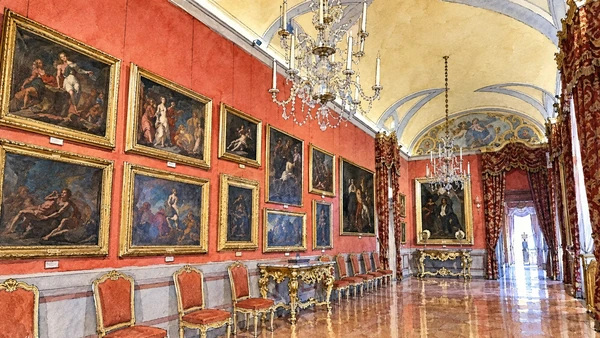
Pinacoteca Civica in the Palazzo dell’Arengo

The civic collection turns the palace from a square-side landmark into a place for sustained looking. Select a few works rather than treating every room as a checkpoint.

Today

Check the institution’s current opening, booking arrangements and accessible route. Individual rooms, exhibitions and approaches may have separate conditions.

History

The collection belongs to the city’s history of collecting and presenting art. Its setting within the civic palace links cultural stewardship with municipal life.

How to read this place

Ask whether an object came from a church, a private collection or another public building. Provenance can explain why works of different periods share a room today.

What to notice

  • Ask whether an object came from a church, a private collection or another public building.
  • The relationship between the site and its surrounding route.
  • The distinction between surviving evidence and modern interpretation.
Regione Marche · Piceno cultural guide
Watercolour: Pinacoteca Civica in the Palazzo dell’Arengo
Pinacoteca Civica in the Palazzo dell’ArengoEditorial watercolour · AI-generated · 2026
09

Evidence and interpretation

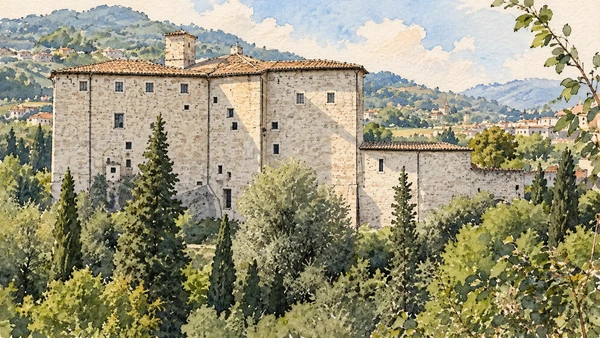
Forte Malatesta and the lapidarium

Forte Malatesta brings fortified architecture together with early medieval collections. Sculpted fragments from the civic lapidarium offer a different way to read the stone encountered in the streets.

Today

Check the institution’s current opening, booking arrangements and accessible route. Individual rooms, exhibitions and approaches may have separate conditions.

History

The Renaissance fortress now houses the Museum of the Early Middle Ages. Its displays include finds from Castel Trosino and sculptural material from the civic lapidarium, whose collecting history reaches back to Giulio Gabrielli in the nineteenth century.

How to read this place

Give the fortress a separate stop from Piazza Arringo. Distinguish the age of the fortress from the dates of the objects displayed inside, and consult the civic museums for the current route.

What to notice

  • Give the fortress a separate stop from Piazza Arringo.
  • The relationship between the site and its surrounding route.
  • The distinction between surviving evidence and modern interpretation.
Ascoli Civic Museums · Forte Malatesta
Watercolour: Forte Malatesta, home of the Museum of the Early Middle Ages
Forte Malatesta and the lapidariumEditorial watercolour · AI-generated · 2026
10

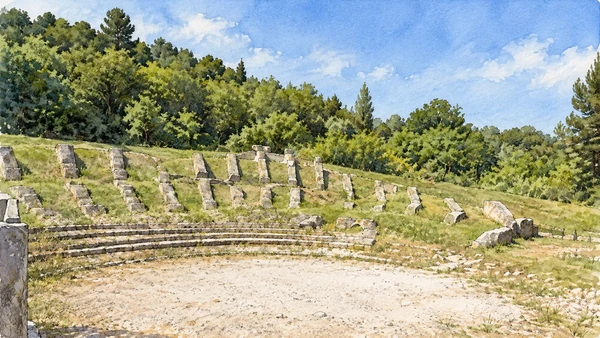
Evidence and interpretation

The Roman theatre

The surviving theatre introduces an ancient city that cannot be reconstructed simply from the later squares. Its remains require a different pace and a separate site check.

Today

Check the institution’s current opening, booking arrangements and accessible route. Individual rooms, exhibitions and approaches may have separate conditions.

History

Roman Asculum was connected to wider routes including the Via Salaria. The theatre belongs to the public architecture of that ancient settlement.

How to read this place

Separate visible masonry from the missing seating and stage structure. Use the current authorised access arrangement and avoid presenting an illustrative view as evidence that the site is freely open.

What to notice

  • Separate visible masonry from the missing seating and stage structure.
  • The relationship between the site and its surrounding route.
  • The distinction between surviving evidence and modern interpretation.
Regione Marche · Piceno cultural guide
Watercolour: The Roman theatre
The Roman theatreEditorial watercolour · AI-generated · 2026

The territory through time

A short chronology

A concise chronology linking the documented sites to the wider story.

  1. Road connections and public buildings link the inland city to wider networks.

  2. Communal institutions and religious foundations shape the city’s centre.

  3. Crivelli’s polyptych belongs to the cathedral’s artistic heritage.

  4. Piazza del Popolo gains a more unified architectural setting.

  5. Civic collecting brings archaeological fragments into the lapidarium.

  6. Decorative fountains add another layer to Piazza Arringo.

  7. Caffè Meletti adds a modern social setting to Piazza del Popolo.

  8. Stone squares remain places of civic, religious and everyday life.

Before your visit

Practical information

01

Plan separate days

Choose a manageable set of visits and allow for transport, booked entries and the return journey.

02

Use the exact place name

The Marche contain separate valleys, towns and coastal approaches. Confirm the precise locality and route rather than treating nearby names as one destination.

03

Check the institution

Opening hours, tickets, exhibitions and religious access change. Use the linked managing institution shortly before visiting.

04

Check the actual terrain

A town walk, gorge walkway, lift arrival and mountain path have different demands. Use current route information, weather and closures for the option you choose.

05

Arrange accessible visits

Historic interiors and mountain approaches can include steps, gradients or uneven surfaces. Ask about the specific route instead of assuming an entire destination is step-free.

06

Respect work and residence

Farms, workshops, churches and historic streets remain in use. Follow signs, keep entrances clear and ask permission before entering private spaces.

Method and sources

Sources and image credits

Prepared on 9 September 2026 from the institutional sources linked below. Historical claims are separated from editorial observations and itinerary suggestions. Older institutional brochures are used for stable cultural context, never as current timetables. Prices, transport schedules, trail status and admission are deliberately left to the responsible operators. Illustrations are not photographs, measured reconstructions or evidence of current conditions.

The eleven images are AI-generated editorial watercolours guided by photographic references. They interpret named places and are not photographs or substitutes for measured plans. Opening hours, tickets, accessible routes, temporary exhibitions and conservation work can change; consult the linked official pages shortly before visiting.

Illustration references and credits
  • Piazza del Popolo — reference: www.chiesadisanfrancesco.it. Transformed into an AI-generated watercolour.
  • San Francesco — reference: www.chiesadisanfrancesco.it. Transformed into an AI-generated watercolour.
  • Palazzo dei Capitani del Popolo — reference: www.chiesadisanfrancesco.it. Transformed into an AI-generated watercolour.
  • Baptistery of San Giovanni — reference: visitascoli.it. Transformed into an AI-generated watercolour.
  • Caffè Meletti and the modern square — reference: Sibilla.io at Italian Wikipedia · CC BY-SA 3.0; this watercolour adaptation is offered under the same licence. Transformed into an AI-generated watercolour.
  • Piazza Arringo — reference: MarkusMark · CC BY-SA 3.0; this watercolour adaptation is offered under the same licence. Transformed into an AI-generated watercolour.
  • Cathedral of Sant’Emidio — reference: Bruno Rijsman · CC BY-SA 2.0; this watercolour adaptation is offered under the same licence. Transformed into an AI-generated watercolour.
  • Pinacoteca Civica in the Palazzo dell’Arengo — reference: Bruno Rijsman · CC BY-SA 2.0; this watercolour adaptation is offered under the same licence. Transformed into an AI-generated watercolour.
  • The Roman theatre — reference: trolvag · CC BY-SA 3.0; this watercolour adaptation is offered under the same licence. Transformed into an AI-generated watercolour.
  • Forte Malatesta and the lapidarium — reference: Sibilla.io at Italian Wikipedia · CC BY-SA 3.0; this watercolour adaptation is offered under the same licence. Transformed into an AI-generated watercolour.
  • Opening image — reference: www.chiesadisanfrancesco.it. Transformed into an AI-generated watercolour.